Windows of Opportunity 

17th December 2023

Treat water as a common good

“Governments must urgently stop subsidising the extraction and overuse of water through misdirected agricultural subsidies, and industries from mining to manufacturing must be made to overhaul their wasteful practices, according to the Global Commission on the Economics of Water. Nations must start to manage water as a global common good, because most countries are highly dependent on their neighbours for water supplies, and overuse, pollution and the climate crisis threaten water supplies globally.” (1)

“”However, water is not just a casualty but also a driver of the climate crisis,” reads the report. “Extreme water events cause an immediate loss of carbon uptake in nature. Droughts lead to fires and massive loss of biomass, carbon, and biodiversity. The loss of wetlands is depleting the planet’s greatest carbon store, while the drop in soil moisture is reducing the terrestrial and forest ecosystem’s ability to sequester carbon… We will fail on climate change if we fail on water,”” (2)

We forget how much water is used by mining and industry (17% of the world’s freshwater use) and by agriculture (70%) – whilst domestic/ municipal use accounts for 12%. By 2030 demand is likely to exceed supply by approximately 40%. This is clearly a problem, and as with so many cases of shortages, it is likely that the poorest in society and the poorest nations will bear the brunt of  distress. 

The matter is further compounded because the source of a water supply may lay outside the user’s borders. Water from the Swiss Alps, feeds the River Po in Italy; the glaciers in the Himalayas feed four great rivers – Brahmaputra, Ganges, Indus, and Tarim. Other countries rely on ‘green water’ where water held in the soil and released through transpiration from trees and other plants, then condenses and falls as rain further down wind. Changes in land use up wind – such as deforestation – can reduce rainfall. (2) Again this can make one country dependent on another for its water. This is one of the causes of the drought being experienced in the Amazon basin (3). 

These cross border issues have the potential for conflict as is already the case in the West Bank (4)

The Global Commission on the Economics of Water recommends seven steps that policymakers must take to avoid a water shortage by the end of the decade, including:

  • Manage water supplies as a common good by recognizing that water is critical to food security and all sustainable development goals;
  • Mobilize multiple stakeholders—public, private, civil society, and local community—to scale up investments in water through new
    modalities of public-private partnerships;
  • Cease underpricing water and target support for the poor;
  • Phase out water and agriculture subsidies that “generate excessive water consumption and other environmentally damaging practices”;
  • Establish Just Water Partnerships to enable investments in water access, resilience and sustainability in low- and middle-income countries;
  • Move forward on steps that can be taken this decade to “move the needle significantly,” including fortifying depleted freshwater systems, recycling industrial and urban wastewater, reusing water in the production of critical materials, and shifting agricultural systems to include less water-intensive crops and drought-resistant farming; and
  • Reshape multilateral governance of water by incorporating new water standards into trade agreements and prioritizing equality in water decision-making. (2)
  1. https://www.theguardian.com/environment/2023/mar/17/global-fresh-water-demand-outstrip-supply-by-2030?CMP=Share_iOSApp_Other
  2. https://www.commondreams.org/news/water-report-un-conference

(3) https://www.weforum.org/agenda/2022/08/green-water-climate-change-deforestation/

(4) see – https://theconversation.com/drought-in-the-amazon-understanding-the-causes-and-the-need-for-an-immediate-action-plan-to-save-the-biome-215650)

(5) see – https://www.theguardian.com/world/2023/may/17/how-israel-uses-water-to-control-west-bank-palestine?CMP=Share_iOSApp_Other

3rd Sunday of Advent

17th December 2023

Reflection (readings are below)

Are we as Christians, as activists for justice,  acorns that God is planting in the hope that the growth we start will become as an oak tree. A mature oak tree can provide a habitat for as many as 2300 species! (Woodlands Trust). Wouldn’t it be amazing if we could create communities that could be home to so many different species? Do the words of Isaiah provide a template for such a community? It would be a place (and a space) in which the broken hearted would find respite and healing, those trapped by unjust systems would find freedom, the oppressed would find hope and new life. It would be a place of justice and empathy and compassion. A place where each and everyone could develop their true potential as creatures of God’s making. And it would become a place of joy and celebration.

The community created would perhaps echo the images of those Christmas cards that show happy families, dinner tables decked for a feast, lights gleaming in every window, peaceful landscapes (usually rural and snow covered), sheep safely grazing, smiling posties with gifts for all, choirs filling the air with songs of praise. 

And such communities, such scenes of peace and joy are possible – if only we really want them, only if we have the will. 

Mary’s Magnificat tells us what we have to remove or change to create such as community. We will need to overcome conceit and self-importance, and rebalance power and opportunity so that they are equally distributed. We will need to encourage the lowly and the vulnerable, to appreciate their value. We will need to redistribute resources so that those with out and those with lots all have an enough.

As the discussion at COP28 come to an end, we are reminded of how much wealth there is in the world and how unequally it is distributed. We have heard how re-distributing wealth from the richer to the vulnerable nations could transform poverty, address the threat of climate change, and create vibrant economies. We have heard how redistributing subsidies from fossil fuels to renewable energy could lift so many out of poverty and stall the rise in global temperatures. We have heard how developing renewable energy and green industries can create new and sustainable jobs. 

This week’s gospel repeats last week’s message from Isaiah that we should make straight the path for the Lord, making smooth the way in for the  of God. 

Let us rejoice and pray without ceasing for the reality that God’s kingdom can come here on earth as in heaven. Let us pray and work for everything that can make the pathway smooth – whether that is in our individual actions by which we love our neighbours and our enemies, or our corporate actions as communities, or our activism in advocating for change by local and national authorities, institutions and  corporations – for in so doing we follow the example of John the Baptist in bearing witness to the will of God, in testifying to the light. 

Isaiah 61:1-4, 8-11

The spirit of the Lord God is upon me,
because the Lord has anointed me;

he has sent me to bring good news to the oppressed,
to bind up the brokenhearted,

to proclaim liberty to the captives,
and release to the prisoners;

to proclaim the year of the Lord’s favour,
and the day of vengeance of our God;
to comfort all who mourn;

to provide for those who mourn in Zion—
to give them a garland instead of ashes,

the oil of gladness instead of mourning,
the mantle of praise instead of a faint spirit.

They will be called oaks of righteousness,
the planting of the Lord, to display his glory.

They shall build up the ancient ruins,
they shall raise up the former devastations;

they shall repair the ruined cities,
the devastations of many generations.

For I the Lord love justice,
I hate robbery and wrongdoing;

I will faithfully give them their recompense,
and I will make an everlasting covenant with them.

Their descendants shall be known among the nations,
and their offspring among the peoples;

all who see them shall acknowledge
that they are a people whom the Lord has blessed.

I will greatly rejoice in the LORD,
my whole being shall exult in my God;

for he has clothed me with the garments of salvation,
he has covered me with the robe of righteousness,

as a bridegroom decks himself with a garland,
and as a bride adorns herself with her jewels.

For as the earth brings forth its shoots,
and as a garden causes what is sown in it to spring up,

so the Lord God will cause righteousness and praise
to spring up before all the nations.

The Song of Mary Magnificat

Luke 1:46-55

My soul proclaims the greatness of the Lord,

my spirit rejoices in God my Saviour; *
for he has looked with favour on his lowly servant.

From this day all generations will call me blessed: *
the Almighty has done great things for me, and holy is his Name.

He has mercy on those who fear him *
in every generation.

He has shown the strength of his arm, *
he has scattered the proud in their conceit.

He has cast down the mighty from their thrones, *
and has lifted up the lowly.

He has filled the hungry with good things, *
and the rich he has sent away empty.

He has come to the help of his servant Israel, *
for he has remembered his promise of mercy,

The promise he made to our fathers, *
to Abraham and his children for ever.

Glory to the Father, and to the Son, and to the Holy Spirit: *
as it was in the beginning, is now, and will be for ever. Amen.

1 Thessalonians 5:16-24

Rejoice always, pray without ceasing, give thanks in all circumstances; for this is the will of God in Christ Jesus for you. Do not quench the Spirit. Do not despise the words of prophets, but test everything; hold fast to what is good; abstain from every form of evil.

May the God of peace himself sanctify you entirely; and may your spirit and soul and body be kept sound and blameless at the coming of our Lord Jesus Christ. The one who calls you is faithful, and he will do this.

John 1:6-8,19-28

There was a man sent from God, whose name was John. He came as a witness to testify to the light, so that all might believe through him. He himself was not the light, but he came to testify to the light.

This is the testimony given by John when the Jews sent priests and Levites from Jerusalem to ask him, “Who are you?” He confessed and did not deny it, but confessed, “I am not the Messiah.” And they asked him, “What then? Are you Elijah?” He said, “I am not.” “Are you the prophet?” He answered, “No.” Then they said to him, “Who are you? Let us have an answer for those who sent us. What do you say about yourself?” He said, “I am the voice of one crying out in the wilderness, ‘Make straight the way of the Lord,’” as the prophet Isaiah said. Now they had been sent from the Pharisees. They asked him, “Why then are you baptising if you are neither the Messiah, nor Elijah, nor the prophet?” John answered them, “I baptise with water. Among you stands one whom you do not know, the one who is coming after me; I am not worthy to untie the thong of his sandal.” This took place in Bethany across the Jordan where John was baptising.

Windows of Opportunity 

16th December 2023

Use less water

“Water and climate change are inextricably linked. Climate change affects the world’s water in complex ways. From unpredictable rainfall patterns to shrinking ice sheets, rising sea levels, floods and droughts – most impacts of climate change come down to water ….Only 0.5 per cent of water on Earth is useable and available freshwater – and climate change is dangerously affecting that supply. Over the past twenty years, terrestrial water storage – including soil moisture, snow and ice – has dropped at a rate of 1 cm per year, with major ramifications for water security”   (1) 

“[I]n the world’s push to achieve a low-carbon economy, water is often forgotten. The focus for decarbonisation often lies on transportation, manufacturing, or other industrial processes, but water utilities are responsible for two percent of total annual global emissions — about as much as the shipping industry. Water cannot be excluded when designing policies to reduce emissions. Water utility companies must make efforts to decarbonise their activities, especially through the energy-intensive process of treating and processing wastewater.” (2)

In 2019 the head of Environment  Agency, Sir James Bevan said “We need water wastage to be as socially unacceptable as blowing smoke in the face of a baby or throwing your plastic bags into the sea ….   the average person’s daily water use of 140 litres could be cut to 100 litres in 20 years by more efficient use in homes and gardens.” (3)

Tips for using less water – https://www.theguardian.com/environment/2023/sep/05/how-to-use-less-water-15-tips-beef-burgers-megabutts-clothes?CMP=Share_iOSApp_Other

And also https://friendsoftheearth.uk/sustainable-living/13-best-ways-save-water

  1. https://www.un.org/en/climatechange/science/climate-issues/water
  2. https://www.weforum.org/agenda/2022/09/how-we-manage-our-water-systems-sustainable-impact/
  3. https://www.theguardian.com/environment/2019/mar/18/england-to-run-short-of-water-within-25-years-environment-agency?CMP=Share_iOSApp_Other

For interest, I now only shower once a week, instead washing in a basin every day – and then using that water to flush the loo.

Windows of Opportunity 

15th December 2023

Regenerative farming     

The World Economic Forum advocates for regenerative farming as “an agricultural technique that essentially focuses on the health of the soil more than other types of agriculture tend to do. Obviously, soil is effectively the base of any farm, and surprisingly, it can sequester quite a bit of our planet’s CO2. Therefore, treating it organically, with natural products and less human disturbance, is key.” (1) 

Scottish based Farming For a Better Climate describes regenerative farming as “an approach centred around improving and revitalising soil health. The group are focusing their work around the following principles:

  • Minimise soil disturbance – help support a healthy soil food web.
  • Maximise crop diversity – different crops bring different rooting depths and attributes,
  • supporting a range of biodiversity both above and below ground.
  • Provide constant soil cover – protect soils from wind and water erosion; reduces water loss.
  • Keep a living root in the system – root exudates benefit microbial populations, supporting soil health.
  • Integration of livestock – promoting species diversity from microbes to mammals and putting dung back into the system.” (2)

A report produced by the World Economic Forum in 2022 found “that if just an additional 20% of farmers adopted climate-smart , by 2030, the EU could reduce its annual agricultural GHG emissions by 6% and improve soil health over an area equivalent to 14% of EU’s agricultural land while improving livelihoods by between €1.9 €9.£ billion annually.” (3)

And not just in Europe. 

“By 2040, through just a 50% adoption of regenerative agriculture across Africa, farmers could see:

  • 30% reduction in soil erosion
  • Up to a 60% increase in water infiltration rates
  • 24% increase in nitrogen content
  • 20% increase in carbon content, or higher depending on the intervention – and not just topsoil (this is huge as soil is the second biggest storehouse of carbon, after oceans). The benefits are even greater when shrubs and grasses are promoted through agroforestry.”
  1. https://www.weforum.org/agenda/2021/03/regenerative-agriculture-revolutionize-farming-climate-cahnge/
  2. https://www.farmingforabetterclimate.org/
  3. https://www3.weforum.org/docs/WEF_Transforming_Food_Systems_with_Farmers_A_Pathway_for_the_EU_2022.pdf
  4. https://www.iucn.org/news/nature-based-solutions/202110/regenerative-agriculture-works-new-research-and-african-businesses-show-how

Windows of Opportunity 

14th December 2023

Cut down on meat and dairy

“[T]he climate impact of plant-based foods is typically 10 to 50 times smaller than that of animal products, it follows that switching from a largely meat-based diet to a vegetarian or vegan diet could help to reduce emissions…According to the analysis, a switch to veganism could save almost 8bn tonnes of CO2e a year by 2050, when compared to a “business-as-usual” scenario. (By comparison, all food production currently causes around 13.7bn tonnes of CO2e a year.) The second highest emissions savings would be delivered by a global shift to vegetarianism which, in the analysis, still includes around one serving of meat or fish a month. An adoption of this diet could save 6bn tonnes of CO2e a year by 2050, according to the analysis”. (1)

And change is possible: “As attendees break for meals between meetings, negotiations, and panel discussions, they may notice one striking difference between COP28 and past UN climate conferences: There won’t be much meat on the menu. After a months-long effort by the youth-led Food@COP coalition, the United Arab Emirates environment minister, Mariam Almheiri, announced last month that two-thirds of the food served at the event will be plant-based.”(2)

Universities are also moving to 100% plant based foods for campus catering. So far this includes the Universities of Warwick, Stirling, Cambridge, Birmingham, Kent, London Metropolitan, Queen Mary University of London, and University College London. This has in part been a response to the Plant-Based Universities campaign –  https://www.plantbaseduniversities.org/about-4

Local councils are also voting to adopt plant-based policies (eg to serve only plant-based food and drink at catered events and meetings – Oxford City Council, Oxfordshire County Council, Cambridge City Council, and Exeter City Council. (3) There is, however, a fight-back against this by livestock farming groups.  

(1) https://interactive.carbonbrief.org/what-is-the-climate-impact-of-eating-meat-and-dairy/

(2) https://www.vox.com/future-perfect/2023/11/30/23981529/cop28-meat-livestock-dairy-farming-plant-based-united-nations-dubai-uae

(3) https://smartercommunities.media/uk-councils-and-universities-adopt-a-plant-based-future/ See also – https://www.vegansociety.com/sites/default/files/uploads/downloads/Catering_For_Everyone_Report_2023_TVS.pdf

Windows of Opportunity 

13th December 2023

Cut food waste

I was once told never to waste so much as a grain of rice because somewhere a farmer had worked hard to produce it. 

“More than 900 million tonnes of food is thrown away every year, according to the  UN Environment Programme‘s Food Waste Index… 17% of the food available to consumers – in shops, households and restaurants – goes directly into the bin. Some 60% of that waste is in the home.”(1)

“About a third of all the world’s food goes to waste, and producing, transporting and letting that food rot releases 8-10% of global greenhouse gases. If food waste were a country, it would have the third-biggest carbon footprint after the US and China, according to the UN’s Food and Agriculture Organisation.”(2)

“In February 2016, France adopted a pioneering law on fighting food waste that meant supermarkets were forbidden to destroy unsold food products and were compelled to donate it instead. This law constituted the starting point of the fight against food waste through banning its destruction and facilitating donation. Since the adoption, its scope has been extended further…”(3)

OddBox and similar fruit and vegetable box  schemes, sell fruit and vegetables that would otherwise go to waste. The produce may come direct from the farm where there is a sudden glut or sudden drop in demand, or from wholesalers when the boxes re-home produce that is too small, too big, too wonky etc. 

Other companies such as Olio and  Too Good to Go, have schemes for re-homing various foods that would otherwise go to waste – such as breads and cakes unsold at the end of the day.

See for more details – https://www.oddbox.co.uk/blog/7-apps-that-are-helping-reduce-food-waste

And also – https://wrap.org.uk/taking-action/food-drink/actions/action-on-food-waste

Food waste is not just a western problem. It is also a problem in, for example, Africa. The World Economic Forum reports “Across Africa, an estimated 100 million people faced catastrophic levels of food insecurity in 2020; …. This is due to conflicts, successive crop failures (as a result of climate change and extreme weather events), pre-existing and COVID-19 related economic shocks, and soaring food prices. Yet, at the same time, significant volumes of food are lost after harvest in sub-Saharan Africa each year — estimated at $4 billion worth for grains alone. This exceeds the value of the total food aid received in sub-Saharan Africa over the past decade, and equates to the annual value of cereal imports. In a continent where so many people are starving, and many more, particularly children and women, are undernourished, it is unconscionable to lose and waste food at this scale. Reducing food loss and waste could be one of the leading strategies for  Africa ….

“[One] major challenge across Africa is a lack of effective transport and storage facilities due to poor access to energy to power cold storage, poor infrastructure such as roads and railway networks, access and affordability, among others. If these were improved, they could help prevent post-harvest losses.” (4)

  1. https://www.bbc.co.uk/news/science-environment-56271385
  2. https://www.theguardian.com/news/2021/sep/04/how-food-waste-is-huge-contributor-to-climate-change
  3. https://zerowasteeurope.eu/wp-content/uploads/2020/11/zwe_11_2020_factsheet_france_en.pdf

(4) https://www.weforum.org/agenda/2022/01/food-loss-waste-africa-agriculture-farming/

Windows of Opportunity 

12th December 2023

Speak up for Activists

Activists and rebels are key ingredients in bringing about change. They bring important issues to the attention of the public, the government, businesses and  organisations. Their constant pushing back stops the issues being sidelined. Often they represent the feelings of a larger groundswell of people who do not feel so free to express their views. The actions of activists should open up the floor for debate, but where there are ingrained fears and invested interests, those with power may try and shut down their voices. 

Here is a report on this topic from the Guardian. “ Emma Thompson, Stephen Fry and Ben Okri have joined the former archbishop of Canterbury Rowan Williams and leading climate scientists to highlight what they describe as a “collective act of madness” that is driving “the destruction of life on Earth”.

A letter signed by more than 100 actors, authors, scientists and academics says the UK government is ignoring the scientific reality of the climate and ecological crisis, pushing ahead with new fossil fuel developments and criminalising peaceful protesters who raise the alarm.

““Rather than listening to reason or scientific fact, the UK government continues to hand out contracts for oil exploration in the name of false ‘energy security’ while steering the UK towards authoritarianism,” the letter states. “In Britain today, it is verging on illegal to urgently and effectively protest for the right of life to survive.”

“Michel Forst, the UN rapporteur on environmental defenders, last month described the situation in the UK as “terrifying”, with protesters having to navigate a draconian new legal environment that includes significant limits on the right to protest.” (1)

(1) https://www.theguardian.com/environment/2023/nov/24/actors-and-academics-criticise-uk-over-climate-madness-and-limits-on-protest?CMP=Share_iOSApp_Other

Windows of Opportunity 

11th December 2023

Increasing cycling

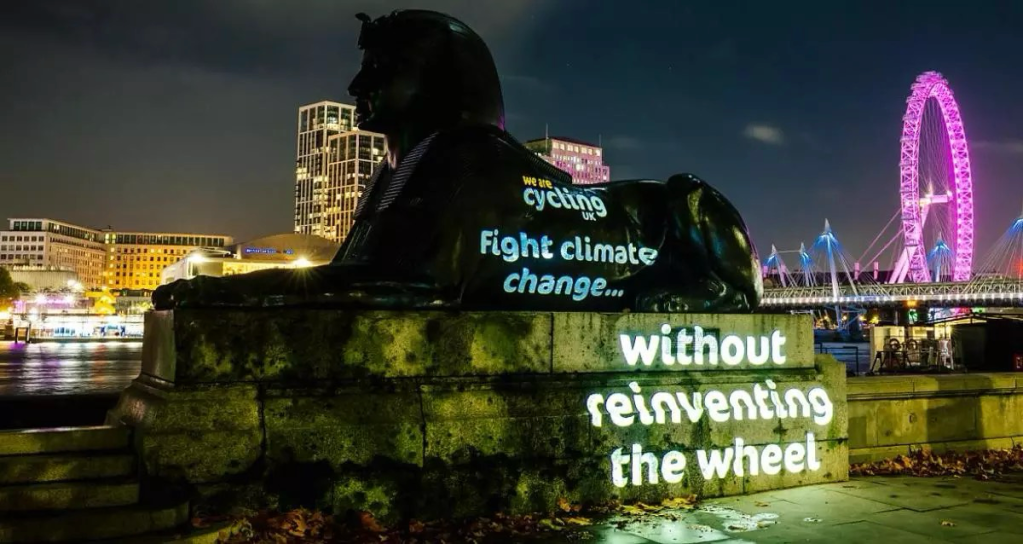
“Before carbon-intensive travel became widespread, cycling epitomised highly efficient transport, and it still does. But now it’s also part of the solution for a low-carbon future. Cycling is one of the simplest lifestyle choices that most individuals can make to reduce their carbon footprint, and it offers huge benefits for health, the economy, air quality and neighbourhoods too.” (1)

The World Health Organisation is a keen to proponent of: “Walking and cycling are simple, cost-effective ways of being active. Walking is an essential part of all journeys. It is accessible and affordable, and socially equitable. Cycling is among the most efficient and sustainable means of transportation. Together, walking and cycling have economic, social, environmental and health benefits.  

WHO is working to help countries retain, promote and enable everyone to walk and cycle for recreation and transport. This will not only deliver significant health benefits but also contribute to developing sustainable mobility systems, creating liveable cities and communities, and cleaner air all of which contribute, directly and indirectly, to multiple Sustainable Development Goals.” (2)

(1) https://www.cyclinguk.org/briefing/case-cycling-tackling-climate-change

(2) https://www.who.int/activities/promoting-walking-and-cycling

And for further interest –  https://www.theguardian.com/commentisfree/2023/nov/27/why-i-quit-complaining-about-cyclists-men-in-lycra?CMP=Share_iOSApp_Other

Windows of Opportunity 

10th December 2023

Universal free transport

“A new statutory obligation to provide universal, equal, and affordable access to public transport should underpin any national transport strategy. Two of the UK government’s most important strategic objectives are addressing regional inequalities (‘levelling up’) and net zero.

“Achieving net zero requires phasing out fossil fuels – and replacing 30 million fossil fuel-powered cars and vans.

“But many parts of the UK depend on private car use. Without prior access to affordable and sustainable public transport, a rapid push to decarbonisation risks harming lives and livelihoods.

“People rely on transport to access shops, entertainment, and jobs.

“If the government is to meet its objectives, universal, UK-wide public transport access is essential.

“What is a universal public transport obligation?

“A universal public transport obligation would make it a statutory requirement for local government and transport authorities to make sustainable forms of public transport available and accessible to everyone everywhere in the UK. It would also set low costs for all users, extending fare caps already in effect in the Transport for London zone to the whole country.” (1)

(1) https://www.ice.org.uk/news-insight/news-and-blogs/ice-blogs/the-infrastructure-blog/public-transport-for-all-net-zero-levelling-up-uk

See also https://www.smarttransport.org.uk/features/making-public-transport-free-or-accessible-to-all

2nd Sunday of Advent

10th December 2023

Reflection (Readings following on below)

How do we comfort the people of Gaza or the people of Israel?

How do we comfort the people of Kenya afflicted by drought and floods? The people of North Sudan caught up in civil war? The millions of refugees across the world who are homeless and struggling? How do we comfort farmers whose crops have failed, whose livestock have died?

How? By preparing a way through the wilderness of our current world. By levelling a pathway we can all journey along together.

We need to level up the conditions in which people live. Everyone needs and – if we truly care our neighbour this should be unquestionable – should have clean water, a safe home, heating or shade as appropriate, sufficient and wholesome food, access to medicine, to education, the means of communication and transport, access to reliable energy supplies, life affirming work or a purposeful occupation. We also know – or should know – that we all need to live in a world rich in biodiversity so levelling up must involve the natural environment. A biodiverse rich world is one in which resources are used and garnered sustainably – and indeed where natural resources are enriched – regenerated.

When the present UK government stood for election, it did so with a manifesto that promised   levelling up for the more disadvantaged parts of the nation. But what it did not talk about was levelling down. You cannot level up without levelling down. 

To fill up the valleys the hills and mountains had to be brought low. The world’s resources are finite. Even those that are renewable are only renewable within certain time frames. To renew a field of wheat takes a year, to renew a forest will centuries. 

Levelling up and levelling down: the key is to redistribute resources and wealth more equitably. That has to mean the rich having to forgo some of their privileges  and give over some of their wealth and use less of the world’s  resources just as Mary says in the  Magnificat:  “He has brought down the powerful from their thrones, and lifted up the lowly; he has filled the hungry with good things, and sent the rich away empty”. It is a biblically based and unavoidable imperative. 

This year it was reported that the richest 10% of the global population currently takes 52% of global income, whereas the poorest half of the population earns 8.5% of it. Billions of people face the terrible hardship of high and rising food prices and hunger, whilst the number of billionaires has doubled in the last decade. Between 2019 and 2020, global inequality grew more rapidly than at any time since WW2. (1) To compound the injustice, the richest 1% of humanity is responsible for more carbon emissions than the poorest 66% and it is the poorest who are suffering disproportionately the adverse affects of the climate crisis. 

But even within nations there is inequality. Here in the UK the richest 1% of households have fortunes of at least £3.6m, whilst the poorest 10% of households have just £15,400 or less, with almost half burdened with more debts than they had in assets. (ONS January 2022). One in ten households face food insecurity; one in five have to choose between eating and heating. Typically on any one night 2,400 people are sleeping rough, 15,000 people are in hostels or supported accommodation and nearly 250,000 are living in temporary accommodation – most of whom are families.

Advent is a time of waiting for the coming of the reign of God. It is not about passive waiting, but,  as the parables of the kingdom season demonstrated, active waiting. A waiting that involves carrying on doing the work with which we have been tasked by Jesus until he comes again with the full glory of the kingdom of God. Advent is a time to be diligent in living lives of “holiness and godliness”. A time to be living lives that “bring good news to the poor…. proclaim release to the captives, and recovery of sight to the blind, to let the oppressed go free, to proclaim the year of the Lord’s favour.”

It is a time to level up the low places and level down the high places, whether that is through personal actions, through the support of charities, through campaigning on issues of wealth and taxation, and on issues on injustice, or through advocacy and prayer. Then when Christmas comes we may perhaps more confidently hear again the words of the angel: “See I am bringing you good news of great joy for all the people: to you is born this day in the city of David a Saviour, who is the Messiah, the Lord.”

(1) https://www.theguardian.com/inequality/2023/jul/17/top-economists-call-for-action-global-inequality-rich-poor-poverty-climate-breakdown-un-world-bank?CMP=Share_iOSApp_Other

Isaiah 40:1-11

Comfort, O comfort my people,
says your God.

Speak tenderly to Jerusalem,
and cry to her

that she has served her term,
that her penalty is paid,

that she has received from the Lord’s hand
double for all her sins.

A voice cries out:

“In the wilderness prepare the way of the Lord,
make straight in the desert a highway for our God.

Every valley shall be lifted up,
and every mountain and hill be made low;

the uneven ground shall become level,
and the rough places a plain.

Then the glory of the Lord shall be revealed,
and all people shall see it together,
for the mouth of the Lord has spoken.”

A voice says, “Cry out!”
And I said, “What shall I cry?”

All people are grass,
their constancy is like the flower of the field.

The grass withers, the flower fades,
when the breath of the Lord blows upon it;
surely the people are grass.

The grass withers, the flower fades;
but the word of our God will stand for ever.

Get you up to a high mountain,
O Zion, herald of good tidings;

lift up your voice with strength,
O Jerusalem, herald of good tidings,
lift it up, do not fear;

say to the cities of Judah,
“Here is your God!”

See, the Lord God comes with might,
and his arm rules for him;

his reward is with him,
and his recompense before him.

He will feed his flock like a shepherd;
he will gather the lambs in his arms,

and carry them in his bosom,
and gently lead the mother sheep.

Psalm 85:1-2, 8-13

1 You have been gracious to your land, O Lord, *
you have restored the good fortune of Jacob.

2 You have forgiven the iniquity of your people *
and blotted out all their sins.

8 I will listen to what the Lord God is saying, *
for he is speaking peace to his faithful people
and to those who turn their hearts to him.

9 Truly, his salvation is very near to those who fear him, *
that his glory may dwell in our land.

10 Mercy and truth have met together; *
righteousness and peace have kissed each other.

11 Truth shall spring up from the earth, *
and righteousness shall look down from heaven.

12 The Lord will indeed grant prosperity, *
and our land will yield its increase.

13 Righteousness shall go before him, *
and peace shall be a pathway for his feet.

2 Peter 3:8-15a

Do not ignore this one fact, beloved, that with the Lord one day is like a thousand years, and a thousand years are like one day. The Lord is not slow about his promise, as some think of slowness, but is patient with you, not wanting any to perish, but all to come to repentance. But the day of the Lord will come like a thief, and then the heavens will pass away with a loud noise, and the elements will be dissolved with fire, and the earth and everything that is done on it will be disclosed.

Since all these things are to be dissolved in this way, what sort of persons ought you to be in leading lives of holiness and godliness, waiting for and hastening the coming of the day of God, because of which the heavens will be set ablaze and dissolved, and the elements will melt with fire? But, in accordance with his promise, we wait for new heavens and a new earth, where righteousness is at home.

Therefore, beloved, while you are waiting for these things, strive to be found by him at peace, without spot or blemish; and regard the patience of our Lord as salvation.

Mark 1:1-8

The beginning of the good news of Jesus Christ, the Son of God.

As it is written in the prophet Isaiah,

“See, I am sending my messenger ahead of you,
who will prepare your way;

the voice of one crying out in the wilderness:
‘Prepare the way of the Lord,
make his paths straight,’”

John the baptiser appeared in the wilderness, proclaiming a baptism of repentance for the forgiveness of sins. And people from the whole Judean countryside and all the people of Jerusalem were going out to him, and were baptised by him in the river Jordan, confessing their sins. Now John was clothed with camel’s hair, with a leather belt around his waist, and he ate locusts and wild honey. He proclaimed, “The one who is more powerful than I is coming after me; I am not worthy to stoop down and untie the thong of his sandals. I have baptised you with water; but he will baptise you with the Holy Spirit.”