Talk given at Climate Fair, Norwich: 30th September 2023
Earlier this year in my blog – the greentau – I imagined what the future might be like. By 2033 we should be at least half way to net zero.
Will we have been successful? What will have changed? What will daily life be like?
The first tale.
In many ways life in 2033 is not that different from how it is in 2023.
I still live in the same house, with the same husband and even the same – now rather elderly – cat.
We have recently replaced the solar panels on our roof and are now not just self sufficient for energy but regularly put electricity back into the grid.
Talking of solar panels, every house in our street now has them, as does the local school and our church – and as you have probably guessed, very few buildings have gas boilers now-a-days.
Other changes in our street include more trees, which provide welcome shade during heat waves,
and fewer cars. Some families have hung into their old electric cars but most journeys are now made by cycle or public transport.
We have a fully integrated national train and bus service that runs on the Swiss-style pulse model, and all communities of 300 + people have an hourly bus service throughout the day, alongside which many rural areas also benefit from a demand responsive minibus service. All town centres are now traffic free and all main roads have dedicated cycle tracks wide enough for cargo and family bikes.
All bus services are free and for rail travel half price rail cards are popular, especially with families as children travel free.
The increase in cycling has made us fitter and healthier and eased the burden on the NHS. You will be pleased to hear that we do still have a national health service! There were some dodgy moments when it looked like the system might collapse, but with the influence of a people’s assembly, the whole health and welfare system has being overhauled. There is a focus on preventative care and long term investment – improving the health of children (physical, mental and educational) will have profound benefits for our society and save money but the savings may take 20 to 30 years to kick in.
It has been surprising how much addressing the climate crisis has simultaneously improved people’s wellbeing. All school and institutional meals are now plant based, and I hope you are not surprised to hear that meat-free dishes now comprise over 50% of all restaurant menus. Vegan cooking is now mainstream although at the time the All Vegan Bake Off series in 2024 seemed radical. The change in our diets has not only improved our health but has changed the appearance of the rural landscape – much more leafy!
The UK is now self sufficient in wheat, and an increasing area of land is used for growing fruits and vegetables. There has been a horticultural revolution with small robots and drones undertaking many of the back breaking tasks, and with more glasshouses and hydroponic irrigation, growing seasons have been extended whilst at the same time reducing the demand for water. Work in this sector is now well paid and popular.
Orchards have multiplied and now encompass new fruits such as olives and pistachios, peaches and almonds, and are often intercropped with shade loving plants. The increase in tree cover is, perhaps the biggest change that you would notice. Not only have we seen orchards expand, but many areas have been rewilded with wide hedgerows, copses and new woodlands. The latest nature report has shown an increase in biodiversity in the UK. It is a revival that required dedication and persistence, but is now reaping rewards. Nightingales can often be heard – but not necessarily in Berkeley Square! – and a new generation of children are listening out for the cuckoos in spring. Walks and trips to wildlife hides are increasingly popular as there is so much to see!
The High Street is still our main shopping area but it does look more attractive with trees and well-stocked planters. If you want a few herbs, it’s a case of pick your own. With fewer cars, there is less demand for car parking. Many car parks have been transformed into green spaces and recreation grounds, with features as diverse as climbing walls and outdoor chessboards. These planted areas double up as SuDS – sustainable drainage systems – absorbing excess water during spells of heavy rain.
There are new shops in the High Street, such as Splash – a bike-wash and coffee shop where customers enjoy coffee and cake whilst their bike is cleaned, oiled and pumped up. There’s a branch of Repairs are Us, where virtuallly any domestic item can be repaired. And next to the charity shop, there’s Tailor Tricks where they will readjust or alter any misfitting clothes. At the other end of the market, we have made to measure fashion outlets such ‘Just for Me’. Video loops show the latest catwalk fashions, whilst on the shelves fabric swatches and accessories entice you to try something new. Interactive screens show you how you would look in these new clothes, and once you have made your choice, the workshop sets to and within a few days – sometimes just hours – your made to measure outfit is ready to wear!
Of course there are more cycle shops – and more cycle accessory shops. The pet shops are thriving too as we are increasingly aware of the value of pets for our mental wellbeing. Another growth area has been in indoor plants as we increasingly enjoy filling our homes with living things – and just as dog walking was a growing business in the 20s, so now there is a growth in companies offering plant care services. No more half dead plants lurking on windowsills when you return from holiday!
Most high streets now have their own coffee roastery, micro brewery, bakery and plant based delicatessen. Cheeses and ice creams made from nuts are a popular indulgence. Across the country local authorities have made a real effort to promote localism with preferential rates for local businesses. Localism boosts local employment opportunities, improves community cohesion, shortens supply chains, reduces transport and commuting costs, and provide more reliable services during extreme weather events.
Ten years on things have changed but it is not a totally different world nor is it a life lacking in comfort. If anything we have a healthier and happier lives.
That’s the positive story. Keep it in mind as I read the second of my two tales.
In many ways life in 2033 is not that different from in 2023. I still live in the same house, with the same husband and even the same – now rather elderly – cat.
We had hoped to replace our equally elderly solar panels, but production of these is so limited that there is an 18 month waiting list. Similarly we are still waiting to upgrade our storage batteries. Like many people we still have to rely on our gas boiler for heating but this is expensive and as far as possible we opt instead for extra layers of clothing. I have finally persuaded Paul to wear leggings under his trousers – assuring him that they are not long john’s in another guise!
What you will notice on the streets is the sparsity of combustion engines – not because they have been phased out but because they are now too expensive to run. Instead many people use secondhand electric cars, which is fine until they break down, blocking the road. Of course for those with money, there are always new electric cars, and like the old petrol models, each new range is bigger, wider and heavier than the last. The roads are just as congested as before and parking is at even more of a premium. With congested roads and a lack of investment in public transport and cycling infrastructure, average journey times are increasing! This is prompting some people to return to home working – which was not part of the government’s plan!
Due to a lack of investment in renewable energy, electricity costs are continuing to escalate and power outages are frequent for those who cannot afford the guaranteed 24/7 tariffs.
In many part of the country – both urban and rural – there are homes which are no longer connected to the grid, as their occupants cannot afford the unit costs or the standing charges. Instead such households use candles for lighting and camping stoves for a minimal amount of cooking. Heating is by body heat only, helped by fleece onesies, duvets and layers of jumpers.
Schools open early and close late so that children can
- be some where warm,
- get a hot meal (the government was forced into providing all primary pupils with free school lunches in 2024), and
- have lighting by which to do their homework, and power to recharge their laptops.
As energy prices have risen so has the cost of travel. The government has been forced to provide low paid workers (not just those on a minimum wage but teachers and nurses too) with free bus passes to enable them to get to work! This was first introduced in London by Sadiq Khan in 2024.
People no longer travel as frequently or as far as we did in 2023.
Health and social care continues to be an issue. We now have a two tier health service: as good as you can afford if you can go private; second rate if you rely on the NHS. Life expectancy rates continue to drop. For those in the most deprived areas, male life expectancy is now 69 years, and for females 75 years. However even for those in the least deprived areas, life expectancy has plateaued at 83 and 86 years respectively. Major factors here are the high cost of living that makes good food and warm homes a luxury, on top of which are the adverse affects of the weather. We regularly have heat waves in the summer when temperatures exceed 44C. These can last from just a few days to extended periods of a fortnight or more. And they usually end with a cataclysmic downpour. High temperatures, particularly when they combine with high night time temperatures, have continued to cause fatalities amongst the young, the elderly, and those with underlying health issues. It is not unusual for excess deaths during the summer months to number more than 100 people a day.
Flooding is a recurring problem. It is not just from short spells of torrential rain which come summer and winter alike, but also from rising sea levels. A sea level rise of 15cm doesn’t sound much but when that is added to a high tide, and strong winds, which effectively heap up the waves, which are then funnelled into river estuaries, it can be experienced as 75cm. The increasing frequency and height of flooding in Norfolk, has seen the permanent closure of the railway line to Lowestoft, and many homes locally have become uninsurable.
Floods and heatwaves are not only affect human life but also wildlife, pets, livestock and crops. Some farmers have stopped growing potatoes because the summers are too dry. Whilst others have switched from growing wheat to growing drought resistant sorghum and millet instead. Sugar beet too is increasingly hard to grow.
And everyone is noticing the rising cost in food prices and food shortages. It is not just the UK that is facing difficulties. The climate crisis is affecting crops across the world. Coffee is no longer grown in Kenya and Ethiopia, sheep are no longer farmed in Australia and wheat no longer comes from the American prairies.
The climate crisis is felt not just in rising food prices but also in conflict and migration. The war in Ukraine may have prompted a reassessment of gas supplies, but not of water. Since then we have seen conflict along the length of the Tigris and the Euphrates, and the Nile, as nations previously reliant on these waters compete to control this valuable resource. Similar conflicts are also taking place along the Congo river where they are compounded by the desire to protect the oil now coming on tap from that same region. All these areas of water shortages and armed conflict have produced an ever growing flow of people into Europe. Most aspire to reach Northern Europe where water security appears more certain.
The UK is now a much more divided nation. On the one extreme, there are those who have no regular income, and who are reliant on food banks, second hand clothes and warm hubs. For them, home is usually a single room, with no provision of either kitchen or bathroom, as these have become luxuries – people’s cooked meals come from soup kitchens, and their laundering and washing happens in the equivalent wash and shower hub at the local amenity centre. It feels as if we are returning to the Victorian model of boarding houses and public baths.
At the other end of the spectrum, are those with jobs and investment incomes who can afford what ever they want and who can live lives completely separated from any crisis. In between is a spectrum of those who can afford food, and/ or accommodation, and /or heating, and/ or transport, and/or leisure activities. Some of us can afford most of these, but some struggle to afford just one.
There is an ever increasing number of people who are choosing to forgo parenthood just so that they can afford to live.
Yet we are still asking ourselves, if there is, perhaps, just enough time to keep global temperatures
below a 3C increase. It seems to be human nature to always have hope despite the odds!
Two very different but equally possible futures.
I have done a lot of speaking!
While I catch my breath, have a chat with your neighbour.
What are makes you most hopeful about the future?
What worries you most about the future?
Have about 5 minutes and then if you wish, we can here back from different people?
Do we have a choice about our future?
Changing the way we live our daily lives and changing the way businesses and governments respond to the climate crisis can be as challenging as stopping and turning round an ocean liner. Making choices about our own daily lives is possibly the easier part – in so far as there are things in my control that I can change. I can choose to turn the thermostat down; I can buy electricity from a green supplier; I can choose not to fly; I can choose to stick to a vegan diet etc.
But these on their own won’t reduce the cost of energy; they won’t alter oil companies investment plant; they won’t transform the public transport system; they won’t revolutionise farming practices; they won’t systematically insulate every home; or rewild flood plains.
My own individual actions will not prevent rising global temperatures. To transition as a nation and globally, we need businesses, large organisations, trade bodies and government draw up plans, to implement policies and to legislate for change.
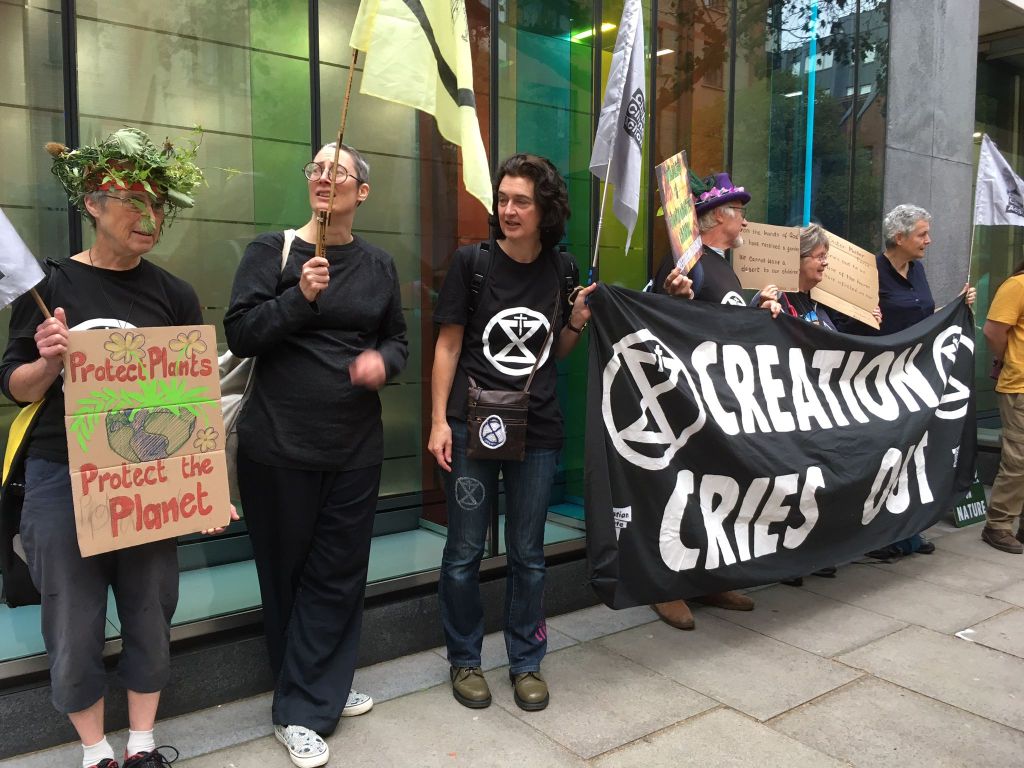
I am here on behalf of Christian Climate Action which is a nation-wide community of climate activists. We not only come from different parts of the country, we also come from different denominations.
Whilst in our own ways (depending on circumstances and opportunities) we have all responded to the climate crisis by making changes to our individual lifestyles, what unites us is the awareness that that in itself is not enough. That what we need to do, is to press for systemic change in the way businesses and organisations are run, in the way that local and national authorities respond to the emergency, and in the way that money is invested.
We are motivated by God’s call that we should care for the earth,
that we should love our neighbours,
that we should speak the truth and call out injustice.
We are inspired by Jesus Christ and guided by the Holy Spirit.
Following the examples of Jesus and the prophets, we carry out acts of public witness, non violent protest and civil disobedience, seeking to advance the values of the kingdom of God.
Recently I had ago at composing a concise descriptor for Climate activism and concluded that the aim of climate activism is ‘A just transition to a fossil free future.’
So as a Christian Climate activist, what actions have I taken?
Some are regular actions, repeated week after week in the hope that, like a constant drip of water can erode stone, they will effect change. So every Wednesday I kneel with a banner outside Shell’s London headquarters. This silent vigil reflects my concern for the environment and the damage that Shell continues to cause through the production and promotion of fossil fuels. I hope that as well as bringing the power of prayer to the situation, that my presence will prick the conscience of Shell employees arriving for work and of passers-by.
I spend a further two hours with other CCA supporters outside Parliament. Again our witness is one of silent prayer and presence. As we sit or kneel, we are passed by a constant stream of people going back and forth for work, tourists, school children and students (visiting parliament), the occasional member of the clergy and the occasional member of Parliament. Wednesday is a busy day as it is Prime Minister’s Questions and various other protest groups also gather – anti brexiters, activists for Armenian, rights, anti ULEZ campaigners, people protesting on behalf of lack of school funding, and so on.
On Ash Wednesday I took part in a progressive act of worship, with lament and ashing, along the streets in and around Parliament Square. Our lament was against the Government’s decision to approve the West Cumbrian Coal Mine.
A few days later, as an act of penitence, I knelt before the altar in Southwark Cathedral. My son cut off my hair and my husband read out a statement that decried the church’s continuing investment in and profiting from fossil fuels. This was part of a weekend of cathedral actions organised by CCA across the country in Catholic and Anglican dioceses which had not them divested from fossil fuels.
With a happier heart I went in July to support CCA’s presence at General Synod when the Church of England’s National Investment Body affirmed their decision to divest from fossil fuels. Southwark diocese, and many others, followed suit.
Together with CCA and XR I joined a day of action with members of an indigenous community from Sarawak who were protesting the destruction of their forest heritage.
For the Big One in April, CCA with other faith groups organised a ‘No Faith in Fossil Fuels’ service at St John’s Waterloo where I was a steward – the attendance was twice the capacity of the church and afterwards a 1000 strong band of pilgrims marched to Parliament Square. Over the weekend CCA maintain a faith hub opposite Westminster Abbey with daily worship, prayers and communion – all out on the street.
I have twice taken action outside the ExCel centre, for Shell’s AGM and for the bi annual Arms Fair.
Earlier this month I led a walk of prayer along the Thames as part of a CCA weekend of pilgrimages for the planet.
Last Saturday I was a protest of one in my local high street, marking Loss and Damage Day.
Next month I will be kneeling in prayer with CCA outside the Oil and Money Conference and in November I will taking action with CCA in Swindon to persuade the National Trust to drop Barclays as it bank. Barclays is one of the largest European investors in fossil fuels and that surely is at odds with the National Trust status as a protector of the natural environment!
The actions I take are ones that
a) aim to persuade those in positions to authority and influence to adopt climate friendly practices,
b) stand up for the rights of those adversely affected by climate change,
c) that pricks the conscience of passers-by prompting them to take notice
and d) speak truthfully of our human failing to live according to God’s kingdom.
I’m going to pause now and invite you to talk with your neighbour about which actions to tackle the climate crisis you feel are most effective, and then, what actions you yourself would be willing to undertake.
Have about 5 minutes and then if you wish, we can hear back from different people?
Does anyone have any questions?
Thank you for inviting me to speak to you today on behalf of CCA.


 The Green Tau