Counting On …

6th November 2021

Today’s agenda at COP26 features ‘nature’ by which one might mean the state of flora and fauna when it is un-damaged by the impact of humans. There are large parts of the world which are termed as nature but which nevertheless have been subject to human impact  where the impact has not been negative or destructive. Re-wilding projects give us some idea of what nature would look like without any human impact – and it is amazing! Sadly there are many more places – on both land and at sea – where vast areas of nature have been severely damaged by human impact. And if global temperatures continue to rise (a direct result from human activity) those areas of damage  will only grow. Yet throughout history humans have been awed and inspired by nature, and at different times and in different ways, appreciated its value. And now we realising the multi faceted value of nature to our well being.

Green and blue spaces are good for our mental and physical health, as places of calm and relaxation, places for exercise, and as places of stimulus. 

From rain forests to peat bogs, oak trees to whales, we now better understand how nature provides the lungs for the planet absorbing and storing carbon dioxide and releasing oxygen. 

At the same time, many constituent parts of nature remove and absorb pollution, be that particulates produced by motor vehicles or by products of sewage and other waste.

Plants can be key ingredients in shaping localised climates creating more congenial living conditions.

Nature is ultimately the source of what we eat, as well as  providing medicines and health treatments. It is also the source of jobs – in farming, tourism and manufacturing.  

Mangroves like their land coastal and their water salty. This tree and shrub family is adapted to spend their lives between land and saltwater, sometimes growing up to 200 feet tall in the process. Mangroves can have their roots in shallow, salty water because they are also exposed to air for part of the day. Their roots use this time above water to sequester oxygen for when they’re submerged. Mangrove roots create some of the most productive ecosystems on Earth, as their intertwined structure provides habitat for sessile creatures like barnacles and creates protective nurseries for juvenile fish. Mangrove roots provide more than habitat though: they trap sediment to stabilise coasts, and bio-filtrate nutrients and pollutants out of the water. These ecosystems are massive carbon sinks, taking in and storing excess carbon dioxide from our atmosphere and water—an important attribute in the face of climate change. By Jessica Knoth, Marine Conservation Institute Communications Intern

Counting On …

Friday 5th November

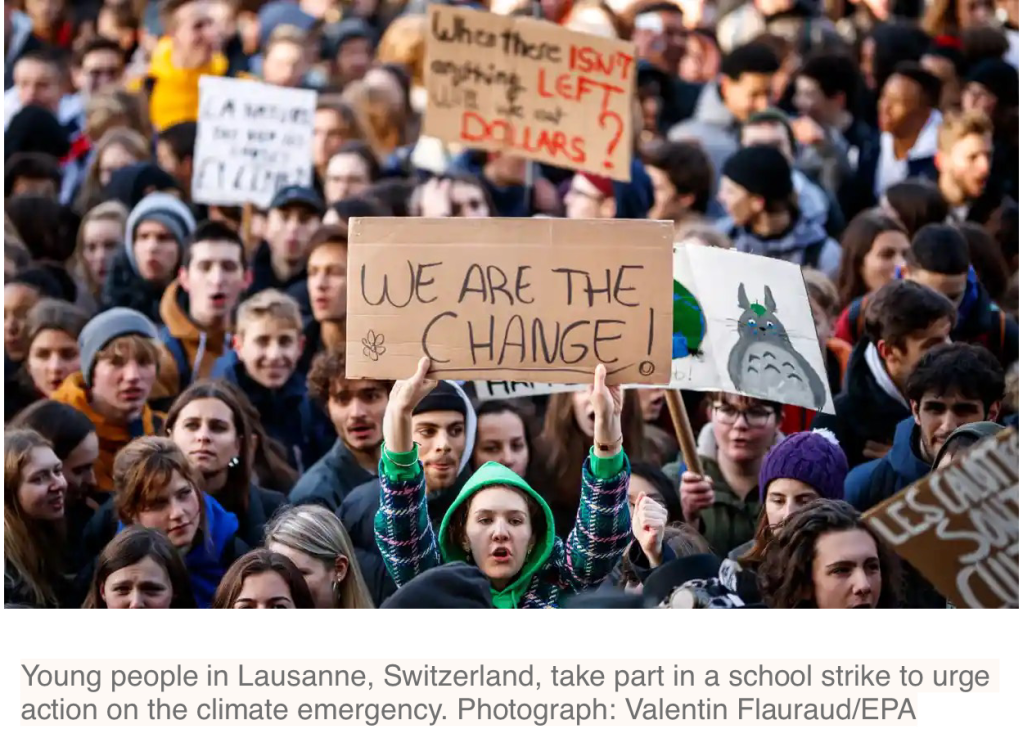
Counting On … is a follow on from the 100 days count down that preceded the start of COP26. Counting on is counting the days thereafter but I hope more importantly it will help us focus on people and groups – including ourselves – that the world is counting on to restrain and transform the current climate crisis. Today at COP26 the theme is youth and public empowerment – and young people both here in Britain and across the world are keen and willing – and already participating in transformative action. 

“The YCCN’s relay to COP26 is currently covering 1,200 miles from Cornwall to Glasgow to campaign for decisions to be made that protect people – not bank balances – and that ensure no country will go into debt tackling climate change.” 

Whilst in the Caribbean Christians Zakour is one of the young participants of the ‘Our Action, Our Future’ project. She is a master’s student in Biodiversity and Conservation from Trinidad and Tobago.

“My generation are the inheritors and rights holders of the future with significant capacity and drive to make changes for the better. In this action research project, the team of researchers and policy leaders get together to capture the value of youth, convert the youth as an asset class so that our action and future can be aligned”. (https://thecommonwealth.org/media/news/empowering-youth-small-states-forefront-commonwealth-cop26-agenda)

Counting On …

4th November 2021

Replacing fossil fuel powered energy with alternative renewable energy is key to addressing the climate crisis. But as well as being green, renewable energy can also provide remote communities with the advantages of electrical power without the need for large scale infrastructure. This can enable some amazing projects!

Practical Action has installed “ solar powered pumps [that] lift water from the river and distribute it to reservoirs close to Nepal’s farming communities, where pipes are installed to  distribute water. Local reservoirs also naturally collect rain water, which is then turned into clean water and can be distributed too.

Even when the sun is at its hottest in the most arid regions of Nepal, it continues to provide the solar powered irrigation systems with energy – and gets water to crops when they need it most.

By having a reliable and safe source of water, farming communities can enjoy bigger harvests that produce enough to feed their families, with enough crops to spare for selling at a profit at the market.

Areas in Nepal that were previously famous for apple farming – but threatened due to climate change – are now viable spaces for orchards again, alongside crop and vegetable farming, according to local farmers. The use of solar pumps helps farming communities produce crops all year round, even during the dry season. The result is hugely positive. Not just financially, but environmentally and for the health of the farmers. Not only does it enable them to drink water safely, it means they can grow crops and enjoy a more balanced diet”. https://practicalaction.org/news-media/2021/03/09/how-solar-power-lifts-water/

Counting On …

3rd November 2021

The topic for COP26 today is finance. 

In order to tackle climate change finance is needed, both state and private finance. This comes in the form of investment needed to facilitate the transfer from carbon-based to green technologies, and to train those who will work in these new industries; to transfer from animal based agriculture to plant based agriculture, and from a meat and diary based food industry to a plant based food industry; the need to invest in restoring, enlarging and maintaining  carbon sequestering land and seascapes; the need to adapt existing and build new infrastructure to cope with the changes in climate that are already happening such as flooding and heat waves, including paying for those individuals and groups who cannot afford to pay for these adaptions themselves; to develop the new systems and infrastructure needed to cope with the future changes in the climate which have already been locked into world and which may increase if global temperatures rise significantly above the current 1C increase.  

Poorer countries and small island states are in particular need of support from affluent countries like ours. The intention – although not yet the fact – is that developed nations will be supplying $1 billion to finance support for these more vulnerable nations. 

Counting On …

As participants meet, discuss, negotiate and take action at COP26, what is at stake is the wellbeing of the amazing ecosystem in which we live. Caring for and improving biodiversity is essential. So many of the earth’s ecosystems can protect us from the adverse effects of climate change, and yet they are so vulnerable to damage from human activity!

Pray for, and support, action to enhance global biodiversity.

Seagrass, the only flowering marine plant, grows in the shallower waters of our seas and oceans as it is reliant on sunlight for photosynthesis. Where it is well established it forms meadows where its roots stabilises sediment on the seabed preventing erosion. Its roots also oxygenate the sediments supporting many burrowing organisms. As it grows it sequesters carbon dioxide and does so at rates 10 to 40 higher than that of forests! It provides food, breeding grounds and nurseries for many marine species – from seahorses to seals, dog fish and octopus.

However world wide seagrasses are under threat. These marine meadows are damaged and destroyed by sewage and chemical effluents, by algal blooms that restrict sunlight penetrating the water and so preventing photosynthesis, by mechanical damage from anchor chains, marine vessels, and dredging as well as from over-fishing which disturbs the balance of the ecosystem. It is estimated that the UK has lost 95% of its seagrass meadows. Restoration projects are in progress in Swansea Bay, Dale Bay Pembrokeshire, in the Solent and off Skye – but they are still very small in scale.

Counting On …day 394

1st December 2022

Collage: The Kinship of Creation

Kinship of all creation: we are all interconnected, dependant upon each other, bound into a finely wrought ecosystem that abounds in beauty. Pray that the interests of all our kindred will be valued and protected.

Climate change is affecting all parts of the world, from the Artic southwards. it affects people, plants and creatures alike.

Reindeer herd, Canada © Peter Ewins / WWF-Canada  

Reindeer numbers across the Arctic have fallen by more than half in the past two decades. They survive by migrating to find food, using their hooves to dig through the snow to eat the nutritious lichen buried underneath. But climate change means herds must swim across previously frozen rivers and many young calves drown – and rising temperatures mean more rain, covering plants with ice instead of snow, making grazing harder.
https://www.wwf.org.uk/updates/11-arctic-species-affected-climate-change

://www.wwf.org.uk/updates/11-arctic-species-affected-climate-chang

And from The Guardian: 30 Oct 2021, Gennadiy Shukin Taymyr, north Russia

I was born in 1962 in a family of deer herders in Taymyr, on a peninsula in the very far north of Russia. I am part of the Dolgan community: we are an indigenous Russian group and there are about 6,000 left of us living in the tundra.

Growing up, the Soviet Union tried to deny us our traditional way of life, but since then climate change has become the biggest challenge to our survival. Our community lives by hunting, fishing and herding deer. Scientists say that Taymyr has the most rapid temperature increase in Russia, and we can really feel it.

Because of the warmer winters, we have seen that deer are giving birth earlier in the year. Many are born too weak and don’t survive the long journeys they have to make. This means there is much less deer for us to hunt and it hurts the whole ecosystem.

Rivers and lakes that we use for fishing have also started to dry out. Others are too polluted after all the big oil and gas plants have sprung up over the years in our lands. Some days we don’t catch any fish at all.

For generations, we have sold the food we caught to local towns and cities to buy basic products like sugar and wheat. Without animals, we cannot survive.

Big craters are also forming because the Arctic permafrost is starting to melt under our feet. This means the routes that we have used for decades to travel, hunt and fish have to be adjusted as whole roads have sunk. It is also dangerous as you never know where the next crater will form.

Our ecosystem is changing quickly: animals like sables that I have never seen before in my life have appeared in the tundra. And now we also have to deal with giant mosquitoes and bugs that attack our livestock. The summers are becoming unbearable. It’s madness.

The young people see that climate change is making our traditional way of life impossible and they are forced to move to the bigger cities to find jobs, which are often low-paid. Our culture is disappearing.

https://www.pressreader.com/uk/the-guardian-supplement/20211030/281732682701562