Counting on … day 12

12th January 2024

Wash less

The 20th century was a time of great change in many ways including how we wash ourselves and our clothes. From a weekly bath to a daily shower, from a laundry day once a week to a daily wash  and tumble dry. Have we ever been cleaner? But do we need to be that clean? Were we that dirty in past eras? 

Over the last year, we have swopped from a daily shower to a weekly one. In between a wash in a basin suffices.  At the same time we have taken to washing our clothes less frequently, washing them only when they smell unclean as opposed to when the fragrance of the detergent has faded. We have swopped from washing the duvet cover every week, to flipping it over for a second week’s use.

These changes save both water and energy and we feel no less clean! It probably extends the life of some of our clothes too. 

For further thoughts see – https://www.theguardian.com/lifeandstyle/2016/jun/14/why-we-should-shower-less-hygiene-water-preservation?CMP=Share_iOSApp_Other

https://www.health.harvard.edu/blog/showering-daily-is-it-necessary-2019062617193

https://www.theguardian.com/lifeandstyle/2023/may/09/how-to-save-money-on-laundry-washing-dont-tumble-dont-soften-and-wash-less-often?CMP=Share_iOSApp_Other

https://www.bbc.com/culture/article/20230529-the-people-who-dont-wash-their-clothes

Counting on …day 10

10th January 2024

Installing a heat pump may not be possible for everyone (or at least not at the moment but maybe in the future there will be a more concerted effort by the Government to make this possible) but it is a good way of reducing carbon emissions. Heat pumps are powered by electricity which increasingly comes from renewable sources and thus with minimal carbon emissions. 

All forms of heating – whether boiler or heat pump – will be use less energy if the space they are heating is well insulated. That includes things such as loft insulation, cavity wall insulation, double glazing etc.

It can also include measures such as thermally lined curtains which ideally are drawn at dusk to keep the warmth in, porches so that there is an ‘air lock’ between the inside and outside of the building, or draught proofing tape to ensure doors and windows fit securely.

Useful web sites –

https://www.ethicalconsumer.org/energy/shopping-guide/eco-heat-pumps

And a recent review of people’s experiences – https://www.theguardian.com/business/2024/jan/08/greener-cheaper-much-warmer-heat-pump-owners-laud-their-new-system?CMP=Share_iOSApp_Other

Counting on … day 9

9th January 2024

Switching to a green energy supplier will mean that the electricity you use (or an equivalent amount as  all our electricity comes through a central grid) will be from a renewable source that produces minimal carbon emissions. Eg from wind turbines, solar panels, or hydro electric plants. It is easy to switch. 

For more information you might look at this web site – https://www.theecoexperts.co.uk/energy-switching/why-you-should-switch

Or if you wish to find out which is the best green energy supplier visit Ethical Consumer’s web page – https://www.ethicalconsumer.org/energy/shopping-guide/energy-suppliers?check_logged_in=1- 

You will need to subscribe to get the full report but you will them benefit from wealth of  information on the most ethical options for numerous products from cat food to beauty products, shoes to supermarkets.  

We buy our electricity from Ecotricity and have found them to provide a good service.

Counting on … day 8

8th January 2024

Adjusting the heating levels in our homes

For many years the recommendation has been to heat living rooms to between 18 and 21°C. At the same time we have also been told that turning down the thermostat by 1°C- and putting on a extra layer – can save 10% of our heating costs. How far could or should we go in turning down the heating?

The WHO recommends 18 as a ‘safe and well balanced indoor temperature’ for people living in a temperate – or colder – climate.  (https://iris.who.int/rest/bitstreams/1161792/retrieve#page=54)

This sounds like good advice and I imagine assumes that we are wearing appropriate cold weather clothing such as vest and jumpers! Equally if we are active – doing the housework, walking backwards and forwards we will probably be quite comfortable at a lower temperature. The Health and Safety Executive Approved Code of Practice on the Workplace (Health, Safety and Welfare) Regulations suggests the minimum temperature for working indoors should normally be at least 16°C or 13°C if much of the work involves rigorous physical effort.

Counting on … day 7

7th January 2024

Fly less/ don’t fly

Fly less or even quit flying although their. For longer journeys and holidays, let the train take the strain! It is amazing how far you can travel both in the UK and across Europe by train (and ferry) and there are an increasing number of sleeper trains allowing you to arrive at your destination in time for breakfast with a whole day ahead of you! 

If you plan to ski this winter in Europe, plan ahead and take the train.

Why not make a flight free pledge? https://flightfree.co.uk/

For more info – https://ourworldindata.org/travel-carbon-footprint

Personal experiences – https://greentau.org/2022/07/04/eco-tips-living-sustainably-and-travel/

Counting on …day 6

6th January 2024

Walk, cycle and use public transport

The most environmentally friendly way of getting around is by walking or cycling – and it has the added benefits of being good for our physical and mental health. If you live in an area that is the equivalent of a 15 Minute City (https://greentau.org/2021/07/17/the-green-tau-issue-8-18th-july/) then it is easy to make all your daily journeys to the shops, the doctors, the gym, the school,  the library, the park, the station on foot or by cycling.

Adopting active travel as your default mode of getting around may take a little practice at first. It is also worth sorting out the right clothes and equipment appropriate to different weather conditions, lighting levels and whether you need to carry things like shopping –

Public transport is also an environmentally friendly way of travelling – shared between users it makes best use of resources and road space. Of course it is easier switching from private car to public transport if you live an area with a good public transport network. Maybe experiment with a weekly car-free day or work towards a car-free Lent. 

For further blog entries about active travel – https://greentau.org/tag/active-travel/

The Energy Saving Trust also has a section of its website devoted to active travel – https://energysavingtrust.org.uk/advice/active-travel/

And for thoughts about encouraging active travel for commuters – https://www.cbi.org.uk/articles/returning-to-the-office-five-ways-to-decarbonise-your-team-s-commute/

Counting on … day 5

5th January 2024

Refills for groceries and other household items

Following on from the principle that reducing waste is good, the growing market for refill shopping enables us to avoid single use plastic bottles and other packaging. One of the oldest schemes must be the refillable milk bottle – and this has been making  a  comeback over recent years, boosted by Covid.

Many milk delivery services offer more than just milk in refillable bottles with, for example, fruits juices, yogurts, washing up liquid, shampoo and even Coca Cola available in returnable, refillable bottles. (https://www.milkandmore.co.uk/)

There are also high street shops offering refill options for goods as diverse as sultanas , peanut butter, tahini and basimati rice. Locally in south west London I use the Source Bulk Food store – https://thesourcebulkfoods.co.uk/ . Whilst for coffee beans, our local Artisan Café, has its own refill scheme. 

Refill schemes are also being trialed by various supermarkets, coordinated  by the Refill Coalition group – https://www.refillcoalition.com/

Counting on … Day 4

4th January 2024

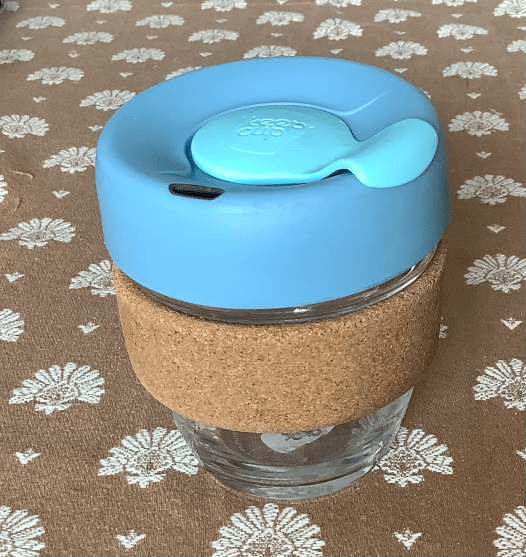
Keep a keep-cup handy

Reducing waste is good for a planet where we currently consume resources faster than they can be replaced. At current rates of consumption, the UK would need 2 and 1/2 planets’ worth of resources. (https://overshoot.footprintnetwork.org/how-many-earths-or-countries-do-we-need/

Using valuable paper and plastic to make a cup that will be in use for maybe 10 minutes whilst the beverage is drunk, and will then require further resources to recycle it, doesn’t make sense – especially as a few as 1 in 400 are actually recycled. Surely it is better to either sit in and have your coffee in a proper ceramic cup, or to use a portable, reusable cup.

“A single-use plastic cup has an impact ranging from 10g CO2e to 30g CO2e, this large range is due to differences in waste management and material selection.  …Over the lifetime of a reusable cup 10.3kg of CO2e could be saved compared to using single-use cups instead (assuming 500 uses / cups of coffee).” https://www.zerowastescotland.org.uk/resources/environmental-benefits-reusable-plastic

Carrying a keep-cup with you when out and about is an easy habit to form. You might equally develop the habit of carrying a reusable water bottle. You might opt for a refillable lunch box, spoon or fork combo if you like buying take out salads, cakes etc. The refill app lists places where you can readily get  refills for water bottles, sandwich boxes etc – https://www.refill.org.uk/

Further reading – https://www.wired.com/story/paper-cups-toxic/

https://www.theguardian.com/business/2023/oct/21/warnings-over-eco-coffee-cups-that-pose-risks-to-health-with-toxic-resin?CMP=Share_iOSApp_Other

Counting on … day 3

3rd January 2024

Avoid food waste

“If food waste were a country, it would be the third biggest polluter in the world. Globally, one third of the food we produce goes to waste, and according to WRAP, £3.5 billion worth of edible food is thrown away each year by UK households” – https://hubbub.org.uk/how-to-tackle-a-complex-issue-like-food-waste-and-turn-it-into-action

Food waste can happen at the farm especially if crops produce more than expected or reach harvesting time sooner or later than expected, which often means that the supermarkets are not ready for the produce. This is good reason for eating what is available which is more achievable when buying from a green grocer or via a veg box scheme. 

Food waste can happen at the shop/ supermarket when items are over stocked. Increasingly supermarkets are encouraged to divert this food to charities rather than letting it go to waste.

Food waste also happens in the home. This is best avoided by preparing and cooking only what you will eat (and so having a good feel for portion sizes), by saving and reusing left overs, and by buying only what you will use – a shopping list is a good way of avoiding overbuying.

For more tips – https://greentau.org/2021/08/09/eco-tips-4/

And – https://www.lovefoodhatewaste.com/

Counting on … Day 2

2nd January 2024

Eat seasonally. It is better to eat what is growing and what is currently available locally than to eat things grown out of season (either in hot houses or imported from abroad. It is also better to eat what is available – even if that means sprouts after Christmas because that’s what the farmer grew to supply the supermarkets, or the broccoli that is ready to be harvested now because the weather has been mild. Not eating what is available means it will go to waste. 

Eating seasonally is also good fun! It is a pleasure to look forward to the first asparagus in May, or the savoy cabbages in January, the first Discovery apples in July or the wild garlic leaves in April. There isn’t the same excitement to be had from always having strawberries to eat every day, or tomatoes (which are never as tasty in the winter as they are in the summer).

For a colourful chart –

Counting on … Day 2

2nd January 2024

Eat seasonally. It is better to eat what is growing and what is currently available locally than to eat things grown out of season (either in hot houses or imported from abroad. It is also better to eat what is available – even if that means sprouts after Christmas because that’s what the farmer grew to supply the supermarkets, or the broccoli that is ready to be harvested now because the weather has been mild. Not eating what is available means it will go to waste. 

Eating seasonally is also good fun! It is a pleasure to look forward to the first asparagus in May, or the savoy cabbages in January, the first Discovery apples in July or the wild garlic leaves in April. There isn’t the same excitement to be had from always having strawberries to eat every day, or tomatoes (which are never as tasty in the winter as they are in the summer).

For information on what is in season see – https://hubbub.org.uk/how-to-eat-seasonally-in-the-uk-a-month-by-month-guide