Another industry highly dependent on energy is the steel industry. Traditionally that has come from coal, but electric furnaces are providing a less environmentally damaging alternative, producing what is termed ‘green steel’. Providing investment to enable British based steel plants to switch is becoming an election issue. The Guardian reported that “Labour is promising to invest £3bn in smoothing the green transition should it win power at the next election. This is substantially more than the offers made by Mr Sunak’s government to Tata Steel and the Chinese Jingye Group, the respective owners of the Port Talbot works and British Steel. As Sir Keir pointed out, with the right kind of backing and vision from Westminster, domestic steel production can become a crucial component in meeting Britain’s clean power targets. That, in turn, will help protect good, well-paid jobs in regions that desperately need them. Britain is set to require more, not less, steel as it builds net zero machinery and infrastructure at pace. That can be a catalyst for industry renewal, if a committed government shows the drive and imagination to make it so. New public procurement rules, for example, could ensure the use of clean British steel in the manufacture of wind turbines, rather than reliance on imports from abroad.” https://www.theguardian.com/commentisfree/2023/oct/24/the-guardian-view-on-labour-and-the-steel-industry-how-to-forge-a-better-future?CMP=Share_iOSApp_Other
Nothing is straight forward. To add to this story, it seems that switching to electric furnaces has to further knock on effects. First the furnace needs fewer people to operate it, so the switch comes with redundancies. We should be aspiring to a just transition to net zero which means we should be looking to create jobs for those facing redundancy. This could involve reskilling people for work in the green sector eg building and installing wind turbines, heat pumps, solar panels, etc. Second – and which is a positive really – electric furnaces don’t produce steel from iron ore but by recycling steel and iron.
It is not just individuals that are trying to make the shift to net zero, but businesses too. And they likewise find the lack of government support and direction frustrating.
Last week the Guardian reported that, “Miles Roberts, the company’s chief executive, said British government decarbonisation policy has lacked the clarity of European rivals, meaning DS Smith[ a FTSE 100 paper packaging company] has moved ahead with a €90m (£78m) investment in a paper mill in Rouen, northern France …Roberts said: “If you are committed to carbon neutral, and it is far more attractive to invest in those solutions elsewhere, what you’ll see is manufacturing decline in the UK.” https://www.theguardian.com/business/2023/oct/22/uk-must-offer-businesses-certainty-over-green-energy-says-boss-of-ftse-100-firm?CMP=Share_iOSApp_Other
The following commentary comes from the publishers of Positive News.
“It’s really pretty simple. If we want to keep the climate stable, we have to ring in some big changes, both societal and personal. Progress is slow on the former. But while governments dither, there are signs that ordinary folk are embracing lifestyle choices that slash emissions.
“A Europe-wide survey this week found that young people are leading the way when it comes to planet-friendly living. Younger people are more likely than other age groups to buy secondhand clobber, cut down on meat and ditch smut-belching cars. Perhaps unsurprisingly, they are also more likely to support pro-climate policies. It chimes with separate research by the UK government, which showed that meat is slipping off menus, although the cost of living crisis may also have something to do with that.”
Each year Ethical Consumer produces a report on the government’s progress in transitioning to net zero. It useful not just for the government, bit for consumers too. It is sponsored by the Ecology Building Society: “Consumers need reliable information to be able to make informed choices and authoritative data can shape priorities and guide actions for businesses and government at all levels. We sponsor this report because the information it contains gives consumers more power to make better choices- by voting with their feet, their wallets or at the ballot box”.
Do read the report – Closing the Gap 2023 – and be one of the many consumers using their spending and voting power to achieve net zero.
Next year will be an election year and already people and organisations are thinking about what policies we want and need from a new government. Here are thoughts from the National Trust: “The next general election will have a profound impact on all our futures. Nature and our climate are facing an emergency. The Trust has a long history of contributing to the challenges of the day: from the need for green spaces for Victorian city dwellers, to the post-war dissolution of country houses and collections, to the over-development of Britain’s coastline. This means acting as partner, friend and critic to governments, while never straying into party politics. “The legal commitments to reach net zero by 2050 and reverse the decline of nature by 2030, require concerted action and we are looking for the policies to match.”
In particular they pick out cleaning our rivers and protecting them rom further pollution; building up a workforce and retrofitting all our pre 1920 buildings with insulation to maintain comfortable internal temperatures whilst reducing energy costs; and re greening the UK so that everyone is within a 15 minute walk of a green space.
Getting to net zero is highly dependent on positive action from governments, which makes the intransigence of our UK government so devastating. There is a group of organisations who comprise Fossil Free Politics, and assert,
“We can no longer afford to let the fossil fuel industry undermine our democracy as we try and halt climate chaos, fix our energy system, and protect people and planet. To tackle the climate emergency, and ensure that climate policy is conducted entirely in the public interest, we must cut fossil fuel interests out of politics, similar to existing restrictions on the tobacco industry. Before it’s too late.”
They recently produced a report on the fossil fuel industry’s sustained lobbying effort to undermine the windfall tax.
It is good to be reminded that the need to cut our use of fossil fuels is still pressing and urgent!
The Imagine newsletter reported on the IEA’s update of its report, Net Zero by 2050: A Roadmap for the Global Energy Sector. The report concludes that by 2030:
– fossil fuel demand must fall 25%
– the energy efficiency of homes, vehicles and other appliances must double
– methane emissions from the oil and gas sector must fall 75%
– and renewable energy capacity must triple and replace coal, oil and as at a rapid pace!
Surplus cabbage and root vegetables lend themselves to being turned into sauerkraut which is good for our gut biome and can be a handy part of a salad or – if heated – main meal.
Food waste accounts for 24% of the green house gas emissions that relate to food. Of this food waste two thirds food’s emissions come from food that is lost in supply chains or wasted by consumers. Almost two-thirds of this is due to losses in the supply chain often the result of poor storage and handling, whilst the other third is food thrown away by retailers and consumers. https://ourworldindata.org/food-waste-emissions
And for a different way of using up bread that might otherwise be thrown away, try Chester Cake. It is a variation of bread pudding without the eggs, and baked as a pie. This recipe comes from https://www.wandercooks.com/chester-squares-gur-cake/
“Climate activists are sometimes depicted as dangerous radicals. But, the truly dangerous radicals are the countries that are increasing the production of fossil fuels.” So said the UN Secretary-General António Guterres last year at the launch of the third IPCC report.
Last week the Intercontinental Hotel in Park Lane hosted the Energy Intelligence Forum – an international gathering of influential figures from the oil and financial industries – formerly known as the Oil and Money Conference. These people hold great power with very little reference to either democratic decision making or alternative view points. The decisions they make, and the strategies they plan, will have a big impact on what happens in the world, on the future of wellbeing of people, the environment and the climate.
In opposition to this Fossil Free London and other groups such as Extinction Rebellion, Greenpeace and Christian Climate Action, organised protests outside the hotel and at selected headquarters of oil and financial institutions across London. With our future at stake, it was imperative right to call out the injustice of what was happening. The IPPC and IEA have both presented the world with the scientific evidence that carbon emissions are causing the climate crisis, and that the urgent response must be cutting back now on fossil fuels extraction and use, as we all transition to net zero. And yet, regardless of this, the oil industry is continuing to expand its operations, and the financial world is continuing to invest in and to insure these projects – using what is ultimately our money.
On the Monday evening, the eve of the conference, Christian Climate Action held an act of worship out on the street opposite the hotel’s main entrance. Using words from the most recent papal encyclical, Laudate Deum (Praise God). It is so called, because the Pope says that when human beings claim to take God’s place, they become their own worst enemies. In the worship we bore witness to the injury and injustice that the oil industry is causing in the world, and in between prayerful silences we sang praises to God using the Taize chant ‘Laudate omens gentes’.
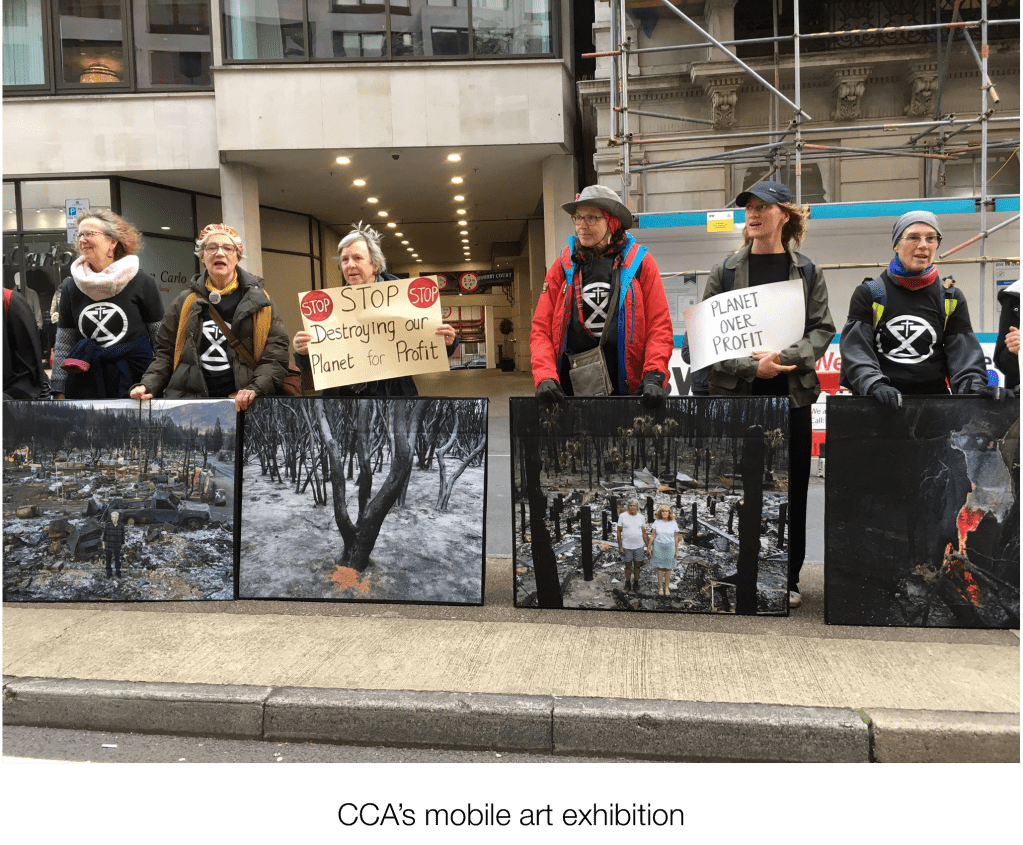
Tuesday CCA again gathered in the street opposite the hotel with a series of photographs – a mobile art exhibition – each an illustration of the effects of wild fire on the environment and people’s lives. Fossil Free London and others blockaded the hotel entrance – the hotel had erected high fences along the whole area restricting the entrance to a meter wide gate way which was easily blocked by protestors preventing guests from entering or leaving. A samba band played, people sang and chanted, and speeches were delivered – the key speaker was Greta Thunberg. Mid morning a group from Greenpeace abseiled down from a top floor window, unfurling a banner down the front of the hotel. The conference delegates could not have gone unaware of the opposition to their plans for an oil fuelled future. Indeed the CEO of Shell had to make his speech by equivalent of zoom. By the early afternoon the police had imposed a section 14 notice on the street, authorising them to remove all protestors from the site.
The Christian Climate Action group set off on a pilgrimage around Mayfair stopping to pray at the offices of a number of ‘Earth Wreckers’ – companies involved in financing, supporting or exploiting fossil fuels and thereby directly or indirectly polluting the world with carbon emissions. (For more information about Earth Wreckers visit – http://umap.openstreetmap.fr/en/map/wreckers-of-the-earth-2021_409815#12/51.5222/-0.1234)
On Wednesday action was taken further afield to the City of London. Ten companies associated with the West Cumbrian Coal Mine and the East Africa Crude Oil Pipeline were targeted, to protest against their involvement in funding these highly polluting projects. Christian Climate Action together with representatives of other faiths and a group from XR Scientists, peacefully entered and sat down in the foyer of 52 Lime Street – a modern glass and steel tower block that houses Chaucer, the UK subsidiary of China Re and a potential insurer of EACOP. Sat together in the middle of the space – allowing office workers to continue in and out of the building – we sang Buddhist and faith songs and shared an agape of bread and ‘good’ olive oil.
Within half an hour the police arrived and stood round us, watching. Then with such joy and hope, we saw the XR procession, that was marching between each of the sites, arrive with hundreds of supporters, flags and banners, and a samba band. They waved to us through the plate glass windows and cheered, and we sang and waved back. When they marched on, a contingent from CCA stayed on outside both protesting and praying. The building’s security staff obviously wished us to leave, but the police having taken advice from the CPS, took the view that as our protest was peaceful, they had no grounds for arresting us. After some discussion within the group, we agreed that we would stay until 3 o’ clock. So at 3 o’ clock we stood up, tidied up our banners and picnic lunch and still singing, walked out. We had made our point.
Despite the rain, we returned to the Intercontinental Hotel that evening for a further act of worship, this time led by various representatives of the Faith Bridge -Buddhist, Muslim, Jewish, Quaker and Christian.
Christian Climate Action continued with its support of other groups on the Thursday, targeting amongst others, the offices of J P Morgan. I meanwhile held my weekly hour long vigil outside Shell’s headquarters.




 The Green Tau