
Counting on … day 1.168

8th September 2023

Trees are good at creating a better environment for us  to live in – shade and cooling the air, limiting flooding, absorbing air pollution, and protection from winds. They can also improve our mental and physical wellbeing. 

There is some research that suggests having indoor plants can also benefit our health and well-being – but this does rely on someone taking the time to look after them. This too may have its own benefits!

For more info on the health benefits of trees –

https://www.theguardian.com/environment/2019/jun/08/forest-bathing-japanese-practice-in-west-wellbeing?CMP=Share_iOSApp_Other

https://www.dec.ny.gov/lands/90720.html

For more info on the health benefits of indoor plants – 

https://www.bbc.co.uk/news/business-66186492

https://www.bbc.com/culture/article/20201022-why-living-with-and-tending-plants-is-good-for-you
Counting on … day 1.167

7th September 2023 

Where it is not possible to plant a tree, or as an interim measure, we could grow green walls. Green walls are where climbing plants are grown either directly against, or on support structures integrated on the outside walls of a building. Growing plants such as ivy on the outside walls can reduce internal temperatures by about 2.5C. https://www.sciencedirect.com/science/article/abs/pii/S0306261916313824

A step up from green walls are living walls. These “are constructed with planter boxes or felt; these do not require the plants to be climbing, they often need to be irrigated and plants for intensive green roofs are frequently suitable for these systems.” * Such walls can sometimes be seen on the sides of tower blocks – offices and hotels – and can presumably provide a green overcoat for buildings that outstrip the height to which plants can naturally grow. 

*https://www.rhs.org.uk/garden-features/green-walls

Counting on …. Day 1.166

6th September 2023

I read recently that a tree provides the equivalent cooling of two air conditioning units. That must depend on the size of the tree and of the AC unit but it is an interesting thought. How much cheaper it must be to plant a tree than buy and run an AC unit. But of course a tree needs time to grow. Should we not be  planting as many trees as we can now to provide cooling for the years to come when summer temperatures may be routinely hotter?

Last year at the Lambeth Conference, the delegates agreed to set up a global Communion Forest. Provinces, dioceses and churches were encouraged to plant trees to celebrate events such as baptisms, weddings and confirmations, by planting trees. It is a good idea and even where we don’t have the space ourselves to plant these trees, we can sponsor the planting of trees in woodland areas such as those cared for by the Woodlands Trust.

https://www.woodlandtrust.org.uk/support-us/give/dedications/

Counting on … day 1.165

5th September 2023

Trees and forested areas are, we know, good for the environment. They cool the air, store carbon, absorb water before later releasing it. They support a diversity of plant and animal life. They protect and enrich soils. And they improve our physical health and mental well being.

Sadly tree overage in the UK is only 13% – compared with 38% across Europe and 31% world wide. 

Planting and looking after new trees and maintaining and protecting existing trees is surely common sense! And where trees are cultivated for use, including felling, that needs to be carried out in a way that protects and nurtures the ecosystem just as one should with a herd or flock of animals.

https://www.forestresearch.gov.uk/tools-and-resources/statistics/forestry-statistics/forestry-statistics-2018/international-forestry-3/forest-cover-international-comparisons/

Counting on … day 1.164

4th September 2023

1st September to 3rd October is creationtide – time to celebrate the awe and wonder of creation and to renew our commitment to care for all of creation. This year’s particular theme is justice. Determining what is fair and right can be a tricky balancing act between competing needs of plants and creatures and humans. Sustainable ecosystems perhaps best demonstrate what is possible – where species support each other, where what is input is generous, and where what is extracted is not detrimental to the whole. 

Counting on … day 1.163

1st September 

Another source of plant based protein is nuts. These can be enjoyed, plain or roasted, chopped or ground into flour. They can be used in these different forms when baking and cooking. For example ground nuts can be added to vegetables to make a pasta sauce or to a creamy soup, as well as enriching cakes and biscuits. Ground nuts can be used to coat vegetables for roasting.  Whole nuts can be added to casseroles, stir fry’s, cakes and deserts. Chopped nuts can be used in vegetable pies, nut roasts, stuffings, risottos, as well as cakes and deserts.

For more tips on swopping to a plant based diet – https://greentau.org/2021/10/12/eco-tips-11/

Counting on … day 1.162

31st August 2023

Seeds are also a good source of protein as well as various minerals and vitamins. Try chia seeds, linseed or – the wild version – camelina seeds, pumpkin, sunflower, poppy, sesame and hemp seeds. You can add seeds to muesli or porridge, salads and mix them into bread dough. 

You can use chia or linseeds as an egg replacement mixing one table spoon of seeds with 2 tablespoons of warm water, leaving it for a short time while the seeds thicken and produce a jelly-like texture.

You can use pumpkin or sunflowers seeds instead of pine nuts to make pesto. 

You can also add seeds to hummus either blitzing them with the chickpeas or adding them whole for a different texture.

Counting on …day 1.161

30th August 2023

Peas and beans can also be used ground up as flour. (Again you can buy different flours from Hodmedod’s).

Pea and bean flour can be used to replace some of the wheat flour in things such as bread, cakes, pastry and pasta, adding more protein to these foods. Pea and bean flour can be used to replace egg in foods such as frittata, pancakes and Yorkshire puddings. (Experiment with vegan recipes for these).

Pea and bean flour can be used to thicken liquids and to make sauces. Mix with a little water as if it were corn flour and add in/into the hot liquid. (You can make these sauces in a microwave to to save energy).

Counting on …day 1.160

29th August 2023 

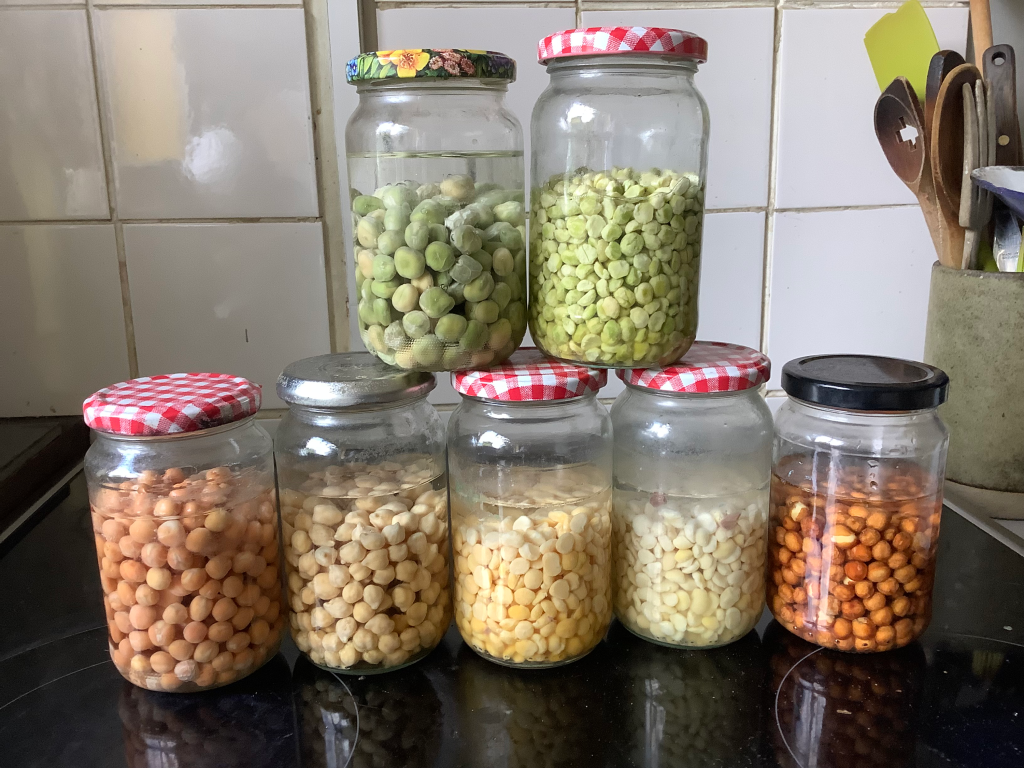
 Seven different times of pea and bean –

Top row: marrow fat peas, split wrinkled peas (these are the peas that didn’t quite make it to the freezing plant in time)

Bottom row: flamingo peas, chick peas, split yellow peas, split fava beans, red carlin peas.

All these are UK grown and come from the retailer Hodmedod. They will provide the basis for a number of meals. For example –

  1. Mushy peas and fried sweet potatoe
  2. Risi bisi*
  3. Ratatouille and wild rice
  4. Hummus and toast
  5. Dhal and rice
  6. Vegetable lasagna
  7. Tagine with millet 

NB I weigh a daily portion of beans into a glass jar, add water and leave to soak. Then I place all the jars in a large pan, half fill with water and bring to the boil. Letting it simmer for 30 minutes before turning of the heat. This gives me 7 jars of ready cooked beans.

*https://greentau.org/2022/06/29/counting-on-day-228/

Counting on … day 1.159

28th August 2023

What often worries people when swopping to a plant-based diet is getting enough protein. We have been brought up understanding that we need protein and that meat, fish and dairy are all good sources of protein. The recommended daily protein consumption is 55.5 grams per person for adult men and 45 grams per person for adult women which ideally would be spread throughout the day. 100g of chicken or beef equates to about 30g of protein, 100g salmon about 25g, 1/2 litre of milk about 15g and 50g of cheese about 12g. As in addition a couple of slices of bread can contain 6g of protein, 100g  of rice 10g it is not surprising that many people consume more than the recommended amount.  https://www.nutrition.org.uk/healthy-sustainable-diets/protein/?level=Consumer

As well as bread and rice, protein can be found in beans, pulses and tofu  – about 8g per 100g (cooked weight); nuts and seeds about 5g per 25g (a tablespoon of peanut butter is about 4g); in green vegetables such as cabbage and broccoli about 3g per 100g. Combining beans/ pulses/ peanut butter  with grains such as rice/bread/pasta provides an optimal mix of amino acids present in protein.  This makes simple dishes such as beans on toast, a peanut butter sandwich, hummus and pitta bread, rice and dhal an excellent source of nutrition.