Green Tau: issue 112

“Poor Clare” and the tricky question of wealth

31st July 2025

“Improbably funny US drama about Saint Clare of Assisi’s renouncement of worldly wealth” Time-out (1)

Earlier this week I went to see a performance of “Poor Clare”, by Chiara Atik, at the Orange Tree theatre in Richmond. It was a beautiful production set in 13th century period costume with a wonderful script that was conversely in the idiom of the 21st century. Clare and her sister Beatrice are like two teenagers preparing for a prom night. 

“Okay so for the skirt, I’m thinking like a gold thread and then the cloth would be like … I don’t know, I’m thinking purple … or like … purplish blue…”

“I like that ‘cause it’s like … deferential.”

“What for you mean?”

“Blue is like, modest. It’s what Mary wore”

“For the bodice … like I want it to go to here-ish – very covered up, very classy.”

“K”

“In red”

“No”

“Just like, a cute lil’ red bodice.”

“Red? Mom would never let you!”  (abridged) (2) 

We see how theses two sisters are ensconced in the world of wealth, how wealth and class shapes what they can and can’t do. We see their acceptance of the status quo as they happily allow maids to do their hair and wash their feet. 

Francis on the other hand we see as the born again idealist who is so caught up in his utopian dream of embracing poverty, that his thoughts run faster than his feet. Francis is acutely aware how wealth and the privilege both inflicts pain on those who don’t have it,  and  blinds those that do. He sees wealth and privilege as so utterly opposed to what God desires that he cannot for a second be compromised by living within its structures. As the story unfolds, he is casting aside piece by piece every part of his life that undermines his vision. 

Francis of course is – or rather was – himself a rich young man. Is his decision to renounce the world something that only someone who is rich can do? We see Clare’s two maids debating the impracticality of doing away with wealth and class – Maybe if the poor had just a little bit more, then they wouldn’t be quite so poor? We also see the homeless ex-soldier and the down-and out beggar giving their take on the issues of redistributing wealth – Does a second hand doublet really fit the bill?

Piqued by Francis, Clare begins a journey of self exploration – does she truly deserve the wealth she has? Does it make her happy? Can she reconcile her good fortune with the plight of those she would rather avoid? Can she justify being wealthy if she were to be a bit more generous? 

Clare’s mother understands the dilemma having travelled to the Holy Land many years before. There, she tells Clare,  however much food they gave to the starving children that swarmed around, there always seemed to be more at the next pilgrim site. Her mother commends getting pregnant: Clare will be able to pour out all her pent-up love and devotion on her children; she will never need have a conscience about anything else.

Step by step Clare follows Francis’s example, divesting herself of the world. But of the two, I think she has greater certainty, greater confidence that she is doing the right thing. She has thought through each issue and knows that she cannot remained within a system which perpetuates such injustices and suffering. 

The play left me feeling challenged: how can I be part of a system that I believe to be flawed? And yet how can I not be part of that system when there seems to be no realistic  alternative? And that challenges me to look again at my vocation as a Franciscan tertiary and how it can enable me to live within but contri to the system of worldly wealth. 

(1) https://www.timeout.com/london/theatre/poor-clare-review

(2) https://www.dramatists.com/previews/6322.pdf

NB The first tertiaries/ secular Franciscans where in fact given their particular vocation and lifestyle by Francis himself in response to the large numbers of married couples who wanted to follow his example. They were to continue living in their own homes and yet still devote themselves to living according to the principles and objectives that Francis taught.

There are different groups of Franciscan tertiaries (Anglican) and seculars Franciscans (Roman Catholic) across the world.

I’m part of the Third Order of the Society of St Francis – https://tssf.org.uk/

Greentau: issue 111

Earth Overshoot Day 

24th July 2025

Leviticus 25 explains that the land should have a sabbath rest every seventh year. In that year no crops would be sown and the people would live off the surplus of previous years. Farmers over the millennia have learnt that you cannot constantly expect the land to keep on producing crops year on year without fail. The land either needs to lay fallow (rest), or it needs to be sown with a restorative crop such as nitrogen fixing beans or clover, or it needs the input of artificial fertilisers (although we are now becoming aware that relying on artificial fertilisers may be a quick fix and not a long term solution), so that it may recuperate its productivity. It is a lesson we are sometimes reluctant to heed. The Dust Bowl disaster of 1930s in the USA destroyed vast acres of farm land because farming practices did not maintain the fertility of the soil. 

It is not just soil that has to be maintained. Water systems too. If we drain more water out than is replenished by precipitation or the melting of glaciers (themselves replenished by winter snow) water supplies will diminish. The Aral Sea – an inland lake – was once the fourth largest area of fresh water in the world,  but has now been reduced to nothing because more water has been extracted year on year – to irrigate local cotton crops – than the rate at which water flows were refilling the lake.

It’s hard to imagine, but we also need to maintain the atmosphere. The Earth’s atmosphere is a delicate mix of various gases, which in the right proportions maintain our climate at one with which we are comfortable. If we put too much of certain gases into the atmosphere it can upset that balance. Too much carbon dioxide, methane and other greenhouse gases, and the atmosphere traps more of heat within the Earth’s atmospheric envelope; global temperatures rise and the climate becomes more extreme and uncomfortable. We are experiencing this every year with floods, heat waves, wildfires and intense storms.

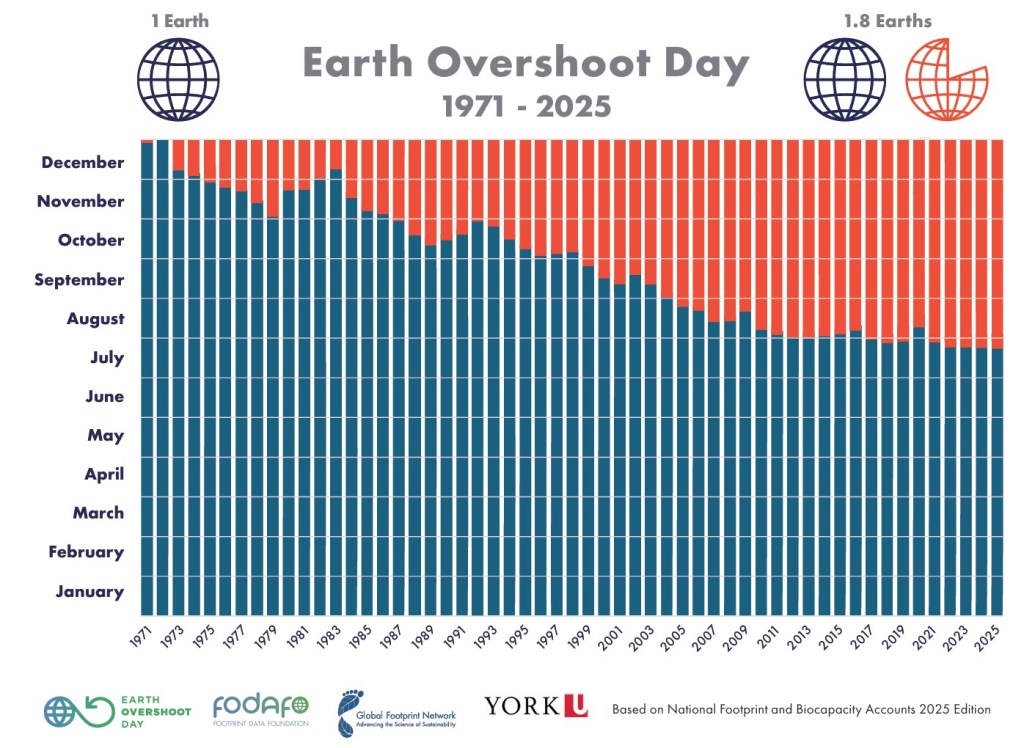
Ideally what we consume from the natural world – crops, timber, drinking water, clean air, energy – is balanced by the earth’s ability to regenerate. Prior to 1970 that was the case. Since then we have been using up the earth’s renewable resources at a rate faster than they are replenished. Scientists each year calculate that point  when we pass from credit to deficit. This is called Earth Overshoot Day. This year the predicted date is 24th July. Seven months into the year and we have already – globally – consumed as much as the earth can replenish in one year! 

Surely this state of affairs can not continue? What can we do about it and why aren’t we doing it? 

Since 1970, Earth Overshoot Day has been falling earlier and earlier each year. Only in 2020 did it reverse: the reduction in world wide consumption came about because Covid gave the earth a three week reprieve. Consuming less has to be the answer which means consuming more carefully and more sustainably. 

If we could do that in 2020 whilst coping with a pandemic, surely we could do it every year? What we must do is make sure that it is not the poor – who already lack a sufficiency – who are the ones who get to consume less; rather it must be the richer over consumers who need to change their lifestyles. And here is another caveat, to live more sustainably and fairly, will need a fundamental change in economic and political systems.

The Earth Overshoot website has details of various ways in which the global community could do this. https://www.overshootday.org/ Meantime we as individuals can make changes to our own lives  and  patterns of consumption. And we can ask or push for our churches, places of work, sports clubs, local authorities, museums, retailers, and government, to make similar reductions in consumption. We need change to happen at all levels.  

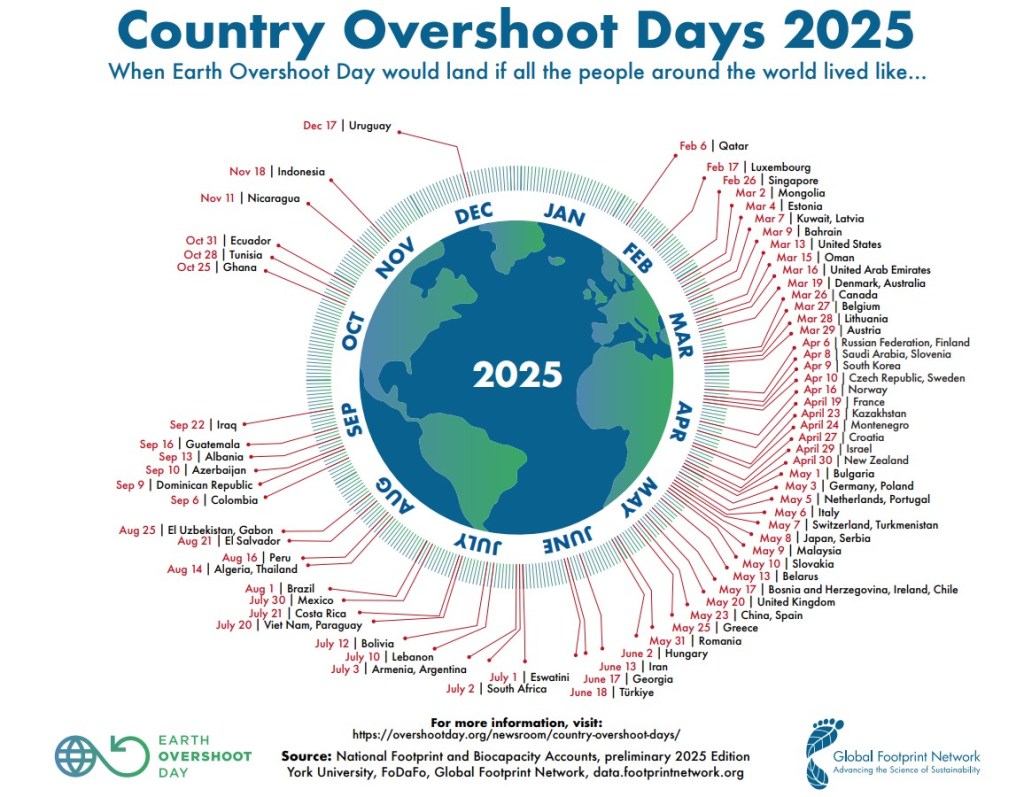
24th July is 2025’s Earth Overshoot Day at the global level. That date is the average  of each nation’s own Overshoot Day. The overshoot dates for individual nations in the diagram below range from  17th December for Uruguay (ie Uruguay pretty much balances its books,  consuming only slightly more than it can regenerate in a year) to 6th February for Qatar. What this diagram does not show are the many poorer nations who do not even use up their equivalent of one year’s resources each year – The UK’s Overshoot Day  was 20th May. We would need three United Kingdom’s to satisfy our current consumption levels; in reality we consume resources of other countries to make up the shortfall. Reducing the Earth Overshoot problem requires cooperation and understanding at a global as a well as at local levels. The Earth is a shared life-support system.

Green Tau: issue 110

16th July 2025

Are there limits to loving our neighbour?

On Sunday I reflected on the day’s gospel story of the Good Samaritan and the principle of integrity. Jesus and the lawyer are both in agreement that to love God with all your being and to love your neighbour is to fulfil the Law. The lawyer however wanted clarity so asks, Who is my neighbour? Jesus, rather than give an answer that would define ‘neighbour’ to a certain group of people or to a certain set of relationships, tells the story of the Good Samaritan and then asks who was a neighbour to the one who fell among thieves – to which the answer was the Samaritan. Jesus is telling the lawyer don’t worry about who your neighbour is, but rather think about what it is to be a neighbour. To be a neighbour is to show mercy – loving kindness – to the one in need. And that is clearly our calling as Christians. But does it still beg the question, which neighbours? Some or all of them?

Does Jesus really expect us to show loving kindness to everyone in need? 

I guess there is the limitation that the commandment says to love your neighbour as yourself – which might mean love your neighbour with all your capacity but when your capacity runs out, then take a break and pass the loving responsibility onto a fellow neighbour. 

And I guess another limitation would be the extent of your knowledge: it would be hard to specifically show loving kindness to the person one hasn’t heard of  or whose situation remains unknown to you. But clearly from the parable, just ignoring someone in need does not put that person outside the relationship of neighbour. 

So yes, I think Jesus does expect us to show loving kindness to anyone in need as far as we have  teh capacity to act.

For decades, there have been individuals and groups who have been concerned for the plight of Palestinians in the former Holy Land. People who have been concerned for the lack of justice experienced by and shown to the Palestinians. For many of us, our understanding has been minimal. The issue had not been in the forefront of the news or in lessons at school or in the word on the street. Maybe we choose not to know. But since the terror attack in October 2023, the plight of the Palestinians in Gaza has been clearly visible – splashed across newsreel and newspapers. And increasingly so – but not as prominently – there has been some focus on the injustices being faced by Palestinians living in the West Bank.

These persecuted people – as much as the hostages held by Hamas – are our neighbours, all of whom we are called to love. There are clearly practical limits to helping people who live thousands of miles away, within national borders through which we would struggle to gain access. And our lack of knowledge of what help is needed would be an issue. Too often we in the West assume we know all the answers. 

Nevertheless there are clearly things we can do. Prayer may seem an easy option out, but regular committed prayer Sunday by Sunday in our churches, day by day in our homes is an act of love. Donating to appeals organised by organisations such as Christian Aid and Oxfam is an act of love. Joining marches to show solidarity with the Palestinian cause is an act of love. Boycotting products produced by companies and organisations that support the persecution of Palestinians is an act of love. Writing to our MPs and government officials asking that our nation intervene to stop the fighting; asking that UK businesses should not continue to supply arms and infrastructure to support the aggression; asking that our government intervenes when international law is broken and when aid is withheld; asking our government to show support when international law is invoked – these are acts of love. 

What if prayer led to a proposal that the Church of England should take action? 

In 2021, “On Saturday 9th of October 60 members of the Church of England gathered together under the leadership of the Bishop of Carlisle, The Rt Revd James Newcome for their autumn Diocesan Synod meeting. Members included clergy and lay people. On their agenda was a motion passed by Solway Deanery, calling on the Church of England to be more proactive in its support and solidarity with Palestinian Christians.” (1)  (For the full text of the motion see below).

The motion was passed unopposed. 

Four years later the Kairos Palestine  motion finally made its way onto the agenda of General Synod. In response to the change in circumstances between 2021 and 2025, a revised motion was put before the Carlisle  Diocesan Synod. It was debated and was passed with a 59/7 majority. It was then also endorsed by Sheffield Diocese. 

Subsequent to that vote by the Carlisle Diocesan Synod, the motion was dropped from the agenda for July’s General Synod, meeting in York. For those who knew this – and I’m guessing it wasn’t known of by the majority of church-goers – this was shocking and pointed to a lack of integrity by an organisation that seeks to follow the teachings of Jesus, and in particular the command to love our neighbour. 

I joined a number of fellow Christians outside York University’s Senate House where the General Synod debates were taking place. We held a large banner “Love calls you to be in solidarity with the crucified Palestinian people.” We laid out on the pavement a series of photographs of Palestinians with brief comments and quotes. We arranged a keffiyeh on which we placed a candle and a cross, bread rolls, a dish of dates and a cup of water. We listened to readings and prayers. heard a recording of voices reading out some of the names of the dead. We observed a half hour silence under the midday sun. We handed out leaflets and spoke to passers-by. 

Why was this happening? Why would the Church not even discuss this issue, let alone take action? Or was this just what people expected of the Church of England is? Aloof, unconcerned, focused on ritual and convention?

On the Sunday – again with banner and placards and leaflets – we gathered outside York Minster where members of the General Synod were arriving for the main Sunday’s Eucharist. Some acknowledged our presence, said thank you and even stood with us. Some took a leaflet en passant. Most smiled or looked away as they carried on passing by on the other side.  A few openly challenged the validity of the protest. 

When the service began we did go inside, wanting to pray and be part of this corporate act of worship. The preacher  – Bishop Andrew from Hong Hong – took as the gospel as his theme, the Parable of the Good Samaritan, emphasising that our neighbour may even be our enemy. Did those who listened find this message prophetic or ironic? 

Is it that the Church of England has reached the limit of its capacity? Is it trying to do too much? Or is focusing to much on things that are not important? Do its church members need to do more?

Appendix

The motion, presented by Solway Deanery member Valerie Hallard, read as follows:

That This Synod

  • Endorses the “Cry for Hope”[1] expressed by Palestinian Christians and the ‘Global Kairos for Justice’ coalition[2] (GKfJ);
  • Requests that the Faith and Order Commission produce a report which analyses and refutes any theological justifications, for example, those promoted by some Christian Zionists, for the oppression of Palestinians.
  • Instructs the Ethical Investment Advisory Group to provide guidance to the National Investing Bodies (NIBs) and Dioceses that will enable them to screen their investments and thereby make decisions regarding engagement with, and divestment from, companies which profit from the occupation. 

The revised motion read:

“That this Synod responds to the call of Palestinian Christians to stand in solidarity with them and their fellow Palestinians in non-violent resistance to the ongoing occupation. We lament the loss of Israeli and Palestinian lives and the violations of human dignity and rights on both sides, as well as the displacement of population.  We commit to a better understanding of the situation in Israel and the occupied Palestinian territory, seeking peace and security for all the peoples of those lands and pursuing that which leads to the establishment of a just and lasting peace. 

In particular, we: 

1.Reject anti-Semitism, anti-Muslim sentiment and all forms of prejudice based on religious affiliation and ethnicity. 

2. Pray for all victims of the current conflicts in Israel and the occupied Palestinian territory and for a lasting peace; 

3. Receive the Kairos Palestine Declaration (2009), the Cry for Hope(2020), and the Call for Repentance (2023) as heartfelt expressions of the lived experience of Palestinian Christians and: 

a) Encourage the Church of England at all levels to engage with those documents as part of a quest for greater understanding of the situation;

b) Ask the the Faith and Public Life Division to commend resources that enable Dioceses and local churches to promote a full understanding of the situation and to respond through prayer, theological study, advocacy and practical support for the work undertaken by the Episcopal Diocese of Jerusalem and other Churches in the service of the people of Israel and the occupied Palestinian territory; 

4. Call on the National Investing Bodies to review their investment policies in the light of the International Court of Justice Advisory Opinion of 19 July 2024 on the illegality of the occupation of Palestinian territory, and to: 

i) disinvest from any entity or corporation with a persistent, on-going, and direct business involvement in severe human rights violations or violations of international law as part of Israel’s military occupation;

ii) provide advice and guidance to the Dioceses to review their investments; and

iii) report back to General Synod accordingly. 

5. Ask His Majesty’s Government to work urgently for a lasting peace in Israel and the occupied Palestinian territory, that will ensure safety and security for all parties and the upholding of the rights and inherent dignity of all people.” (2) 

  1. https://www.sabeel-kairos.org.uk/carlisle-diocese-passes-historic-cry-for-hope-motion/#more-8919

(2) https://www.sabeel-kairos.org.uk/updated-kairos-palestine-motion-moves-forward-to-general-synod/

Green Tau issue 109

27th June 2025

Tipping Points

Four years ago I wrote about the tipping points likely accelerate the climate crisis. In June 2021 the concentration of carbon dioxide in the atmosphere stood at 418.93 parts per million (ppm). As of May 2025 the concentration of carbon dioxide stands at 430.51 ppm (https://gml.noaa.gov/ccgg/trends/mlo.html) As the safe level of carbon dioxide lies somewhere between 280 and 350ppm, we were clearly in a danger zone in 2021, since when things have got worse rather than better.

Here is the 2021 article, below which is a comment from the Ecologist journal as to where we currently stand vis a vis the likelihood of triggering any or all of the global climate tipping points and another article from the Guardian.

In Alan Stoppard’s play Jumpers, George Moore, a philosophy professor, muses that at some point in history, the balance of believers versus non believers tipped from the former being the majority to the latter. He suspected it was the decline in woollen socks in preference for nylon ones that precipitated this tipping point: woollen socks kept the wearer in mind of the link between nature and daily life and thus a link between a divine creator and daily life. 

We have seen a number of social issues reach a tipping point: the acceptability or not of smoking, the acceptability or not of drink-driving, the use of plastic bags versus reusable versions, and most recently the wearing of face masks. At some point social pressure, social acceptance and/ or social understanding shifted in favour of a new status quo. Social norms are not fixed and what interests me is what initiates and sustains the sequence of changes that lead us to change our patterns of behaviour and belief. 

The Intergovernmental Panel on Climate Change is increasingly concerned that the current rate of global warming could reach a number of tipping points. One such scenario centres on the Arctic. As temperatures increase so the frozen soil have melted – not just the surface levels which is ‘normal’ but also the deeper levels of the permafrost. As they melt they release methane locked away for thousands of years ago. This flammable gas has led to outbreaks of wild fires across the Arctic destroying large areas of the tundra’s flora and fauna. Methane is one of the greenhouse gases and has a warming effect on the climate 80 times that of carbon dioxide. The melting of the permafrost in the Arctic disproportionately adds to the heating of the global environment and to the consequential further melting of frozen soils as well as sea ice. In other words the rise in temperatures that allows the Artic to thaw triggers a sequence of events that leads to a further upward spiralling of temperatures. 

Other tipping points have also been observed: in Greenland where the more the ice-sheet melts the faster is the rate of melting in subsequent years, leading both to rising sea levels and a likely reversal of the Gulf Stream*; in the Amazon the loss of rainforest (due to commercial felling) is expanding the area of land covered by Savannah grass lands causing rising air temperatures and depleting levels of rainfall which both threatened the natural regeneration of the rainforest; in the tropics rising sea temperatures bleach coral reefs as plant and animal life grows more slowly or dies off completely. As these living forms die so they absorb less carbon dioxide which in turn compounds rising air and sea temperatures. 

Worryingly the danger presented by such scenarios doesn’t become apparent until the tipping point has been reached! This means preventative action needs to be taken before the affects of the danger are felt. We have in recent months learnt the lesson that the way to limit rocketing covid infections is to follow lockdown procedures before the number of cases becomes unmanageable. Can we do the same to prevent the extreme effects of climate change? Can we as individuals rapidly decarbonise our lifestyles now to safeguard the future for ourselves and our grandchildren? Can we create the social groundswell needed to make a carbon neutral lifestyle the norm? Can we create the popular groundswell to change the direction of our political leaders?

“Multiple climate tipping points are likely to be triggered if global policies stay on their current course, new research shows.

Scientists assessed the risk of tipping in 16 different parts of the Earth system – ranging from the collapse of major ice sheets to the dieback of tropical coral reefs and vast forests.

Their most conservative estimate is a 62 per cent risk of triggering these tipping points on average, based on current policies and the resulting global warming.

However, more sustainable future pathways – with lower greenhouse gas emissions – significantly reduce the risk of tipping points.

The study, by the universities of Exeter and Hamburg, also found that carbon released by certain tipping points – Amazon rainforest dieback and permafrost thaw – is unlikely to cause enough warming to trigger other tipping points.

“The good news from our study is that the power to prevent climate tipping points is still in our hands,” said lead author Jakob Deutloff.

“By moving towards a more sustainable future with lower emissions, the risk of triggering these tipping points is significantly reduced.” https://theecologist.org/2025/may/21/cascading-climate-tipping-points-likely

Green Tau: issue 108

16th June 2025

A different take on ‘chastity’

“Members of the Third Order fight against all such injustice in the name of Christ, in whom there can be neither Jew nor Greek, slave nor free, male nor female; for in him all are one. Our chief object is to reflect that openness to all which was characteristic of Jesus. This can only be achieved in a spirit of chastity, which sees others as belonging to God and not as a means of self-fulfilment.”

At the same workshop I mentioned in  Green Tau 107, we also reflected on the above. This is the  Franciscan (TSSF – Third Order of the Society of St Francis) principle given for day 8. Its understanding of chastity as not making use of someone else, not using someone else as a means of fulfilling our desires, is noteworthy. Making use of other people is something that is easily done, and often unconsciously. 

For example when we buy a cup of coffee, is our desire for the drink being satisfied through the exploitation of underpaid coffee workers in distant parts of the world? Is it being met by the exploitation of café staff who scrape by on a zero hours contract and the minimum wage? 

The teaching of St Francis (which itself follows the understanding gained from Genesis 2, Job 38 and psalms 19 and 104 etc) is that all parts of creation – birds and animals, sun and moon, wind and fire, and all manner of plants – and not just fellow humans, are our brothers and sisters and should be respected and treated as such, for they are all created by God and each praises God. So when we are asked to see ‘others as belonging to God and not as a means of self-fulfilment’ then included in all those others, are birds and animals, sun and moon, wind and fire, and all manner of plants etc. We should not be using or exploiting that which God has created as our brethren here on Earth.

For example, if we think to buy a dog, we should not see having that dog as a means of satisfying our own needs – maybe for companionship or protection or as an instagram prop – but as a brother or sister worthy of respect and care.

Or for example, if we buy a pint of milk, we should consider whether our desire for milk is being met by a system that sees a cow as a milk-producing machine that will be slaughtered at at the age of 4 to 6 years. 

Or for example, when we fly or drive a petrol car, we should consider whether our desire for travel is being met by a system that sees the atmosphere as a useful place to dispose of greenhouse gas emissions even though that space is already over full. 

We don’t live in a perfect world, and many of the systems within which we live are not ones we can readily change – but that should not stop us being aware of the times when we are exploiting others and when we can, changing the way we behave, and when we can’t pressing for change.

For the full set of principles and objectives visit https://tssf.org.uk/tssf-downloads/about-the-third-order/the-principles-of-the-third-order/

Green Tau: issue 107

15th June 2025

‘The Gospel is as much about where you are coming from as where you are going’.

I was recently taking part in a workshop entitled ‘Tools for contemplative action’ and this phrase that came up, set me thinking. ‘Where you are coming from’ suggests not just your roots or the place where you started, but what is it that is shaping your thinking? What is influencing the choices you make or the actions you take? And if this is important in determine how we respond to God and God’s kingdom, can we change ‘Where are you coming from’ mindset? 

By way of an example, Saul – before he became Paul – was coming from the mindset that valued the Law as the absolute and unassailable sole way of encountering God, and he acted accordingly chasing down and imprisoning those who threatened. Then Saul undergoes a 180° transformation – or conversion – and now comes from a mindset where the only way of understanding God and living as God desires is to embrace Jesus Christ and to follow his way of absolute love. 

One local church within the period of a year achieved the Eco Church bronze award. They ticked enough of the right boxes and their scores stacked up. They introduced oat milk with their coffee, stopped using pesticides in the garden, and invested in LED lighting. 

Did it make any radical changes to the way the congregation thought about the climate and ecological crises? Not really.

Did it transform their hearts and minds, attuning them more closely with ethical and ecological issues, changing the way they behaved? Not really. 

But what if that congregation had undergone an ecological conversion? What if their hearts and minds had been transformed to love God and each other and creation in a new and heartfelt ecological way? 

Pope Francis, in his encyclical Laudatory Si, called on all people of faith to seek an ecological conversion, confident that this would lead to:-

  • gratitude and gratuitousness (recognition that the world is God’s loving gift)
  • generosity in self-sacrifice and good works
  • a loving awareness of a universal communion with the rest of creation
  • greater creativity and enthusiasm in resolving the world’s problems
  • a feeling of responsibility based on faith (1)

Ecological conversion is to change where we are coming from. It transforms the base line from which we operate. It reorientates our focus. It changes how we live and think and behave. It transforms how we embody and share the Gospel – ie how we live and share the good news of the kingdom of God.

Such an ecological conversion would have us asking how does what I buy impact other living beings? Could I change or reduce what I buy to show greater love towards, or to protect, others? How does who I bank with impact the natural world, or impact those of my brothers and sisters enduring the impacts of climate change? Does my money help others have better lives or does it cause harm? Do I tread lightly on the earth or does my lifestyle demand a disproportionate amount of the earth’s resources? Am I mindful of the needs of others when I plan my holidays, choose how to travel, go on a shopping spree? Do I treasure the natural world around me, or do I trample what is before my nose to snap that iconic view on the other side of the world?

Such a conversion would have us being grateful for and finding joy in what we already have, and realising that for many of us what we have is more than we need in order to live a fulfilled – ie God-filled – life. We might find ourselves challenging the premise that ‘the more you have, the happier you are’.

Such a conversion would have the effect of giving us time and space to wonder and delight in the natural beauty and integrity of the world that God has created. We might find it an under-appreciated source of joy and sustenance.

Such a conversion would have us asking questions of retailers and industrialists and companies that extract raw materials – How does what you do show care for planet, for the natural world, for people you employ, and for the people you sell to? We would be questioning them about practices that are destructive and products that are elitest – and boycotting them if they continue with such practices. Equally such a conversion would have us asking questions of our local and national politicians and how they might use their power to protect biodiversity, to limit the emission of greenhouse gases, to ensure justice for all but especially for those already marginalised and persecuted by our current economic and social systems. 

Such a conversion would have us signing petitions, writing letters and joining campaigns to challenge and change oppressive operations. Such a conversion would have would see us drawing together as communities, helping support others of our brothers and sisters – human and creaturely – close at home and far away.

All these ways of behaving differently are out there in the world and being practiced by individuals and communities. Any of us could take up these alternative ways of behaving. Yet many of us don’t. And I think the reason we don’t – or why we try and then give up – is because we still hold onto old mindsets. We haven’t had that transformation, that experience of ecological conversion, that changes the ‘where we are coming from’. 

Can we as fellow Christians, as fellow beings, encourage and enable and pray for that ecological conversion? 

  1. https://laudatosimovement.org/news/what-is-an-ecological-conversion-en-news/

Green Tau: issue 107

3rd June 2025


Why actions of solidarity work

Wednesday has been chosen as a day to fast in solidarity with the people of Gaza. As I explained this to a friend, they replied that it seemed a pointless action and that I would be better off making a financial donation. 

I did, in my limited way, fast. (And I’ll try again this week). I don’t think it’s a waste of time. Why? Because …

  • In a very small way it helps me understand how real hunger feels. 
  • More importantly it keeps me more focused on the plight of the people of Gaza and therefore more prayerful. 
  • And I do believe prayer does have some kind of power. 
  • It gives me something to talk about and talking about the horrendous situation in Gaza is good because the more it is talked about, the more politicians and the media will take notice. 

And all these points are equally applicable to actions such as praying for Gaza in the weekly intercessions at church and in our daily prayers, or going on marches, or wearing badges and T-shirts etc.

Green Tau issue 106

13th May 2025

Insurance Vigils

On Tuesdays, I and one or two others from Christian Climate Action, hold vigils outside one or more insurance companies in the City of London. We do this to both highlight the degree to which the insurance industry supports and enables the expansion of the fossil fuel industry and its carbon emissions, and to bring the presence of prayer into the situation.  Today’s vigils were held outside the offices of Marsh McLennan and of Lloyds of London.  

How does the insurance industry work? Insurers and their customers identify risks and calculate both the likelihood of the risk materialising and the likelihood cost for the customer of that materialisation. The insurer calculates a fee and in return – once paid – undertakes to pay out to the customer if or when the destructive event happens. The insurer invests the fee to increase its value against the day when it may have to pay up. To spread the risk and the potential cost of the insurance policy, the insurer will approach other insurance companies to share the fee and the risk. Equally the insurer will formulate and sell a wide range of insurance policies, on the basis that each will earn a fee but only a small number will lead to a financial payout by the insurance company. 

In the short term (2 years) damages due to extreme climate events is, according to the World Economic Forum, is seen as the second highest risk. Whilst in the long term (10 years) it is seen as the highest risk. 

Insurance companies presumably increase premiums to respond to the increasing risks but is there still not a concern that they may underestimate the risk and end up paying out large sums to affected customers? And equally is there a likelihood that in the face of increased premiums customers may cut back on insurance either internalising the risk or cutting back their business plans?

Is there not also something perverse that these same insurance companies may be increasing the climate risks by, 1) investing income from premiums in fossil fuel industries or 2) providing the necessary insurance that enables oil and gas companies to continue to expand production, and thus through the increase

in greenhouse gas emissions,  further accelerating the risks of adverse weather events, and the potential liabilities accruing to the insurers. 

The best option for customers and the wider public – not to mention biodiversity and the planet – Would be for insurers to stop insuring oil and gas interests.

Yet looking at the be-suited office staff, is this a reality they have even considered? Or do they just place their trust in business as usual?

Green Tau: issue 105

The Power of Silence

8th May 2025

According to a recent report in the Guardian, banks including Barclays, HSBC, NatWest and Lloyds have poured more than £75bn into companies developing huge fossil fuels projects with the potential of producing  420bn tonnes of carbon emissions. That would be equivalent to more than 10 years of current global carbon dioxide emissions. (1) 

Banks and fossil fuel companies are clearly working together to wreck our green and sustainable global environment. How do we as ‘powerless’ – when compared to the financial clout of these businesses – individuals respond? 

Yesterday (Wednesday 7th May 2025) Barclays held its AGM at the QEII conference centre just off Parliament Square. The building itself was barricaded off – a barrier reinforced on the inner face by a large number of private security officers (the kind of thing that big businesses can buy) and further reinforced on the outer face by large numbers of police officers. Their objective being to ensure that proceedings were not disrupted by any protest – even though the UK still (just about) upholds the right for people to undertake peaceful protest.

A sizeable crowd of protestors had squeezed into the limited space that lay between the QEII barricades  and the barricades that enclosed the extensive gas repairs being carried out in front of the Methodist Central Hall. Palestinian flags flew high, placards announced “Barclays – Don’t Bank on Apartheid” and protestors accompanied by a drum as protestors chanted slogans highlighting and castigating Barclays for their involvement in financing the genocide in Gaza. 

Meanwhile stage left a small group of Buddhists and Christians from Buddhists XR and Christian Climate Action, spent several minutes checking in with each other as they prepared for an extended period of silent protest. Circling round us were more police officers who then followed as in pairs we quietly walked carrying our various banners across to the QEII centre. We found a space on the street where we could face the conference centre, and enter into a period of silent meditative prayer and reflection. 

Can you hold a silent protest when surrounded by fellow protestors chanting and drumming? Would it not be as easier undertaking if one moved to a quieter spot away from the protest? Yes and yes. Moving to a quieter spot would have made our focus easier, but not being in the heart of the protest would have made it harder.  Rather the noise and clamour focused our minds on the scale of the outrage – the unjust and implacable way that big money rides roughshod over other people’s lives – that we were all protesting against. 

Once focused, the hour and half we were there was tangibly channelling a power into space that would not otherwise have been present. And the contrast between our silence and the noise of the other protesters added to the overall impact of the action. 

Did the shareholders listen? Did the CEO and the board of Barclays take note of what was going on? Will they search in their hearts and consider the morality of financing activities that make the world a worse place? Will they look beyond the profits and bonuses they make, to consider the many lives they are destroying? Will the power they wield, immunise them from feelings of guilt?

We may not know the answers but we do know that we have asked the right questions.

(1) https://www.theguardian.com/environment/2025/may/01/uk-banks-put-75bn-into-firms-building-climate-wrecking-carbon-bombs-study-finds?CMP=Share_iOSApp_Other

Green Tau: issue 104

Reshaping how we can talk positively about the climate crisis – part 3: Finance

April 2025

How can we talk about the climate crisis in a way that sounds encouraging?

The climate crisis is an existential threat which is certainly not good news. Its causes and impact are diverse and numerous such that it is hard to pin down ‘This is the cause’ or ‘This is the solution’. It is hard to quantify ‘This is how it will effect you’ and ‘This will be the time table.’ 

All this makes it difficult to find a way of talking to people about the crisis and how we might respond.

So here are some thoughts that might help.

Finance for a Better Future

We are told that one of the most effective ways of tackling climate change is to redirect the money that funds climate damaging industries such as oil and gas production . Make My Money has campaigned on this issue with both humour (short films and ) and straightforward  facts and graphics:  

“All of these banks refuse to stop funnelling money to the companies pumping new fossil fuels. 

They each talk about climate change, but we need less talk and more action on what really matters:

* Immediately stop providing money to new clients who are involved in expanding fossil fuel operations

* End the flow of new money to existing fossil fuel clients who won’t stop the expansion of fossil fuel operations and haven’t published credible plans aligned to a 1.5 degree global warming limit
* Set out a clear timeline for cutting ties with existing clients that continue to expand fossil fuel operations”

But despite the ease with which we can switch banks, many of us haven’t bothered to take this simple action. Perhaps because there is no immediately visible result. Stop driving to the shops and you straight away see the benefit of not having to refuel your car. Switch your bank and there is no noticeable reduction in oil production, no financial gain. And anyway aren’t high street customers mere minnows in an ocean of big financial organisations?

Is it also that with banking we see ourselves as customers buying a service, not as patrons providing banks with money and probity? Banks like – need – to be seen as upright, trustworthy and moral institutions: people with whom you can safely entrust your money. That is part of the reason that banks will sponsor sporting and cultural events – it improves their perceived reputation as ‘responsible’ companies. And that is why groups have campaigned against such greenwashing bank relationships eg Barclays and Wimbledon Lawn Tennis/ Live Nation music festivals/ National Trust/ Sadler’s Wells. 

Turning the situation round, should we be actively expecting our bank – the bank we support with our money and our patronage – to demonstrate how it is using its financial clout to create  better world? By way of example let’s look at Triodos. Triodos scored the top mark in a recent survey by Ethical Consumer, scoring 96 out  of a possible 100 points. The big five high street banks – Lloyds, HSBC, NatWest, Santander and Barclays scored 6 or less. (1)

Triodos does not provide finance for fossil fuels, nor fast fashion, nor weapons and warfare, nor gambling. Triodos does provide finance for renewable energy, nature restoration, healthcare, art and culture: “We believe it’s not enough to avoid funding harmful practices, so we actively support those building a better tomorrow. Our commitment goes beyond avoiding harmful investments. We proactively seek out and support initiatives that contribute to a sustainable future, ensuring that every loan and investment aligns with our mission.” (2)

For example, “Ember, the UK’s first all-electric intercity bus operator, has increased its fleet of zero emission coaches with a £5.6m loan from Triodos Bank UK. The electric coach operator, based in Scotland, has a fleet of vehicles designed specifically for intercity travel. These buses are zero-emission, contributing to environmental sustainability by reducing carbon footprints and improving urban air quality.” (3) 

Triodos also finances “Copeland Park … a social, cultural and creative hub in Peckham, an area of London that is becoming increasingly known as a haven for artistic individuals and collectives. At Copeland Park, traditional warehouses and industrial buildings have been transformed into workspace for a number of creative businesses. The historic Bussey Building, for example, now provides a home for artists’ studios, theatre groups, live music venues, fitness studios and faith groups – along with incomparable views of London.” 

In Wandsworth “Beyond Autism seeks to improve the education and health of children diagnosed with autism and/or related communication disorders. A loan from Triodos Bank allowed Beyond Autism to purchase their facility.” 

On Mull “NWMCWC was set up by the local community in 2006 to purchase and manage the Langamull and West Ardhu forests in North West Mull. With 2 Triodos loans, we were able to help with a variety of projects, including helping with the construction of a woodshed for timber felled at the woodland.”

And in Wales “NWMCWC was set up by the local community in 2006 to purchase and manage the Langamull and West Ardhu forests in North West Mull. With 2 Triodos loans, we were able to help with a variety of projects, including helping with the construction of a woodshed for timber felled at the woodland.” (4)

In addition Triodos does not use its profits to pay bonuses to its staff. Rather “Triodos believe all our workers should be paid fairly and our focus should be on impact – for the whole Triodos community.” (2)

Choosing – switching to – an ethical banking really does enable our money to create a better future, and can do so in a clearly transparent way, such that we can be proud of what our patronage can achieve. 

The following websites help individuals switch to ethical banks:-

(1) https://www.ethicalconsumer.org/money-finance/shopping-guide/current-accounts 

NB the other banks recommended in the Ethical Consumer report included Coop Bank/ Smile, Cumberland Building Society, and Nationwide, all scoring 70 or more.

(2) https://www.triodos.co.uk/your-money-has-power

(3) https://www.triodos.co.uk/articles/2024/powering-sustainable-travel-with-ember

(4) https://www.triodos.co.uk/know-where-your-money-goes