Sunday Reflection

First Sunday of Lent

6th March 2022

Deuteronomy 26:1-11

When you have come into the land that the Lord your God is giving you as an inheritance to possess, and you possess it, and settle in it, you shall take some of the first of all the fruit of the ground, which you harvest from the land that the Lord your God is giving you, and you shall put it in a basket and go to the place that the Lord your God will choose as a dwelling for his name. You shall go to the priest who is in office at that time, and say to him, “Today I declare to the Lord your God that I have come into the land that the Lord swore to our ancestors to give us.” When the priest takes the basket from your hand and sets it down before the altar of the Lord your God, you shall make this response before the Lord your God: “A wandering Aramean was my ancestor; he went down into Egypt and lived there as an alien, few in number, and there he became a great nation, mighty and populous. When the Egyptians treated us harshly and afflicted us, by imposing hard labour on us, we cried to the Lord, the God of our ancestors; the Lord heard our voice and saw our affliction, our toil, and our oppression. The Lord brought us out of Egypt with a mighty hand and an outstretched arm, with a terrifying display of power, and with signs and wonders; and he brought us into this place and gave us this land, a land flowing with milk and honey. So now I bring the first of the fruit of the ground that you, O Lord, have given me.” You shall set it down before the Lord your God and bow down before the Lord your God. Then you, together with the Levites and the aliens who reside among you, shall celebrate with all the bounty that the Lord your God has given to you and to your house.

Psalm 91:1-2, 9-16

1 He who dwells in the shelter of the Most High, *
abides under the shadow of the Almighty.

2 He shall say to the Lord,
“You are my refuge and my stronghold, *
my God in whom I put my trust.”

9 Because you have made the Lord your refuge, *
and the Most High your habitation,

10 There shall no evil happen to you, *
neither shall any plague come near your dwelling.

11 For he shall give his angels charge over you, *
to keep you in all your ways.

12 They shall bear you in their hands, *
lest you dash your foot against a stone.

13 You shall tread upon the lion and adder; *
you shall trample the young lion and the serpent under your feet.

14 Because he is bound to me in love,
therefore will I deliver him; *
I will protect him, because he knows my Name.

15 He shall call upon me, and I will answer him; *
I am with him in trouble;
I will rescue him and bring him to honour.

16 With long life will I satisfy him, *
and show him my salvation.

Romans 10:8b-13

“The word is near you, on your lips and in your heart” (that is, the word of faith that we proclaim); because if you confess with your lips that Jesus is Lord and believe in your heart that God raised him from the dead, you will be saved. For one believes with the heart and so is justified, and one confesses with the mouth and so is saved. The scripture says, “No one who believes in him will be put to shame.” For there is no distinction between Jew and Greek; the same Lord is Lord of all and is generous to all who call on him. For, “Everyone who calls on the name of the Lord shall be saved.”

Luke 4:1-13

After his baptism, Jesus, full of the Holy Spirit, returned from the Jordan and was led by the Spirit in the wilderness, where for forty days he was tempted by the devil. He ate nothing at all during those days, and when they were over, he was famished. The devil said to him, “If you are the Son of God, command this stone to become a loaf of bread.” Jesus answered him, “It is written, ‘One does not live by bread alone.'”

Then the devil led him up and showed him in an instant all the kingdoms of the world. And the devil said to him, “To you I will give their glory and all this authority; for it has been given over to me, and I give it to anyone I please. If you, then, will worship me, it will all be yours.” Jesus answered him, “It is written, ‘Worship the Lord your God, and serve only him.'”

Then the devil took him to Jerusalem, and placed him on the pinnacle of the temple, saying to him, “If you are the Son of God, throw yourself down from here, for it is written,

‘He will command his angels concerning you, to protect you,’ and ‘On their hands they will bear you up,
so that you will not dash your foot against a stone.'”

Jesus answered him, “It is said, ‘Do not put the Lord your God to the test.'” When the devil had finished every test, he departed from him until an opportune time.

Reflection

“You are my refuge and my stronghold, my God in whom I put my trust.”

What does it mean to put our trust in God? What effect does it have?

The reading from Deuteronomy tells of the richly rewarded life being enjoyed by those who once been wandering Arameans, who had been subject to slavery and oppression a foreign land, but who had slight help from God. But our knowledge of the Book of Exodus would suggest that the people’s trust was not always 100%, that there were times of wavering and doubt. Certainly the teaching that comes from Jesus whilst in the wilderness, is that trusting in God is not about expecting or demanding material gain. 

Today’s psalm from which the opening quote comes, also gives praise to God for the protection and deliverance from evil. It is also the psalm from which the devil quotes as he tries to persuade Jesus to parade God’s power. But trusting God is not about expecting or demanding God to shield us from either danger or our own recklessness. 

The passage from Paul’s letter to the Romans reminds us God’s concern for us is affected by neither our nationality, nor our background. Rather there is but one Lord whom we should honour and who will save us. The divisions of nationality which the devil claims to control, are a false diversion. 

To put our trust in God, is not to expect everything to magically come right in our favour.  It is not to expect that what we want will fall into our laps. To trust in God is not to act carelessly or selfishly, and then expect God to pick up the pieces. To trust in God is not to have predetermined the answer, nor is it to force the issue. To trust in God is to want what God wants – what God wants for our neighbours, what God wants for creation, as well as what God wants for us. 

How do we know what God wants? Prayer; studying the Bible; studying the book of nature;  listening prayerfully with others; paying attention to what builds up the community, to  what enhances life, to  what allows creation to flourish. To love God with all our being, and to love our neighbours as ourself. 

“You are my refuge and my stronghold, my God in whom I put my trust.”

Where does all this find us today? 

How do we reconcile the conflict, the suffering and the destruction we are seeing in Ukraine, with the assertion that God is a refuge, a source of strength and trust? Our hearts ache with concern for the people and whilst we can send aid, we feel helpless. We urgently hope for an end to the hostilities but can so no way of resolution, no quick or easy way of establishing peace. We harbour the fear that this conflict will spill out beyond Ukraine’s borders and that our way of life too will be in peril. How can we pray if we cannot imagine how our prayers can be answered?

Above we noted that trusting in God is likely to be separate from knowing the answer to the problem. Trust is about continuing to hope without knowing. We noted that trusting is not about testing God,  nor trying to force a particular solution. But is is about aligning our selves with God, of endeavouring to want what God wants, to act the way God wants. God wants us to love our neighbours. So we should pray for them. We should give consolation to one another, listen to one another, give each other support. We should give practical support. For the wellbeing of Ukrainians practical support in this instance is best provided through financial donations to charities who can provide the aid they need. Later we may be able to offer more direct help when Ukrainian refugees come into our communities. 
Lent Reflection

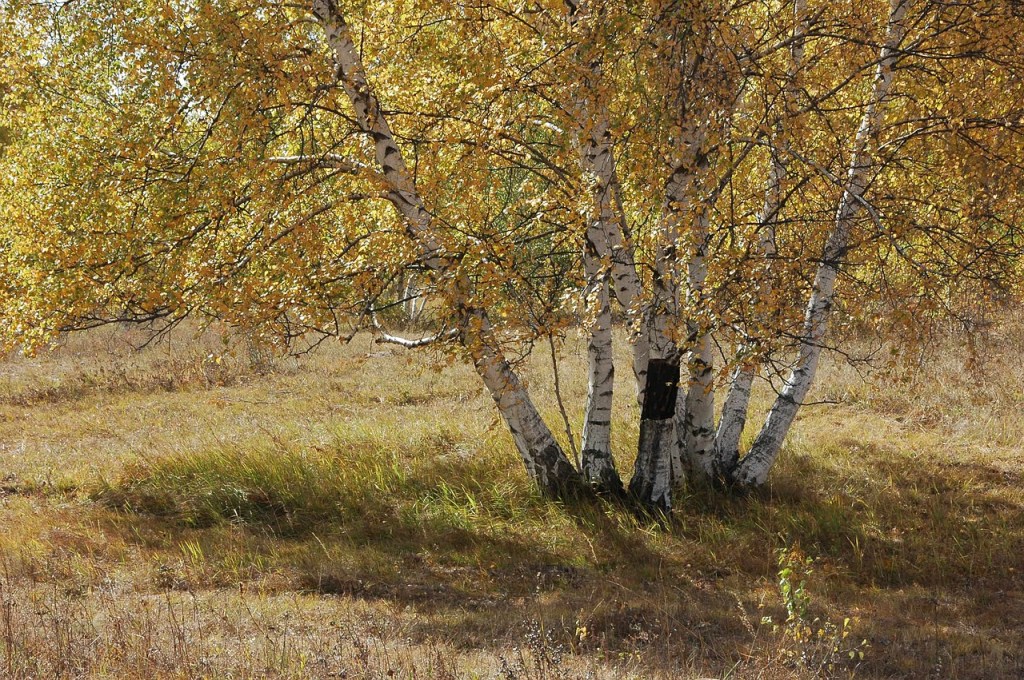
Grassland Autumn Forest White Birch Trees

The silver birch – betula pendula – can grow up to 30m in height. Its widely spread roots enables it to draw nutrients from a large area enabling it to grow where the soil’s fertility may initially be low. Its trunk often provides nesting spaces for woodpeckers as well as supporting various types of fungi.

Birch wood is often used in making ply wood. Its bark can be used to make bowls, boxes, baskets and even small boats. 

In Celtic mythology, the silver birch symbolised renewal and purification.

“…the birch trees which grew on this margin of the vast Edgon wilderness had put on their new leaves, delicate as butterflies’ wings and diaphanous as amber.” Thomas Hardy, The Return of the Native, Book VI, Chapter 1

Create in me a clean heart, O God, and put a new and right spirit within me. Psalm 51:10 

 Counting on…113

5th March 2022 

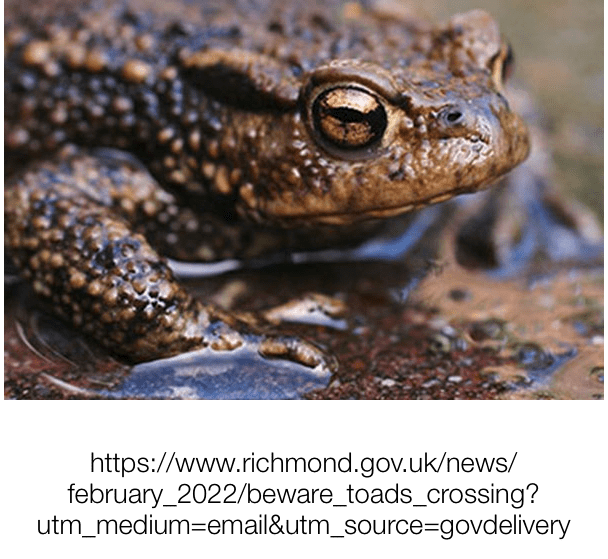
‘Toads which live on Ham Common are currently breeding and will make the 100-metre journey from their habitat to pools on the other side of the road to spawn for approximately three weeks.’ Our local council is temporarily closing this road to ensure the safety of the roads. Toad number have fallen by two thirds over the last 30 plus years largely because of the disappearance of ponds, ditches and wet ground which are part of their natural habitat. Toads are a gardener’s friend because they eat slugs and snails.

Lent Reflection

4th March 2022

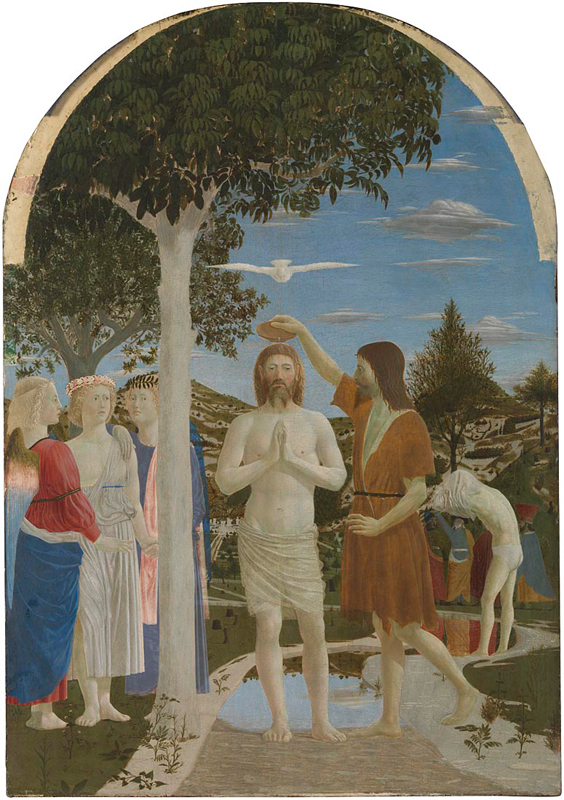
Piero della Francesca The Baptism of Christ after 1437 Egg on poplar, 167 x 116 cm Bought, 1861 NG665 https://www.nationalgallery.org.uk/paintings/NG665


Piero Della Francesca lived in Tuscany and his paintings often reflect the local countryside. At this time chestnut trees were common in this mountainous region and the chestnut itself was a staple part of the people’s diet, as it could be ground into a flour to make bread – known as ‘pane di legno’ or tree bread.

Here in the middle of this picture is a tall tree that might be a chestnut tree or maybe a walnut tree. Perhaps it is a reminder of Jesus’s words, ‘I am the Bread of Life.’

Blessed are you, Lord, our God, King of the universe, who brought forth bread from the earth. 

Ha-Mitzi blessing for bread.

 Counting on … day 112

4th March 2022

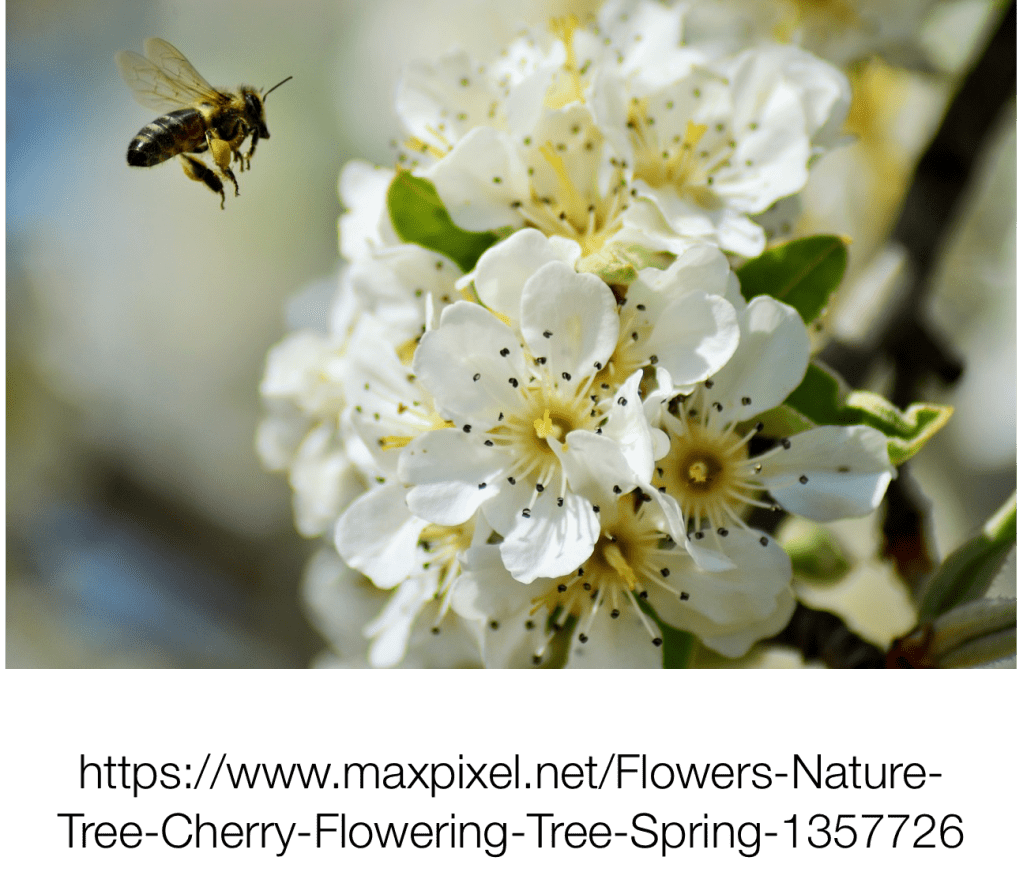
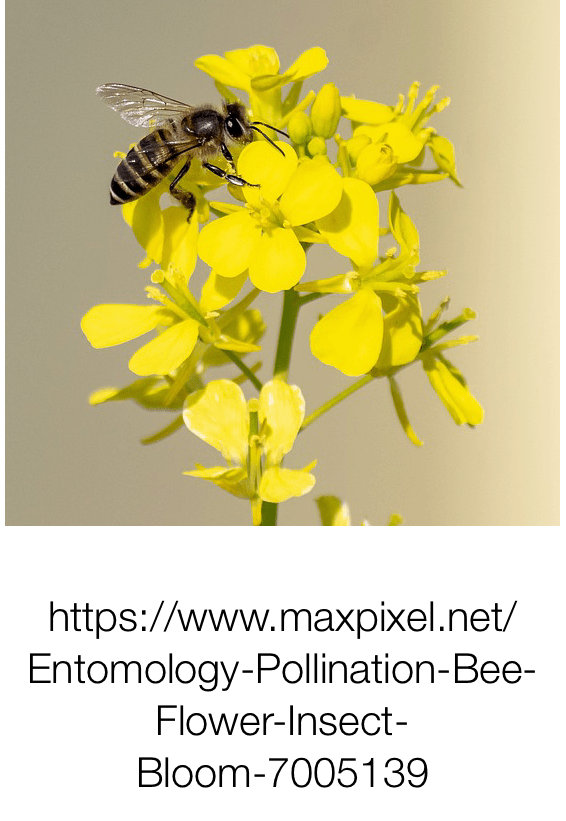
‘Counting on’ can have the meaning  interdependency. About a third of the foods that we enjoy only reach our plates because of the input of pollinators – bees and other insects and even bats. Without such pollinators our diets would be severely compromised. Imagine breakfast without coffee or fruit, treats without chocolate or nuts. Looking after pollinating insects is to look after our wellbeing too.

Lent Reflection trees -day 2

3rd March 2022


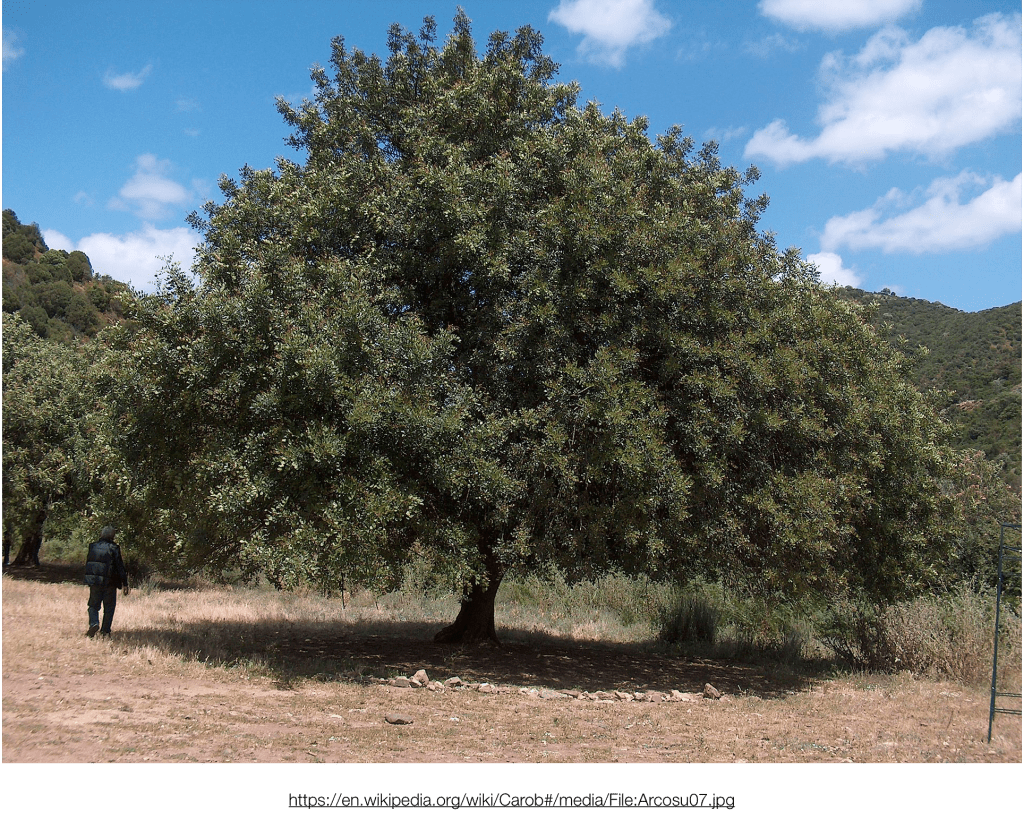
The Carib tree – ceratonia siliqua – or locust tree is an evergreen shrub growing up to 15m. It grows happily in Mediterranean climates and can survive periods of drought. Its fruit is an edible bean tasting like cocoa. There is a suggestion that it was these locust beans, and not insects, that were eaten by John the Baptist in the wilderness. The tree is sometimes referred to as St John’s bread.

In those days John the Baptist appeared in the wilderness of Judea, proclaiming, ‘Repent, for the kingdom of heaven has come near.’ Matthew 3:1-2

Wilderness is not a luxury but a necessity of the human spirit. Edward Paul Abbey, environmentalist (1927-1989)

Counting on …day 111

3rd March 2022 

Bees or sugar? Warmer winters, a result of climate change, encourages aphids to thrive. Aphids can spread yellow virus that can damage sugar beet crops. Where sugar beet is not grown organically (which would be the better option for our own health and that of the soil) farmers can choose to spray their crops with pesticides. This year British Sugar has again been granted  permission to spray sugar beet with Cruiser SB, a neonicotinoid that is known to be harmful to bees and which is banned in Europe. Is the loss of some of the sugar beet crop, sufficient reason to knowingly harm bees and other insects, as well as polluting rivers and damaging the soil? 

The better option would be to reintroduce organic production of sugar beet here in the UK, using methods such as ‘crop selection, crop rotation, fertility build, inter-cropping, establishing insect predator habitat’  https://cdn.friendsoftheearth.uk/sites/default/files/downloads/Sugar%20Beet%20briefing_FOE_Buglife_PAN_02.2018_0.pdf 

See also https://www.theguardian.com/environment/2022/jan/14/uk-charities-condemn-betrayal-of-allowing-bee-killing-pesticide-in-sugar-beet-crops

Lent Reflection

 Counting on ….day 110

2nd March 2022

Dust and ash – a reminder of our frailty, and a reminder of our connectedness with the whole of creation. We are part of a most amazing world, a world of intricate life cycles which we damage at our peril. We count on God, asking God to be the means by which we can transform our lives. 

Counting on …day 109 

1st March 2022

Today is Shrove Tuesday. Shrive comes from the Old English to write, and thence to assign or prescribe, and from that to confess. Today would be a good day to list all the things that we feel are out of kilter in our lives and in the lives of our society, with perhaps a particular focus on those relating to our care of creation. 

The Green Tau: preparing for Lent


1st March 2022

Lent is the forty day season of preparation for Easter; preparation for the new life that we share with Christ through his resurrection.

Lent is marked by Christians as a time of self examination, penitence, self denial and moderation, spiritual discipline (usually involving prayer and study/ reading) and alms giving. More generally it is seen as a time for giving up on a luxury we enjoy or giving up on a vice which has become an unwanted habit. The climate crisis has prompted some to use Lent as a season for fasting from carbon. 

Lent begins with Jesus in the wilderness, where with nothing to eat, he is totally reliant on his relationship with God. We might also think of other wilderness. The wilderness that lay outside the Garden of Eden, where Adam and Eve faced the challenge of tending and filling the earth so that it might bloom and flourish as it had in the garden planted by God. The wilderness between Egypt (where the prevailing system had been one of slavery and oppression) and the Promised Land. Here too the exiles had to learn to trust and learn from God how they should live, how they should adapt to a new environment. 

Lent can therefore be the time when we should  focus on how we tend and care for the environment, on how we pay attention  and respond to God’s will, so that we can flourish in harmony with God’s gift of creation.  

Jesus’s time in the wilderness occurs straight after he has been baptised by John in the Jordan. John too had chosen to locate himself in the wilderness, knowing its  symbolic status as a place of encounter with God and a place of repentance. John called on the people to own up to their sins, to change the way they lived, to transform their lifestyles, and to prepare the ground for the new era – the new creation – that the Messiah was bringing. John’s challenge was tough: the rich were to share their wealth, officials were not to cheat, and soldiers were not to abuse their power. Every tree that did not bear good fruit would be chopped down and burnt!

Should we too see Lent as the time to call truth to power? To point to both what is wrong in the way we live  and to what the dire consequences will be? Is it time to stand up in the wilderness calling on everyone to prepare for a new way of life, a new beginning, a fresh start? John and Jesus were charismatic activists. They spoke out, they told stories, they acted out their message. They spoke the truth. They healed and consoled people. And they showed people the right way.  

This Lent we need to be up front and open in talking about the climate crisis. We need to talk about it with our friends and neighbours. We need to both console and inspire. We need to show in our daily lives how we can live differently. We need to repeatedly demand change from those in power, MPs and local councillors, business leaders and investors, local businesses, manufacturers and retailers. We need to be vocal in our churches and in the streets (a poster in your window or on your gatepost). Now is the time to repent and change if we are to avert great disaster and instead to welcome in a new age of hope.

Jesus answered, ‘The first is, “Hear, O Israel: the Lord our God, the Lord is one; you shall love the Lord your God with all your heart, and with all your soul, and with all your mind, and with all your strength.”  The second is this, “You shall love your neighbour as yourself.” There is no other commandment greater than these.’ Mark 12:29-31

Keep these words that I am commanding you today in your heart.  Recite them to your children and talk about them when you are at home and when you are away, when you lie down and when you rise. Bind them as a sign on your hand, fix them as an emblem on your forehead, and write them on the doorposts of your house and on your gates. Deuteronomy 6:6-9

At core the message is simple: Love God, love your neighbour. Learn these words, teach them to your children, talk about them, repeat them at home and abroad, know them you sleep and when you rise, imprint them on your heart, display them on your gate post and door post, wear them on your sleeve.