Counting on … day 117

25th July 2025

Today I’d like to share the Joy in Enough confession as a good starting point for thinking about how we live sustainably within the Earth’s limits.

“Your earth is exploited, and we are complicit in its exploitation. Species are lost, soil erodes, fish stocks decline, resources dwindle. We confess that many of us have taken too much, and not considered the needs of future generations.” 

For the full confession see https://joyinenough.org/2019/01/29/the-joy-in-enough-confession/

Counting on … day 116

24th July 2025

Today is Earth overshoot day – the day in the calendar when the world’s population has consumed one whole year’s worth of the Earth’s renewable resources and services (eg soil fertility for crops, clean water, fish stocks, the delicate balance of gases in the atmosphere, etc).

Our current patterns of consumption are unsustainable – they are also inequitable for whilst countries like the UK have vastly consumed more than is sustainable, part of our consumption has been at the expense of poorer nations who do not even get the chance to consume their fair share of the Earth’s resources and services, 

From here on we are eating into wellbeing of future generations. 

Greentau: issue 111

Earth Overshoot Day 

24th July 2025

Leviticus 25 explains that the land should have a sabbath rest every seventh year. In that year no crops would be sown and the people would live off the surplus of previous years. Farmers over the millennia have learnt that you cannot constantly expect the land to keep on producing crops year on year without fail. The land either needs to lay fallow (rest), or it needs to be sown with a restorative crop such as nitrogen fixing beans or clover, or it needs the input of artificial fertilisers (although we are now becoming aware that relying on artificial fertilisers may be a quick fix and not a long term solution), so that it may recuperate its productivity. It is a lesson we are sometimes reluctant to heed. The Dust Bowl disaster of 1930s in the USA destroyed vast acres of farm land because farming practices did not maintain the fertility of the soil. 

It is not just soil that has to be maintained. Water systems too. If we drain more water out than is replenished by precipitation or the melting of glaciers (themselves replenished by winter snow) water supplies will diminish. The Aral Sea – an inland lake – was once the fourth largest area of fresh water in the world,  but has now been reduced to nothing because more water has been extracted year on year – to irrigate local cotton crops – than the rate at which water flows were refilling the lake.

It’s hard to imagine, but we also need to maintain the atmosphere. The Earth’s atmosphere is a delicate mix of various gases, which in the right proportions maintain our climate at one with which we are comfortable. If we put too much of certain gases into the atmosphere it can upset that balance. Too much carbon dioxide, methane and other greenhouse gases, and the atmosphere traps more of heat within the Earth’s atmospheric envelope; global temperatures rise and the climate becomes more extreme and uncomfortable. We are experiencing this every year with floods, heat waves, wildfires and intense storms.

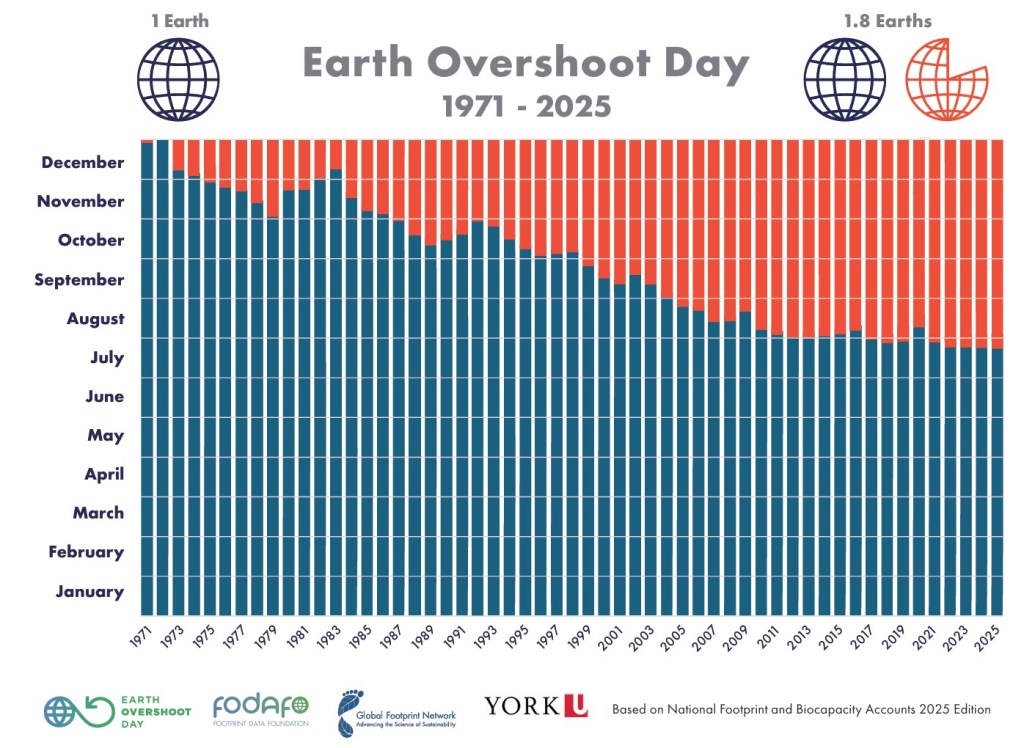
Ideally what we consume from the natural world – crops, timber, drinking water, clean air, energy – is balanced by the earth’s ability to regenerate. Prior to 1970 that was the case. Since then we have been using up the earth’s renewable resources at a rate faster than they are replenished. Scientists each year calculate that point  when we pass from credit to deficit. This is called Earth Overshoot Day. This year the predicted date is 24th July. Seven months into the year and we have already – globally – consumed as much as the earth can replenish in one year! 

Surely this state of affairs can not continue? What can we do about it and why aren’t we doing it? 

Since 1970, Earth Overshoot Day has been falling earlier and earlier each year. Only in 2020 did it reverse: the reduction in world wide consumption came about because Covid gave the earth a three week reprieve. Consuming less has to be the answer which means consuming more carefully and more sustainably. 

If we could do that in 2020 whilst coping with a pandemic, surely we could do it every year? What we must do is make sure that it is not the poor – who already lack a sufficiency – who are the ones who get to consume less; rather it must be the richer over consumers who need to change their lifestyles. And here is another caveat, to live more sustainably and fairly, will need a fundamental change in economic and political systems.

The Earth Overshoot website has details of various ways in which the global community could do this. https://www.overshootday.org/ Meantime we as individuals can make changes to our own lives  and  patterns of consumption. And we can ask or push for our churches, places of work, sports clubs, local authorities, museums, retailers, and government, to make similar reductions in consumption. We need change to happen at all levels.  

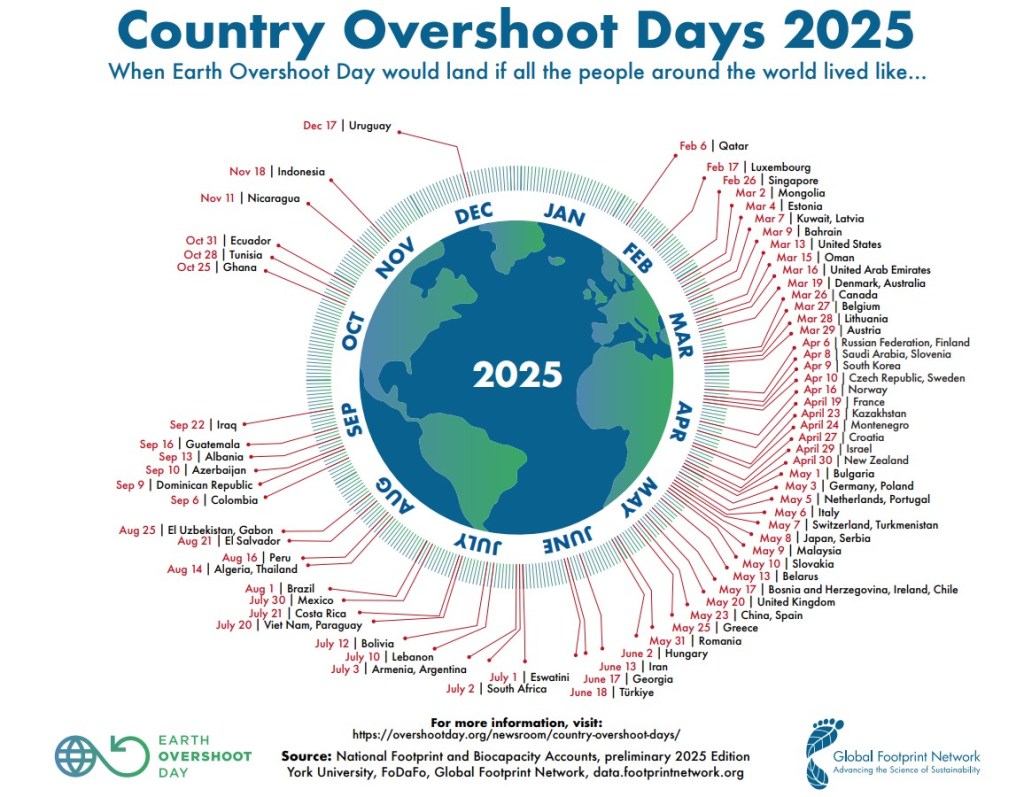
24th July is 2025’s Earth Overshoot Day at the global level. That date is the average  of each nation’s own Overshoot Day. The overshoot dates for individual nations in the diagram below range from  17th December for Uruguay (ie Uruguay pretty much balances its books,  consuming only slightly more than it can regenerate in a year) to 6th February for Qatar. What this diagram does not show are the many poorer nations who do not even use up their equivalent of one year’s resources each year – The UK’s Overshoot Day  was 20th May. We would need three United Kingdom’s to satisfy our current consumption levels; in reality we consume resources of other countries to make up the shortfall. Reducing the Earth Overshoot problem requires cooperation and understanding at a global as a well as at local levels. The Earth is a shared life-support system.

Counting on … day 115

23rd July 2025

Joy in Enough is the name of one of the Green Christian groups, and it strikes me  as a beautiful description of how it would be to live well. And so how to live in a world where waste is valued.

Their aim is to seek out, develop and pursue a new form of economics that would ensure joy in enough for all.

‘…the purpose is clear. We want to build a society where there is delight in enough, taking from the earth only enough to meet our needs rather than satisfying our greed. We want to allow time for earth’s resources to be replenished, safeguarding them for future generations. We joyfully seek a just and ecologically sustaining economy where there is enough for everyone, locally and globally.’ (1) 

  1. https://joyinenough.org/resources/awakening-to-a-new-economics/

Counting on … day 114

22nd July 2025

During a vigil holding up the plight of the Palestinian people in the absence of any concern during the debates at this month’s Church of England synod, someone spoke of ‘wasting love’. This I take to mean being so generous with love that it is poured out liberally, abundantly, with careless abandon, with no regard as to whether it is either earned by the recipient or likely to repaid. In other words to be as generous as God who daily wastes love on us.

In the parable of the sower and the seed, the behaviour of the sower might be seen as wasteful but maybe it is actually generous, casting the seed everywhere because the sower doesn’t prejudge where it will take root. 

Counting on … day 113

21st July 2025

Prayer was once described to me as ‘wasting time with God’. It is an activity that doesn’t have to achieve a particular outcome, or be marked according to words spoken or topics covered. It can simply be time spent in one another’s company.

Perversely while there may be not clear purpose or outcome, such prayer calms our anxiety and strengthens our relationship with God.

This thought relates well to yesterday’s Gospel, when Jesus honours the value of what Mary does by sitting at his feet, whilst Martha allows herself to be overwhelmed by domestic tasks – Martha doesn’t appreciate the value of wasting time with God. (Luke 10: 38-42)

Proper 11, 5th Sunday after Trinity

20th July 2025

Reflection with readings below

In today’s reading from the prophet Amos, we hear of God’s warning to the people of the consequences of pursuing profit whilst ignoring God’s ways: vis suffering and calamity 

Do not the same threats hang over our world, over our economic and social systems today? 

Here in the UK, we  do “trample on the poor” – think of the two child benefit cap, the reduction of benefits for the disabled, the practices that favour landlords over tenants such that rents become unaffordable, those tax breaks that benefit the rich but not the poor, the low wages that benefit the employer not the employee, those subsides that benefit fossil fuels companies not energy consumers etc. And more widely we bring ruin to the poor with international policies that place heavy debt burdens on poor nations from which we benefit, with policies that do not meet the needs of those countries suffering the impact of climate change which we have caused at their expense, with trade policies that are stacked against the smaller nations and smaller companies. Truly the rich and powerful in our world use “false balances” – ie weighing scales – that favour us and not the poor.  

(NB an Ephah is a measure of weight, shekel a unit of currency).

It is not just people but the environment that we wilfully damage and we are already seeing the initial consequences of this with heatwaves and droughts, flash floods and wild fires. The Earth is a delicate ecosystem – a life support system – which is being damaged by our greed and misuse. July 24th will be 2025’s Earth Overshoot Day (last year it was 1st August). That is the day when globally we will have used up a year’s supply of the Earth’s resources. Our extraction of water will exceed the rate of renewal. Our use of the atmosphere to absorb carbon dioxide will exceed capacity (without causing further global temperature rises). Our use of the soil’s capacity to produce food will exceed the rate at which its fertility can be maintained – leading to reduced crops yields in the future. Etc etc. Do check out the Earth Overshoot website to understand more about this situation. Here in the UK, we had used up our share of the Earth’s resources by 20th May, so already our lifestyle choices are being made at the expense of poorer people across the world and future generations. 

The Earth Overshoot website has one section entitled solutions. Here it says “While our planet is finite, human possibilities are not. The transformation to a sustainable, carbon-neutral world will succeed if we apply humanity’s greatest strengths: foresight, innovation, and care for each other.” (1) Here is the invitation to live differently – and for those of us who are Christians, that surely means living according to God’s commands, living according to the values of God’s kingdom. The phrase ‘care for each other’ sharply echoes last week’s gospel story of the Good Samaritan. 

Today’s Gospel reminds us of the importance of spending time and attention on Jesus’s teachings. We can rush around being busy, thinking that being busy will solve the world’s problems, but unless we are     following Jesus – doing God’s will – our efforts may prove fruitless. We also run the risk of burnout. Burnout diminishes our ability to love our neighbours. Jesus set us the example in his own daily life of taking time out to be be in nature, to spend time with God, to be refocus and re-energised. In today’s gospel that is Jesus’s advice for Martha – and it is good advise for us too.

Maybe the extract from the Letter to the Colossians should be a reminder to us that we are not solely responsible for saving the world (a deceit I can be guilty of). Rather it is in and through Christ that salvation is being effected. Our contribution will only ever be but a small part within the the greater whole which is the body of Christ – a fellowship that is empowered by the Holy Spirit. It will be together  in Christ that we will see the salvation of life in Earth being as it is in Heaven.  

  1. https://overshoot.footprintnetwork.org/solutions/

Amos 8:1-12

This is what the Lord God showed me– a basket of summer fruit. He said, “Amos, what do you see?” And I said, “A basket of summer fruit.” Then the Lord said to me,

“The end has come upon my people Israel;
I will never again pass them by. 

The songs of the temple shall become wailings in that day,”
says the Lord God; 

“the dead bodies shall be many,
cast out in every place. Be silent!” 

Hear this, you that trample on the needy,
and bring to ruin the poor of the land, 

saying, “When will the new moon be over
so that we may sell grain; 

and the sabbath,
so that we may offer wheat for sale? 

We will make the ephah small and the shekel great,
and practice deceit with false balances, 

buying the poor for silver
and the needy for a pair of sandals,
and selling the sweepings of the wheat.” 

The Lord has sworn by the pride of Jacob:

Surely I will never forget any of their deeds.

Shall not the land tremble on this account,
and everyone mourn who lives in it, 

and all of it rise like the Nile,
and be tossed about and sink again, like the Nile of Egypt? 

On that day, says the Lord God,
I will make the sun go down at noon,
and darken the earth in broad daylight. 

I will turn your feasts into mourning,
and all your songs into lamentation; 

I will bring sackcloth on all loins,
and baldness on every head; 

I will make it like the mourning for an only son,
and the end of it like a bitter day. 

The time is surely coming, says the Lord God,
when I will send a famine on the land; 

not a famine of bread, or a thirst for water,
but of hearing the words of the Lord. 

They shall wander from sea to sea,
and from north to east; 

they shall run to and fro, seeking the word of the Lord,
but they shall not find it.

Psalm 52

1 You tyrant, why do you boast of wickedness *
against the godly all day long?

2 You plot ruin;
your tongue is like a sharpened razor, *
O worker of deception.

3 You love evil more than good *
and lying more than speaking the truth.

4 You love all words that hurt, *
O you deceitful tongue.

5 Oh, that God would demolish you utterly, *
topple you, and snatch you from your dwelling,
and root you out of the land of the living!

6 The righteous shall see and tremble, *
and they shall laugh at him, saying,

7 “This is the one who did not take God for a refuge, *
but trusted in great wealth
and relied upon wickedness.”

8 But I am like a green olive tree in the house of God; *
I trust in the mercy of God for ever and ever.

9 I will give you thanks for what you have done *
and declare the goodness of your Name in the presence of the godly.

Colossians 1:15-28

Christ Jesus is the image of the invisible God, the firstborn of all creation; for in him all things in heaven and on earth were created, things visible and invisible, whether thrones or dominions or rulers or powers– all things have been created through him and for him. He himself is before all things, and in him all things hold together. He is the head of the body, the church; he is the beginning, the firstborn from the dead, so that he might come to have first place in everything. For in him all the fullness of God was pleased to dwell, and through him God was pleased to reconcile to himself all things, whether on earth or in heaven, by making peace through the blood of his cross.

And you who were once estranged and hostile in mind, doing evil deeds, he has now reconciled in his fleshly body through death, so as to present you holy and blameless and irreproachable before him– provided that you continue securely established and steadfast in the faith, without shifting from the hope promised by the gospel that you heard, which has been proclaimed to every creature under heaven. I, Paul, became a servant of this gospel.

I am now rejoicing in my sufferings for your sake, and in my flesh I am completing what is lacking in Christ’s afflictions for the sake of his body, that is, the church. I became its servant according to God’s commission that was given to me for you, to make the word of God fully known, the mystery that has been hidden throughout the ages and generations but has now been revealed to his saints. To them God chose to make known how great among the Gentiles are the riches of the glory of this mystery, which is Christ in you, the hope of glory. It is he whom we proclaim, warning everyone and teaching everyone in all wisdom, so that we may present everyone mature in Christ.

Luke 10:38-42

As Jesus and his disciples went on their way, Jesus entered a certain village, where a woman named Martha welcomed him into her home. She had a sister named Mary, who sat at the Lord’s feet and listened to what he was saying. But Martha was distracted by her many tasks; so she came to him and asked, “Lord, do you not care that my sister has left me to do all the work by myself? Tell her then to help me.” But the Lord answered her, “Martha, Martha, you are worried and distracted by many things; there is need of only one thing. Mary has chosen the better part, which will not be taken away from her.”

Magnificat reimagined 

19th July 2025

Trust in the Lord and be doing good; dwell in the land and be nourished with truth.
 Let your delight be in the Lord and he will give you your heart’s desire.
Psalm 37:3-4

You Lord are the bread of life;

feed us with your wisdom.

Our nourishment is to do God’s will;

guide us in all we do

Whenever we eat or drink

Let it be to the glory of the kingdom of God.

A reading from Matthew 25: 34-36 (The Message)

“Then the King will say to those on his right, ‘Enter, you who are blessed by my Father! Take what’s coming to you in this kingdom. It’s been ready for you since the world’s foundation. And here’s why:

I was hungry and you fed me,
I was thirsty and you gave me a drink,
I was homeless and you gave me a room,
I was shivering and you gave me clothes,
I was sick and you stopped to visit,
I was in prison and you came to me.’” 


A canticle reimagining the Magnificat:
My soul proclaims the greatness of the Lord,
my spirit rejoices in God my Saviour;
he has looked with favour on his lowly servant.

Praise to you O God, for the rich creation of this world 

for which you have created humans to be under-gardeners.

From this day all generations will call me blessed;
the Almighty has done great things for me
and holy is his name.

You have blessed Earth with fruit bearing trees and plants, 

ensuring food throughout the seasons.

God has mercy on those who fear him,
from generation to generation.

Your wisdom guides those who, in each generation, 

have the honesty and humility  to seek it.

God  has shown strength with her arm
and has scattered the proud in their conceit,

May  each generation see the damage 

they cause when they  disdain your will. 

Casting down the mighty from their thrones
and lifting up the lowly.

Raise the spirits of those who work at the grassroots, 

give them strength to overcome the deceits of big business.

God  has filled the hungry with good things
and sent the rich away empty.

Bless the work of food banks and charities that feed the hunger, 

and teach those with wealth to be sacrificial in their giving.

God came to the aid of his servant Jacob
to remember his promise of mercy,

Help nations and communities to work together

for justice and for peace. 

God’s promise is made to our ancestors,
from Abraham and his children and for all generations to come.

May every generation to come, reap the harvest,

not of our greed, but of God’s grace .

Amen.

Trust in the Lord and be doing good; dwell in the land and be nourished with truth.
 Let your delight be in the Lord and he will give you your heart’s desire.
Psalm 37:3-4

Counting on … day 112

18th July 2025

Is wasting time a waste of time? Not so according to the poet W H Davies:

What is this life if, full of care,

We have no time to stand and stare.

No time to stand beneath the boughs

And stare as long as sheep or cows.

No time to see, when woods we pass,

Where squirrels hide their nuts in grass.

No time to see, in broad daylight,

Streams full of stars, like skies at night.

No time to turn at Beauty’s glance,

And watch her feet, how they can dance.

No time to wait till her mouth can

Enrich that smile her eyes began.

A poor life this if, full of care,

We have no time to stand and stare.

It can be all to easy to be drawn into thinking that unless we are working flat out, or filling our days with ‘useful’ activities, we are not living life to the full. This feels like a 21st century problem or maybe it’s a problem of the western world. Having spare time, time that we can ‘waste’ do anything we want or nothing of any importance, is highly rewarding, good for our wellbeing and good for our communities. It can be those spare time moments when we can notice the world around us, chat to a neighbour or  shop assistant or passer-by, take time to think, read a notice, pick up a piece of litter, watch a bee, enjoy the warmth of the sun or the cool of a tree, that make us who we are, give us a sense of our true identity. They are also moments that can strengthen the glue that makes a community a community. They are also those moments that bring us joy.

Counting on … day 110

17th July 2025

Over the centuries the British landscape has changed and changed again as farming practices have changed. In recent decades one of the big changes has been the removal of hedgerows to create ever larger fields and the use of ever larger (and heavier) farm vehicles. The Woodlands Trust reports that ‘118,000 miles of hedgerows have disappeared since 1950.’ (1)  The hedge was seen as a waste of space. Yet that linear strip of land can serve as a valuable green corridor for wild life and a unique ecosystem supporting a rich biodiversity of plants, animals, birds and insects. Thankfully about 500, 000 miles of hedgerow remain in place but that resource still needs care and protection. 

Farm land shouldn’t be seen as solely a place to grow food but as land that provides clean air, fertile soils, pollinators, relief for mental wellbeing, water stewardship, and life-giving biodiversity. Farming needs to include both the production of food and  the maintenance of healthy ecosystems, with space for nature to thrive. 

Hedgerows are not a waste of space; rather their absence is a waste of ecological benefit. 

  1. https://www.woodlandtrust.org.uk/trees-woods-and-wildlife/habitats/hedgerows/

More information