day 10 No Faith in Fossil Fuels’ Vigil

23rd February 2024

The day was crisp and dry as I walked over Westminster Bridge. Even at 6.30 it was already light. The night shift looked warm and cheerful – Ben has the technique of keeping in warm inside the depths of a sleeping bag down to a fine art!

It looks like it will be a beautiful day. The sky is turning blue and the sun is gilding the pale stone of the  buildings opposite. Today Brethren Seagull are less focused on feeding and rather more on gliding effortlessly on their perfectly arched wings. Perhaps they too are relish the sunlight. 

Maybe it’s the lack of rain but there are more birds around. Several crows fly past, black fingered wings against the blue sky. Then my eye is caught by flashes of white and three magpies swoop round and settle themselves – diplomatically – on top of the Foreign Office. 

The pigeons too are favouring the dry weather. One with a very distinctive white ruff I have definitely seen earlier in the week. They peck at microscopic crumbs with which the pavement is apparently littered. 

Today is a day for praising God for the beauty of creation.

As the morning passes so the growing patch of sunlight progresses across the Square. St Margaret’s church has a sundial on one side and a clock on another, yet bizarrely the sundial seems to be half an hour slow!

Today I feel like a tourist – or maybe a flaneur – someone with time to spend just watching. I’m enjoying  watching the different people walk past. Those going to work, students, holiday makers, police officers and runners: these make up the normal stock in trade. But then there are others – delightful dogs and those walking dogs, runners of different speeds, and – today -lots of Scout leaders! They come thick and fast, with different coloured scarves neatly rolled and fastened round their necks, as well as different coloured lanyards. Often they are wearing a collection of lanyards  – much as soldier might wear campaign medals. Some have come from north of the Border and proudly swing past in their kilts. I think there is a service for them in Westminster Abbey. 

Maybe it’s the sunshine or maybe because we have been here for so many days, but several staff members and police offices give us  a cheery ‘Good Morning’ as they go in or out of the Parliamentary gates. 

Today is a day for praising God for the kindness of human.

8pm and I’m back for a final hour. For the first time during the vigil the train is late – about 5 minutes . The Square is in evening mode. Cars chase round the circuit, effortlessly outnumbering buses and taxies. People are walking past in two or threes,  chatting and laughing. No longer are they head down forging  past on their way to work. 

I’m only there for an hour but overlap with four others. The comradeship of the vigil has been special. People have come from far and wide – Bristol and Cheltenham, Liverpool and Sheffield, Scotland and all points of  London – and from different groups: Christian Aid and Cafod, Green Christian and Laudate Si, from Just Money and Tearfund, from local churches and of course from CCA.

Today is a day for praising God for friends.

Counting on … day 52

23rd February 2024

Keeping the temperature rise – global warming – within 1.5C necessitates constraining the carbon dioxide (and other greenhouse gas) emissions we release into the atmosphere. The diagram below shows the correlation between global temperatures and carbon dioxide concentrations in the atmosphere. 

Keeping global warming within this window involves both reducing the amount of greenhouse gases we emit and enhancing processes that absorb such gas emissions. An example of the first would be reducing – or even cutting out entirely – the burning of fossil fuels; an example of the second would be reinstating woodlands and wetlands. 

Day nine No Faith in Fossil Fuels’ vigil

22nd February 2024

I managed a 6.30 start this morning as others from the night shift were leaving early. As I crossed Westminster Bridge it was spotting with rain. Prayer stool out – the pavement was still dry. Poncho on creating a little tent – my warm dry space.

Today I am tired. Prayer doesn’t come easily. What more can I say to God that I have not already said?

It feels like the same flow of people passing along the pavement. I even recognise some as ones I have seen several times already this week. Maybe they recognise me – or if not me, then the presence of a small group gathered on the edge of the pavement. Certainly the police think this, and several wish us a ‘Good morning’ as they pass. 

My friends the gulls are busy feeding, but no geese today. 

Faint trails of prayer: all who pass by are God’s children – children of our heavenly parent. 

Pupils from Westminster School drift by sporting  a variety of sports gear and musical instruments. Do their lessons include climate change? Do they learn about the right to protest? Might they become members of parliament or civil servants in due course?

God’s kingdom come, God’s will be done. What would this world look like if that were the case? A place of equality, where all have enough food to eat, homes to live, medical aid according to need?

Could those in the building behind us bring in such a world? Is it a world that people would want? Is it a world that faith groups could further?

The rain comes and goes. The flow of people waxes and wanes. I struggle to focus. Up above the sky and the clouds shift and change in colour and intensity. 

Time passes. At last Big Ben strikes eleven.

Counting on … day 51

22nd February 2024

Tipping points – “In climate science, a tipping point is a critical threshold that, when crossed, leads to large, accelerating and often irreversible changes in the climate system.” https://en.wikipedia.org/wiki/Tipping_points_in_the_climate_system

Likely tipping points if we reach 1.5c of warming include the loss of boreal permafrost in the artic regions. This would result in the release of large amounts of methane rapidly increasing the rate of global warming.
Another potential tipping point would be the die-out of mangroves and seagrass meadows in the tropics, reducing how much carbon dioxide is absorbed by the oceans and so fuelling further global warming.

Tipping points accelerate global warming.  

Further reading – https://www.theguardian.com/environment/2023/dec/06/earth-on-verge-of-five-catastrophic-tipping-points-scientists-warn?CMP=Share_iOSApp_Other

Day Eight of the No Faith in Fossil Fuels’ Vigil

21st February 2024

Another wet morning as I walk across Westminster Bridge. The night shift report that it has only been raining a few hours and that they are all relatively dry. Vanessa and I settle into their seats, draping our ponchos strategically to keep as much dry as possible.

Rain isn’t all bad – Brethren Seagulls are again enjoying a delicious breakfast as they peck their way across the grass. 

I stay an hour before moving on to Shell where it’s just as wet! This is my regular Wednesday slot and I receive encouraging greetings and acknowledgements. The ‘F*ck Shell’ from a cyclist is emphatic.

Back to Parliament and where before there were just two vigilers, now there is half a dozen. Likewise the footfall has increased. As tourists gather around the statues in Parliament Square, their umbrellas form an undulating sea of colour.

School children and students on the other hand are less concerned about the rain and walk passed bareheaded. They are seem bemused by our presence. The words from a World War I poem go through my mind: ‘For your tomorrow we gave our today.’ What can we give or do now to ensure a liveable future for this next generation? Our efforts sometimes seem so futile in face of what is coming. On the other side of London, my daughter is on trial with 4 other women for breaking the glass of the offices of JPMorgan Chase in an attempt to give the bank a wake up call about the urgent and catastrophic nature of the climate crisis. 

But we are faced not just by a climate crisis: we have a biodiversity crisis, an ecological crisis, and a  justice crisis. We need to change the way we live as humans. We cannot go on as greedy beings (mainly those of us in the global north) consuming resources at an annual rate that needs one and three quarter worlds to be sustainable. 

We need to change our aspirations and priorities. We need to work together, to collaborate. Does the answer lie with the world faiths? Is this where we should find the teachings and the impetus to create a different and better way of living together as human beings? 

Heavenly Parent, may your kingdom come, your will be done.

The rain is not a disincentive. Our numbers continue to swell and soon there are maybe two dozen people plus two beautifully behaved dogs. It is no just tourists and school parties walking by. There are more and more activists – maybe first time activists – with kefir scarves or Palestinian flag and badges, heading for the Cromwell entrance. They are going to Green Card their MPs and use this democratic right to impress upon Parliament the urgent and pressing need for a ceasefire in Gaza. Here is an overwhelming crisis of justice. 

Does it matter which bank we bank with?

21st February 2024

Banks are key players in ensuring the flow of finance through global and national economies. As such they can influence which industries and companies receive funds and grow, and which do not. One of the greatest threats to life is the climate crisis which is primarily driven by emissions from fossil fuels. The International Energy Agency (IEA) has already told us that if we are to keep emissions and hence global warming at a tolerably safe level, we should not open up any new oil and gas projects. Yet this is precisely what the fossil fuel industry is doing, with funding secured by a – still – large number of banks. 

Make My Money Matter has long been urging us to direct our money so that it supports action to tackle the climate crisis, rather than allowing it to fill the coffers of those who perpetuate the problem. 

“The fossil fuel industry cannot exist without banks, yet our high street banks are continuing to pump money into them. So our message is simple – don’t bank on fossil fuel expansion. Banks must act and you can drive that change. ” https://makemymoneymatter.co.uk/

Another such platform advocating and enabling change is Switch it Green.

“Together, we will move £7 billion out of fossil fuel support this year; pressuring banks to phase out their climate-harming investments.

“We are harnessing the power of switching en masse. By switching alongside thousands of others – and maximising your switch with our ready-to-go lobbying features – your individual action is transformed into a collective call for change.” https://www.switchit.green/why-switch-it/article/how-do-banks-contribute-to-climate-change

And coming from a specifically Christian focus there is Just Money which provides information  and leads  campaigns on issues of money and justice.

“The money that we put into a bank helps it to do its work. A growing movement of Christians want to bank more ethically and campaign for a fairer, greener banking sector…Some banks are good news for people and planet. As Christians we can champion these, and support ethical alternatives, like credit unions.” https://justmoney.org.uk/

This Lent Just Money has a special campaign encouraging us all to switch to a green bank – https://justmoney.org.uk/the-big-bank-switch/

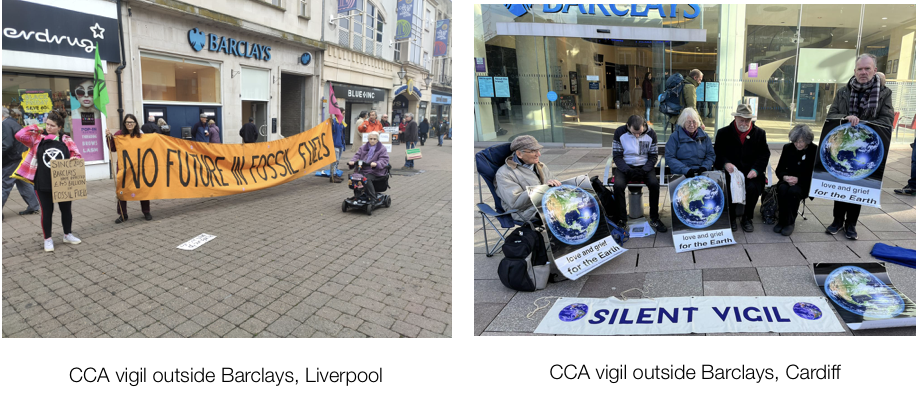
I am involved with Christian Climate Action and their campaign to highlight the harmful practices of Barclays Bank – the largest European funder of the fossil fuel industry (2016-2022) – and to encourage both individuals but also organisations and charities to switch to greener, more ethical banks. 

Actions taken by CCA include regular vigils held outside local branches of Barclays. This is done by local CCA groups often in conjunction with other groups concerned about justice and the environment. See CCA’s event page for more details – https://christianclimateaction.org/events/

  CCA has also written to and met with organisations – such as Christian Aid, Oxfam  and The National Trust – and have held prayerful vigils outside their headquarters. 

See also – https://www.churchtimes.co.uk/articles/2024/2-february/news/uk/more-charities-sever-ties-with-barclays-over-stance-on-fossil-fuels

CCA is also liaising with those Church of England dioceses that bank with Barclays, and recently organised a workshop for diocese to share and explore how they can switch to a better bank. (For more information about CCA’s campaign with dioceses – https://christianclimateaction.org/2023/11/14/urging-church-to-drop-barclays/

Success is being achieved. Christian Aid, Greenbelt, Sheffield Cathedral and Oxfam have all  undertaken to switch away from Barclays. 

Counting on … day 50

21st February 2024

1.5C is the level of warming within which we should be trying to stay if we are to avoid an unbearably worse deterioration of the global climate. This figure is the product of over 6,000 scientific references, and was prepared by 91 authors from 40 countries. https://en.wikipedia.org/wiki/Special_Report_on_Global_Warming_of_1.5_°C

This is not to say that even with global warming at 1.5C there won’t be adverse effects. The extreme hot summer temperatures, floods, wild fires, droughts, and storms that we have experienced over the last few years will now be the norm. Glaciers, sea ice and ice caps will continue to melt and disappear, causing rivers to dry up in the summer, and elsewhere raising sea levels. The change in climate is already altering natural habitats reducing numbers of plants, birds, animals, insects etc, and having similar adverse effects on agriculture. Food and water security are already being threatened. Warming oceans is reducing marine life. All this will increase as temperatures rise.

Each fraction of a degree of further global warming  will accentuate these problems for all life forms. The charts show  how much greater would be the effects of 2C warming over 1.5C. 


Day six of the No Faith in Fossil Fuels’ Vigil

19th February 2024

As I walk over Westminster Bridge just before seven, I see twelve cormorants swoop and swerve and land in the buoyant waters of the Thames.  

I’ve come to relieve the night shift who all looked amazingly bright and alert! Maybe being outside for the occasional night is good for us – a bit like the tradition of putting babies outside to sleep in their prams. 

Monday morning and these are the going to work hours. The flow of pedestrians (from right to left) comes in rushes as, presumably, the pedestrian crossing upstream turns green. So many people pass by. A few do give a nod or a smile but hundreds don’t. Do they notice us? Or are we blanked out along with so much else that we ignore in order to manage our hectic pace of life? But I notice two passers-by whom I had seen earlier in the week – one who slated us about the futility of prayer; the other who had prayed with us. So maybe it is distraction not disinterest.

From across the street a man shouts an inaudible greeting that could be positive or negative. He weaves his way through the traffic and lands in front of us.

‘Do we want a cigarette? No? Well can he sit down – he’s tired.’

There’s an empty chair so we say yes. He half talks to us and half talks to passers-by shouting out greetings with a ribald feel. 

We’re praying we explain. We’re not ignoring him but praying is what we’re doing here. 

After a few more minutes he lurches to his feet, leaves and then swings back to give us a final piece of advice. 

We continue to pray. Across the Square the trees stand clear and upright but less shiny than they were in the rain.

A smart business man, briefcase in hand, pauses to read the sign. He’s the business side of what we’re doing. Money is the solution to the climate crisis. His company redirects the massive sums of finance needed to boost renewable energy. He advises other companies, knows the people one needs to know. He’s on first name terms with the head of the Church of  England’s investment board. 

I venture that CCA has been active in encouraging charities and dioceses to switch from Barclays. ‘Why ever so? They have just announced they will not be funding new oil and gas.’

‘Is it that clear cut? They’re still providing a lot of funds for the oil and gas industries.’

‘XR don’t understand. We need oil and gas to keep people supplied with cheap energy in the interim. We can’t just stop investing in oil and gas – you need to invest to continue to the extraction from developing wells. Here, take my business card.’

Earlier the bells at Westminster Abbey chimed in anticipation of the 8 o’ clock prayers. Now they sound for the 10 o’ clock prayers. After I have gone, they will ring again for the noonday service. There are, I think, more services on a week day than a Sunday.

I welcome Michelle who is taking the next hour, gather myself up and walk back over Westminster Bridge now heaving with tourists. 

8.00pm for the evening shift. The departing crew are numerous including four from one church -I’m impressed: I’m the only one from my church and I’m a given. 

I settle into place tucking my feet under my prayer stool and my hands into my gloves. The banner and thus our place of gathering has shifted. Now I’m facing a tall lamppost. At the top is a round bright line that suggests the moon brightly glowing. But I look up into the clear sky above and there is the genuine thing – serene and surreal, nothing can match her beauty!

 On the banner before me are two nightlights their flames gently flickering in jam jars. I’m alone for the first hour – they keep me company, whilst across the Square my other faithful companions remain resolute in their isolation. 

Your kingdom come – what were Mandela and Gandhi and Fawcett trying to establish? The right of self determination for the poor and marginalised. For their freedom to live as equally and as comfortably as those with power. For justice.

Evening is the hour of the car. No construction vehicles and work trucks now. Instead fast and expensive cars glide effortlessly around the Square, their sleek outlines contrasting with the workaday shapes of the double decker bus and the London cabs. 

We have created a kingdom where the car rules supreme – the pinnacle of a achievement. A luxury self contained  capsule where in quiet and ease we can travel oblivious to the troubled lives of others. 

Hot of foot Daniel joins me. He is soon drawn down into the other world of the vigil. Here in the edge of the Square we’re not part of the stream of human life that trickles  and flows through the Square. We’re not part of the traffic that flows in, and round, and out. We’re part of the infrastructure – living stones – of the Square. 

Evening is the hour of entertainment. Those walking by do so with a leisurely gait – hand in hand or laughing. Night tour buses and rickshaw bicycles bedecked with lights loop the Square. One bus is a travelling restaurant serving haute cuisine. 

Not everyone’s entertainment has been so refined. Roy is certainly under the influence of something other than fines wine. His clothes too are street weary. He wants to talk, to express his support for what we are doing. His body can’t keep still and his words won’t come out straight. Swear words slip in unbidden – he knows they will but he’s also apologetic. He tries to divert his conversation to the police on gate duty but the wrong words come out – expressions of pent up feelings. He pulses his body together and his feet waver off down the street. 

Your kingdom come – what would that look like for Roy? A place where is respected and valued, where his needs are fully furnished not approximated, where he can be free of addiction. 

Gentle quiet Esther joins us. The vigil accentuates calmness in those who participate, but some people have it with them always. 

The news is full of fighting and the threat of fighting. Your kingdom come – what would it look like in Gaza? In Israel? 

Evening is the end of the working day in Parliament. They exit in ones or twos – slightly weary, heading home – or as small groups full of cheer and camaraderie – a good meeting or meal, a successful day! These are mostly young things – political interns or policy makers?

For other Parliamentarians (the more senior ones?) journey home is motorised: the police open and close the heavy metal  inner and outer gates that guard the driveway, allowing these solid heavyweight vehicles to slip quietly out before powering off down the street. Others come out wheeling their bikes. Then swinging over a leg, they pedal off into the night.

The night shift arrives equipped with sleeping bags and warm clothes! It’s time for me to move, to unbend my legs, flatten my feet and stretch out my toes.

Counting on … day 49

20th February 2024

Global warming is defined by the IPCC as “an increase in combined surface air and sea surface temperatures averaged over the globe and over a 30-year period. Unless otherwise specified, warming is expressed relative to the period 1850–1900, used as an approximation of pre-industrial temperatures… For periods shorter than 30 years, warming refers to the estimated average temperature over the 30 years centred on that shorter period…” (1) https://www.ipcc.ch/sr15/ An IPCC Special Report on the impacts of global warming of 1.5°C 2018

The chart below shows a baseline which is the average (mean) of the combined surface air and sea surface temperatures for the period 1850-1900. The bred and blue columns shows the annual deviation around that base line. Between 1850 and 1900 the blue and red columns cancel each other out. The increasing number and height of the red lines thereafter show the extent of global warming.

Counting on … day 

19th February 2024

Carbon dioxide – parts per million

The concentration of carbon dioxide is measured as so many ‘parts per million’. Measurements of carbon dioxide are made at the Mauna Loa Observatory, Hawaii (NOAA). Recordings there first began in 1958. 

Pre industrial levels of CO2 were fairly constant (for at least 6000 years) at around 240ppm. However since the Industrial Revolution this has been rising. Between 1750 and 1800 the average CO2 levels was 278ppm and it is from this baseline that the IPCC has been measuring increases. It has been suggested that between 280 and 350ppm represents a safe level. However we have past 350ppm in 1987. In 2018 scientific models suggested carbon dioxide levels of 425-785 ppm would lead to 1.5 °C temperature rise, and and 489-1106 ppm for 2 °C.

As of January 2024 the level of carbon dioxide had risen to 423ppm. In 2023 global temperatures were 1.5 °C higher than the pre-industrial average – but this in part was due to the El Niño effect, so in terms of human-made heating, the rise for 2023 is calculated at 1.3°C of warming. 

The red lines and symbols represent the monthly mean values, centered on the middle of each month. The black lines and symbols represent the same, after correction for the average seasonal cycle. The latter is determined as a moving average of SEVEN adjacent seasonal cycles centered on the month to be corrected, except for the first and last THREE and one-half years of the record, where the seasonal cycle has been averaged over the first and last SEVEN years, respectively.