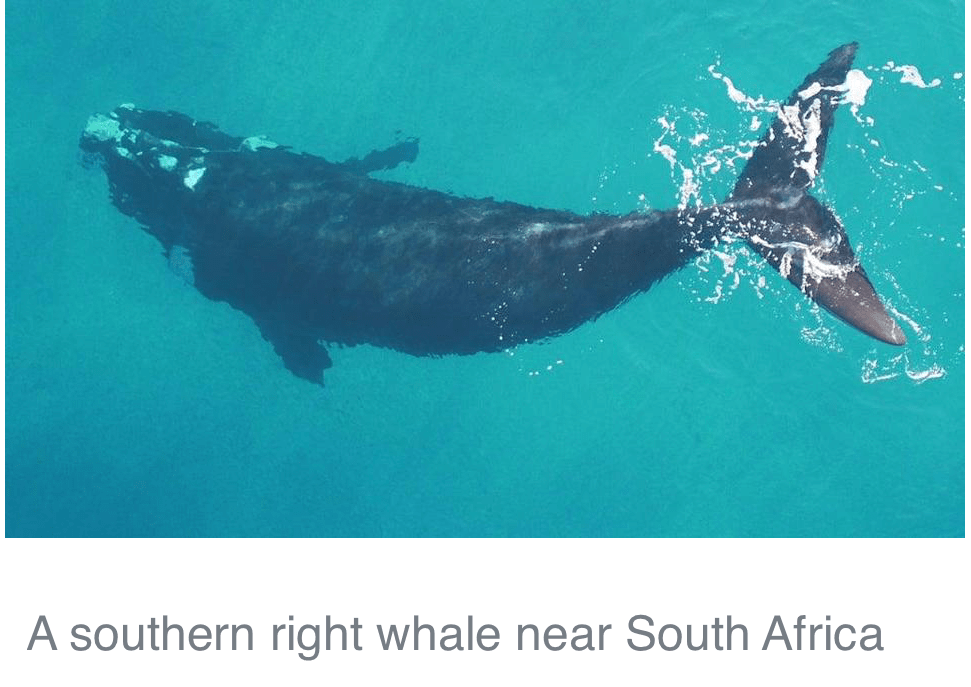
A word for whales. Whales are important as tiller of the oceans. They circulate nutrients that are essential parts of the food chain and in particular nutrients needed by phytoplankton. These serve the same function as leaves, absorbing carbon dioxide and sunlight to create oxygen. As we count on whales doing their bit to maintain the global ecosystem, so they should be able to count on us not to harm them.
However as has been widely reported, various groups are launching a last-chance bid to stop Shell using shockwaves in the Wild Coast of South Africa – a fragile ecosystem that is a vital whale breeding ground. The applicants, which included Greenpeace Africa and fishing groups, had been seeking to stop the survey on the basis it could cause “irreparable harm” to the marine environment, especially to migrating humpback whales in the area. (Yahoo News)
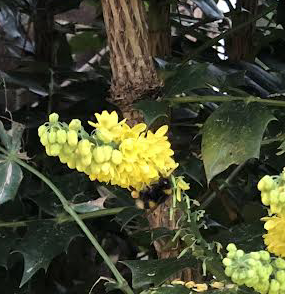
Keep a look out when you are outside – there is lots of wild life to see: starlings and blue tits on the bird feeders, robins in the trees and even bumble bees. These bees don’t hibernate but rely on winter flowering plants.
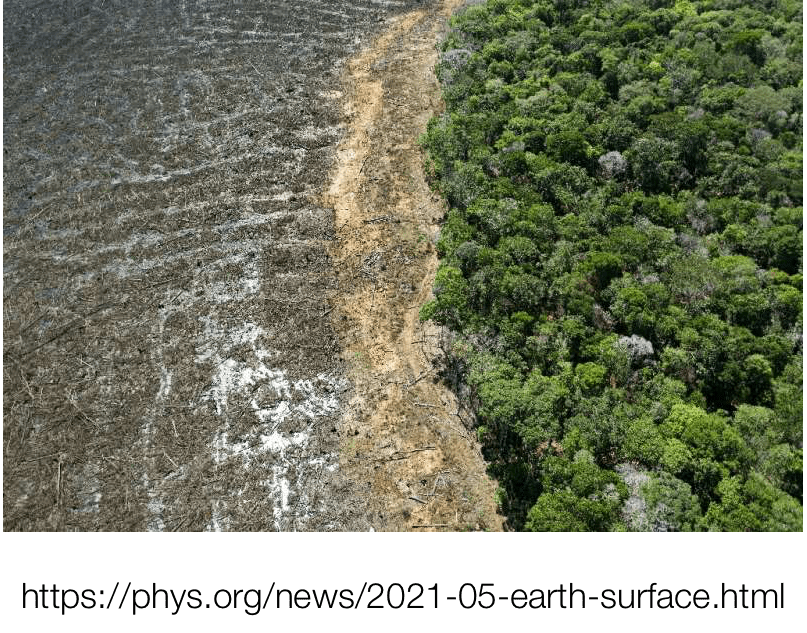
Sugar cane is the source of about 80% of the sugar consumed across the world. It is a plantation crop that goes back centuries and has a history linked with exploitation and slavery. As a plantation crop it has been responsible for the deforestation of tropical landscapes and as demand for sugar continues to increase this is still on going – especially in Brazil where sugar cane is also grown to produce the fuel ethanol: ‘The Atlantic Forest, or Mata Atlântica in Portuguese, is found on the Atlantic coast of Brazil.It should be full of life, supporting thousands of species of plants and animals, many of which are found nowhere else. It’s different from the Amazon rainforest but equally important. Around 500 years ago it would have covered an area of more than 1.5 million square kilometres. Now, more than 90% of it is gone, cleared mostly for timber, pasture and sugar.’ (https://www.nhm.ac.uk/discover/sugar-a-killer-crop.html)
Sugar cane occupies approximately 2.4 million hectare world wide. 70% of production is for domestic use (which for example would include the production of ethanol in Brazil) but for some countries the production of sugar for export constitutes a significant part of their national income eg Cuba and Belize. Volatile global prices makes for great uncertainty for local growers/ plantation workers who can do little to control their incomes. Whilst the premium paid through the Fair Trade scheme undoubtedly helps, the production of fair trade sugar – 528,000 tonnes – is a fraction of the 200 million tonnes of sugar produced globally (2019).
Sugar cane as a crop, aside from the issue of deforestation, has unwanted adverse affects on people and the environment.
it requires large amounts of water, often taking the water away from other crops and natural vegetation
It requires large amounts of pesticides and fertilisers which flow into the water system damaging other ecosystems
Before harvesting, old leaves are burnt off to assist the harvesting process. This kills wildlife, important natural organisms and pollutes the air. As nutrients in the leaves are burnt rather than being returned to the soil, the fertility of the soil is reduced requiring additional fertilisers to be used
It is an annual crop requiring the land to be cleared each year and the exposed soil is then susceptible to loss during the rainy season and with not roots to absorb moister, flooding too increases.
It is a labour intensive crop where child labour still happens.
Alternative sugar crops are grown, of which the main one is sugar beet – accounting for about 20% of world production – which is grown mainly in Europe. It too can be reliant on pesticides and fertilisers: organic sugar beet is grown in Europe but not as yet in Britain. Other sugar crops include coconut palms and oil palms where the sap is harvested.
There is a further downside to all sugars: sugar damages our health, causing major problems such as heart disease, type 2 diabetes and tooth decay. The WHO urges that sugar consumer should be reduced to between 5 and 10% of a person’s daily calorie intake. The NHS advises sugar consumption be limited to less than 30g per day: https://www.nhs.uk/live-well/eat-well/how-does-sugar-in-our-diet-affect-our-health/ Yet sugar consumption globally is still rising. The USA tops the charts with an average consumption of 126.4g per person per day. Britain comes in at number 7 with 93.2g per day (2019).
As well as being concerned about the damage sugar growing causes to the environment and it’s work force, should we be acting to reduce the demand for this commodity?
“Too often, divisions in civil society can be exploited by powerful commercial interests. ‘Don’t go too hard on health, as it will threaten jobs’ or ‘Don’t raise pollution standards, as they’ll be undercut by another country somewhere’ or ‘Don’t mention labour pay rates, or we’ll drop the preferred status.’ Or ‘Don’t stop sugar beet as it’ll affect tourism brought by geese feeding on sugar beet tops in winter’. Such horse-trading happens in realpolitik, of course, but we think now is the time to take the sugar debate back to ecological public health basics: land, labour, capital, health and culture…We see this future food world as one where less not more sugar is produced and consumed, and land use and labour are liberated from the folly of sugar production. This is hardly a vital product. It has been injected into culinary culture on a scale it does not deserve. Nor should a sugar reduction strategy be compensated for by a growth in use of artificial sweeteners which industry constantly seeks. Artificials, whether relatively ‘old’ such as aspartame or ‘new’ such as stevia, merely normalise the sweetening of diet as well as maintain the processing industries’ option to sweeten a product to sell it.” https://foodresearch.org.uk/wp-content/uploads/sites/8/2015/06/Does-Sugar-Pass-the-Environmental-and-Social-Test-23-june.pdf
thrones were set in place, and an Ancient One took his throne,
his clothing was white as snow, and the hair of his head like pure wool;
his throne was fiery flames, and its wheels were burning fire.
A stream of fire issued and flowed out from his presence.
A thousand thousands served him, and ten thousand times ten thousand stood attending him.
The court sat in judgment, and the books were opened.
As I watched in the night visions,
I saw one like a human being coming with the clouds of heaven.
And he came to the Ancient One and was presented before him.
To him was given dominion and glory and kingship,
that all peoples, nations, and languages should serve him.
His dominion is an everlasting dominion that shall not pass away,
and his kingship is one that shall never be destroyed.
Psalm 93
1 The Lord is King; he has put on splendid apparel; * the Lord has put on his apparel and girded himself with strength.
2 He has made the whole world so sure * that it cannot be moved;
3 Ever since the world began, your throne has been established; * you are from everlasting.
4 The waters have lifted up, O Lord, the waters have lifted up their voice; * the waters have lifted up their pounding waves.
5 Mightier than the sound of many waters, mightier than the breakers of the sea, * mightier is the Lord who dwells on high.
6 Your testimonies are very sure, * and holiness adorns your house, O Lord, for ever and for evermore.
Revelation 1:4b-8
Grace to you and peace from him who is and who was and who is to come, and from the seven spirits who are before his throne, and from Jesus Christ, the faithful witness, the firstborn of the dead, and the ruler of the kings of the earth.
To him who loves us and freed us from our sins by his blood, and made us to be a kingdom, priests serving his God and Father, to him be glory and dominion forever and ever. Amen.
Look! He is coming with the clouds; every eye will see him,
even those who pierced him; and on his account all the tribes of the earth will wail.
So it is to be. Amen.
“I am the Alpha and the Omega,” says the Lord God, who is and who was and who is to come, the Almighty.
John 18:33-37
Pilate entered the headquarters again, summoned Jesus, and asked him, “Are you the King of the Jews?” Jesus answered, “Do you ask this on your own, or did others tell you about me?” Pilate replied, “I am not a Jew, am I? Your own nation and the chief priests have handed you over to me. What have you done?” Jesus answered, “My kingdom is not from this world. If my kingdom were from this world, my followers would be fighting to keep me from being handed over to the Jews. But as it is, my kingdom is not from here.” Pilate asked him, “So you are a king?” Jesus answered, “You say that I am a king. For this I was born, and for this I came into the world, to testify to the truth. Everyone who belongs to the truth listens to my voice.”
Reflection
Today is the feast of Christ the King, and our readings have the theme of dominion and kingdom.
In science the world of living organisms is divided into five kingdoms using a system devised by Carl Linnaeus. These are the kingdoms of animals (all multicellular creatures), plants, fungi, protists (Amoeba, Chlorella and Plasmodium) and prokaryotes (bacteria, blue-green algae). The classification system then recognises that each kingdom can be further subdivided. The kingdom of animals subdivides into phylum one of which – Chordata – includes all creatures with back bones. Phylum can then be subdivided into classes. Chordata for example has the subdivision of mammals. And so on.
This plurality of Kingdoms and subdivisions overlap and co-exist and are dependent on each other for survival. In today’s readings we hear of the kingdoms of heaven and of earth, and it would seem that they too incorporate differences and interdependencies. Earth is not separate from heaven, but through the presence and involvement of God are interdependent – this seems to me to be what John is grappling with as he records this speech between Pilate and Jesus.
In the Psalm we hear how the Lord – God – is king. God’s kingdom is what God has created and the strength of God’s dominion, power, rule, comes from the firmness, the immovability of the earth – and yet even the strength God has created there cannot over come God. God is more than strength. Divine dominion comes from the excellence of God’s truth and holiness. The response of the earth (here it is specifically the waves) is to lift up its voice – presumably in joy and praise and admiration and honour.
From the reading from the Book of Daniel we learn that the difference between God’s dominion and that of earthly dominions, is that whilst the latter may pass away, the former will not. This is echoed at the end of the passage from Revelation: for God is the beginning and the end, the alpha and omega.
The Book of Daniel presents the kingdom, the realm of God as a place of hierarchy. There are many – lesser – thrones and the one throne of God. This heavenly throne is at the centre from which flows fire – a divine emanation – and around the oneness of God are thousands upon thousands of those who serve, and even more thousands of thousands who attend/ worship God. These thousands are dwellers of the heavenly realm. It is in this place, this court that we see the one, like a human, to whom all power and dominion in earth – the place of peoples, nations and languages – is given. For us as Christian readers, this is Jesus, the anointed one, who is bringing together the dominions of earth and heaven. This relationship between the kingdoms and heaven and earth and the intertwining role of Jesus is also being explored in today’s reading from Revelation.
It is good for us to be reminded that we are not the rulers of any of the kingdoms whether of earth or heaven. Rather we need to be ones who serve and and worship God.
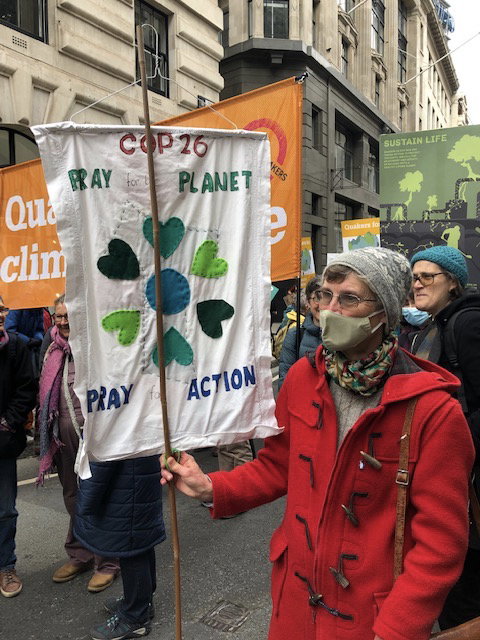
Who are we counting on to make a success of the COP26 conference?
The biggest countries or the smallest? The richest or the poorest? Those with most to offer or those who are most vulnerable?
World leaders? Our politicians? Business leaders? Scientists? Investors and financiers? Charities and NGOs? Faith groups? Youth groups?
Ourselves? Ourselves alone or ourselves as communities?
Who is counting on the success of the conference in order to survive? Small islands? Indigenous peoples? The poor? The disadvantaged? Wildlife? Marine life? Plant life? Forests and woodlands? Glaciers and icecaps? Coral reefs? Alpine meadows? We in the developed countries? The comfortably middle class? Our children and grandchildren?
We are all linked as part of a finely balanced ecological network, where it is one for all and all for one.
Do look back at past posts for ideas and thoughts about how we can be part of the solution, and do keep in touch as the Green Tau continues to address ecological issues.
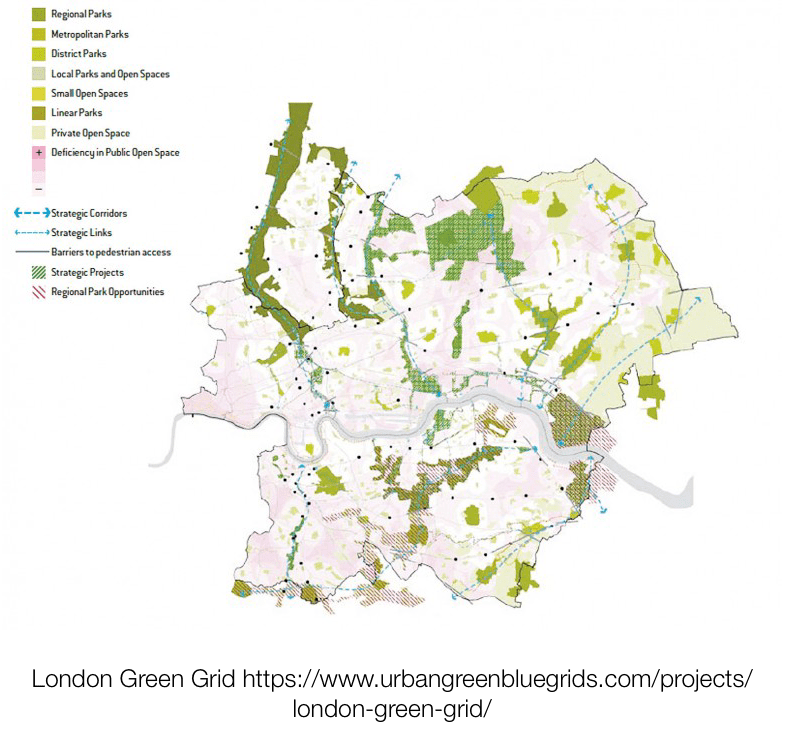
Greening our cities will make them better places both for humans and other living beings, flora and fauna. And it will address the climate crisis reducing our dependency of carbon polluting structures and carbon polluting lifestyle choices.
“Recent studies have highlighted the importance of boosting green urban areas and connecting fragments of green space with ecological corridors to improve biodiversity and animal species dispersal within the urban landscape. If adequately designed, green corridors can improve urban ventilation, allowing for cooler air from outside to penetrate into the more densely built areas, and reducing thus the urban heat island effect. Urban green areas can also have positive effects for human health and climate change adaptation. The capacity of vegetation to retain water is an important flood prevention feature that can reduce peak discharges..
[Where] patches of urban woodlands are generally separated from each other, [this] affects the ability of many woodland species to disperse, or move among different locations with similar habitats. Ecological corridors or connections between urban woodlands, gardens or other green spaces are recognised as a way to limit the negative effects of fragmentation.”
This concept is being developed in London, where there are already many parks and green corridors – the latter often following the course of the many small tributaries to the Thames.
In July 2019 London because the world’s first National Urban Park. 45% of the city is green space which includes 3000 parks, 30,000 allotments, two national nature reserves a s 142 local nature reserves, 36 sites of special scientific interest and is home to about 13,000 different species of wildlife. London’s overall tree cover amounts to 21% sufficient for it to be the world’s largest urban forest! (The UN definition of a forest is anywhere with at least a 20% cover of trees.)
Today’s agenda at COP26 features ‘nature’ by which one might mean the state of flora and fauna when it is un-damaged by the impact of humans. There are large parts of the world which are termed as nature but which nevertheless have been subject to human impact where the impact has not been negative or destructive. Re-wilding projects give us some idea of what nature would look like without any human impact – and it is amazing! Sadly there are many more places – on both land and at sea – where vast areas of nature have been severely damaged by human impact. And if global temperatures continue to rise (a direct result from human activity) those areas of damage will only grow. Yet throughout history humans have been awed and inspired by nature, and at different times and in different ways, appreciated its value. And now we realising the multi faceted value of nature to our well being.
Green and blue spaces are good for our mental and physical health, as places of calm and relaxation, places for exercise, and as places of stimulus.
From rain forests to peat bogs, oak trees to whales, we now better understand how nature provides the lungs for the planet absorbing and storing carbon dioxide and releasing oxygen.
At the same time, many constituent parts of nature remove and absorb pollution, be that particulates produced by motor vehicles or by products of sewage and other waste.
Plants can be key ingredients in shaping localised climates creating more congenial living conditions.
Nature is ultimately the source of what we eat, as well as providing medicines and health treatments. It is also the source of jobs – in farming, tourism and manufacturing.
Mangroves like their land coastal and their water salty. This tree and shrub family is adapted to spend their lives between land and saltwater, sometimes growing up to 200 feet tall in the process. Mangroves can have their roots in shallow, salty water because they are also exposed to air for part of the day. Their roots use this time above water to sequester oxygen for when they’re submerged. Mangrove roots create some of the most productive ecosystems on Earth, as their intertwined structure provides habitat for sessile creatures like barnacles and creates protective nurseries for juvenile fish. Mangrove roots provide more than habitat though: they trap sediment to stabilise coasts, and bio-filtrate nutrients and pollutants out of the water. These ecosystems are massive carbon sinks, taking in and storing excess carbon dioxide from our atmosphere and water—an important attribute in the face of climate change. By Jessica Knoth, Marine Conservation Institute Communications Intern
As participants meet, discuss, negotiate and take action at COP26, what is at stake is the wellbeing of the amazing ecosystem in which we live. Caring for and improving biodiversity is essential. So many of the earth’s ecosystems can protect us from the adverse effects of climate change, and yet they are so vulnerable to damage from human activity!
Pray for, and support, action to enhance global biodiversity.
Seagrass, the only flowering marine plant, grows in the shallower waters of our seas and oceans as it is reliant on sunlight for photosynthesis. Where it is well established it forms meadows where its roots stabilises sediment on the seabed preventing erosion. Its roots also oxygenate the sediments supporting many burrowing organisms. As it grows it sequesters carbon dioxide and does so at rates 10 to 40 higher than that of forests! It provides food, breeding grounds and nurseries for many marine species – from seahorses to seals, dog fish and octopus.
However world wide seagrasses are under threat. These marine meadows are damaged and destroyed by sewage and chemical effluents, by algal blooms that restrict sunlight penetrating the water and so preventing photosynthesis, by mechanical damage from anchor chains, marine vessels, and dredging as well as from over-fishing which disturbs the balance of the ecosystem. It is estimated that the UK has lost 95% of its seagrass meadows. Restoration projects are in progress in Swansea Bay, Dale Bay Pembrokeshire, in the Solent and off Skye – but they are still very small in scale.
Caring for our future is about caring for all different sorts of creatures. We are continually learning how important so many large and small creatures are for keeping the environment healthy – be that worms who keep the soil fertile, ladybirds that keep aphids under control, ants that eat parasites, geese that stop lakes silting up, pigs that loosen and fertiliser soil under trees.
Today’s project is making a bug hotel. It is a place where small beetles and insects can overwinter ready to resume their activities in the spring. For this you will need a tin.
Using a skewer make two holds at top and bottom on one side of the tin. You might like adult help.
Thread a paper clip through each of the holes.
Collect from your garden bits of dead twigs and plant stalks. Choose ones of different thicknesses. Cut these into equal lengths, just long enough to stand upright in the tin.
Dear Dear
Fill the tin with these twigs and stalks. Ensure they are well packed so that none can fall out. The little gaps will provide the hiding places that insects seek.
Take a piece of string and thread it through the paper clips and tie the ends together. Hang the bug hotel outside in your garden. Find somewhere sheltered from the wind and rain so that your bug hotel won’t become flooded or blown away in a storm.





 The Green Tau