Bread

A poem on Maundy Thursday, 17th April 2025

Bread 

the essential of life:

Toast for breakfast,

Sandwich for lunch – 

and, if dainty, afternoon tea too.

A get-me-through the morning 

or quick late night snack- 

croissant and bagels, 

doughnut or pretzels.

A shape for every occasion.

Elaborate or mundane, 

Common place or prized,

Unknowingly irreplaceable.

Good bread is true bread

Stone ground and hand kneaded,

Proved and cosseted.

Freshly baked, a yeasty aroma.

Crunchy bite , soft crumb,

a mouth-filling taste.

White or brown –

always a whole meal.

The bread of life –

no life without it!

Blessed and shared – 

round a table, round an altar. 

Eaten with family, 

with friends and with strangers,

all now are ‘com pane ‘ – 

with-bread-companions.

Broken and shared, 

for those in need 

and those who are needy –

the coming together as those in communion.

The bread of life 

is life-long life. 

Risen and resurrected

Lived and loved 

and lived again.

This is the bread of eternity. 

Proper 15, 12th Sunday after Trinity

Reflection with readings below

It is with Wisdom that God created world. Wisdom is following God’s commandments. It is with Wisdom that people gain understanding. But Wisdom is still about choice. We are not automatically filled with Wisdom, we are not programmed to unvaryingly follow Wisdom. There is always the opposite figure, that of Folly which we may pursue. Indeed later in chapter 9 of Proverbs, we come across Golly inviting people to step aside into her house!

Throughout the Bible there is alway choice. The choice to follow God or ignore God. To do what is right or to do what is wrong. To choose what is life giving or what is life-defeating. Adam and Eve make choices. Noah makes a choice. Abraham makes a choice. The people of Israel make a choice. Those who hear the cry of John the Baptist make a choice. Those who believe in Jesus make a choice. Yet the choices we make are not unalterable. If we find we have made a bad choice, we can repent, turn round and make a better choice – as the parable of the prodigal son so colourfully explains. 

In today’s first reading we have a dinner invitation. The description of Wisdom preparing the meal, and sending out her invitation to would-be guests sounds very similar to a couple of Jesus’s parables about people preparing sumptuous feasts and then sending out the invitations to the guests. How one receives the invitation becomes the process of judgement. Those who seek a good life, who seek peace and happiness – who seek God’s kingdom – are the ones who accept the invitation positively. Those who turn aside to enter Wisdom’s house have made the right choice; by eating and drinking the meal she has prepared, they internalise Wisdom. 

The psalmist also reminds us to make the right choice: “Turn from evil and do good; seek peace and pursue it.” And suggests that our approach to God should be one of fear – or as we might phrase it – one of awe. Both awe and fear can sharpen our senses, prompting us to seek out and make the right choices – and not to be lackadaisical. The writer to the Ephesians suggests ways in which we can live our lives wisely and fully –  singing songs and praises, giving thanks for everything in the name of Jesus. In other words responding positively to all that God offers us – and thus we will be filled with the Holy Spirit.

It all sounds so  very simple and yet we can find it such a hard discipline to stick to. Is being wise simple or complicated? Is shaping our lives according to God’s will straightforward or difficult? Is becoming one with Jesus easy or ever so tricky?

If we look back over John’s Gospel we see that for some people the decision to follow Jesus was so simple. Andrew realises straight away that Jesus is the Messiah. Philip too follows him without any hesitation, and when Nathaniel meets him, he straightway recognises him as the Son of God. But then we have people like Nicodemus, teacher and leader of the Jews. He cannot get his intellectual mind around who Jesus is and how one might enter the kingdom of God. Nicodemus cannot understand how things can be both earthly and heavenly, how there might be such a fluid interconnection between heaven and earth. 

Spiritual food cannot be separated from physical food. Physical food cannot be set aside from spiritual food. We cannot just be satisfied by eating physical bread – we need to understand it spiritually. There is nothing we eat that does not ultimately come from God who is the creator of all things. We need to acknowledge that in giving thanks to God. But neither will we be satisfied with just an intangible spirituality. When we seek the spiritual we need the groundedness of things physical. Baptism comes in the medium of water and the spirit. The Eucharist comes in the medium of bread and wine as well the medium of Christ’s flesh and blood. 

And we can chose to accept Jesus’s invitation to share the bread that is his body and the wine that is his blood, as a simple gift – or we can choose to convert it into a complicated conundrum, one which then allows us to create barriers and exclude others. 

As we prepare to eat and drink the gift of Jesus, we will remember that all that we have – both physical and spiritual – is a gift from God and that is is only with what God gives us, that we can return our thanks. And this perhaps brings is back to where we began – with Wisdom. Through choosing that invitation, by entering that house and following that way of life, we can live the way God wishes – Wisdom that calls us to care for the earth, for all that God has created, to use and share it wisely with one another, to live simply so that all may simply live.

Let us take that wisdom into every aspect of our lives this week and see how it changes the way we treat others, the way we buy and sell, make and take, give and share, teach and listen, sing and give thanks – to the glory of God the Father and in the name of the Lord Jesus Christ. He 

Proverbs 9:1-6

Wisdom has built her house,
she has hewn her seven pillars.
She has slaughtered her animals, she has mixed her wine,
she has also set her table.
She has sent out her servant-girls, she calls
from the highest places in the town,
“You that are simple, turn in here!”
To those without sense she says,
“Come, eat of my bread
and drink of the wine I have mixed.
Lay aside immaturity, and live,
and walk in the way of insight.”

Psalm 34:9-14

9 Fear the Lord, you that are his saints, *
for those who fear him lack nothing.

10 The young lions lack and suffer hunger, *
but those who seek the Lord lack nothing that is good.

11 Come, children, and listen to me; *
I will teach you the fear of the Lord.

12 Who among you loves life *
and desires long life to enjoy prosperity?

13 Keep your tongue from evil-speaking *
and your lips from lying words.

14 Turn from evil and do good; *
seek peace and pursue it.

Ephesians 5:15-20

Be careful then how you live, not as unwise people but as wise, making the most of the time, because the days are evil. So do not be foolish, but understand what the will of the Lord is. Do not get drunk with wine, for that is debauchery; but be filled with the Spirit, as you sing psalms and hymns and spiritual songs among yourselves, singing and making melody to the Lord in your hearts, giving thanks to God the Father at all times and for everything in the name of our Lord Jesus Christ.

John 6:51-58

Jesus said, “I am the living bread that came down from heaven. Whoever eats of this bread will live forever; and the bread that I will give for the life of the world is my flesh.”

The Jews then disputed among themselves, saying, “How can this man give us his flesh to eat?” So Jesus said to them, “Very truly, I tell you, unless you eat the flesh of the Son of Man and drink his blood, you have no life in you. Those who eat my flesh and drink my blood have eternal life, and I will raise them up on the last day; for my flesh is true food and my blood is true drink. Those who eat my flesh and drink my blood abide in me, and I in them. Just as the living Father sent me, and I live because of the Father, so whoever eats me will live because of me. This is the bread that came down from heaven, not like that which your ancestors ate, and they died. But the one who eats this bread will live forever.”

Bread for sharing

27th July 2024

Is there anyone among you who, if your child asks for bread, will give a stone? Matthew 7:9

You Lord, are the source of all good things: 

We praise you.

You call us to tend and care for your creation: 

May we strive to do your will.

You have made us as brothers and sisters with all that lives: 

May we live together in peace.

Genesis 8:22 As long as the earth endures, seedtime and harvest, cold and heat, summer and winter, day and night, shall not cease.

Heavenly Parent, mother and father of us all,

May you be ever honoured by your people.

For you are the one who caused the earth to bring forth seed bearing plants –

wheat and barley, oats and rye and all manner of grains. 

You are the one who provides the staff of life.

Hallowed be your name!

Isaiah 55: 10 -11 For as the rain and the snow come down from heaven, and do not return there until they have watered the earth, making it bring forth and sprout, giving seed to the sower and bread to the eater, so shall my word be that goes out from my mouth; it shall not return to me empty, but it shall accomplish that which I purpose, and succeed in the thing for which I sent it.

Heavenly God, creator of soul and body,

May you be ever honoured by your people.

From you comes wisdom and insight 

so that we may learn how to,love you and our neighbour.

You are the one who provides the staff of life.

May your kingdom come!

Matthew 14:19-20  Then he ordered the crowds to sit down on the grass. Taking the five loaves and the two fish, he looked up to heaven, and blessed and broke the loaves, and gave them to the disciples, and the disciples gave them to the crowds. And all ate and were filled; and they took up what was left over of the broken pieces, twelve baskets full.

Heavenly Redeemer, sustainer of life, 

May you be ever honoured by your people.

You provided manna for the long years in the wilderness,

And the harvests of the earth are sufficient to feed the whole world,

such that all should have the means to thrive and flourish.

May your will be done!

Teach us today and every day to handle bread with respect.

Teach us today and everyday to appreciate that bread is the means of life.

Teach us today and everyday to take only what we need.

Teach us today and everyday not to steal from tomorrow’s supply.

Teach us today and everyday not to hoard what comes to us as a gift.

Teach us today and everyday to share what you give us.

Teach us today and everyday not to be satisfied until everyone is fed.

The Lord’s Prayer

Sunday Reflection

8th August 2021, Proper 14: 1 Kings 19:4-8, Psalm 34:1-8, Ephesians 4:25-5:2John 6:35, 41-51

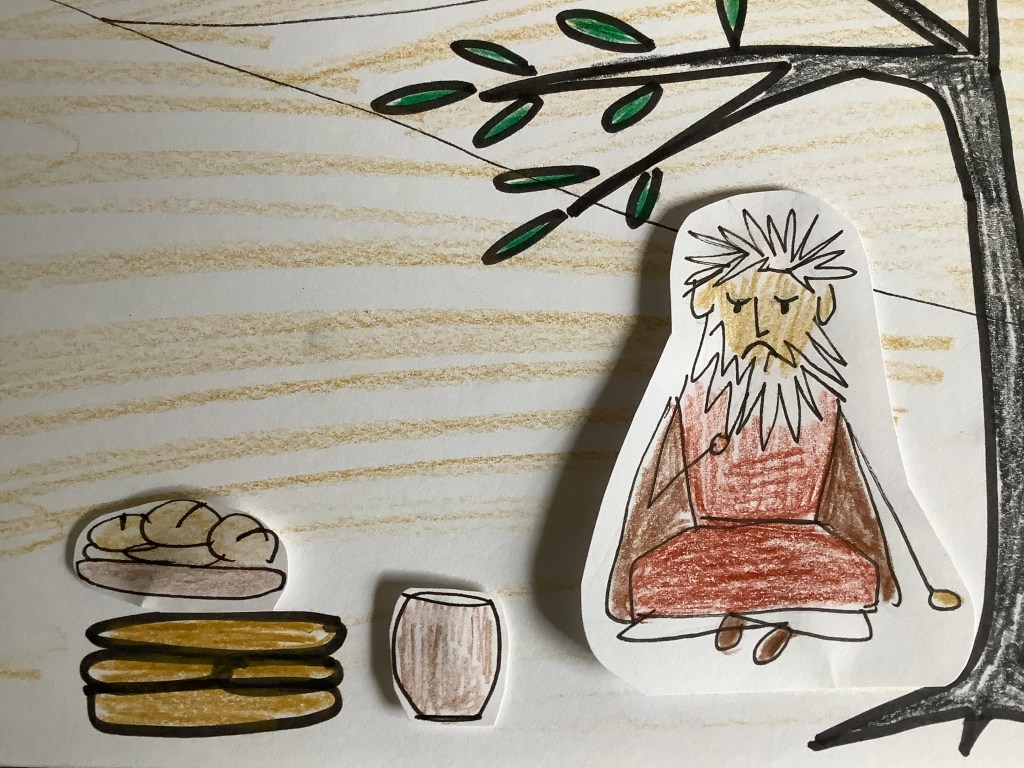
Elijah under a broom tree

I feel a lot of sympathy for Elijah. Prior to where we meet Elijah in today’s reading he has been extremely busy. Elijah lived during the reign of King Arab who is described as the king who did more evil than all the other kings before him. He was a king who definitely did not walk in their  ways of God! God has seen all that has happened and tells Elijah that, as a consequence, no rain nor even dew shall fall on the land. The land will be afflicted by a drought that will last for years. 

Pausing a moment it is worth reflecting that for decades, if not more, we residents of planet earth have increasingly mistreated and plundered the earth damaging both its climate, its ecosystems and and its most vulnerable creatures. We have not followed the ways of God. And now we are increasingly aware that our folly is causing problems that affect us directly – floods, heat waves, wars, covid etc. 

Back to Elijah. He follows God’s instructions as to how and where he will find sustenance, and sees at first hand the effect the delight has on the land and in its inhabitants. After three years of drought God sends Elijah to speak with Ahab (who is finally feeling the effects of the drought. Those who are rich and/or powerful usually find ways of minimising the inconveniences that cause others to suffer) and to reprimand him for all that he has done wrong. Like many business leaders and investors today, Ahab still believes that his model of life – worshipping the Baals and sacrificing children – is the only right one. So Elijah sets up a competition, challenging the priests of Baal to prove the efficacy of their gods. 

This must have taken great determination on Elijah’s part. He was just the one lone voice speaking out against the falseness of the Baals and their rule of life. God was certainly with him and strikes the winning shot – a fire bolt from heaven – on Elijah’s behalf, but yet it still must have been stressful to the point of exhaustion for Elijah. The single handed, Elijah destroys all the false prophets. And once again he challenges Ahab to repent. Ahab instead seeks guidance from his equally wicked wife, Jezebel, and somehow it is her cursing of Elijah, that breaks the camel’s back. Elijah fears for his life and flees into the wilderness.  

So we come to today’s episode. Elijah is ready to give up and die. Have you ever felt yourself to be at that point of exhaustion, of despair, of self doubt?  Elijah curls up under a broom tree – an evergreen bush which because of its deep roots and narrow leaves can survive in arid environments and provides a welcome place of shade for travellers. Having spoken out-loud his grievance, his desperation, he is finally able to sleep. Owning up to ourselves and to God about what troubles us is a good starting point. After he slept, God wakes Elijah and provides him with food and water. He eats and drinks and once more sleeps. God waits and then wakes him a second time, prompting him to eat and drink, so as to be ready for the next stage of his journey – his life. One rabbi has noted the similarity between ‘rothem’ the Hebrew for broom and ‘rachem’ Hebrew for compassion. God has compassion on Elijah. God knows that what he needs is sleep and food and only when  those needs have been satisfied does God suggest to Elijah that he journeys to God’s holy mountain of Horeb where the two will engage in a much deeper spiritual experience. 

So I think it can be for us. Being open and honest about how we feel, understanding when we need rest, accepting support especially physical comfort even when we feel spiritually drained. God is concerned for our total wellbeing, physical and spiritual, and often we have to satisfy the first before we can address the second.

Today’s Psalm aptly describes Elijah’s experiences. ‘Taste and see that the Lord is good’ both physically and spiritually.

The passage from Ephesians is entitled in NRSV Rules for the New Life. Rules for a new life were certainly what Ahab and his people needed. I think they are also what we need for living a new climate friendly, all-inclusive people friendly, sustainable life. The passage reminds us that we are interconnected, and that the way we each act has repercussions for everyone, and further more affects our relationship with God. 

The reading from John’s gospel continues to explore the idea of Jesus as the bread of life. Believing in and following his ways, have both physical and spiritual benefits. Jesus feeds and heals people physically and spiritually. Jesus by his very nature is a two way conduit between earth and heaven, between God and human kind, between the present day and eternity. This is something the Jews, the hearers of Jesus’s message find hard to understand and accept. For them, he is just a local boy – a local who has become a popular crowd puller but nevertheless surely still just someone like them? Is there something about needing to be ready, to be open, to seeing God at work in our everyday environment? Perhaps of finding the spiritual in the physical and the physical in the spiritual? 

Feed us Lord God

with what we need,

both physical 

and spiritual. 

Amen.