Counting on … 169

21st October 2025

Recently Christian Climate Action produced a vision document calling on the Church to be more prophetic. https://drive.google.com/file/d/1yOj-jCh9H8L_vqFJ89fbpJHPQibwPgQ0/view?usp=drivesdk

On the one hand the Church of England is pressing ahead with its challenge of reaching net zero carbon emissions by 2030, which is seeing many church buildings (including schools and vicarages etc) being fitted with low energy light bulbs, insulation, solar panels and heat-pumps etc. And this is clearly very important and especially so if it also motivates people to do likewise in their own homes and places of work. (The number of regular worshippers is now just over a million). 

On the other hand does the Church challenge individuals, industries and governments to address the systemic wrongs that perpetuate the climate and biodiversity crises and the social injustices that these cause? 

As an analogy, I as an individual can be rigorous about placing my plastic in the recycling bin, but if  most of that plastic ends up on beaches in Africa because the price of virgin plastic is cheaper than that of recycled plastic, the economic system has won. 

I can try and raise this issue as an individual, but how much more effective would it be if the Church were there calling for change – using its cultural status and its position in Parliament to call for effective policies to incentivise recycling within the UK, to incentivise the use of recycled plastic and taxing the production of virgin plastic? 

What if – for example- the Church of England were, say, to publicly back Greenpeace which has long been challenged the status quo vis a vis the pollution and global injustices arising from inadequate policies around plastics? 

For further information

Green Tau Issue 97

3rd November 2024

Is the National Trust Walking the Talk?

The National Trust is the UK’s largest conservation and environmental protection charity with between 6 and 7 million members and is custodian of just under 260,000 hectares of land. One of its two overarching strategic priorities is its ambition of reaching net zero emissions by 2030. It has already met its target of creating and restoring 25,000 ha of new wildlife habitats and is working towards 50% of Trust land being nature friendly, by 2025. It also aims to plant 20 million trees by 2030.(1)

Recognising the scale of  the twin crises of climate change and biodiversity loss, and that neither of these recognises boundaries in terms of either cause or effect, the National Trust collaborates with other bodies such as the RSPB and WWF. This trio has produced the  The People’s Plan for Nature and the Save our Wild Isles campaign. The National Trust has joined many more groups in supporting events such as the Restore Nature Now March and the March for Clean Water.

Surely the National Trust can be said to be walking the talk? 

And yes in so many ways they are, but to quote the UN Secretary General, Antonio Guterres, we must do ‘everything, everywhere, all at once’ if we are to avert the worst of the climate and biodiversity crises. 

So what about banking? Over recent years many organisations and individuals have looked at their financial arrangements and divested from fossil fuels – whether that is selling shares directly linked to oil and gas production or withdrawing from pension and investment funds that are reliant on returns generated through the production of fossil fuels. In 2019 the National Trust announced its decision to divest from fossil fuels to safeguard the long term future of the environment. 

So what about banking?

Banks are essential to the ongoing production of fossil fuels. Their banking services enable companies, such as Shell and BP, to remain operational and able to continue to develop new oil and gas fields. The annual fossil fuel finance report for 2024, ‘Banking on Climate Chaos’,(2) shows that  Barclays is still the eighth largest funder of fossil fuels globally and, once again, holds the number one slot in Europe. In 2023 Barclays supplied the fossil fuel industry with $24 billion. 

Clearly who you bank with has an environmental impact element! For individuals several organisations exist – such as Make My Money Matter, Switch It Green and JustMoney (3) –  to enable people to review their banking arrangements and to switch to a more environmentally friendly alternative. Other organisations such as Mothertree (4) offer the same service for both individuals, organisations and businesses. Most notably this past year both Christian Aid and Oxfam (organisations with complex banking needs) have dropped Barclays as their bank. 

Yet Barclays is the National Trust’s bank. 

Not surprisingly, there has been growing pressure on the National Trust to switch to a more environmentally friendly bank. Continuing to bank with Barclays does dint the National Trust’s credibility as a leading conservation and environmental protection charity.

Christian Climate Action has been actively campaigning on this issue for the last three years, attending the National Trust’s AGMs, writing to and talking with people inside the Trust’s organisation. 

In July Christian Climate Action, along with other organisations, organised a week of action, targeting National Trust properties with banners and placards, banking-themed picnics, fancy dress, questionnaires, scoreboards, and an online petition calling on the Trust to ‘Drop Barclays’.(5) (Later we learnt that the staff and volunteers were pleasantly surprised at the engaging and friendly approach of the actions having previously experienced more aggressive tactics from other campaign groups).

This year’s National Trust’s AGM was held in Newcastle. A group of us from Christian Climate Action organised a pilgrimage -well equipped with flags, pennants and banners (and flapjack) – that set off from The Sill and walked along Hadrian’s  Wall and via the Tyne Valley to Newcastle. On the way we happy band of pilgrims stopped off at National Trust sites – Housesteads Roman Fort, Cherryburn (Thomas Bewick’s birthplace) and the one room dwelling that had been Stephenson’s birthplace.

Up bright and early on the day of the AGM, the CCA pilgrims were joined by other climate activists standing outside the Civic Centre handing out leaflets about the Drop Barclays campaign – and about the equally important Climate and Nature (CAN) Bill campaign. (6) NT staff greeted us with smiles and a genuine interest in what we were doing. 

Those who were members with tickets to go into the AGM, were able to have many face to face conversations with Trustees, Council members and members of the executive team, and to talk with them openly on issues related to the climate, environment and biodiversity loss. Altogether there were some 400 National Trust members attending in person, there were a further 3000 who took part on line – and when it came to questions and comments during the AGM, each contingent was able to participate equally. I was surprised that more people didn’t take part. I asked a question in the first Q and A session and thought that I would then have to sit on my hands thereafter to give space to others. But there was no rush of hands so I was able to make a further two comments in subsequent discussions. 

There were only two points of contention. One concerned the system of Quick Votes – an issue which had been the basis of an unsuccessful resolution the previous year which was felt by a vocal minority to be undemocratic. The Quick Vote is an option where members chose to follow the position of the Trustees. It is a system used by many organisations with a large membership. It is only an option and members can mix and match the way they vote on the different issues.  It does not stifle debate: anyone can still join in the debate regardless of which voting method they have chosen. As the use of the Quick Vote was not a resolution this year (the same topic can not be brought back until three years has elapsed) there was no vote on the matter.

The other issue that produced contentious debate was that of plant based foods. Some members asserted that the proposal forced them to eat food which was not of their choosing, whilst – as  the resolution itself highlighted – felt that instead the proposal gave everyone choices about what they ate. Others were concerned about the impact on the Trust’s tenant farmers. The National Trust aims to use local produce and produce from their farms as much as possible – much of the flour used in their cafes comes from wheat grown on the Trust’s Wimpole Estate. 

In all three member’s resolutions were proposed, discussed and voted on. One called for an increase of plant based foods in the National Trust’s cafes (from the current 40% to 50%). Another called for the strengthening of the National Trust’s response to climate and ecological emergency, and the third called for the National Trust to give its formal support to the Climate and Nature Bill. All three resolutions were passed with significant majorities – voting included votes cast before the AGM and those cast on the day whether in person or online. Whilst the Trustees are not obliged to adhere to the resolutions, they clearly show the Trustees what topics matter most to the Trust’s members.  

I came away from the AGM feeling physically and emotionally drained. I felt taking part had been both important and, as it happened, highly productive. I felt that the pilgrimage had been a good preparation – walking along companions, walking through some of the wonderful landscapes and habitats that we wish to protect and enhance, meeting and sharing with local people, grappling with and overcoming tiredness, and creating the headspace to think clearly and prayerfully. 

Our conversations with the National Trust will continue as we both applaud the many good things they do and  press them to Drop Barclays.

  1. https://www.nationaltrust.org.uk/who-we-are/annual-reports

(2) https://www.bankingonclimatechaos.org/ This report was a joint effort among Rainforest Action Network (RAN), BankTrack, Center for Energy, Ecology, and Development, Indigenous Environmental Network (IEN), Oil Change International (OCI), Reclaim Finance, the Sierra Club, and Urgewald. The finance data was co-researched with significant contributions from Profundo.

(3) https://makemymoneymatter.co.uk/; https://www.switchit.green/; https://justmoney.org.uk/the-big-bank-switch/

(4) https://www.mymothertree.com/

(5) https://christianclimateaction.org/2024/06/08/week-of-action-urging-national-trust-to-drop-barclays/

(6) https://www.zerohour.uk/

Green Tau: issue 91

An even greener National Trust?

29th July 2024

Over the last few weeks I have made a grand tour of England and Wales, visiting iconic National Trust sites. Ours is still a green and pleasant land, from St Michael’s Mount in the south west to Newcastle’s Souter Lighthouse in the northeast; from Windermere in the northwest to Box Hill in the south east, from Worms Head on the Gower Peninsula in the west to Kinder Scout in the middle. It is green and pleasant because people care passionately about the environment!

This is not to say that there isn’t room for improvement – uniform green fields full of grazing sheep may in reality be products of monoculture, and placid waters may mask life-damaging pollutants.

One of the greatest threats to our green and pleasant land is climate change. Rocketing temperatures in the oceans are fuelling a wet and windy summer here and across Northern Europe. Flooding and tree damage, poor harvests and dwindling numbers of butterflies is one of the many consequences. Late autumns and early springs upset the breeding patterns of birds, and the flowering cycles of plants. Intermittent heat waves stress many plants and animals, and increase the risk of wild fires.

And yes, generally, people do care and do want a sustainable, green, accessible, biodiverse rich environment in which to live. The National Trust is one of the bigger organisations that is making that a reality. And we know we must do all we can to limit the output of carbon dioxide to keep climate change in check. And again the National Trust is addressing this specific issue with a target of net zero by 2030.

We know we need fossil fuel companies to cut back their output and transition to renewables. We know we need pension funds, insurers and banks to use their financial power to press for faster change. 

So why then does the National Trust – the nation’s largest conservation charity – still bank with Barclays, the biggest funder of fossil fuels in Europe?

This week there is a week of action, coordinated by Christian Climate Action, which aims to press the National Trust to go that one more step, to become that bit greener, by switching from Barclays to a bank that is fully aligned with the National Trust’s environmental credentials.

The actions at various National Trust sites across the country with banners and placards – possibly even with visits by Peter Rabbit -will be peaceful and friendly, inviting people to learn more about banking with Barclays is an issue and inviting them to sign a petition asking the National Trust to drop Barclays – something which other charities, such as Oxfam and Christian Aid, have already done.

Counting on … day 115

27th May 2024 

Living more sustainably has also become about campaigning to create a sustainable world for everyone. This we do through supporting charities and organisations that operate in this field

– such as the RSPB, WWT and National Trust – which aim to conserve and improve the natural environment and biodiversity because such environments are key to sustainability;

– such as the London Cycling Campaign and Sustrans which focus on particular issues within sustainability- vis active travel;

– such as Friends of the Earth which both campaign and develop educational resources for living sustainably;

– such as Practical Action and Christian Aid which campaign and  give support to those who are suffering because of the current lack of justice and sustainability globally;

and Christian Climate Action Green Christian which bring the Christian ethic to campaigning.

Does it matter which bank we bank with?

21st February 2024

Banks are key players in ensuring the flow of finance through global and national economies. As such they can influence which industries and companies receive funds and grow, and which do not. One of the greatest threats to life is the climate crisis which is primarily driven by emissions from fossil fuels. The International Energy Agency (IEA) has already told us that if we are to keep emissions and hence global warming at a tolerably safe level, we should not open up any new oil and gas projects. Yet this is precisely what the fossil fuel industry is doing, with funding secured by a – still – large number of banks. 

Make My Money Matter has long been urging us to direct our money so that it supports action to tackle the climate crisis, rather than allowing it to fill the coffers of those who perpetuate the problem. 

“The fossil fuel industry cannot exist without banks, yet our high street banks are continuing to pump money into them. So our message is simple – don’t bank on fossil fuel expansion. Banks must act and you can drive that change. ” https://makemymoneymatter.co.uk/

Another such platform advocating and enabling change is Switch it Green.

“Together, we will move £7 billion out of fossil fuel support this year; pressuring banks to phase out their climate-harming investments.

“We are harnessing the power of switching en masse. By switching alongside thousands of others – and maximising your switch with our ready-to-go lobbying features – your individual action is transformed into a collective call for change.” https://www.switchit.green/why-switch-it/article/how-do-banks-contribute-to-climate-change

And coming from a specifically Christian focus there is Just Money which provides information  and leads  campaigns on issues of money and justice.

“The money that we put into a bank helps it to do its work. A growing movement of Christians want to bank more ethically and campaign for a fairer, greener banking sector…Some banks are good news for people and planet. As Christians we can champion these, and support ethical alternatives, like credit unions.” https://justmoney.org.uk/

This Lent Just Money has a special campaign encouraging us all to switch to a green bank – https://justmoney.org.uk/the-big-bank-switch/

I am involved with Christian Climate Action and their campaign to highlight the harmful practices of Barclays Bank – the largest European funder of the fossil fuel industry (2016-2022) – and to encourage both individuals but also organisations and charities to switch to greener, more ethical banks. 

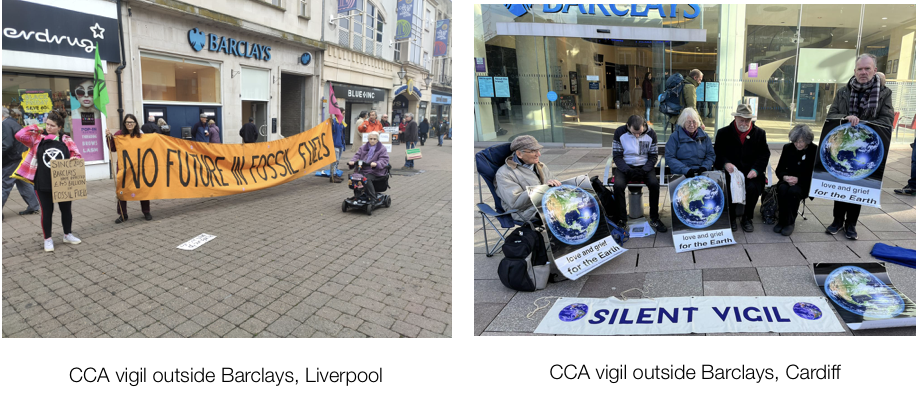
Actions taken by CCA include regular vigils held outside local branches of Barclays. This is done by local CCA groups often in conjunction with other groups concerned about justice and the environment. See CCA’s event page for more details – https://christianclimateaction.org/events/

  CCA has also written to and met with organisations – such as Christian Aid, Oxfam  and The National Trust – and have held prayerful vigils outside their headquarters. 

See also – https://www.churchtimes.co.uk/articles/2024/2-february/news/uk/more-charities-sever-ties-with-barclays-over-stance-on-fossil-fuels

CCA is also liaising with those Church of England dioceses that bank with Barclays, and recently organised a workshop for diocese to share and explore how they can switch to a better bank. (For more information about CCA’s campaign with dioceses – https://christianclimateaction.org/2023/11/14/urging-church-to-drop-barclays/

Success is being achieved. Christian Aid, Greenbelt, Sheffield Cathedral and Oxfam have all  undertaken to switch away from Barclays. 

Green Tau: issue 85

18th December 2023

Taking action in the National Gallery 

The National Gallery began when in 1824 the British Government bought, on behalf of the nation, 38 paintings from the heirs of the late John Julius Angerstein, a business man and art collector. Thus it is that the National Gallery’s collection is owned by the government on behalf of the British public. Its constitution  states “The Gallery’s aim is to care for the collection, to enhance it for future generations, primarily by acquisition, and to study it, while encouraging access to the pictures for the education and enjoyment of the widest possible public now and in the future.” 

It goes on to describe it audience as:

  • Frequent and occasional visitors to the Gallery in London
  • Those who see its pictures while they are on loan elsewhere, both inside and outside the UK, and those who know the collection through publications, multimedia and TV
  • Those who live nearby as well as those who live further away in the United Kingdom and overseas
  • Every age group – from children to pensioners
  • The socially excluded and the privileged; the uninformed and the specialist; and those with special needs
  • The worldwide community of museums and galleries
  • Most importantly: future generations 

And further on adds: 

“Allow the public to use the collection as their own by maintaining free admission, during the most convenient possible hours, to as much as possible of the permanent collection” (3) (3) https://www.nationalgallery.org.uk/about-us/organisation/constitution

The National Gallery certainly aims takes seriously its particular role of caring for a collection of art works that belongs to the British people, and making it fully accessible to them. 

Like many museums and art galleries, the National Gallery undertakes a responsibility to facilitate and enhance the educational use of the collection for the benefit of people of all ages and backgrounds. It hosts exhibitions, school visits, workshops and talks, tours, musical events, sketching sessions etc as well as producing many publications relating to the collection. It makes full use of digital technology and the further opportunities that that affords.

Chris Michaels, the director of digital, communications and technology at the National Gallery, spoke at ‘greenloop 22’ – a visitor attractions conference focusing on sustainability – spoke about the practical steps the National Gallery is taking to respond to the climate crisis – such as making positive choices about which electricity supplier to use. He also spoke of ways in which the Gallery could go beyond such operational steps.  

“It concerns thinking about how we, as storytelling institutions, can start to think about the future and make sure that the stories we tell live in that future the right way. To me, very simply, art finds new relevance in this time of crisis.” 

He expanded on this with examples. “If you look at Canaletto now, if climate change progresses at the speed it is now, and if we don’t make things better, this Venice will disappear beneath the waters for good.

“If we think about artists even as recent as Monet, painting in the late 19th century, there is a picture he famously painted from when he was staying at the Savoy in London. The hazy skies in the picture were also products of climate change, even at that time. This landscape, too, will vanish as London potentially disappears beneath the waters.”

He concluded, “Climate change and the climate crisis, for museums, becomes a storytelling frame to understand the new relationship between art history and our futures. Those hazy skies and their meaning are something I keep coming back to in terms of the way they change our understanding of the past and of the future.” (2)

This September the first UK Museum COP was held at Tate Modern. It issued the following statement: “As leaders of the UK museums, we feel a responsibility to speak out about the current climate and biodiversity crisis and call upon UK politicians and businesses to accelerate action to mitigate this crisis before it is too late. We are already around or beyond crucial tipping points: global temperatures are higher than they have ever been since humans emerged as a species, and extinctions are occurring at around a thousand times the normal rate. There is an existential threat to the world we have become accustomed to.

“Museums are institutions with a long-term view. Many have collections relating to the Earth’s five previous mass extinction events, and we are now in the midst of the sixth, the Anthropocene. UK museum leaders feel they have an ethical obligation to take action to alleviate that damage.”

They went on “We will [u]se relevant collections, programmes and exhibitions to engage audiences with the climate crisis and inspire them to take positive action …” (3) 

Clearly there is a growing awareness of the role that museums and art galleries can take in advancing the debate about climate change and in shaping how the public responds to this crisis. But is this growing awareness leading to action at a fast enough pace to be of use? Or are they likely to be overtaken by events?

In some instances they already have. The National Gallery, the Royal Academy, the Courtauld, and the Kelvingrove Art Gallery have all been targeted by Just Stop Oil activists have used popular paintings to make the point that very little – in proportion to the scale of the emergency – is being done to address the climate crisis. Their actions seek both to raise awareness in the wider public, and to call upon the art galleries themselves to demand action from the Government.  Similar actions have also been carried by climate activists in France, Germany, Austria, Italy, Spain,Norway, Canada, and Australia.

What would happen if rather than closing down these actions, museums and art galleries choose to work with activists as they seek to press for responsible climate action? Several museums in Germany have done just this, working with the group Letzte Generation (Last Generation). At the Hamburger Kunsthalle, activists took over the foyer for a non-violent resistance, reading essays and conversing with visitors. Similar essays actions took place at the Ludwig Museum in Cologne, the Museum of Ethnology in Leipzig, the Zeppelin Museum in Friedrichshafen, the Rostock art gallery, the European Hansemuseum in Lübeck and the Museum for Communication in Nuremberg. (4) 

Works of art, as well as  have great value in inspiring thoughts and new ideas, often have spiritual values too. Indeed many were created for religious purposes to aid and encourage worship. 

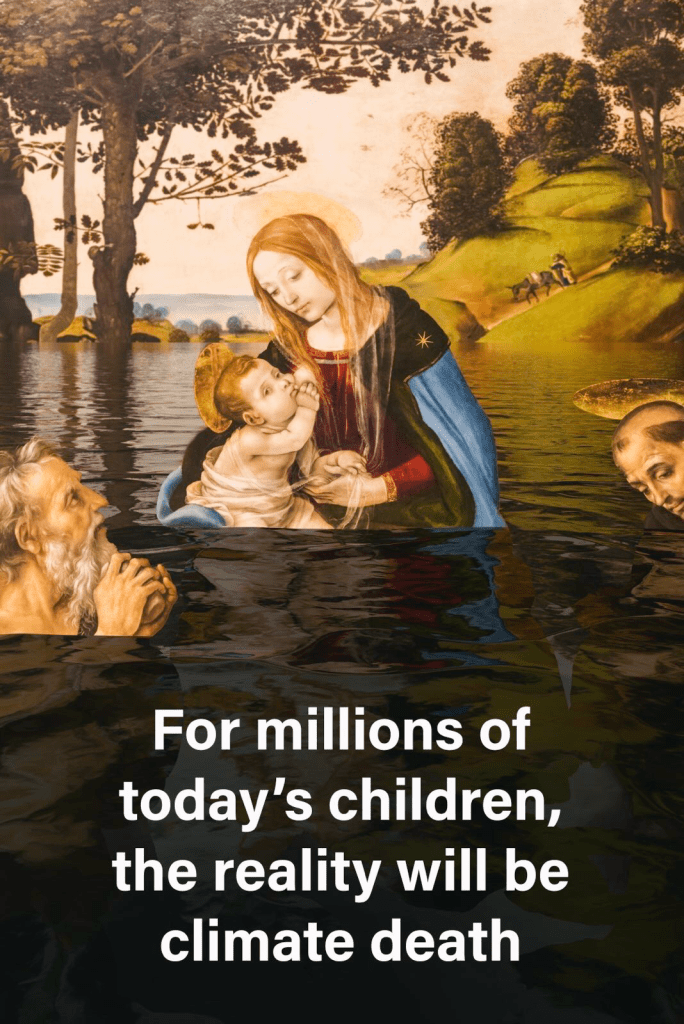
Last week I took part in an action at the National Gallery with others from Christian Climate Action. We gathered in front of a painting of ‘The Madonna and child with saints Jerome and Dominic’ by Filippino Lippi, where we unrolled a copy of the picture which had been digitally altered to show flood waters that half submerged the characters. This we held as a statement was read out describing how for  many Christmas is not a time of joy, because their lives are threatened by the effects of climate change. As we knelt prayerfully we sang a version of Silent Night – the acoustics were wonderful. 


Sadly security staff quickly cleared that section of the  gallery and visitors were not able to participate in the event.
If  you would like to see images from the event visit https://christianclimateaction.org/2023/12/15/protest-climate-change-inaction-at-virgin-and-child-painting/

Whilst here is the statement that was read out:

“Why did members of Christian Climate Action gather prayerfully beside a nativity painting at London’s National Gallery, with a different picture to reveal? 

“As Christians we celebrate the birth of Jesus, born in poverty as a refugee, to show us the way of love and peace, and justice which is love in action. Christmas is still for the children. But today, world leaders are failing them. As governments profit from weapons and from fossil fuels, babies are born into climate chaos as well as war. In this painting, the baby – like his mother but unlike Jesus and Mary – is white, but we remember those brown and black babies born in the Global South still waiting for climate reparations and most at risk of unliveable heat, hunger, drought, flooding and displacement. We honour those born into poverty here in the UK as inequality widens, and all the world’s children whose future is at risk while the adults in charge pursue yet more oil and gas. We grieve that after 28 COPs, world emissions in 2023 have reached a record high to match all the heat records broken month after month. 

“Only with change for good can the young find hope. Christmas lights can’t dispel their darkness. Along with inflatable Santas, magical snowmen and red-nosed reindeer, art like this is hollow and fake. The altered image we held beside Lippi’s painting shows the terrifying reality children face. Sentiment, tradition and festivity won’t save us. The science is clear that new gas, oil or coal will accelerate climate breakdown. We can’t serve God unless we serve that truth. Unless we work for life, justice and peace – with love.

“One billion children – almost half of the world’s child population – live in countries that are climate-vulnerable. A third of the world’s child population is impacted by both the climate crisis and poverty.

“According to UNICEF, extreme weather has internally displaced at least 43 million children in the last six years – the equivalent of 20,000 children a day being forced to abandon their homes and schools.”

(1) https://www.nationalgallery.org.uk/about-us/organisation/constitution

(2) https://blooloop.com/museum/in-depth/museums-climate-crisis-technology/

(3) https://fadmagazine.com/2023/11/07/u-k-museum-leaders-issue-first-ever-joint-commitment-to-tackle-climate-change/

(4) https://news.artnet.com/art-world/german-museums-take-a-new-tack-to-prevent-climate-activists-attacking-their-art-inviting-them-in-2307623

Counting on …. Day 1.199

23rd October 2023

“Climate activists are sometimes depicted as dangerous radicals.  But, the truly dangerous radicals are the countries that are increasing the production of fossil fuels.” So said the UN Secretary-General António Guterres last year at the launch of the third IPCC report.

Last week the Intercontinental Hotel in Park Lane hosted the Energy Intelligence Forum – an international gathering of influential figures from the oil and financial industries – formerly known as the Oil and Money Conference. These people hold great power with very little reference to either democratic decision making or alternative view points. The decisions they make, and the strategies they plan, will have a big impact on what happens in the world, on the future of wellbeing of people, the environment and the climate. 

In opposition to this Fossil Free London and other groups such as Extinction Rebellion, Greenpeace and Christian Climate Action, organised protests outside the hotel and at selected headquarters of oil and financial institutions across London. With our future at stake, it was imperative right to call out the injustice of what was happening. The IPPC and IEA have both presented the world with the scientific evidence that carbon emissions are causing the climate crisis, and that the urgent response must be cutting back now on fossil fuels extraction and use, as we all transition to net zero. And yet, regardless of this, the oil industry is continuing to expand its operations, and the financial world is continuing to invest in and to insure these projects – using what is ultimately our money.  

On the Monday evening, the eve of the conference, Christian Climate Action held an act of worship out on the street opposite the hotel’s main entrance. Using words from the most recent papal encyclical,  Laudate Deum (Praise God). It is so called, because the Pope says that when human beings claim to take God’s place, they become their own worst enemies. In the worship we bore witness to the injury and injustice that the oil industry is causing in the world, and in between prayerful silences we sang  praises to God using the Taize chant ‘Laudate omens gentes’.

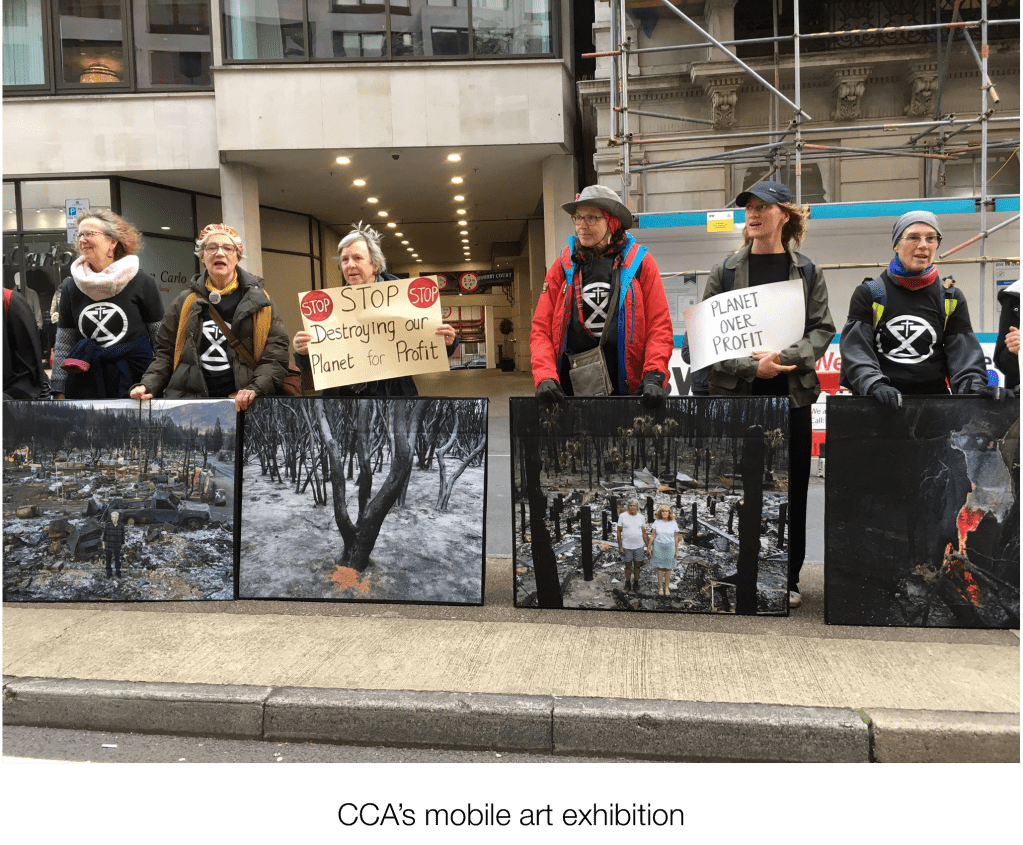
Tuesday CCA again gathered in the street opposite the hotel with a series of photographs – a mobile art exhibition – each an illustration of the effects of wild fire on the environment and people’s lives. Fossil Free London and others blockaded the hotel entrance – the hotel had erected high fences along the whole area restricting the entrance to a meter wide gate way which was  easily blocked by protestors preventing guests from entering or leaving. A samba band played, people sang and chanted, and speeches were delivered – the key speaker was Greta Thunberg. Mid morning a group from Greenpeace abseiled down from a top floor window, unfurling a banner down the front of the hotel. The conference delegates could not have gone unaware of the opposition to their plans for an oil fuelled future. Indeed the CEO of Shell had to make his speech by equivalent of zoom. By the early afternoon the police had imposed a section 14 notice on the street, authorising them to remove all protestors from the site. 

The Christian Climate Action group set off on a pilgrimage around Mayfair stopping to pray at the offices of a number of ‘Earth Wreckers’ – companies involved in financing, supporting or exploiting fossil fuels and thereby directly or indirectly polluting the world with carbon emissions. (For more information about Earth Wreckers visit – http://umap.openstreetmap.fr/en/map/wreckers-of-the-earth-2021_409815#12/51.5222/-0.1234)

On Wednesday action was taken further afield to the City of London. Ten companies associated with the West Cumbrian Coal Mine and the East Africa Crude Oil Pipeline were targeted, to protest against their involvement in funding these highly polluting projects. Christian Climate Action together with representatives of other faiths and a group from XR Scientists, peacefully entered and sat down in the foyer of 52 Lime Street – a modern glass and steel tower block that houses Chaucer, the UK subsidiary of China Re and a potential insurer of EACOP. Sat together in the middle of the space – allowing office workers to continue in and out of the building – we sang Buddhist and faith songs and shared an agape of bread and ‘good’ olive oil. 

Within half an hour the police arrived and stood round us, watching. Then with such joy and hope, we saw the XR procession, that was marching between each of the sites, arrive with hundreds of supporters, flags and banners, and a samba band. They waved to us through the plate glass windows and cheered, and we sang and waved back. When they marched on, a contingent from CCA stayed on outside both protesting and praying. The building’s security staff obviously wished us to leave, but the police having taken advice from the CPS, took the view that as our protest was peaceful, they had no grounds for arresting us. After some discussion within the group, we agreed that we would stay until 3 o’ clock. So at 3 o’ clock we stood up, tidied up our banners and picnic lunch and still singing, walked out. We had made our point. 

Despite the rain, we returned to the Intercontinental Hotel that evening for a further act of worship, this time led by various representatives of the Faith Bridge -Buddhist, Muslim, Jewish, Quaker and Christian.

Christian Climate Action continued with its support of other groups on the Thursday, targeting amongst others, the offices of J P Morgan. I meanwhile held my weekly hour long vigil outside Shell’s headquarters. 

For information about Christian Climate Action visit – https://christianclimateaction.org/

Creation-tide – Christian Climate Action and the prophetic role 

17th September 2023

Reflection (readings below)

To be a prophet is not a popular calling. Often the message you have been given by God is not exactly the message that people want to hear. The message is often contradictory, challenging the norm; it may ask for a life-style that is counter cultural, it may be a message that counters the way people  current live  – and are happily living in fact, ‘thank you very much!’

Jeremiah was certainly in that position. The message God asked Jeremiah to deliver was definitely not what the people of Judah wanted to hear. 

Nor was it the message the religious leaders wanted to hear.

Nor was it the message the political leaders, including the King, wanted to hear. 

How is Jeremiah going to get the people to pay attention, how is he going to get them a) to listen to God’s message and b) to respond to it positively?

In the passage we have just heard, Jeremiah takes an earthware jar – a large one I’m guessing – and throws it the ground. (Push a heavy book onto the floor) SMASH! That surely got their attention! And he gives them God’s message. 

Why am I telling you this? Because I see the role of the climate activist as being like that of a prophet. The climate activist has a message to deliver, a message that people do not necessarily want to hear because it is asking them to make changes in their lifestyle, to change the way they relate to other people, to change the way they relate to other creaturely beings, to change the way they relate to the entirety of God’s creation. 

Is the climate activist’s message a message from God or just a repetition of what the scientists are saying? From the very beginning we are told that the earth is the work of God, that God created all that exists in its beauty and diversity, and declared it to be good. And we are also told that God specially created humans to have a very particular role within creation: to tend and care for the earth, working with and for the wellbeing of the other beings that God has created. The unfolding drama of the Bible, especially in the books of the prophets, tells us that when we live in harmony with God’s will, the earth is a place of flourishing. And when we go astray and live in disharmony with God, then the earth becomes a place of desolation – crops fail, animals and people die, rivers dry up, and warfare and illness stalk the land. For the Christian climate activist, the message they bear is definitely one from God; it is based on prayer and on the study of both scripture and scientific research.

As a Christian climate activist, I endeavour to speak God’s truth, to call out injustice, and to call on people – whether as individuals or as organisations – to pay attention to the crisis creation faces and to reorientate their way of living – shaping it as God wills. Like the prophets, I have engaged in nonviolent direct action to get the message across. I have knelt in prayer outside Shell’s headquarters, I have petitioned my MP, I have marched on the streets, I have been arrested for obstructing the highway, I have written a blog, I have preached, I have knelt in the cathedral and had my hair cut off as a sign of penitence. Other Christian activists have gone further and even been sent to prison for the non violent disruptive actions they have taken in the cause of safeguarding creation. That is something Jeremiah also encountered. At one point he was even imprisoned in a pit by his opponents.

But is disruptive action in line with the teaching, the example, of Jesus? 

Think back to our gospel reading. Can you imagine the scene? Here is Jesus riding on a donkey – one that has been rather oddly purloined for him – riding slowly into Jerusalem whilst all around his followers are pulling branches from the trees and taking off their garments to cover the road. And all the time they are doing this, they and the crowd are shouting slogans, slogans that challenge the religious status quo and the political status quo! What is Jesus doing if not being disruptive? And does he stop when those in authority ask him to? No way! This is the word from God. Even if the people were to be silent, then the very stones would take up the message!!

This is one example, but throughout the gospels we see and hear Jesus carrying out actions that challenged the status quo. He healed the sick on the sabbath. He touched the unclean. He brought in the outsider. He preached a message which turned the economics of the day upside down. He fed the hungry. He inaugurated a meal that demonstrated that in him is the divine source of life. He provoked the authorities to seek his execution and even in death challenged them to see the world differently.

Prophets do not just highlight what is going wrong, they also point to what is possible, to the vision of how God wishes and desires things to be. John – the John who is named as the writer of the Book of Revelation –  knows of the evils and destructive habits of the world of which he is a part, but he is also aware that God envisages something far better – a new heaven and a new earth in which no evil resides, in which all live in harmony with God. Climate activists too have a vision to share of a new and possible future. A world of clean energy. A world of homes well insulated against the cold and the heat respectively.  A world in which there is enough good food for everyone. A world in which resources are shared fairly and used sustainably. Indeed a world where everyone lives in harmony just as God desires. 

To be a climate activist is a prophetic calling. It is, I think, a calling that is more widespread than many people would believe. But if one looks at the state of the world, the enormity of the crisis we face, the scale of social injustice being created, then actually we should not be surprised that God is calling more and more of us to take on the prophetic role and become climate activists.  Maybe this creation-tide you will find yourself moved by God to become a  climate  activist. 

Jeremiah 19:1-6, 10-13

Thus said the Lord: Go and buy a potter’s earthenware jug. Take with you some of the elders of the people and some of the senior priests, and go out to the valley of the son of Hinnom at the entry of the Potsherd Gate, and proclaim there the words that I tell you. You shall say: Hear the word of the Lord, O kings of Judah and inhabitants of Jerusalem. Thus says the Lord of hosts, the God of Israel: I am going to bring such disaster upon this place that the ears of everyone who hears of it will tingle. Because the people have forsaken me, and have profaned this place by making offerings in it to other gods whom neither they nor their ancestors nor the kings of Judah have known, and because they have filled this place with the blood of the innocent, and gone on building the high places of Baal to burn their children in the fire as burnt-offerings to Baal, which I did not command or decree, nor did it enter my mind; therefore the days are surely coming, says the Lord, when this place shall no more be called Topheth, or the valley of the son of Hinnom, but the valley of Slaughter. 

 Then you shall break the jug in the sight of those who go with you,  and shall say to them: Thus says the Lord of hosts: So will I break this people and this city, as one breaks a potter’s vessel, so that it can never be mended. In Topheth they shall bury until there is no more room to bury.  Thus will I do to this place, says the Lord, and to its inhabitants, making this city like Topheth.  And the houses of Jerusalem and the houses of the kings of Judah shall be defiled like the place of Topheth—all the houses upon whose roofs offerings have been made to the whole host of heaven, and libations have been poured out to other gods.

Revelation 21:1-4

Then I saw a new heaven and a new earth; for the first heaven and the first earth had passed away, and the sea was no more. And I saw the holy city, the new Jerusalem, coming down out of heaven from God, prepared as a bride adorned for her husband. And I heard a loud voice from the throne saying,

‘See, the home of God is among mortals.
He will dwell with them;
they will be his peoples,
and God himself will be with them;

he will wipe every tear from their eyes.
Death will be no more;
mourning and crying and pain will be no more,
for the first things have passed away.’

Luke 19:29-40

When he had come near Bethphage and Bethany, at the place called the Mount of Olives, he sent two of the disciples, saying, ‘Go into the village ahead of you, and as you enter it you will find tied there a colt that has never been ridden. Untie it and bring it here.  If anyone asks you, “Why are you untying it?” just say this: “The Lord needs it.”’  So those who were sent departed and found it as he had told them.  As they were untying the colt, its owners asked them, ‘Why are you untying the colt?’  They said, ‘The Lord needs it.’ Then they brought it to Jesus; and after throwing their cloaks on the colt, they set Jesus on it. As he rode along, people kept spreading their cloaks on the road. As he was now approaching the path down from the Mount of Olives, the whole multitude of the disciples began to praise God joyfully with a loud voice for all the deeds of power that they had seen, saying,

‘Blessed is the king
    who comes in the name of the Lord!
Peace in heaven,
    and glory in the highest heaven!’

Some of the Pharisees in the crowd said to him, ‘Teacher, order your disciples to stop.’  He answered, ‘I tell you, if these were silent, the stones would shout out.’

Green Tau: issue 65

6th March 2023

In the last Green Tau I wrote about Ash Wednesday and penance: ‘Maybe our penance – the penance for those who see the harm we have as humans have caused – is raise the cry, to sound the alarm, to be prophetic, so that others too can be called to account.’

Yesterday across the UK, Christian Climate Action held a day of action in which Christians around the country visited their local cathedral (Church of England and Catholic) to either thank their diocese for making a fossil fuel divestment commitment or ask them to do so as a matter of urgency.

I joined one such group attending the service at Southwark Cathedral. At the notices, at the end of the service, I got up and knelt on the dais steps and began to cut of my hair. (My son then took over the cutting). At the same time my husband went to the lectern where the sub Dean who was presiding at the service allowed him to read out a statement explaining the action (see below). Meanwhile others from Christian Climate Action stood on the dais with a long  banner that read:  “C of E Divest Now from Fossil Fuels.” When Paul finished the congregation applauded. We all walked to back of the cathedral whilst the sub Dean called for a time of silent prayer before giving the remaining notices. 

“Today Christian Climate Action is calling upon Southwark diocese to rid itself of all investments that finance the fossil fuel industry and its destructive activities, and instead to make investments which will safeguard the environment and benefit our neighbours.

As a member of Southwark diocese, Judith is cutting off her hair today as a sign of penitence, in this season of Lent. With grief and alarm Christian Climate Action members accept that we have been complicit in both causing the climate crisis and in benefitting financially from the profits of the fossil fuel industries. We have between us unsustainably eaten meat, driven petrol cars, taken air flights, and used gas central heating. We have variously had mortgages, received home insurance payouts and received pensions, all financed in part by fossil fuel investments.

And we repent. All our actions have contributed to the deep and widespread damage being caused to God’s creation. We have failed to love our neighbour – both here in London and as far away as the island of Vanuatu in the Pacific. We have failed to tend and care for the earth – the one role God gave us in the Garden of Eden.

Yet we believe God does not turn away from us. Rather God invites us to try again. Thank you for listening to this addition to today’s notices. We would be happy to meet and discuss further our urgent call for divestment from fossil fuels, both with the Bishops of Southwark and with other members of the diocese.”

Afterwards talking with the sub Dean, the  Revd Canon Michael Rawson

Green Tau issue 48

Lambeth Conference: Environment and Sustainable Development 

12th August 2022

Every ten years (or thereabouts) all the bishops of the Anglican Communion meet together as the Lambeth Conference at the invitation of the Archbishop of Canterbury. Their meeting this year was the 15th such gathering with over six hundred bishops – and spouses – convening from all parts of the globe: Alaska, Australia, Brazil, South Sudan, the Philippines, Scotland, India and the Solomon Islands, and more. (Sadly the bishops of Nigeria, Rwanda Uganda declined to attend).   

The theme of the conference has been ‘God’s Church for God’s World – walking, listening and witnessing together.’  In fact the conference begins before the bishops arrive with the preparation of a document called ‘Lambeth Calls’. On each issue to be discussed at the conference a  paper – or “call” – is drafted by a group made up of bishops, clergy and laity from around the communion led by a Primate or senior bishop. Each Call includes:

  • A declaration, summarising what the Christian Church has always taught about these matters.
  • An affirmation, summarising what the bishops want to say on these matters in the present time.
  • Specific requests (The Calls) to future witness, sharing actions or challenges that the bishops want to give to each other, to fellow Christians and to the world.

Within each ‘Call’ there are be matters to discuss and decisions to be made. It may be that not all bishops will want to add their voices to every element of every call. As has always been the case at every Lambeth Conference bishops will confer together but they will not necessarily agree on everything. And the work of the conference continues after each participant has returned home as matters are taken forwards. https://www.lambethconference.org/programme/lambeth-calls/

The conference itself takes place in Canterbury but midway everyone travels to London for a day at Lambeth Palace. The focus for this day was the Environment and Sustainable Development. You can read the material prepared for this day here, pages 19 to 21 –  https://www.lambethconference.org/wp-content/uploads/2022/07/Lambeth-Calls-July-2022.pdf The Call clearly states the biblical imperative that humans should care for all creation, as well as being honest about the crisis we now face – 

“the triple environmental crisis of climate change, biodiversity loss and pollution is an existential threat to millions of people and species of plants and animals across the globe. The Intergovernmental Panel on Climate Change (IPCC) has warned that it is “code red for humanity”; “It’s now or never, if we want to limit global warming to 1.5°C”. Drastic action is needed in the next three years to bring down greenhouse gas emissions.” 

The Call also addresses the need to take action – “With crisis comes opportunity: for the Church to listen to God’s voice, to imagine how the world could be different, and to help build towards God’s Kingdom” – and is realistic about the lack of time available. “By the next Lambeth Conference, increasing areas of the Communion will be uninhabitable, because of drought, rising sea levels and other impacts as we reach tipping points in climate change. Meanwhile despite these terrible realities, carbon emissions continue to rise and there are over 50,000 new fossil fuel developments in the pipeline. Our oceans and rivers are clogged with plastic and people are choking and dying from polluted air. The web of life is becoming so damaged by the loss of biodiversity that the integrity of creation is under threat.” 

The Call then moves on to action that needs to be taken:-

“We call on world leaders to:

1. Enact bold and urgent policy changes, including:

• achieving net-zero carbon emissions as soon as possible to limit the global average temperature rise to 1.5 degrees above pre-industrial levels.

• fulfilling and substantially increasing their commitments to climate finance, including for loss and damage due to climate change.

• halting new gas and oil exploration.

• protecting and restoring biodiversity and tackling pollution.

2. Challenge wealthier nations and those with greatest responsibility for climate change to take the lead on climate action and just financing for other countries to reduce emissions.”

Those assembled to hear, think and talk about these pressing issues included those from communities already suffering the dire consequences of the climate crisis, those from communities who have historically been most responsible for the causes, those who have most to offer by means of practical and financial help, and those least able. As such the Anglican Communion can, together, speak from a basis of lived experience. This does not make the dilemmas any less tractable. Certainly some of the bishops spoke from experience when they highlighted the dangers of speaking out against the views of both governments and big business. For some communities the idea of living within reliance on fossil fuels seems a near impossible ask. 

I spent the day outside the Palace with Christian Climate Action actively praying that the outcome of the day would be that bishops would have a clear understanding of the need to end reliance on fossil fuels and to address the global injustices of climate change. In advance of the day, CCA had contacted all the bishops, highlighting these concerns and inviting them to share in a prayerful response. 

One of the bishops from South Sudan in turn asked for support for his campaign to protect Africa’s largest wetland, The Sudd. Fed by the White Nile this area floods each year providing a wetland habitat for a diversity of wildlife as well as provide irrigation and subsequent rainfall for the grasslands surrounding the wetland that supports pastoral farming. The future of this wetland is threatened by a project to build a 300km  canal that bypasses the Sudd, transferring the flood waters to the northerly reaches of the Nile. 

It was encouraging when some of the bishops as they passed on their way into  – and at the end of the day, out off – the Palace diverted to talk with us or wave a hand to show their support. Some revelled in having their photos taken with the CCA banners as a back drop! From those who talked and prayed with us we learnt more of the issues that they face. In seeing such numbers of people – many dressed in brilliant colours reflecting their national identity – we were made aware of the scope and scale of this global crisis.

And the outcome of the day? Bishops spoke of heating at first hand from their colleagues about the effects of the climate. Hopefully it was a means to greater understanding and empathy, and a spur to more incisive action. At a corporate level, the day saw the launch of The Communion Forest – “a global initiative comprising local activities of forest protection, tree growing and eco-system restoration undertaken by provinces, dioceses and individual churches across the Anglican Communion to safeguard creation.”

In the run up to the Lambeth Conference, the Vatican signed up to the call for a Fossil Fuel Non Proliferation treaty  – https://fossilfueltreaty.org/vatican There was perhaps a hope that the Anglican Communion might have taken the opportunity of echoing this. At their conference earlier this year, the call for this treaty was endorsed by various faith groups including the Methodist Church of Great Britain. Other signatories include Green Christian UK, Anglican Church of Southern Africa Environment Network, Interfaith Scotland, North Carolina Council of Churches,  Operation Noah, Quaker Earthcare Witness. 

In his final key note speech Justin Welby said of the Lambeth Calls, “They are not an end in themselves. They are an appeal to each  Church and Province, and  Bishop and Diocese, to every Anglican, to be more visibly the people of God…” This then is where we can take action.As individuals we can sign this call for a Fossil Fuel Non Proliferation treaty; we can ask our churches to sign; we can ask our diocese to sign – and do so with reference to the Lambeth Call for the Environment and Sustainable Development. Step by step, piece by piece we can work together for the care of creation. 

Later in the same speech he said, “The Church, salt and light, courageous in prophetic utterance, gracious yet clear, is not another NGO: it is God’s chosen means of shining light in the darkness…This is not the church getting involved in politics. It’s the church getting involved in God. “

See also https://christianclimateaction.org/2022/08/04/bishops-at-lambeth-conference-join-protestors-calling-for-climate-action-from-the-anglican-church/