Counting on … day 207

18th December 2025

How do we see the impact of exceeding the planetary boundaries for fresh water?

“Climate change has become the main global driver of freshwater disruption. A warmer atmosphere holds more moisture and changes how and where rain falls, leading to more intense floods in some regions and severe droughts in others. These shifts are transforming long-established rainfall and river patterns, creating new and unpredictable hydrological conditions that put pressure on both ecosystems and human societies.” (1)

A disruption in rainfall patterns can mean either more or less rain than usual, or more rainfall but less often so that rainfall is more intense. This can lead to the drying out of wetlands, the lowering of lake and river levels and the disruption of the ecosystems those water features supported. In the Amazon basin we are seeing river levels drop significantly impacting local communities and their livelihoods and destabilisation of the rainforest such that trees, plants and creatures are lost.

Disruption means loss of soil moisture. Not only does this impact plant growth and thus a whole food chains, it also makes landscapes more vulnerable to droughts and wildfires. The UK saw a record number of wildfires this year.

Excessive amounts of rainfall over a prolonged period, or concentrated into a short time frame, causes extreme flooding that disrupts habitats, destroys infrastructure, displaces people, erodes soils and causes devastating landslides. We have seen many examples of this in the recent Asian super typhoons. 

Disruption to normal rainfall patterns leads to water scarcity. A lack of rain depletes water supplies, whilst infrequent intense rainfall runs quickly of the land, again failing to restore water stocks in reservoirs and rivers. Warmer winters diminishes the replenishment of glaciers, and increase the rate at which they melt. Together this reduces the flow of water into rivers during summer periods aggravating water scarcity.  Both in Iran and in South Africa, whole communities are face a complete lack of drinking water as droughts combine with atypical rainfall patterns. 

  1. https://www.planetaryhealthcheck.org/boundary/freshwater-change/

Counting on … 197

2nd December 2025

The imbalance of the nitrogen cycle also causes air pollution. Whilst nitrogen based fertilisers in the soil and water are being consumed by various microbes, processing nitrites in to become a nitrates which can be absorbed  by the plants, nitrogen oxide (NO) is released as a bi-product. (1)

Nitrogen oxide, like carbon dioxide, is a greenhouse gas, but with 300 times the warming potential. 

Nitrogen  oxide readily reacts with other gases in the atmosphere to form nitrogen dioxide which is a healthy hazard inflaming airways and increasing susceptibility to respiratory infections and allergens.

Together nitrogen oxide and nitrogen dioxide are nitrous oxides or NOx. (2)

Whilst agriculture is the main source of nitrous oxides, they are also emitted  through the burning of fossil fuels – including from petrol and diesel power vehicles, diesel powered shipping and railway engines,  and from aviation. 

(1) https://www.bbc.co.uk/future/article/20210603-nitrous-oxide-the-worlds-forgotten-greenhouse-gas

(2) https://www.gov.uk/government/statistics/emissions-of-air-pollutants/emissions-of-air-pollutants-in-the-uk-nitrogen-oxides-nox

(3) https://ourworldindata.org/emissions-by-sector

Counting on … 189

18th  November 2025

Oceanic tipping points

The oceans redistribute cold and warm water across the globe influencing winds – both direction and intensity – and weather patterns. Ocean currents enable the flow of water from hotter to cooler areas (tropics to the poles) and by the flow of water between areas of higher to lower salt density. Here in the UK we particularly benefit from the warmth that the Atlantic currents bring giving us mild winters and year round rainfall. 

The driving force for these ocean currents lies in the artic regions. The density of the cold, saline rich waters causes the waters here to sink and as they do this pulls in warmer waters from the tropics. However as  sea ice and icecaps melt, so the water becomes less salty, and less inclined to sink, reducing the energy that pulls the oceanic currents. In the North Atlantic this driving force is known as  the Atlantic Meridional Overturning Circulation or AMOC.

Here in the UK, our climate and weather patterns are highly dependent on the functioning of AMOC. If this slows or becomes unstable, it will impact temperature and rainfall patterns cross Europe and giving us in the UK and Northern Europe a much colder, wetter climate. And at the same time changing the climate in southern Europe, making it hotter and dryer. 

This graphic comes from the IPCC 6th Assessment Report (https://www.ipcc.ch/report/ar6/wg1/figures/chapter-9/faq-9-3-figure-1)

Whilst there are signs that AMOC is weakening, it is hard for predict quite how quickly and to what degree it will change as global temperatures rise. On the other hand the potential damage a change in AMOC will cause, should make decision-makers focus on avoiding that as a matter of urgency. 

“The risk of a critical AMOC transition is real and very serious, even if we cannot confidently predict when and whether this will happen. We have already left behind the stable Holocene climate in which humanity has thrived (Osman et al., 2021), and the latest IPCC report warns us that beyond 1.5°C of global warming, we move into the realm of “high risk” with respect to climate tipping points (IPCC, 2023).” (1)

(1) – https://tos.org/oceanography/article/is-the-atlantic-overturning-circulation-approaching-a-tipping-point

Further information. This webpage depicts what the climate and weather patterns might be like if the AMOC collapses, an event it suggests could happen by 2050 if global temperatures rise by 2+C – https://amocscenarios.org/?lat=45&lon=-5&model=cc_RCP45&is_amoc_on=false&is_delta=false&metric=warm_days

Counting on … 185

12th November 2025

Cutting methane emissions is clearly a quick and important way of reducing the short term damaging effect of greenhouse gas emissions, but unless emissions from fossil fuels are also tackled, the climate crisis will only increase. National governments and fossil fuel companies need to legislate and implement (respectively) plans to end fossil fuel production. Yet unbelievably across the world countries are still planning to further expand fossil fuel production! 

“The increases in fossil fuel production estimated under the government plans and projections pathways would lead to global production levels in 2030 that are 500%, 31%, and 92% higher for coal, oil, and gas, respectively, than the median 1.5ºC-con­sistent pathway.” (1) 

The International Energy Agency itself reported in 2021 that there was no need for new developments: sufficient oil and gas production is already in place to meet global needs as the world transitions to renewable energy. (2)

Clearly this is an issue that needs to be addressed during COP30. 

  1. https://productiongap.org/2025report/
  2. https://www.iea.org/reports/net-zero-by-2050

Counting on … 184

11th November 2025

CO2 is the main GHG but methane is another, particularly potent, GHG. Methane doesn’t last as long in the atmosphere (ten to twelve years compared with hundreds or even thousands of years for carbon dioxide) but its warming effect is greater than that of carbon dioxide – as much as 80% more. (1)

40% of methane emissions are natural; 60% are manmade. Methane levels are now two-and-a-half times greater than pre-industrial levels. 

Methane levels are still rising but clearly if emissions were curtailed it would help address the short term impact of climate change and rising temperatures. Frustratingly the IEA reports that “around 40% of today’s methane emissions from fossil fuels could be avoided at no net cost” (2) Methane emissions from fossil fuels can be reduced by reducing flaring and venting and by curtailing leaks! NB Natural gas is 80-95% methane.

To date methane emissions reduction has been via voluntary pledges, which are not tackling the problem. This is something that needs to be addressed during COP30. “ Durwood Zaelke, the president of the Institute for Governance and Sustainable Development, said countries must sign a new global agreement on methane rather than sticking with the non-binding pledge. “With emissions still high, the voluntary pledge is clearly not enough to keep us from passing the fast-approaching tipping points,” he said. “We need a more muscular binding methane agreement.” (3) 

  1. https://energy.ec.europa.eu/topics/carbon-management-and-fossil-fuels/methane-emissions_en

(2) https://www.iea.org/reports/global-methane-tracker-2024/key-findings

(3) https://www.theguardian.com/environment/2025/nov/10/rich-countries-have-lost-enthusiasm-for-tackling-climate-crisis-says-cop30-chief?CMP=Share_iOSApp_Other

Counting on … 183

10th November 2025

COP30 starts this week in Belém, Brazil. Global greenhouse gas emissions are continuing to rise as are global temperatures. The real hope is the all the parties will agree to transition rapidly away from fossil fuels – fossil fuels are the single biggest cause of greenhouse gas emissions. Unless they are eliminated, there is no way we can curb, let alone rein in, rising global temperatures and all that that will do to destroy the ecosystems in which we rely.

The main greenhouse gas, and one most easily measured, is carbon dioxide. Carbon dioxide in the atmosphere keeps in heat. Without some CO2 in the atmosphere our planet would be very cold. 

CO2 levels in the atmosphere (measured in parts per million) have varied throughout geological time. This graph (1)  shows atmospheric carbon dioxide concentrations in the atmosphere over the last 800,000 years (red line). CO2 levels were lower during the ice ages, and higher during the warmer interglacial periods. During this entire era, CI2 levels never exceeded 300 PPM until the modern era. The graphic also shows the differences  global temperatures above and below the mean – the temperature anomaly.

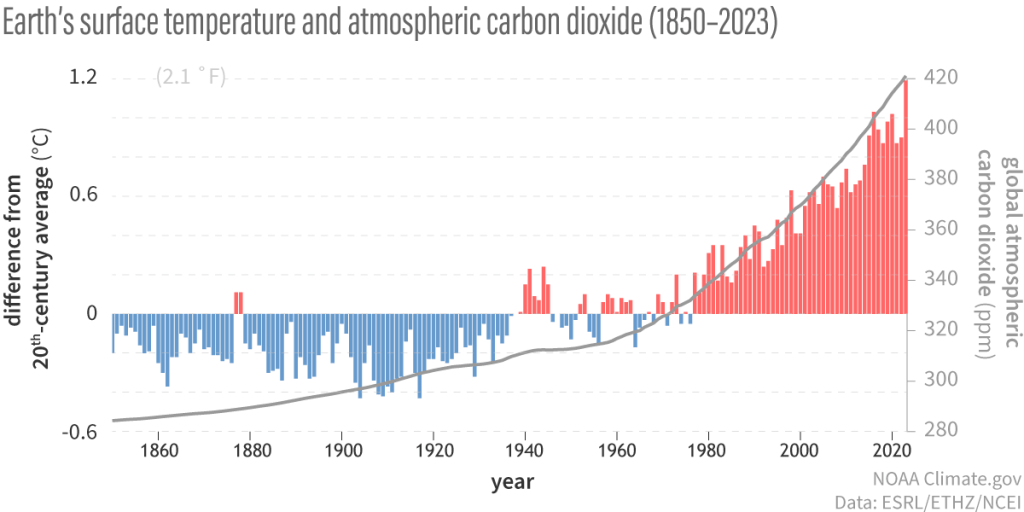
There is a clear correlation between CO2 levels and temperature fluctuations. But more significantly the graph shows how rapidly both CO2 levels and temperatures are rising. It is a rate of change that is not due to natural deviations but to the impact of human activity. 

 (1) – https://theconversation.com/the-three-minute-story-of-800-000-years-of-climate-change-with-a-sting-in-the-tail-73368

9th November 2025

Reflection with readings below

The first chapter of the book of Haggai is set a month before today’s passage. In it Haggai is told by God that it is not yet time to rebuild the Lord’s house. But then God speaks again asking Haggai to consider the wellbeing of the people – they have planted much but harvested little; they have something to drink but not enough to satisfy their thirst; they have clothes but not enough to keep warm. And God says “Give careful thought to your ways.”

It seems that God is setting the ground – maybe enacting a parable – that challenges the people to understand that there are different ways of living. They can live according to the ways of the past, of convention, which don’t  satisfy their needs, or they can live according to the ways of God which will satisfy all their needs. And so it is in the next month that God’s word to Haggai calls on the people to restore God’s house and so restore their own well-being – and handsomely so with much wealth!

For the people of Judah, the temple was the house of God that had been destroyed by the Babylonian invaders. Now that some of those exiled to Babylon have returned to Jerusalem, the desire is to rebuild the temple. But for us in the 2st century might we rather consider the Earth as being God’s house? 

“The God who made the world and all things in it, since He is Lord of heaven and earth, does not dwell in temples made with hands” Acts 17:24 

And if we look at the Earth as God’s temple, do we see it as a place that has been well cared for, a place of peace and beauty? Or do we see a place that is broken and damaged, and in need of repair? 

When we look at the wellbeing of our fellow creatures (human and nonhuman)do we not see communities that do not have enough to eat and drink, that do not have adequate clothing and protection? Could that be because we are not living in accordance with God’s ways?  Are we misusing the world’s resources such that the needs of many are not satisfied? Surely it is therefore time to reassess and redirect the way we live? 

Absolutely! Time and again we hear scientists warning us that our continued use of fossil fuels and of greenhouse gas emitting practices is continuing to fuel the climate crisis. We are now on track for more than 2C of warming. This will ensure brings even more extreme weather events – droughts, storms, wild fires and hurricanes such as Melissa last week – more food shortages (over the last three years, British farmers have lost the equivalent of a year’s supply of bread because of adverse weather affecting harvests) – more deaths from excess heat, the increasing loss of species and destruction of delicate ecosystems, etc. 

We also hear social welfare and justice campaigners telling us that the gap between rich and poor is growing; that people’s lives are being diminished not because the resources aren’t there, but because they are not being made available; that they are not being shared fairly. We hear that mental ill health is rocketing;  that corporate power is trumping democracy; that the justice systems favours governments over individuals, and big businesses over everyone. Injustice is endemic world wide.

And we hear of governments ignoring the warning signs, of governments focusing on those with loudest voices, of governments focusing on the next election not our corporate long term survival. Next week COP30 begins its deliberations. Participating nations knew well in advance that they would have to come to this meeting with updated plans to reduce their national emissions in line with the net zero targets.  In fact they have known this since the  signing the Paris Agreement in 2015. Yet many have not even submitted a plan, and of those that have, none have been sufficiently ambitious to keep the world on track to avoid even a 2C rise in temperatures!

Absolutely it is time to reassess and redirect the way we live.

Haggai 1:15b-2:9

In the second year of King Darius, in the seventh month, on the twenty-first day of the month, the word of the Lord came by the prophet Haggai, saying: Speak now to Zerubbabel son of Shealtiel, governor of Judah, and to Joshua son of Jehozadak, the high priest, and to the remnant of the people, and say, Who is left among you that saw this house in its former glory? How does it look to you now? Is it not in your sight as nothing? Yet now take courage, O Zerubbabel, says the Lord; take courage, O Joshua, son of Jehozadak, the high priest; take courage, all you people of the land, says the Lord; work, for I am with you, says the Lord of hosts, according to the promise that I made you when you came out of Egypt. My spirit abides among you; do not fear. For thus says the Lord of hosts: Once again, in a little while, I will shake the heavens and the earth and the sea and the dry land; and I will shake all the nations, so that the treasure of all nations shall come, and I will fill this house with splendour, says the Lord of hosts. The silver is mine, and the gold is mine, says the Lord of hosts. The latter splendour of this house shall be greater than the former, says the Lord of hosts; and in this place I will give prosperity, says the Lord of hosts.

Psalm 145:1-5, 18-22

1 I will exalt you, O God my King, *
and bless your Name for ever and ever.

2 Every day will I bless you *
and praise your Name for ever and ever.

3 Great is the Lord and greatly to be praised; *
there is no end to his greatness.

4 One generation shall praise your works to another *
and shall declare your power.

5 I will ponder the glorious splendour of your majesty *
and all your marvellous works.

18 The Lord is righteous in all his ways *
and loving in all his works.

19 The Lord is near to those who call upon him, *
to all who call upon him faithfully.

20 He fulfils the desire of those who fear him; *
he hears their cry and helps them.

21 The Lord preserves all those who love him, *
but he destroys all the wicked.

22 My mouth shall speak the praise of the Lord; *
let all flesh bless his holy Name for ever and ever.

2 Thessalonians 2:1-5, 13-17

As to the coming of our Lord Jesus Christ and our being gathered together to him, we beg you, brothers and sisters, not to be quickly shaken in mind or alarmed, either by spirit or by word or by letter, as though from us, to the effect that the day of the Lord is already here. Let no one deceive you in any way; for that day will not come unless the rebellion comes first and the lawless one is revealed, the one destined for destruction. He opposes and exalts himself above every so-called god or object of worship, so that he takes his seat in the temple of God, declaring himself to be God. Do you not remember that I told you these things when I was still with you?

But we must always give thanks to God for you, brothers and sisters beloved by the Lord, because God chose you as the first fruits for salvation through sanctification by the Spirit and through belief in the truth. For this purpose he called you through our proclamation of the good news, so that you may obtain the glory of our Lord Jesus Christ. So then, brothers and sisters, stand firm and hold fast to the traditions that you were taught by us, either by word of mouth or by our letter.

Now may our Lord Jesus Christ himself and God our Father, who loved us and through grace gave us eternal comfort and good hope, comfort your hearts and strengthen them in every good work and word.

Luke 20:27-38

Some Sadducees, those who say there is no resurrection, came to Jesus and asked him a question, “Teacher, Moses wrote for us that if a man’s brother dies, leaving a wife but no children, the man shall marry the widow and raise up children for his brother. Now there were seven brothers; the first married, and died childless; then the second and the third married her, and so in the same way all seven died childless. Finally the woman also died. In the resurrection, therefore, whose wife will the woman be? For the seven had married her.”

Jesus said to them, “Those who belong to this age marry and are given in marriage; but those who are considered worthy of a place in that age and in the resurrection from the dead neither marry nor are given in marriage. Indeed they cannot die anymore, because they are like angels and are children of God, being children of the resurrection. And the fact that the dead are raised Moses himself showed, in the story about the bush, where he speaks of the Lord as the God of Abraham, the God of Isaac, and the God of Jacob. Now he is God not of the dead, but of the living; for to him all of them are alive.”

Counting on … 179

4th November 2025

Planetary Health Diet

The EAT-LancetCommission is a global, interdisciplinary group of world-leading researchers with expertise in nutrition, health, agriculture, sustainability, social justice, and policy – working together towards a healthy, sustainable, and just food system. (1) In 2019 this group’s research developed the Planetary Health Diet being a diet that is both healthier for us and for the planet.  It is a dietary outline that can be adapted to suit different cultural traditions and different social contexts – in other words it is a diet that everyone could follow with out difficulty. 

“The PHD is rich in plants: whole grains, fruits, vegetables, nuts, and legumes comprise a large proportion of foods consumed, with only moderate or small amounts of fish, dairy, and meat recommended.” (2)

This year their research was updated producing the 2025 EAT-Lancet Commission Report. This report demonstrates that the PHD could both bring the human behaviour back within safe planetary boundaries as well as cutting greenhouse gas emissions. 

This 2025 report outlines eight areas where transformation can lead to positive outcomes.  Protect and promote traditional healthy diets –

  • Create accessible and affordable food environments that increase demand for healthy diets
  • Implement sustainable production practices that store carbon, create habitat, and improve water quality and availability
  • Halt agricultural conversion of intact ecosystems
  • Reduce food loss and waste
  • Secure decent working conditions across the food system
  • Ensure meaningful voice and representation for food systems workers
  • Recognise and protect marginalised groups (3)
  1. https://eatforum.org/eat-lancet

(2) https://eatforum.org/eat-lancet/the-planetary-health-diet/

(3) https://eatforum.org/update/eat-lancet-commission-warns-food-systems-breach-planetary-limits/

Green Tau: issue 114

2nd September 2025

The IMF and Carbon Debt

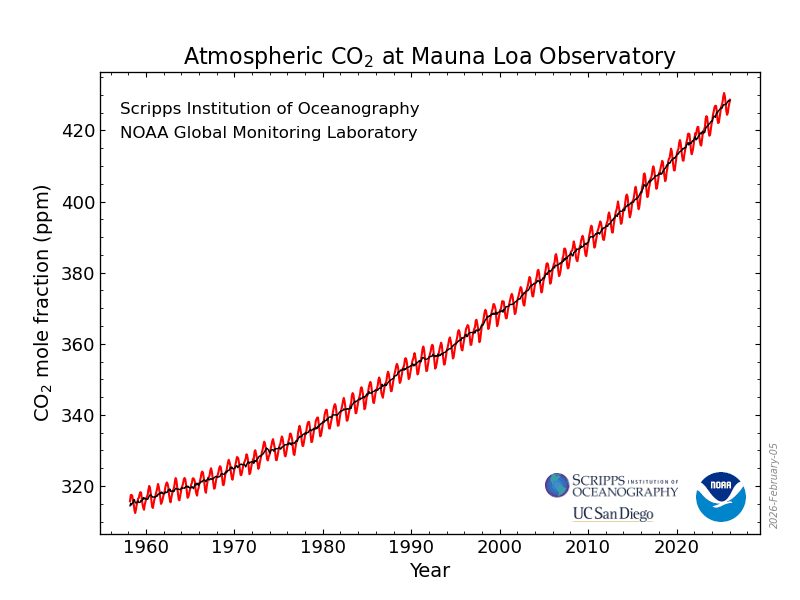
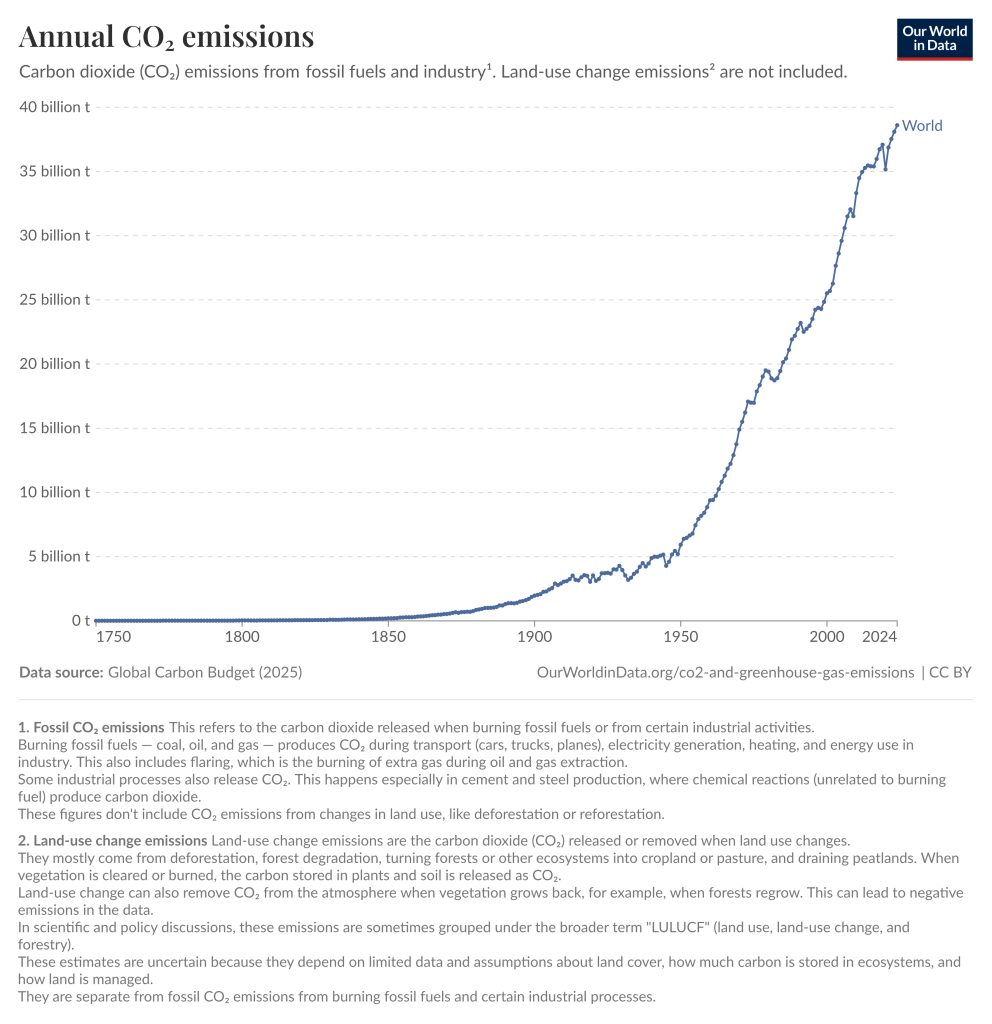
The rising temperatures we are now witnessing cone not just from the CO2 currently being emitted but also the accumulation of CO2 over the centuries. Carbon dioxide stays in the atmosphere for anywhere between 300 and 1000 years, constantly acting as a blanket keeping in the sun’s warmth. For humans and the environment that best suits us, the ideal amount of CO2 in the atmosphere is between 280 and 350 parts per million (ppm). That was the level prior to the industrial revolution when we began significantly increasing the emission of carbon dioxide beyond the Earth systems capacity to absorb the extra CO2. Carbon dioxide levels in the atmosphere now stand at 425 ppm, reflecting the continued and increasing emission of CO2. 

Countries that industrialised first have been contributing to this problem for some 175+ years. Newly industrialised countries for a shorter time span. The amount produced by countries in both scenarios varies reflecting degrees of heavy industry, levels of consumer consumption, dependency on fossil as opposed to alternative fuels etc. Each country can be judged to have a ‘climate debt’ according to how much carbon dioxide it has cumulatively contributed towards global warming since industrialisation. The debt can be costed in terms of what proportion of the negative costs of climate change – its  adverse effects on health, the  cost of adverse weather events, etc. 

According to the IMF’s report, Settling the Climate Debt (2023)  “It can be argued that each global citizen has an equal right to an environment unaffected by climate change. This implies that countries with high climate debt because of their high emissions should compensate countries that have caused less damage to the environment.” (1) And clearly if countries fail to curb their emissions, that debt will be constantly increasing. 

The report also attempts to put figures to show the scale of the debt. “Climate debt can be estimated based on actual and projected emissions and the social cost of carbon, which measures the economic damage per ton of CO2 emissions. We find climate debt to be extremely large—some $59 trillion over 1959–2018 (Chart 1)—and projected to increase by another $80 trillion during 2019–35. The size of each country’s climate debt reflects both the size of its economy (which is positively correlated with emissions) and how intensively it uses fossil fuels (thus generating emissions) for every dollar of economic output. The composition of energy use (for example, heavy use of coal) has an impact as well. As of 2018, the largest contributors were the United States ($14 trillion), China ($10 trillion), and Russia ($5 trillion).  Beginning in 2018, developing economies will account for a larger share of climate debt, given their relatively higher economic growth.” 

These figures are large. The report notes “Climate debt is substantial relative to government debt; in G20 countries, it is about 81 percent of GDP, compared with average general government debt of 88 percent of GDP in 2020.” Perhaps for this reason, the report does not suggest ways in which this debt might realistically be repaid to those who have suffered the impact of climate change – and perhaps that was not the purpose of the report. 

Rather the report goes onto explore how countries through their Nationally Determined Contributions, mandated by the Paris Agreement, are in fact reducing their emissions and thus reducing the ongoing rate at which their climate debt is accumulating. The IMF feels hesitant about asking countries both to reduce their emissions (which does come with a cost implication in the short term at least) and asking them to repay their climate debt. The report surmised that “Instead, advanced economies may need to focus on reducing emissions over a longer time period or aggressively compensating developing economies for the damage caused by climate change, including through more generous climate financing.”

However the report does conclude: “Climate debt from CO2 emissions is large and unevenly spread across the world’s economies. The size of the debt—and its disparity among countries—portends contentious discussions on countries’ fair burden in slowing climate change and the level of assistance to developing economies to compensate for these differences.

“Climate debt per capita is projected to be much higher in advanced than in developing economies, even under full implementation of NDCs by G20 countries. This implies that advanced economies may need to make additional efforts to achieve fair burden sharing in the fight against climate change.”

So whilst there is no clear strategy as to how the climate debt should be repaid – and continue to be paid as the impact of our emissions continues – at least there is the acknowledgement that the current situation between those who contributed most to the climate crisis and those who suffer the most, is unfair. 

(1)  https://www.imf.org/en/Publications/fandd/issues/2023/09/settling-the-climate-debt-clements-gupta-liu

Counting on … day 128

26th  August 2025

Base lines shift not only in our psyche but in science too. 

“A heatwave is an extended period of hot weather relative to the expected conditions of the area at that time of year, which may be accompanied by high humidity…[It is] met when a location records a period of at least three consecutive days with daily maximum temperatures meeting or exceeding the heatwave temperature threshold.” (1)

Heatwaves are thus relative rather than absolute. As temperatures have risen, so the threshold for a heatwave has increased. (2) In London the threshold was 26C but as of 2022 it is now set at 28C. We have had four heatwaves this summer in London, so I guess it is possible that the threshold marker will be raised again. 

  1. https://weather.metoffice.gov.uk/learn-about/weather/types-of-weather/temperature/heatwave

(2) https://www.rmets.org/metmatters/shifting-baseline-uk-heatwaves