Those who sow in tears shall reap with joyful shouting.
He who goes to and fro weeping, carrying his bag of seed,
Shall indeed come again with a shout of joy, bringing his sheaves with him. Psalm 126:5-6
In Scandinavia a sheaf of wheat or other grains is saved and put out at Christmas for the birds. If lots of birds come, it is said to presage a good harvest. Maybe it is a reminder that generosity is frequently reciprocal.
A reading from Deuteronomy 24:10-21
When you reap your harvest in your field and have forgotten a sheaf in the field, you shall not go back to get it; it shall be for the alien, for the orphan, and for the widow, in order that the Lord your God may bless you in all the work of your hands. When you beat your olive tree, you shall not go over the boughs again; it shall be for the alien, for the orphan, and for the widow. “When you gather the grapes of your vineyard, you shall not go over it again; it shall be for the alien, for the orphan, and for the widow.
As we prepare for Christmas amidst a rush to buy all that we want and more, let us pray for those from whose labour we gain:
We pray for shop staff and shelf stackers, warehouse workers and delivery drivers:
May their work be rewarding and well rewarded.
We pray for factory hands and machinists, for assemblers and packers:
May their labour be rewarded, their safety ensured.
We pray for farmers and growers, labourers and pickers:
May the fruits of their work be savoured and not be wasted.
We pray for the soil and the water table:
May what is extracted be replenished, may their good health be sustained.
We pray for agricultural live stock – birds, animals and fish:
May they be raised with love and respect and, at their life’s end, with dignity and care.
May we as consumers, always show out thanks and respect for the work of others.
May we be measured in what we buy,
may we be conscientious in caring for what we have,
and may we be generous in passing forward all that we can share.
This is the week of Black Friday, followed by Cyber Monday. Are these the Feast Days of the Consumerist faith? Are they not something that we should be challenging as they encourage people to spend money on things they don’t need and further deplete our limited world resources?
Here is an informative piece from the Ethical Consumer.
As well as making conscious choices about what we buy, we also tread the path of not buying. We live in a consumerist society where the opportunity to buy something is constantly being promoted – buy this new model, or that improved/ upgraded/ repackaged product; indulge yourself with this luxury or that trivial frippery; indulge your pet/ garden/ kitchen; buy this humorous nonsense; buy this upgrade; buy another and save 50%.
Early on I learnt to avoid lifestyle magazines which are really only vehicles for promoting consumption!
It’s not being mean or stingy but rather it is lovely to look at things we have, and think of its history, how long we’ve had it, where or who it originally came from.
The earth is the LORD’s, and the fullness thereof, the world and all who dwell therein. Psalm 24:1
You Lord, are the source of all good things:
We praise you.
You call us to tend and care for your creation:
May we strive to do your will.
You have made us as brothers and sisters with all that lives:
May we live together in peace.
A Reading: Matthew 6: 19-26 The Message
“Don’t hoard treasure down here where it gets eaten by moths and corroded by rust or—worse!—stolen by burglars. Stockpile treasure in heaven, where it’s safe from moth and rust and burglars. It’s obvious, isn’t it? The place where your treasure is, is the place you will most want to be, and end up being.
“Your eyes are windows into your body. If you open your eyes wide in wonder and belief, your body fills up with light. If you live squinty-eyed in greed and distrust, your body is a musty cellar. If you pull the blinds on your windows, what a dark life you will have!
“You can’t worship two gods at once. Loving one god, you’ll end up hating the other. Adoration of one feeds contempt for the other. You can’t worship God and Money both.
“If you decide for God, living a life of God-worship, it follows that you don’t fuss about what’s on the table at mealtimes or whether the clothes in your closet are in fashion. There is far more to your life than the food you put in your stomach, more to your outer appearance than the clothes you hang on your body. Look at the birds, free and unfettered, not tied down to a job description, careless in the care of God. And you count far more to him than birds.”
A reflection on Proverbs 1:10, 13-15:-
If shop windows say,
“Buy all kinds of costly things;
fill your houses with luxury”:
Do not be seduced,
but follow the way of righteous simplicity.
If magazines say,
“Here are the solutions to all life’s problems;
check out this month’s lifestyle”:
Do not be seduced,
but follow the way of righteous simplicity.
If neighbours say,
“Come, be like us,
keep up with our standards”:
Do not be seduced,
but follow the way of righteous simplicity.
If adverts say,
“Enjoy today and
throw away tomorrow”:
Do not be seduced,
but follow the way of righteous simplicity.
If money-makers say,
“Here, make a quick buck;
don’t worry about the risk”:
Do not be seduced,
but follow the way of righteous simplicity.
If businesses say,
“Enjoy what we promise,
forget the environmental cost”:
Do not be seduced,
but follow the way of righteous simplicity.
Merciful God,
protect us from ourselves – our ignorance and our gullibility –
Give us wisdom to discern your truth
and insight to see your ways,
that we may live with simplicity,
enjoying your gifts and sharing your bounty.
Amen.
Praise be to God! For simple things:-
Clean air and the scent of the flowers,
wind that lifts and freshens.
For water, crystal clear or dark as bronze,
now skittering, now languidly flowing.
For trees that grow, ring upon ring,
and bats and beetles and tiny tree creepers.
For the musical interruption of robin and blackbird,
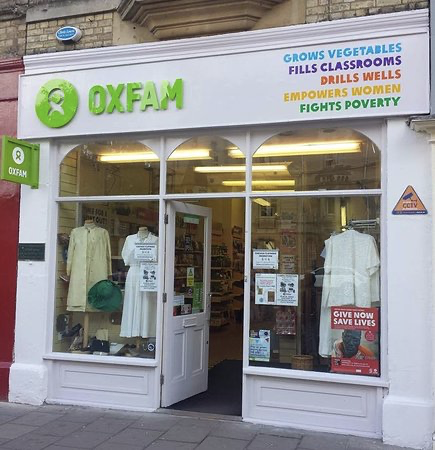
I love the advertising over the Oxfam shop’s front. Here is a shop where your money will grow vegetables, fill classrooms, drill wells, empowers women and fights poverty – wow! With a little thought money can do some amazingly positive things.
Chapter 3 of Laudate Si is titled “The Human Roots of the Ecological Crisis”. If we focus initially on the climate crisis, this is being caused by an ongoing increase in the amount of carbon dioxide in the atmosphere.
1. Looking at the diagram below, what do you think has been and/or is the cause of this rise on CO2?
Prior to the industrial revolution, the energy to power machinery or equipment came from wind or water, human or animal power – oxen pulled ploughs and carts; wind or water ground flour and other such necessities; horses or ‘shanks’s pony’ moved people and messages; pedal power worked lathes and spindles; hand power cut timber, wove cloth or created portraits. Wood provided fuel for heat and cooking. When wood is burnt, it releases carbon dioxide in proportion to the amount of carbon that has been formed in the tree as it grew. Over a relatively short time scale the absorption of carbon dioxide by the tree and its release through burning, are evened out. This is not the case with the burning of fossil fuels.
Coal, oil and gas are all forms of carbon that were living on earth millions of years ago as plants and animals. When they died and decayed the carbon content of those living beings was compressed in layers below the surface of the soil or the surface of the oceans. There it became deposits of coal, oil and gas: concentrations of carbon locked away. When these fossil fuels are burnt, the carbon dioxide absorbed into the earth over thousands of years, is realised rapidly within a whole different time frame.
2. The Industrial Revolution began with the use of coal to create steam to power machines in factories, in mines and on railway tracks. Continuing improvement and refinement gave rise to a proliferation of products that could be consumed, of labour-saving devises, of large scale farming, improvements in health, faster and cheaper communications …
As well as creating all this, did the industrial Revolution also create new markets? Did the industrialists need to stimulate demand for the products that they could manufacture with increasing speed and in increasing quantity? Who knew that they needed fish knives until they were marketed to the up and coming middle classes?
Can we say with any certainty that the Industrial Revolution was either good or bad? Might we vary our judgement if we were to consider who has benefited and who has lost out?
3. Over time, steam engines became more efficient and were the in their time replaced by petrol and Diesel engines, and electric motors. Continuing improvement in both purpose and efficiency are still ongoing. Telephones that replaced the telegraph, have now been replaced by the mobile phone – initially the size of a large brick, they now slip into a back pocket and yet have the capacity to make and show films, to interrogate the internet, send messages, programme home heating programmes, monitor hearts rates and so on.
Why might it be that despite all these improvements in design and efficiency, our demand for energy is still increasing? And that despite the increase in nuclear and renewable energy, our use of fossil fuels and the consequent production of polluting CO2 does not seem to abate?
5. What causing us to consume more and more? Because it is more efficient, is it better? Because it advances technology, is it better? Because it makes a bigger profit, is it better? Who actually gains?
Have we become trapped in a viscous circle?
Pope Francis begins by quoting from Benedict XVI “… we have “a sort of ‘super-development’ of a wasteful and consumerist kind which forms an unacceptable contrast with the ongoing situations of dehumanising deprivation” and goes in to write “ while we are all too slow in developing We fail to see the deepest roots of our present failures, which have to do with direction, goals, meaning and social implications of technological and economic growth.” (Laudate Si section 119) He then goes on to write (section 111) “Ecological culture cannot be reduced to a series of urgent and partial response to the immediate problems of pollution, environmental decay and the depletion of natural resources. There needs to be a distinctive way of looking at things, a way of thinking, policies, an educational programme, a lifestyle and a spirituality which together generate resistance to the assault of the technocrat paradigm. Otherwise, even the best ecological initiatives can find themselves caught up in the same globalised logic. To seek only a technical remedy to each environmental problem which comes up is to separate what in reality is interconnected and to mask the true and deepest problems of the global system.”
What might this ‘distinctive way’ look like? Here are some suggestions picked out from sections 112 – 122.
i. Be non consumerist, cooperative
ii. Enable people to live with more dignity and less suffering
iii. Recover a sense of meaning and depth to life, encouraging wonder about the purpose and meaning of life
iv. Offer the possibility of a happy future
v. Be a cultural revolution
vi. Recognise the intrinsic dignity and beauty of the world
vii. Understand humanity’s true in the world and have a humble awareness of our limits,
viii. Acknowledge the worth of our fellow humans and not to take advantage of them
ix. Accept our responsibility to care for creation – our particular gifts give us an equally particular responsibility
x. Acknowledge the connection between our relationship with God and our relationship with nature
6. How might these suggestions change the way we look at the world. How might they change the way we do things?
7. Can the Christian faith offer this “distinctive way”?
Who could propose and promote it? And how?
8. Who would listen? Would it ‘reach the ears’ of governments, businesses (their board and shareholders), banks and investors, social commentators? And if not, why not?
Below is a sustainability diagram which may be of interest.
A prayer for our earth
All powerful God,
you are present in the universe
and in the smallest of your creatures.
You embrace with your tenderness all that exists. Pour out upon us the power of your love,
that we may protect life and beauty.
Fill us with your peace, that we may live
as brothers and sisters, harming no one.
O God of the poor,
help us to rescue the abandoned
and forgotten of this earth,
so precious in your eyes.
Bring healing to our lives,
that we may protect the world and not prey on it, that we may sow beauty,
not pollution and destruction.
Touch the hearts
of those who look only for gain
at the expense of the poor and the earth.
Teach us to discover the worth of each thing,
to be filled with awe and contemplation,
to recognise that we are profoundly united
with every creature
as we journey towards your infinite light.
We thank you for being with us each day. Encourage us, we pray, in our struggle,
for justice, love and peace.
Amen.
‘A prayer for our earth’ was published in Pope Francis’ encyclical, Laudato Si’. It is for all who believe in God who is the all-powerful Creator.



 The Green Tau