Every year the Global Footprint Network calculates the date by which humans will have consumed a year’s worth of the Earth’s resources. Further consumption after that date uses resources at a faster rate than by which they can be replenished – in other words for that remaining part of the year our consumption takes us beyond safe planetary boundaries.
This is a global calculation. Individual nations – and indeed individuals themselves – will be consuming at different rates. Specifically there are some nations who consume far more then others and will have consumed their share of the Earth’s resources much earlier than the global Earth overshoot day – eg Qatar, the USA, Belgium inter alia. Whilst there are other nations who consume far less and may not even consume their share of the Earth’s resources before the year’s end – eg Burundi and Bhutan.
Clearly those nations who consume over and above the global average need to reduce their consumption, but would be enough if they reduced their consumption to that average? Not really because those levels of consumption would only stay within the limits of our planetary boundaries if the poorer nations were content to continue to under consume. In reality those poorer nations should be able to benefit from the better living standards that accrue from having satisfactory levels of food, education, healthcare, sanitation, housing, transportation etc.
Consumption levels for the richer nations need to fall substantially if everyone is to have a good standard of living.
Today is Earth overshoot day – the day in the calendar when the world’s population has consumed one whole year’s worth of the Earth’s renewable resources and services (eg soil fertility for crops, clean water, fish stocks, the delicate balance of gases in the atmosphere, etc).
Our current patterns of consumption are unsustainable – they are also inequitable for whilst countries like the UK have vastly consumed more than is sustainable, part of our consumption has been at the expense of poorer nations who do not even get the chance to consume their fair share of the Earth’s resources and services,
From here on we are eating into wellbeing of future generations.
Leviticus 25 explains that the land should have a sabbath rest every seventh year. In that year no crops would be sown and the people would live off the surplus of previous years. Farmers over the millennia have learnt that you cannot constantly expect the land to keep on producing crops year on year without fail. The land either needs to lay fallow (rest), or it needs to be sown with a restorative crop such as nitrogen fixing beans or clover, or it needs the input of artificial fertilisers (although we are now becoming aware that relying on artificial fertilisers may be a quick fix and not a long term solution), so that it may recuperate its productivity. It is a lesson we are sometimes reluctant to heed. The Dust Bowl disaster of 1930s in the USA destroyed vast acres of farm land because farming practices did not maintain the fertility of the soil.
It is not just soil that has to be maintained. Water systems too. If we drain more water out than is replenished by precipitation or the melting of glaciers (themselves replenished by winter snow) water supplies will diminish. The Aral Sea – an inland lake – was once the fourth largest area of fresh water in the world, but has now been reduced to nothing because more water has been extracted year on year – to irrigate local cotton crops – than the rate at which water flows were refilling the lake.
It’s hard to imagine, but we also need to maintain the atmosphere. The Earth’s atmosphere is a delicate mix of various gases, which in the right proportions maintain our climate at one with which we are comfortable. If we put too much of certain gases into the atmosphere it can upset that balance. Too much carbon dioxide, methane and other greenhouse gases, and the atmosphere traps more of heat within the Earth’s atmospheric envelope; global temperatures rise and the climate becomes more extreme and uncomfortable. We are experiencing this every year with floods, heat waves, wildfires and intense storms.
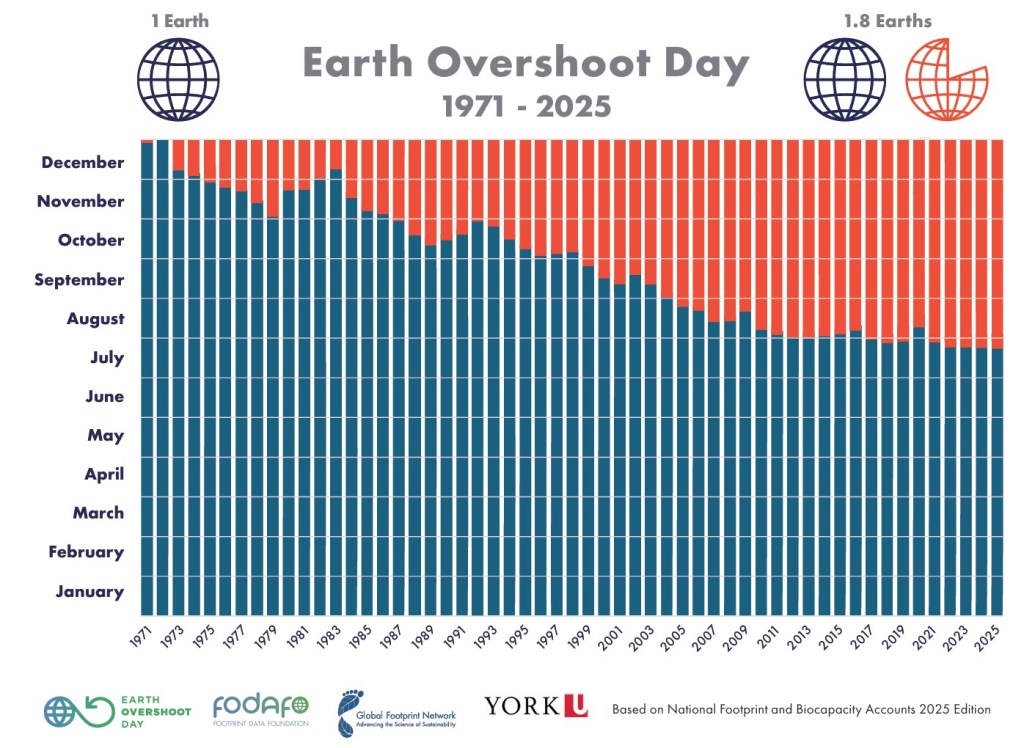
Ideally what we consume from the natural world – crops, timber, drinking water, clean air, energy – is balanced by the earth’s ability to regenerate. Prior to 1970 that was the case. Since then we have been using up the earth’s renewable resources at a rate faster than they are replenished. Scientists each year calculate that point when we pass from credit to deficit. This is called Earth Overshoot Day. This year the predicted date is 24th July. Seven months into the year and we have already – globally – consumed as much as the earth can replenish in one year!
Surely this state of affairs can not continue? What can we do about it and why aren’t we doing it?
Since 1970, Earth Overshoot Day has been falling earlier and earlier each year. Only in 2020 did it reverse: the reduction in world wide consumption came about because Covid gave the earth a three week reprieve. Consuming less has to be the answer which means consuming more carefully and more sustainably.
If we could do that in 2020 whilst coping with a pandemic, surely we could do it every year? What we must do is make sure that it is not the poor – who already lack a sufficiency – who are the ones who get to consume less; rather it must be the richer over consumers who need to change their lifestyles. And here is another caveat, to live more sustainably and fairly, will need a fundamental change in economic and political systems.
The Earth Overshoot website has details of various ways in which the global community could do this. https://www.overshootday.org/ Meantime we as individuals can make changes to our own lives and patterns of consumption. And we can ask or push for our churches, places of work, sports clubs, local authorities, museums, retailers, and government, to make similar reductions in consumption. We need change to happen at all levels.
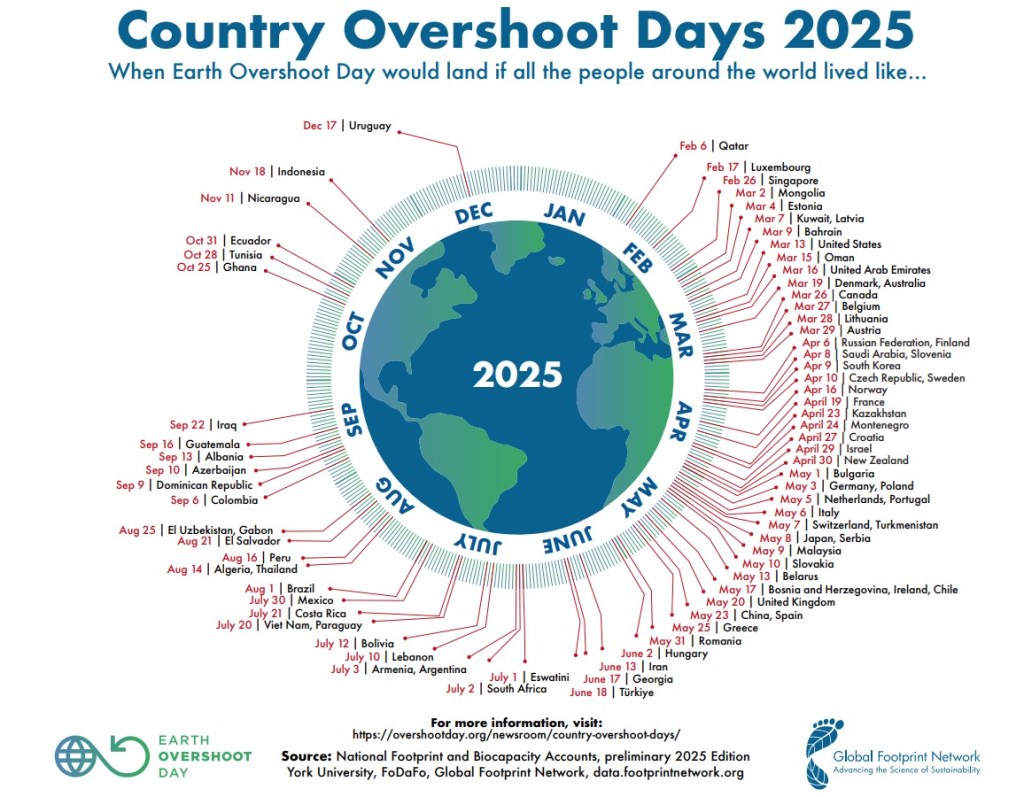
24th July is 2025’s Earth Overshoot Day at the global level. That date is the average of each nation’s own Overshoot Day. The overshoot dates for individual nations in the diagram below range from 17th December for Uruguay (ie Uruguay pretty much balances its books, consuming only slightly more than it can regenerate in a year) to 6th February for Qatar. What this diagram does not show are the many poorer nations who do not even use up their equivalent of one year’s resources each year – The UK’s Overshoot Day was 20th May. We would need three United Kingdom’s to satisfy our current consumption levels; in reality we consume resources of other countries to make up the shortfall. Reducing the Earth Overshoot problem requires cooperation and understanding at a global as a well as at local levels. The Earth is a shared life-support system.
We usually focus on Earth Overshoot Day in the summer as we approach that day in which we have consumed a full year’s worth of the earth’s renewable resources. (In 2024 Earth Overshoot Day fell on 1st August). But why don’t we focus on it sooner when we might have a greater motivation for change? ie at the start of the New Year?
Many of us use the New Year as a time to make improving resolutions, so making better or more considered use of the Earth’s resources would seem a good start.
January is also ‘veganuary’ and a considered vegan diet can also be good for the Earth. Locally grown, seasonal food has a lower footprint than meat and dairy whether that footprint is measuring carbon or methane missions, water use, fertiliser use or pollution.
The Earth Overshoot Day website talks about the ‘power of possibility’ and hosts examples of many and various ways in which we could reduce our annual overshoot and so organise our care and use of resources that we could both maintain and enhance the world’s fruitfulness.
One area is food.
If we – prevent food loss and waste
– opt for plant-based foods
– adopt agroecological and regenerative practices
we could, they suggest, shift Earth Overshoot Day by 32 days.
Today is Earth overshoot day, the day on which we have used up the whole year’s worth of the world’s capacity to replace regenerative resources – we fished our full quota from the oceans, maxed out on the atmosphere’s capacity to absorb carbon dioxide, cut down more than a year’s worth of timber, used up a year’s ration of soil fertility etc etc. Going beyond this point we are consuming now at the expense of future generations.
Of course this is not happening uniformly, nor equally, across all populations. Many smaller – ‘poorer’ or ‘less developed’ – nations have yet to reach their national overshoot day, whilst for many larger -‘richer’ or ‘highly developed’ – nations passed their national overshoot day some months ago. The UK’s overshoot day was 3rdJune. For the Republic of Moldovan it will be 28th December.
To reduce our global footprint we need to live much more sustainably. Whilst Earth Overshoot Day for the whole world will this year be 1st August, we passed the UK’s Overshoot Day last month – 1st June. In other words we in the UK would need two earths to support our current lifestyles!
Earth Overshoot day has a ecological footprint calculator which you might want to try out – http://footprintcalculator.org/home/en – it is not very refined but points out areas we might want to think about as we try and reduce our negative impact on the environment.
In less than a month the world’s population will have used up a year’s worth of renewable resources. Earth Overshoot Day – this year 1st August – is the day when our consumption of resources exceeds the rate at which the earth can regenerate those resources for future consumption.
Natural resources regenerate over time. For example annual plants such as wheat, poppies, beans lettuces produce seeds each year which can sprout and produce a fresh crop. Some do this on an annual cycle, whilst others, such as rice, may reproduce several crops per year – depending on climatic conditions. Other plants have a much longer regenerative time frame. An oak for example may take 150 years to be of an age to produce acorns.
The same is true for fauna. Some species such as fruit flies will produce the next generation within a matter of days, where as for an elephant, the time scale is closer to twenty years.
Other regenerative resources include water, nitrogen and carbon. The life cycle of these varies according to climatic, topographical, and other factors. In tropical rain forests water can go through a daily cycle of rainfall, evaporation, condensation and once again, rainfall. In the artic regions rainfall is usually infrequent with much of the water then being locked away as ice sheets and glaciers.
Air, soil and water have regenerative features in terms of absorbing and ‘cleaning’ pollutants. One of the major causes of the current climate breakdown is our human action in pumping more carbon dioxide into the atmosphere than can safely be absorbed. The safe level of carbon dioxide in the atmosphere is around 280 part per million. In March 2024 CO2 levels were at 425 ppm and still rising.
Earth Overshoot Day is the day on which our global ecological footprint exceeds the earth’s bio capacity. (This year’s date has yet to be announced).
“Humanity is living beyond its means, which results in an environmental dilemma – because it is living at the expense of the Earth. Every year, the consumption of resources outstrips the natural regenerative capacity of our planet.” (1) So reports myclimate.org
The day on which we have consumers one year’s worth of resources and tip into the red, is known as as Earth Overshoot Day. Last year, 2023, it fell on 2nd August, which means that in the whole of that year we consumed resources that were equivalent to 1.7 earths! Clear this is cannot be sustainable on an ongoing basis.
To create a sustainable lifestyle that safeguards our future, we need to address three key things:
“Efficiency: better usage of resources so that goods are produced with less energy and resources.
Consistency: linear production replaced by the circular economy, which minimises waste. Renewable energy is key here.
Sufficiency: A sustainable change in lifestyle under which the economy is geared to moderate consumption of resources rather than constant growth. The goal is to fulfil the wishes and requirements of our society without disproportionate waste or consumption.” (1)
For those who are interested the Global Footprint Network has a online tool that calculates in broad terms your environmental footprint. Knowing the size of our impact on the earth can motivate us to change our lifestyle accordingly. https://www.footprintcalculator.org/home
But do we want to shrink our lives, do we want to give up things we enjoy?
An interesting article on their blog reframes the approach. Rather than focusing on reducing our footprint, focus on creating a comfortable lifestyle that is more efficient in its use of resources. And a more resource efficient lifestyle will be a more secure and a more affordable lifestyle. And if shared, this lifestyle will enable others to enjoy a comfortable, safe and affordable lifestyle too .

 The Green Tau