Counting on … 179

4th November 2025

Planetary Health Diet

The EAT-LancetCommission is a global, interdisciplinary group of world-leading researchers with expertise in nutrition, health, agriculture, sustainability, social justice, and policy – working together towards a healthy, sustainable, and just food system. (1) In 2019 this group’s research developed the Planetary Health Diet being a diet that is both healthier for us and for the planet.  It is a dietary outline that can be adapted to suit different cultural traditions and different social contexts – in other words it is a diet that everyone could follow with out difficulty. 

“The PHD is rich in plants: whole grains, fruits, vegetables, nuts, and legumes comprise a large proportion of foods consumed, with only moderate or small amounts of fish, dairy, and meat recommended.” (2)

This year their research was updated producing the 2025 EAT-Lancet Commission Report. This report demonstrates that the PHD could both bring the human behaviour back within safe planetary boundaries as well as cutting greenhouse gas emissions. 

This 2025 report outlines eight areas where transformation can lead to positive outcomes.  Protect and promote traditional healthy diets –

  • Create accessible and affordable food environments that increase demand for healthy diets
  • Implement sustainable production practices that store carbon, create habitat, and improve water quality and availability
  • Halt agricultural conversion of intact ecosystems
  • Reduce food loss and waste
  • Secure decent working conditions across the food system
  • Ensure meaningful voice and representation for food systems workers
  • Recognise and protect marginalised groups (3)
  1. https://eatforum.org/eat-lancet

(2) https://eatforum.org/eat-lancet/the-planetary-health-diet/

(3) https://eatforum.org/update/eat-lancet-commission-warns-food-systems-breach-planetary-limits/

 Counting on … day 85

16th June 2025

If petrol, diesel and biodiesel fuels are incompatible with net zero carbon targets, how should transport be powered?

On the roads, electric vehicles (EVs or sometimes ZEVs) are one answer, and one favoured by many governments. With the stimulus of subsidies and legislation establishing an end date for the sale of combustion engine cars, EVs are gaining in popularity. 

“The UK’s EV sector is gaining momentum, with pure electric cars capturing 21.8% of the market in May 2025. For the first five months of the year, EVs held a 20.9% share, falling short of the government’s 28% zero-emission vehicle mandate target. Including plug-in hybrids and petrol-electric hybrids, electrified vehicles accounted for 47.3% of all registrations last month. Meanwhile, petrol car sales dropped 12.5% year-on-year to 71,000 units, representing 47.5% of the market, while diesel sales fell 15.5% to 7,900 units, just 5.2% of total registrations.” (1)

Not only does the UK have a zero sales date for combustion driven cars of 2030, the UK also has a mandatory 45% emissions reduction target for trucks by the same date. Already electric trucks are being developed with ranges of 500km. (2)

“Sales of electric trucks increased 35% in 2023 compared to 2022, meaning that total sales of electric trucks surpassed electric buses for the first time, at around 54 000. China is the leading market for electric trucks, accounting for 70% of global sales in 2023, down from 85% in 2022. In Europe, electric truck sales increased almost threefold in 2023 to reach more than 10 000 (>1.5% sales share).” (3)

There would seem therefore to be a strong economic case for businesses to invest in electrical vehicles and associated infrastructure, rather than for businesses to be using their market power to relentlessly promote the continued use of combustion engines which are known to make a significant contribution to climate damaging greenhouse gas emissions. 

  1. https://evxl.co/en_gb/2025/06/05/uk-electric-vehicle-sales-tesla-decline/
  2. https://logistics.org.uk/logistics-magazine-portal/logistics-magazine-features-listing/auto-restrict-folder/06-03-25/2025-the-year-of-the-electric-truck-accelerating-t
  3. https://www.iea.org/reports/global-ev-outlook-2024/trends-in-heavy-electric-vehicles

Counting on … day 218

20 November 2024 

While the power sector has done the heavy lifting of Britain’s emissions cuts so far, the 2035 target will require bigger cuts in sectors such as domestic transport — which accounts for more than a quarter of Britain’s emissions — and buildings, responsible for about a fifth.(1)

The transport industries – providers and manufacturers- the government and we as users, need to each make the shift to sustainable travel options.

  1. https://assets.publishing.service.gov.uk/media/65c0d15863a23d0013c821e9/2022-final-greenhouse-gas-emissions-statistical-release.pdf

Counting on … day 87

16th April 2024

Green cement – part 2

As part of the need to reduce all greenhouse gas emissions to address the climate crisis, reducing emissions from cement production is essential. 

50% of the emissions come from the release of carbon dioxide as a byproduct during the clinker making process. One solution is carbon capture- capturing the CO2 before it escapes into the atmosphere, pressurising it to a liquid which is injected into rock strata deep underground.  This technology has yet to be developed for use at an industrial scale. 

Another solution is to replace the limestone with an alternative that produces less CO2 – such as magnesium oxide mixed with magnesium chloride solution. However such alternative cements may not have all the attributes of cement when in use – different construction methods may be needed.

40% of the emissions are attributable to the energy needed to heat the clinker kilns. Switching to renewable energy to replace coal is one solution but requires considerable investment in green electricity production and distribution. 

Using materials other than limestone – such as volcanic rock – that can produce clinker at lower temperatures is another possible solution. Another alternative is to replace a proportion of the cement with an alternative binder such as ground granulated blast furnace slag or pulverised fly ash. Again this may alter the properties of the cement and require different construction methods.

10% of the emissions comes from energy used in mining and transporting the raw materials. Energy efficiency and the use of renewable energy will be a way forward.

Further reading –https://theconversation.com/green-cement-a-step-closer-to-being-a-game-changer-for-construction-emissions-126033

(https://theconstructor.org/concrete/green-cement-types-applications/5568/

Counting on … day 86

15th April 2024

Green cement? Part 1

Cement is made by heating limestone and clay together at very high temperatures. The clay and limestone is converted to a dried out material called clinker, whilst at the same time releasing large amounts of carbon dioxide. The clinker when ground to a powder is what we know as cement. 

The production of cement has a very high carbon footprint arising from a) the energy needed to roast the clay and limestone which invariably comes from fossil fuels, and b) the carbon dioxide released during manufacture. Each tonne of cement produces up to 622kg carbon dioxide. 

Cement is widely used in large quantities across the globe in the construction of buildings, roads, drains and various other types of infrastructure. CO2 emissions from cement account for 7% of all global emissions – 1605 tonnes per year. Here in the UK cement produces about 4b tonnes CO2.

https://www.bbc.co.uk/news/science-environment-46455844

Counting on … day 84

11th April 2024

Fossil Fuel Subsidies -1

This overview of fossil fuel subsidies comes from the IMF: “Subsidies are intended to protect consumers by keeping prices low, but they come at a substantial cost. Subsidies have sizeable fiscal consequences (leading to higher taxes/borrowing or lower spending), promote inefficient allocation of an economy’s resources (hindering growth), encourage pollution (contributing to climate change and premature deaths from local air pollution), and are not well targeted at the poor (mostly benefiting higher income households). Removing subsidies and using the revenue gain for better targeted social spending, reductions in inefficient taxes, and productive investments can promote sustainable and equitable outcomes.” (1)

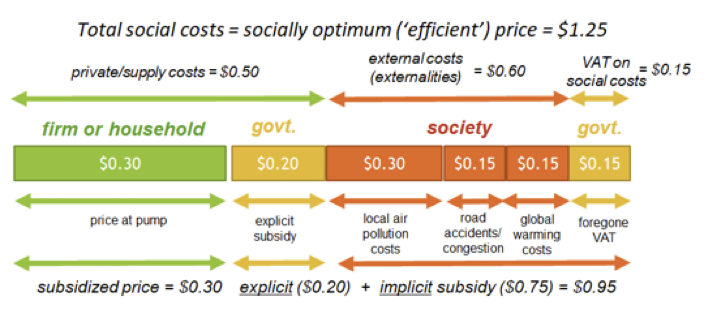
The article goes on to explain the difference between explicit and implicit subsidies, the former being the obvious direct payments to fossil fuel producers to bring down the unit cost of the fuel. The latter is a subsidy that is likely always present, vis in the practice of not charging the fossil fuel producers for the costs of pollution, climate change etc that are a consequence of their business. 

“Implicit subsidies occur when the retail price fails to include external costs, inclusive of the standard consumption tax. External costs include contributions to climate change through greenhouse gas emissions, local health damages (primarily pre-mature deaths) through the release of harmful local pollutants like fine particulates, and traffic congestion and accident externalities associated with the use of road fuels”(1)

By way of example they provide the following bar chart: 

(1) https://www.imf.org/en/Topics/climate-change/energy-subsidies

Counting on … day 80

5th April 2024

Green Steel 

Steel manufacturing produces more CO2 than any other heavy industry, comprising around 8% of total global emissions. 

Traditionally steel is made in a blast furnace where the iron ore is he@ted at high temperatures together with coal. As the coal burns it produces carbon monoxide which bonds with and removes oxygen in the iron ore so purifying it to produce metallic iron. The carbon monoxide binding with oxygen becomes carbon dioxide and is one of the main sources of carbon emissions. Other sources of emissions will vary depending how the furnace is heated etc. 

The industry is developing various ways of producing steel without – or with reduced – carbon dioxide emissions – known as green steel.

Replacing coal with hydrogen: Green steel can be produced by using hydrogen to remove the oxygen from the the ore – producing water (H2O). Ideally this would be green hydrogen – ie hydrogen produced using renewable energy. This method of producing steel requires heating the furnace to a higher temperature.

Reusing existing steel: steel can easily be recycled in arc furnaces powered by electricity – which ideally would be electricity from renewable energy sources with no carbon dioxide emissions.

Around 30% of the world’s steel is made from recycled steel. However steel cannot be recycled endlessly without loss of quality. Each time it is recycled the proportion of unwanted elements such as copper, nickel and tin increases. On the other hand steel has  long in-use life which means that the amount of steel made available for recycling does not at present keep up with the growing demand for more steel. Our modern economies are big users of steel!

(For more detail see https://theconversation.com/green-steel-is-hailed-as-the-next-big-thing-in-australian-industry-heres-what-the-hype-is-all-about-160282)

Which ever form of green steel is produced, the availability of large amounts of renewable energy is going to be critical. 

As important will be the way the transition is managed as furnaces are large and highly expensive pieces of kit – ie needing substantial investment – and can take years to install which in some instances has led to workers being laid off – as is proposed at the Tata steel works in Port Talbot. (https://www.theguardian.com/uk-news/2024/mar/25/tata-port-talbot-job-losses-labour-subsidy?CMP=Share_iOSApp_Other). 

Other important issues to address are how steel is used – with product design ensuring a long life, whether other materials could be used – timber for example in building construction, and how effectively scrap  steel is collected and recycled.

Further reading – https://www.bbc.co.uk/news/business-64538296

Counting on … day 77

2nd April 2024

Land management is key in reducing damaging emissions and improving biodiversity. This is acknowledged by the Government but not always pursued.

“Globally, around a quarter of GHGs come from land management activities, including deforestation and agriculture. However, terrestrial and marine ecosystems take up carbon dioxide equivalent to over half of the emissions caused by people.  The challenge is to reduce anthropogenic emissions and increase uptake by ecosystems, storing carbon in soils, sediments and vegetation….

“In the UK our land, coast and seas have been managed for millennia to provide food and other resources for people.  Some patterns of management were sustainable over the centuries, supporting biodiversity and storing carbon as well as providing for the needs of people.  However, there has also been habitat destruction and degradation, leading to declining biodiversity and substantial emissions of carbon to the atmosphere. 

“Repairing this damage to stop emissions and capture more carbon is an essential element of achieving net zero, alongside deep cuts in emissions from other sectors such as energy and transport. The Climate Change Committee estimates that 20% of agricultural land will need to be released before 2050 to deliver actions that reduce emissions and sequester carbon. Such a shift in land use change will require us to prioritise opportunities that also deliver wider co-benefits for climate change adaptation, biodiversity, water management, air quality and soil health.” 

Counting on … day 52

23rd February 2024

Keeping the temperature rise – global warming – within 1.5C necessitates constraining the carbon dioxide (and other greenhouse gas) emissions we release into the atmosphere. The diagram below shows the correlation between global temperatures and carbon dioxide concentrations in the atmosphere. 

Keeping global warming within this window involves both reducing the amount of greenhouse gases we emit and enhancing processes that absorb such gas emissions. An example of the first would be reducing – or even cutting out entirely – the burning of fossil fuels; an example of the second would be reinstating woodlands and wetlands. 

Counting on … day 1.206

1st November 2023

The following commentary comes from the publishers of Positive News.  

“It’s really pretty simple. If we want to keep the climate stable, we have to ring in some big changes, both societal and personal. Progress is slow on the former. But while governments dither, there are signs that ordinary folk are embracing lifestyle choices that slash emissions.
 
“A Europe-wide survey this week found that young people are leading the way when it comes to planet-friendly living. Younger people are more likely than other age groups to buy secondhand clobber, cut down on meat and ditch smut-belching cars. Perhaps unsurprisingly, they are also more likely to support pro-climate policies. It chimes with separate research by the UK government, which showed that meat is slipping off menus, although the cost of living crisis may also have something to do with that.”