Counting on … day 83

12th June 2025

Diesel – or petroleum diesel – is made from fossil fuels.

Biodiesel is a similar product which is made from plant based oils, animal fats and recycled cooking grease. Once treated using a process of ‘transesterification’ it can be mixed with regular diesel for use in combustion engines – it is not sufficiently similar chemically for use a complete substitute for petroleum diesel. 

Renewable diesel or HVO (hydrotreated vegetable oil) is also made from plant and animals based fats, and waste oils using a process called ‘hydrotreating’. This diesel substitute closely mimics regular diesel and can be used as a direct replacement – ‘drop in’ – fuel for combustion engines.(1)

Again the issue that makes the sustainability of renewable diesel questionable is the available supply of plant and animals based fats and waste oil needed in its production. There is a risk that virgin forests in South America and Asia may be cleared to make way for soy and palm oil cultivation – as fuel crops – exacerbating the imbalance of CO2 emissions (virgin forests are net absorbers of carbon dioxide). Equally relying animal based fats (also known as tallow) that come from beef farming adds to the growing trend in deforestation to make way for grass and fodder crops. And, ironically for a product sold as sustainable, when demand for waste oil exceeds supply, the shortfall is made up by substituting virgin plant oil. (2) 

Replacing fossil fuel diesel with plant based diesel does not provide a sustainable low carbon solution. Plants and animals are best farmed to provide food and not as a fuel source for energy. 

  1. https://hartfueling.com/the-difference-between-renewable-diesel-biodiesel-regular-diesel/
  2. https://news.mongabay.com/2025/05/as-renewable-diesel-surges-sustainability-claims-are-deeply-questioned/

Counting on … day 29

11th February 2025

The drinking water that comes into our homes, comes at an environmental cost. The water has to be purified to a drinkable standard, it has to be stored and pumped, all of which requires energy and resources – pipe work, concrete for reservoirs etc. Once used it has to be treated again to be clean enough to return into rivers and waterways or to be recycled again as drinking water. If we are more careful about not wasting water, then we are improving the sustainability with which we live. 

The climate crisis increases the likelihood of both droughts – when the benefits of conserving water are most obvious – and floods. Floods can lead to the contamination of drinking water as well as causing difficulties in remove waste water and sewage. 

Counting on day …. 129

19th July 2024

Efficient 

The things we buy and use should perform their task without the need for disproportionate amounts of time or energy. Some products – eg washing machines and fridges – come with a rating that tells you how efficient they are in their use of energy. 

Equally there are some things that we are sold that use electrical or other power where ‘elbow grease’ would be as – if not – more effective. For example leaf blowers which blow leaves around as a way of clearing them, whereas a brush would do the same task  with no additional energy other that our own muscles.

Counting on … day 110

20th May 2024

Being as green as we can with energy includes not boiling more water than we need for drinks, turning off appliances and lights when not in use, replacing lightbulbs with LEDs, and opting for energy efficient appliances when buying new ones. In the garden we don’t use power tools – cutting the grass (infrequently) by hand. In the kitchen we have an electric stick blender which is a real boon but otherwise use hand powered tools for cooking such as balloon whisks and a hand cranked coffee grinder. Elbow grease is an undervalued source of energy! And there is also the energy saving component that comes from not buying the electrical item in the first place.

As previously mentioned, we are also able to save energy by showering less often, washing clothes – and therefore ironing – less often.

With cooking, we use primarily the hot plates and microwave, and when using the oven (usually bread making day) cook several items to maximise use the energy. 

Further reading – https://greentau.org/2021/09/10/the-green-tau-issue-16/

Counting on … day 90

19th April 2024

How sustainable is wind power? 

The following comes from a report by the German broadcaster, Deutsche Welle (DW).

“On average, wind turbines are operated for about 25 years. During this time, they generate 40 times more energy compared to the energy required for the production, operation and the disposal of a wind power plant.

“So-called upstream emissions, generated mostly through the production of carbon-intensive steel and cement, are included in the overall carbon balance of a wind turbine’s life cycle.

An onshore wind turbine that is newly built today produces around 9 grams of CO2 for every kilowatt hour (kWh) it generates, according to according to the UBA. A new offshore plant in the sea emits 7 grams of CO2 per kWh.

“Compared with other technologies, wind power does well in terms of carbon emissions. By comparison, solar power plants emit 33 grams CO2 for every kWh generated. Meanwhile, power generated from natural gas produces 442 grams CO2 per kWh, power from hard coal 864 grams, and power from lignite, or brown coal, 1,034 grams.” (1)

But what about the renewability of the turbines? Can their component parts be recycled so conserving the materials used? Wind turbines have a lifespan of 30+ years. At present the number being decommissioned is small but will grow – DW suggests that by 2050 up to 50,000 wind farms in Germany alone will need replacing. Whilst to some extent the concrete for the bases can be crushed and recycled as hardcore etc, and the steel and other minerals from pylons can be recycled, recycling the blades is less easy as they are a composite of glass fibre, plastic, carbon etc. Old blades may end up in landfill. However – “The first recyclable rotor blades for large offshore plants are currently being produced in Denmark. By 2030, the plant constructor Siemens Gamesa plans to only sell recyclable rotor blades: from 2040 the production of the company’s wind power plants is expected to be completely carbon neutral.” (1)

Nevertheless, wind power is one of the least environmentally damaging sources of energy.

  1. https://www.dw.com/en/how-sustainable-is-wind-power/a-60268971

Counting on … day 89

18th April 2024

How Renewable are Renewables?

Many things are renewable as in they can be naturally replaced – timber is a renewable resource in that for every tree used/ consumed, another tree can be grown. Water is a renewable resource in that once used it can be recaptured and reused: this might be through the natural water cycle of evaporation, transpiration, condensation and rainfall, or through collecting and cleaning waste water for further use. Fish for use as food is a renewable resource – this supply of food is maintained through the natural reproductive processes of the fish. 

However the renewability of things isn’t necessarily limitless. 

If oceans are overfished, the rate at which new fish are born and mature will not keep pace with the rate at which fish are caught. Eventually there will be no fish.

If trees are felled faster than the rate at which new trees reach maturity – which can be  40 to 150+ years depending on the species – the landscape will become deforested. 

If an ecosystem is not maintained, more can be lost through evaporation in a locality than falls as rain. Without forests in the middle of large continents, rainfall in these areas would be negligible reducing the landscape to desert. If rainforests are cleared, rainfall in those areas will be diminished reducing the landscape to bare earth.

Solar energy is a renewable energy source – the sun is constantly producing heat – as is wind, as the earth’s weather system continues to be generate wind. (Sometimes resources such as sunshine, wind, tides and geothermal energy are known as perpetual resources).

 But whilst solar and wind energy are constant/ renewable, the means by which we capture that energy may not be as readily replaced. Solar panels that convert the sun’s energy into electricity are  made of non-renewable minerals – silicon, silver, aluminium, and copper. Wind turbines that capture the wind’s energy converting it into electricity are made of large amounts of non renewable materials such as steel and carbon fibre.

The source of the energy is renewable but not always the means by which we capture the energy.

Here is an interesting blog describing how solar panels are made – https://blog.ucsusa.org/charlie-hoffs/how-are-solar-panels-made/

and wind turbines – https://blog.ucsusa.org/charlie-hoffs/how-are-wind-turbines-made/

Counting on … day 84

11th April 2024

Fossil Fuel Subsidies -1

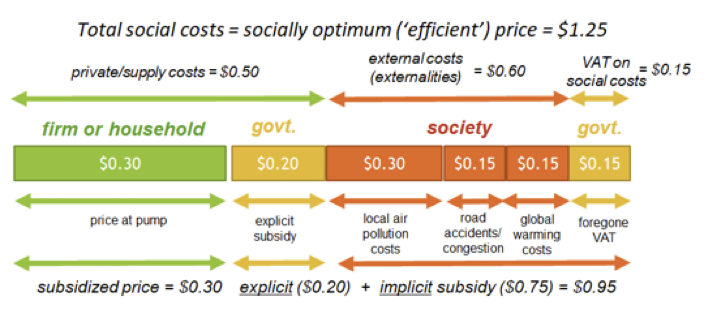
This overview of fossil fuel subsidies comes from the IMF: “Subsidies are intended to protect consumers by keeping prices low, but they come at a substantial cost. Subsidies have sizeable fiscal consequences (leading to higher taxes/borrowing or lower spending), promote inefficient allocation of an economy’s resources (hindering growth), encourage pollution (contributing to climate change and premature deaths from local air pollution), and are not well targeted at the poor (mostly benefiting higher income households). Removing subsidies and using the revenue gain for better targeted social spending, reductions in inefficient taxes, and productive investments can promote sustainable and equitable outcomes.” (1)

The article goes on to explain the difference between explicit and implicit subsidies, the former being the obvious direct payments to fossil fuel producers to bring down the unit cost of the fuel. The latter is a subsidy that is likely always present, vis in the practice of not charging the fossil fuel producers for the costs of pollution, climate change etc that are a consequence of their business. 

“Implicit subsidies occur when the retail price fails to include external costs, inclusive of the standard consumption tax. External costs include contributions to climate change through greenhouse gas emissions, local health damages (primarily pre-mature deaths) through the release of harmful local pollutants like fine particulates, and traffic congestion and accident externalities associated with the use of road fuels”(1)

By way of example they provide the following bar chart: 

(1) https://www.imf.org/en/Topics/climate-change/energy-subsidies

Counting on … day 80

5th April 2024

Green Steel 

Steel manufacturing produces more CO2 than any other heavy industry, comprising around 8% of total global emissions. 

Traditionally steel is made in a blast furnace where the iron ore is he@ted at high temperatures together with coal. As the coal burns it produces carbon monoxide which bonds with and removes oxygen in the iron ore so purifying it to produce metallic iron. The carbon monoxide binding with oxygen becomes carbon dioxide and is one of the main sources of carbon emissions. Other sources of emissions will vary depending how the furnace is heated etc. 

The industry is developing various ways of producing steel without – or with reduced – carbon dioxide emissions – known as green steel.

Replacing coal with hydrogen: Green steel can be produced by using hydrogen to remove the oxygen from the the ore – producing water (H2O). Ideally this would be green hydrogen – ie hydrogen produced using renewable energy. This method of producing steel requires heating the furnace to a higher temperature.

Reusing existing steel: steel can easily be recycled in arc furnaces powered by electricity – which ideally would be electricity from renewable energy sources with no carbon dioxide emissions.

Around 30% of the world’s steel is made from recycled steel. However steel cannot be recycled endlessly without loss of quality. Each time it is recycled the proportion of unwanted elements such as copper, nickel and tin increases. On the other hand steel has  long in-use life which means that the amount of steel made available for recycling does not at present keep up with the growing demand for more steel. Our modern economies are big users of steel!

(For more detail see https://theconversation.com/green-steel-is-hailed-as-the-next-big-thing-in-australian-industry-heres-what-the-hype-is-all-about-160282)

Which ever form of green steel is produced, the availability of large amounts of renewable energy is going to be critical. 

As important will be the way the transition is managed as furnaces are large and highly expensive pieces of kit – ie needing substantial investment – and can take years to install which in some instances has led to workers being laid off – as is proposed at the Tata steel works in Port Talbot. (https://www.theguardian.com/uk-news/2024/mar/25/tata-port-talbot-job-losses-labour-subsidy?CMP=Share_iOSApp_Other). 

Other important issues to address are how steel is used – with product design ensuring a long life, whether other materials could be used – timber for example in building construction, and how effectively scrap  steel is collected and recycled.

Further reading – https://www.bbc.co.uk/news/business-64538296

Counting on … day 78

3rd April 2024

Biofuels are fuels derived from biomass such as plant material, food waste, algae, or animal waste. There are two forms of biofuel – 

“Bioethanol is an alcohol made by fermentation, mostly from carbohydrates produced in sugar or starch crops such as maize, sugarcane, or sweet sorghum. Cellulosic biomass, derived from non-food sources, such as trees and grasses, is also being developed as a feedstock for ethanol production. Ethanol can be used as a fuel for vehicles in its pure form (E100), but it is usually used as a gasoline additive to increase octane ratings and improve vehicle emissions.

And “Biodiesel is produced from oils or fats using transesterification. It can be used as a fuel for vehicles in its pure form (B100), but it is usually used as a diesel additive to reduce levels of particulates, carbon monoxide, and hydrocarbons from diesel-powered vehicles.” (https://en.wikipedia.org/wiki/Biofuel)

Brazil is the largest producer of bioethanol and the EU is the largest producer of biodiesel. 

Both forms of biofuel differ from fossil fuels in that they are produced from organic materials being grown now as opposed to using organic materials that were decomposing millions of years ago.  

Both produce greenhouse gas emissions but less than do fossil fuels. Biofuels may be made using only waste materials, but often are made from crops that have been specifically grown for this purpose. This may have the affect of diverting land that would otherwise be used for growing food, or may involve deforestation to create new crop lands. 

Drax power station which burns timber as a biofuel to generate electricity uses wood pellets. Although wood pellets can be made from waste wood, most of the pellets that are burnt at Drax are made from whole trees that were once growing in virgin forests in South Carolina and British Columbia. These are then imported to the UK. For more information- https://www.bbc.co.uk/news/science-environment-68381160

Counting on … day 70

20th March 2024

The geological history of oil and gas. 

“The formation of oil takes a significant amount of time with oil beginning to form millions of years ago. 70% of oil deposits existing today were formed in the Mesozoic age (252 to 66 million years ago), 20% were formed in the Cenozoic age (65 million years ago), and only 10% were formed in the Paleozoic age (541 to 252 million years ago). This is likely because the Mesozoic age was marked by a tropical climate, with large amounts of plankton in the ocean.

“The formation of oil begins in warm, shallow oceans that were present on the Earth millions of years ago. In these oceans, extremely small dead organic matter – classified as plankton – falls to the floor of the ocean. This plankton consists of animals, called zooplankton, or plants, called phytoplankton. This material then lands on the ocean floor and mixes with inorganic material that enters the ocean by rivers. It is this sediment on the ocean floor that then forms oil over many years”.

  1. The dead plankton, plus algae and bacteria form an organic rich mud.
  2. If the mud remains in an anoxic environment  – lacking in oxygen such as stagnant water – it does not decompose and so retains its carbon content. 
  3. This anoxic environment becomes embedded by subsequent layers of mud, compressing the carbon rich  layer into an organic shale. 
  4. Overtime the shale sinks as more layers are added. At a depth of 2 to 4km the temperatures from the earth’s core plus the increased pressure converts the organic shale to oil shale.
  5. If the temperatures at this depth are between 90 and 160C this oil shale is transformed into oil and natural gas. This will either seep upwards being lighter than water, or maybe sealed in by subsequent layers of impervious rock.

(https://energyeducation.ca/encyclopedia/Oil_formation)

Again it is mind blowing to reflect that these oil and gas deposits that took millions of years in the making, are now being burnt at an annual rate of 6.6 billion tonnes, such that we have 47 years of reserves remaining – should we be foolish enough to want to burn them.(https://www.worldometers.info/oil/

We should keep in mind that the IEA warns that a cannot risk developing and burning new oil and gas reserves without exceeding the 1.5C global warming limit.