Reshaping how we can talk positively about the climate crisis – part 1: energy security
10th January 2025
How can we talk about the climate crisis in a way that sounds encouraging?
The climate crisis is an existential threat which is certainly not good news. Its causes and impact are diverse and numerous such that it is hard to pin down ‘This is the cause’ and ‘This is the solution’. It is hard to quantify ‘This is how it will effect you’ and ‘This will be the time table.’
All this makes it difficult to find a way of talking to people about the crisis and how we might respond.
So here are some thoughts that might help.
Energy security.
1. At the outbreak of war between Russia and Ukraine we were worried that we would not have enough energy (ie oil and gas from Russia) to keep power stations and industries running. There was a fear that the lights might go out. There is always going to be a energy security risk when we are reliant on an imported fuel. Despite what the government may suggest, the oil and gas supplies in the North Sea are insufficient to meet current needs, and the business arrangement is such that any North Sea oil and gas we use, has to be bought in the international market at the going rate. There are no special deals for UK customers. How much better then if we could obtain all our energy from home produced renewable sources – wind, solar, tidal. That surely would be a better definition of secure energy.
Any projects that involve increasing our renewable energy capacity are good news stories. This includes not just wind turbines and solar panels, but also the grid infrastructure need to distribute the energy.
For more info – https://www.ucl.ac.uk/bartlett/sustainable/sites/bartlett_sustainable/files/isr_141123_energy_security_-_a_sustainable_strategy_for_the_uk.pdf
2. Community energy projects enable communities to invest in and benefit from local energy production be that a wind turbine or turbines, solar panels on community rooves, or hydro power from a river or tide. New legislation is being introduced that would enable communities to benefit directly from selling their energy (under existing rules communities – and individuals – have to seek to one of the electricity producers). Community energy projects can give local populations greater energy security and to benefit directly from cheaper energy bills – this may be the compensating factor that outweighs local reluctance to the expansion of wind farms etc.
For more info – (re rural communities) https://www.cpre.org.uk/discover/why-we-love-community-energy/
(re urban communities) https://www.communityenergy.london/wp-content/uploads/2021/09/Cities-and-Community-Energy-in-England-FINAL-combined.pdf
3. There is a counter argument that renewable energy doesn’t provide security because we could have a run of windless, sunless days (which do happen as we have seen recently). Batteries are the obvious answer, combined with price tariffs that encourage consumers to use less when generation is low, and to use – or store – energy when generation is high. These will need to be used in conjunction with ‘large scale electricity storage’ which would involve using excess power to create hydrogen which would then be stored in salt mines. (For more details see https://royalsociety.org/-/media/policy/projects/large-scale-electricity-storage/large-scale-electricity-storage-policy-briefing.pdf)
Improvements in battery technology are good news stories. Batteries also give individual households as well as business units, schools, hospitals etc immediate energy security. There are genuine concerns about the environmental and social costs of some of the minerals needed to make batteries. Current research is developing a sodium battery that uses salt, which is widely available, rather than rare and expensive lithium.
For more info – https://www.field.energy/views/energy-security-how-battery-storage-helps-keep-the-lights-on
Energy costs
Energy security is linked to energy costs. If energy costs are so high as to preclude people being able to afford it, then their energy supply is not secure. The outbreak of war between Russia and Ukraine triggered a rapid rise in the cost of energy initially rising by around 40%, 130% and 180% for oil, coal and gas. The prices of these fossil fuels are determined by global commodity markets so everyone is susceptible to the prices hikes. Renewable energies on the other hand reflect local factors – although the cost and availability of key materials such as steel, will have an impact on the building of, for example, new wind turbines, and the relative prices charged for renewable energy and fossil fuels will impact investment decisions.
By and large renewable energy is cheaper than fossil fuel energy – although currently in the UK a levy is charged on energy costs to cover the cost of transitioning to renewable energy, and (bizarrely) this adds more to the cost of electricity that it does to gas (16% of the final price of electricity and 5.5% of the final price of gas). https://www.nesta.org.uk/household-energy-bills-green-levies/
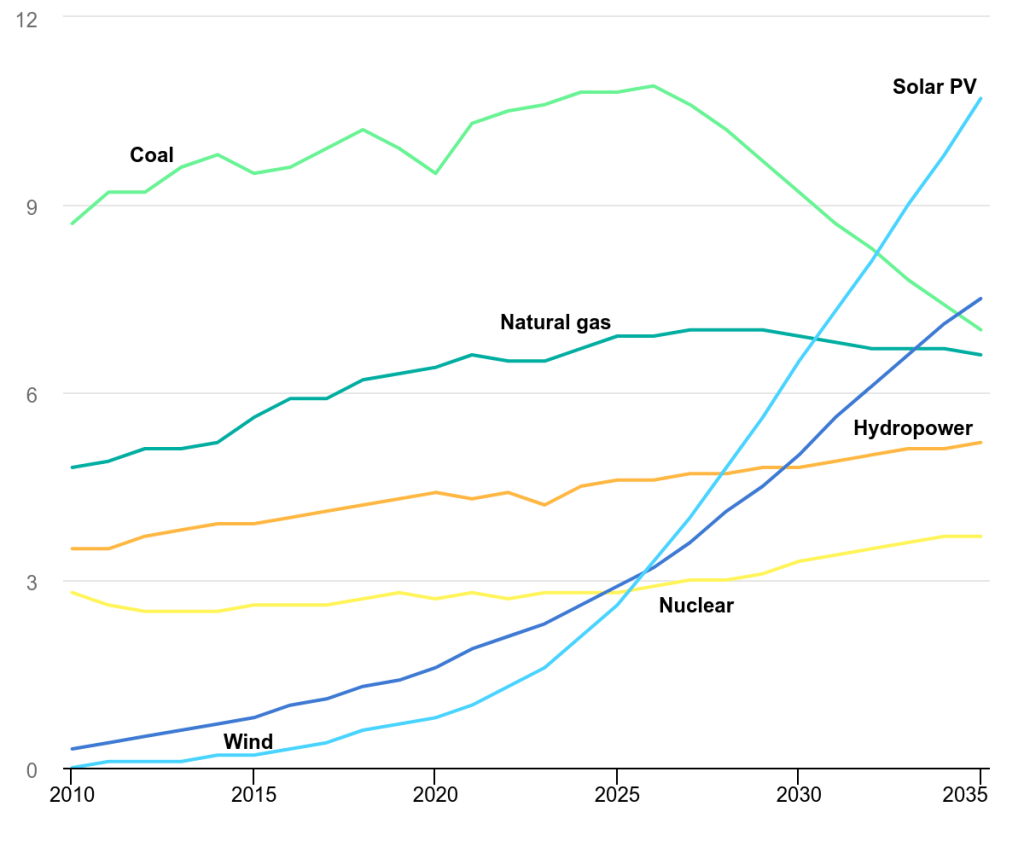
Going on into the future renewable energy will continue to fall in real terms whilst the cost of fossil energy will rise. By offering affordable energy, renewables will continue to offer energy security.

 The Green Tau