Counting on day … 159

29th August 2024

After travel and accommodation, food maybe the next consideration. We can, whether eating out or self catering, make our diet more or less environmentally friendly depending on what we choose to eat. Choosing a plant based diet will have a lower environmental impact than one based on dairy and/or meat. “Avoiding meat and dairy products is one of the biggest ways to reduce your environmental impact, according to scientific studies” (1) 

(1)https://www.bbc.co.uk/news/science-environment-46459714

Further reading https://ourworldindata.org/food-choice-vs-eating-local

Counting on … day 157

27th August 2024

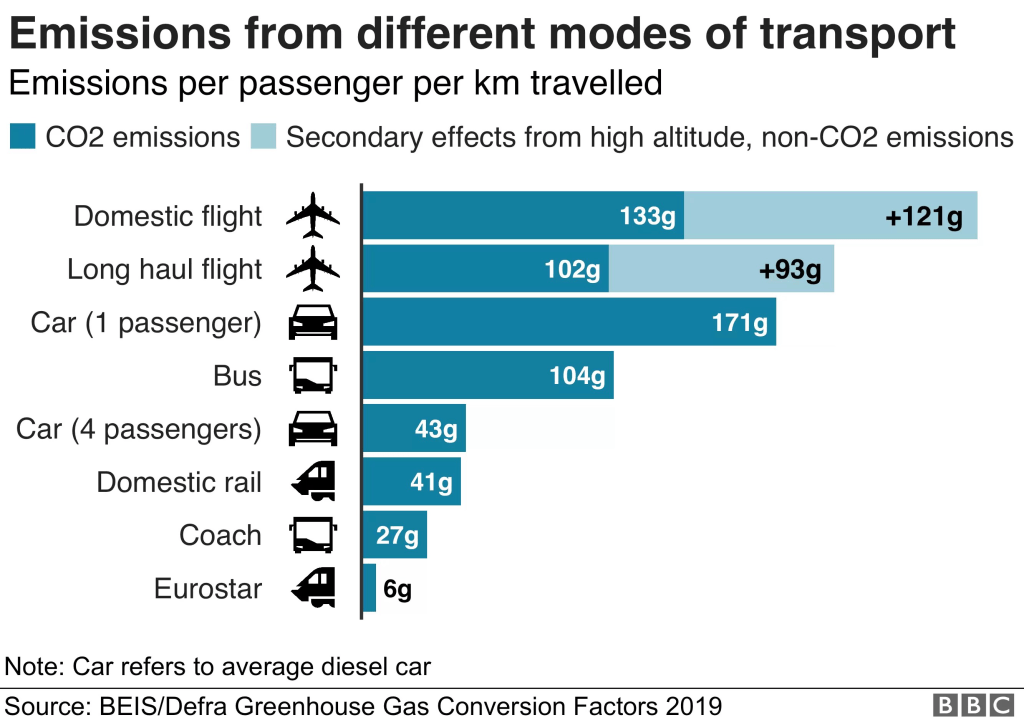
Do our holidays adversely impact on the environment? Googling eco friendly holidays, I am surprised how many website focus on the eco credentials of the destination but not the mode of travel. This is not always the case and some websites do give advice on flight free holidays. Nevertheless the transport element of our holidays usually contributes most to its environmental impact.

“Global tourism accounts for about 8% of total greenhouse gas emissions and transport between origin and destination explains three quarters of this impact” (1)  Cutting out flying will benefit the environment most. After that saving has been made, cutting back on the distance travelled will also have an impact.  (2)

(1) https://www.sciencedirect.com/science/article/pii/S0261517722001431

(2) https://www.bbc.co.uk/news/science-environment-49349566

Counting on day … 153

21st August 2024

Niche construction

Many creatures – and plants – create niche environments that benefit their well being. For example, many birds make nests as a safe place to raise their young; beavers build dams to create deep waters where they can build a lodge (home) where they will be safe from predators such as wolves and bears; termites build mounds to both protect their underground nests from predators and to ensure cool fresh air for their nest. 

Likewise humans have from early days created niche environments that have helped them thrive – building houses on platforms in a lake to protect them from predators; burning wooded areas to create open spaces where they could graze animals and sow crops; obstructing rivers to trap fish. And we continue to do this! One new venture could be in creating 15 minute cities where we can live more independently of cars and improve social communication.

Taste and see – God is good!

17th August 2024

O taste and see that the Lord is good Psalm 34:8a

You Lord, are the source of all good things: 

We praise you.

You call us to tend and care for your creation: 

May we strive to do your will.

You have made us as brothers and sisters with all that lives: 

May we live together in peace.

A reading from Isaiah 55:1-3 (The Message translation)

Hey there! All who are thirsty,
    come to the water!
Are you penniless?
    Come anyway—buy and eat!
Come, buy your drinks, buy wine and milk.
    Buy without money—everything’s free!
Why do you spend your money on junk food,
    your hard-earned cash on cotton candy?
Listen to me, listen well: Eat only the best,
    fill yourself with only the finest.
Pay attention, come close now,
    listen carefully to my life-giving, life-nourishing words.
I’m making a lasting covenant commitment with you,
    the same that I made with David: sure, solid, enduring love.

A response:

Listen; attune your ears – what do you hear? 

The excited chatter of children,

and the chatter of jackdaws,

wind rustling the leaves,

and feet tapping the road.

Or the drone of cars – too much!

Or the whine of planes – too many!

Look; focus your vision – what do you see?

a lacework of branches against the sky,

and curvaceous clouds,

tawny shades of fallen leaves,

and the tight curl of a snail shell.

Or traffic crawling bumper to bumper – too much

Or discarded tatters of plastic – too many!

Stretch; bare your skin – what do you feel?

The warm caress of the sun, 

the chilly nip of the breeze,

the prickle of grass,

the textured bark of a tree

Or the rasp of exhaust in your throat – too much!

Or the scratch of particulates in your eyes – too many!

Sniff; breathe deeply – what do you smell?

The aroma of fresh coffee,

and the zest of orange juice,

the fragrance of the last rose,

and the warmth of ground spices.

Or the reek of petrol – too much!

Or the sting of pesticides – too many!

Savour; let it linger on your tongue – what do you taste?

The fresh acidity of an apple, 

and the earthy satisfaction of bread,

the squashy sweetness of banana,

and the melting delight of chocolate.

Or the fake sweetness of green wash – too much!

Or the gall of climate injustice- too many !

Merciful God, 

bring us to  our senses.

Help us rebuild a world 

of right experiences.

Amen.

Counting on … day 146

12th August 2024

The so called ‘Glorious Twelfth’ marks the start of the shooting season for grouse. Over the next few months some 700,000 red grouse will be shot on moors across the UK. These birds, whilst they remain wild, are husbanded by the owners of the grouse moors using methods that involve burning heather and shooting predators and competitors such as foxes, crows and magpies, and birds of prey. The burning of the moorland heather is intended to maximise the new shoots which the grouse feed on, but at the same time it damages the underlying peat and reduces biodiversity, killing insects and small mammals, and by inhibiting the growth of a wider range of native plants. 

Grouse-moors are an artificial construct and do not equate with maintaining a ‘natural’ environment. 

“Grouse are charming, sensitive birds who can survive as far north as the Arctic circle and are devoted parents to their chicks. They deserve better than being killed in cold blood for someone’s twisted idea of entertainment.” https://www.peta.org.uk/blog/grouse-shooting/

Counting on … day 136

29th July 2024

Today is the start of Christian Climate Action’s week of action urging the National Trust to switch away from its current bank, Barclays, because Barclays is Europe’s biggest funder of fossil fuels in Europe. “We love the National Trust – not Barclays”

There is an online petition you can sign and you can reader a longer article here – https://greentau.org/2024/07/29/green-tau-issue-91/

Green Tau: issue 91

An even greener National Trust?

29th July 2024

Over the last few weeks I have made a grand tour of England and Wales, visiting iconic National Trust sites. Ours is still a green and pleasant land, from St Michael’s Mount in the south west to Newcastle’s Souter Lighthouse in the northeast; from Windermere in the northwest to Box Hill in the south east, from Worms Head on the Gower Peninsula in the west to Kinder Scout in the middle. It is green and pleasant because people care passionately about the environment!

This is not to say that there isn’t room for improvement – uniform green fields full of grazing sheep may in reality be products of monoculture, and placid waters may mask life-damaging pollutants.

One of the greatest threats to our green and pleasant land is climate change. Rocketing temperatures in the oceans are fuelling a wet and windy summer here and across Northern Europe. Flooding and tree damage, poor harvests and dwindling numbers of butterflies is one of the many consequences. Late autumns and early springs upset the breeding patterns of birds, and the flowering cycles of plants. Intermittent heat waves stress many plants and animals, and increase the risk of wild fires.

And yes, generally, people do care and do want a sustainable, green, accessible, biodiverse rich environment in which to live. The National Trust is one of the bigger organisations that is making that a reality. And we know we must do all we can to limit the output of carbon dioxide to keep climate change in check. And again the National Trust is addressing this specific issue with a target of net zero by 2030.

We know we need fossil fuel companies to cut back their output and transition to renewables. We know we need pension funds, insurers and banks to use their financial power to press for faster change. 

So why then does the National Trust – the nation’s largest conservation charity – still bank with Barclays, the biggest funder of fossil fuels in Europe?

This week there is a week of action, coordinated by Christian Climate Action, which aims to press the National Trust to go that one more step, to become that bit greener, by switching from Barclays to a bank that is fully aligned with the National Trust’s environmental credentials.

The actions at various National Trust sites across the country with banners and placards – possibly even with visits by Peter Rabbit -will be peaceful and friendly, inviting people to learn more about banking with Barclays is an issue and inviting them to sign a petition asking the National Trust to drop Barclays – something which other charities, such as Oxfam and Christian Aid, have already done.

Counting on … day 123

11th July 2024

It is easy to see how plant and animal/ fish resources can be regenerated. But what about metals? 

The iron ore that is mined from the earth was typically formed millions of years ago – the exception being where recent volcanic eruptions release iron-containing magma. So rather than talking about regenerating metals, we should talk about recycling metals. 

Do we recycle as much – indeed all – the metal we discard? 

The FT reports “The UK produces 10mn-11mn tonnes of scrap steel each year of which less than 3mn is recycled. The rest is exported as there is not enough demand from domestic steelmakers.” https://www.ft.com/content/1e273a6d-2683-419c-9567-91281df3c648   However as the UK switches from coal burning blast furnaces to green electric furnaces, which smelt 100% recycled steel, that demand will grow. 

What about newer metals such as lithium, which we have only recently begun to exploit? Even if we did recycle all that we discard, growing demand for lithium still means more raw ore will be mined. Can this be sustained – and sustained in a way that does it exploit people nor damage their land and ecosystems?

“Q. How can I recycle my lithium-ion batteries?

  1. You can take your used batteries to designated collection points such as local authorities, civic amenity sites, retailers, and waste electrical and electronic equipment (WEEE) recycling sites that hold an ABTO license.” https://www.cellcycle.co.uk/a-guide-to-lithium-ion-battery-recycling-in-the-uk/

Further reading –

https://www.bbc.co.uk/future/article/20240319-the-most-sustainable-alternatives-to-lithium-batteries

Counting on … day 120

8th July 2024

We’re now in Plastic Free July – https://www.plasticfreejuly.org/

Cutting back on our use of plastic and our failure to prevent waste plastic from entering our food, water and other ecosystems is important. Last year I wrote “The United Nations Environment Programme is calling on all countries to reduce their plastic consumption by 80% by 2040. Plastics are problem items because they are made from oil and thus come with an inbuilt unsustainable carbon footprint, and because much of the plastic is not recycled and instead causes pollution – especially in marine areas”

Sadly we now live in a culture where buying things wrapped in plastic – sandwiches and strawberries, biros and note books – is the norm. One item that stands out is water. We live in a country where tap water is drinkable and, to all intents and purposes, free yet shops and cafes are stacked out with bottles (plastic ) of water. In the UK we consume more than 2.5 billion litres of bottled water per year and throw away over 7.7 billion plastic water bottles. 

We need to change this culture of buying bottled water – using a refillable water bottle would save money, protect the environment, and make a stand against the market economy that wants to make everything into a retail opportunity .

 Further reading: https://greentau.org/tag/plastic/

Trinity Sunday

26th May 2024

Reflection with readings below

Rublev’s icon of the Holy Trinity is perhaps one of the most iconic images of the Trinity. The three figures – visitors who arrived at Abraham’s tent by the oaks of Mamre – represent the three persons of the Trinity. Each is individual but related and all form a circle about the chalice at the centre of the table. The colours of their robes and the positioning of their hands and faces suggests the different characteristics they bring to their united existence and how their patterns of behaviour interrelate.


(There are plenty of web sites that explore the theology of this icon – eg https://sacredheartpullman.org/documents/2017/8/Trinityicon.pdf)

At the time the icon was painted, the Holy Trinity was understood as being the embodiment of unity of spirit, peace, harmony, mutual love and humility.

The interrelated and interdependent and mutually enhancing character of the Holy Trinity is also to be found in the natural world that is the Trinity’s creation. All parts of creation are interrelated and interdependent and when working together, enhance the whole. 

For example when the weather warms  in the spring, butterfly eggs hatch into caterpillars, which grow fat on new green plant shoots. At the same time butterflies that have hibernated overwinter, wake and begin a new round of egg laying. The superfluity of caterpillars provides food for newly hatched blue tit chicks, ensuring the next generation. Feeding caterpillars to the young chicks additionally prevents the complete loss of the new spring plant growth! Birds, insects, plants and the seasonal changes in temperature and rainfall work in harmony for the thriving of the ecosystem. This beautiful dance reflects the nature of our trinitarian God. 

We humans are as dependent on the smooth progress of this dance as any other creature. Without insects to pollinate crops, we would have a severely restricted diet – no fruit, no peas and beans, courgettes or tomatoes. Without the right amounts of sun and rain in due season, we face hunger as crops sown will not flourish and indeed may fail altogether – something we are seeing in the UK this year cereal crops.

Yet we humans are deliberately damaging our environment. We are pouring pollution into the seas and water ways. We are spraying crops with insecticides that wantonly kill of all manner of creatures – birds as well as insects. We are burning carbon fuels and releasing more and mo greenhouse gases into the atmosphere, warming the atmosphere at a disastrous rate. We are taking the goodness out of the soil reducing its fertility. We’re cutting down forests and replacing natural biodiversity with monocultures of crops and livestock, exacerbating the loss of ground water and nutrients and accelerating climate change. 

We fail to see ourselves as part of creation. We are not living in harmony with all our brothers and sisters of creation – and that means we are not living in harmony with the will of God. 

We have sinned and fallen short. We need to cry out to God, who is both our parent and the parent of all creation, asking for healing and mercy. We need to ask forgiveness of all our brothers and sisters in creation and be willing to likewise offer forgiveness to all who have harmed our shared life. We need to hang onto the truth that Jesus came not to condemn but to save the world. And like Isaiah, we must be ready to speak the truth and to act in accordance with the will and desire of the Trinity, following their example of living in unity of spirit, peace, harmony, mutual love and humility.

This is not just an airy-fairy spiritual dream for our hour in church. It is a real demand and challenge that comes from God and which can find a genuine response in practical action. Here in the UK we are facing a general election. We can enquire of our candidates what their policies are vis a vis the environment, the climate, and human-made pollution. We can ask for a commitment that we see laws and policies being implemented that will ensure an economic system that respects and works in harmony with creation. Green Christian has put together a package of ideas, questions and templates in response to the general election. The Zero Hour website has details and plans for a Climate and Nature Bill addressing these issues about the care of the environment, and practical resources to help communities in every constituency engage with prospective candidates so that this Bill can become a reality in the next Parliament. 

Ascribe to the divine Trinity the glory due their Name; worship their divine nature in the beauty of holiness.

Isaiah 6:1-8

In the year that King Uzziah died, I saw the Lord sitting on a throne, high and lofty; and the hem of his robe filled the temple. Seraphs were in attendance above him; each had six wings: with two they covered their faces, and with two they covered their feet, and with two they flew. And one called to another and said:

“Holy, holy, holy is the Lord of hosts;
the whole earth is full of his glory.”

The pivots on the thresholds shook at the voices of those who called, and the house filled with smoke. And I said: “Woe is me! I am lost, for I am a man of unclean lips, and I live among a people of unclean lips; yet my eyes have seen the King, the Lord of hosts!”

Then one of the seraphs flew to me, holding a live coal that had been taken from the altar with a pair of tongs. The seraph touched my mouth with it and said: “Now that this has touched your lips, your guilt has departed and your sin is blotted out.” Then I heard the voice of the Lord saying, “Whom shall I send, and who will go for us?” And I said, “Here am I; send me!”

Psalm 29

1 Ascribe to the Lord, you gods, *
ascribe to the Lord glory and strength.

2 Ascribe to the Lord the glory due his Name; *
worship the Lord in the beauty of holiness.

3 The voice of the Lord is upon the waters;
the God of glory thunders; *
the Lord is upon the mighty waters.

4 The voice of the Lord is a powerful voice; *
the voice of the Lord is a voice of splendour.

5 The voice of the Lord breaks the cedar trees; *
the Lord breaks the cedars of Lebanon;

6 He makes Lebanon skip like a calf, *
and Mount Hermon like a young wild ox.

7 The voice of the Lord splits the flames of fire;
the voice of the Lord shakes the wilderness; *
the Lord shakes the wilderness of Kadesh.

8 The voice of the Lord makes the oak trees writhe *
and strips the forests bare.

9 And in the temple of the Lord *
all are crying, “Glory!”

10 The Lord sits enthroned above the flood; *
the Lord sits enthroned as King for evermore.

11 The Lord shall give strength to his people; *
the Lord shall give his people the blessing of peace.

Romans 8:12-17

So then, brothers and sisters, we are debtors, not to the flesh, to live according to the flesh– for if you live according to the flesh, you will die; but if by the Spirit you put to death the deeds of the body, you will live. For all who are led by the Spirit of God are children of God. For you did not receive a spirit of slavery to fall back into fear, but you have received a spirit of adoption. When we cry, “Abba! Father!” it is that very Spirit bearing witness with our spirit that we are children of God, and if children, then heirs, heirs of God and joint heirs with Christ– if, in fact, we suffer with him so that we may also be glorified with him.

John 3:1-17

There was a Pharisee named Nicodemus, a leader of the Jews. He came to Jesus by night and said to him, “Rabbi, we know that you are a teacher who has come from God; for no one can do these signs that you do apart from the presence of God.” Jesus answered him, “Very truly, I tell you, no one can see the kingdom of God without being born from above.” Nicodemus said to him, “How can anyone be born after having grown old? Can one enter a second time into the mother’s womb and be born?” Jesus answered, “Very truly, I tell you, no one can enter the kingdom of God without being born of water and Spirit. What is born of the flesh is flesh, and what is born of the Spirit is spirit. Do not be astonished that I said to you, ‘You must be born from above.’ The wind blows where it chooses, and you hear the sound of it, but you do not know where it comes from or where it goes. So it is with everyone who is born of the Spirit.” Nicodemus said to him, “How can these things be?” Jesus answered him, “Are you a teacher of Israel, and yet you do not understand these things?

“Very truly, I tell you, we speak of what we know and testify to what we have seen; yet you do not receive our testimony. If I have told you about earthly things and you do not believe, how can you believe if I tell you about heavenly things? No one has ascended into heaven except the one who descended from heaven, the Son of Man. And just as Moses lifted up the serpent in the wilderness, so must the Son of Man be lifted up, that whoever believes in him may have eternal life.

“For God so loved the world that he gave his only Son, so that everyone who believes in him may not perish but may have eternal life.

“Indeed, God did not send the Son into the world to condemn the world, but in order that the world might be saved through him.