
Green Tau: Issue 89

Profit, cost and loss

10th May 2024

Maximising profits seems to be the name of the game, the chief goal of businesses, educational establishments, public services, governments etc. But what are profits and are they intrinsically good?

What is profit?

A profit is an advantage or benefit, or more specifically a financial gain. The word’s meaning comes from the Latin ‘profectus’ meaning growth,  advance, increase, success or progress. From this there comes the idea that to profit  is to benefit.

In business terms profit may be understood as:-

Gross profit = revenue from selling a product or service less costs of materials used in producing it.

Operating profit = gross profits less operating costs such as of labour, machinery, depreciation, rent and utilities.

Net profit = operating profit less all other costs such as taxes and interest payments.

Who benefits from the profit?

  • The business owner who can simply pocket the lot. 
  • The business owner as a return on his/ her investment – possibly a risky investment. 
  • The business if the owner reinvests the profit in the business. Such investment could upgrade the business’s resources, infrastructure, and/or workforce, and so improve productivity. 
  • The shareholders if the profit is shared as a dividend. 
  • The employees if the profit is shared as a bonus.
  • The country may benefit if tax is paid on the profit.

The company and its shareholders may also benefit in other ways. Increasing profits can increase the value of the company’s shares which benefits the share holders (if they choose to sell) and increase the value of the company. The latter can benefit the company if the owner wished to sell or, conversely, protect the company if the owner wished to avoid being bought out. It can also benefit the company by making it easier for it to obtain finance for its operations. Maintaining and indeed improving profits also safeguards the jobs of the senior members of staff.

But are higher profits always better?

Increased profits may not be better for the consumers who may be contributing to these profits through paying higher prices. Last summer UK supermarkets were accused of ‘greed-flation’ as they reported significant profits whilst food price increases peaked at nearly 20%. 

Increased profits may not be better for employees who may face redundancies and pay cuts in order to maintain profits. Labour costs are often the first things a business tries to reduce to improve profitability.

Increased profits may not be better for the environment, if more damaging processes and trading practices are used to reduce costs and increase profits. Some companies transfer operations to other countries where there are lower environmental protection standards – or where there is cheaper labour and/ or lower welfare requirements. 

Increased profits may not be better for the environment if they also increase pollution. Increasing oil production leads to more flaring and more oil leaks damaging the environment. Increasing profits through sales of more takeaway meals, increases the use of single use plastic and the pollution it causes. 

Increased profits may not be better for the environment if the increase comes from the increased production of a product that is intrinsically damaging – whether that is carbon producing fossil fuels, or muck and methane producing cattle/ chickens etc. 

 All the above will also have adverse effects on the local community either though increased local unemployment or through increased pollution. Local communities can also be affected if the increase in profits arises from increases in production leading to increases in delivery traffic. 

If the increase in profits only, or disproportionately, benefits those on high incomes, that can increase environmental damage as those on high incomes tend to have lifestyles with a higher carbon and environmental footprint. It can increase social inequalities that undermine social cohesion and wellbeing. It can create inequalities in power, resulting in the community/ society/ economy being shaped to suit those with most money – further disadvantaging the low paid and unemployed.

The increase in profits may not benefit the host country if the company can arrange its affairs so that its tax is paid elsewhere – probably at a lower rate.

Do markets prevent excess profits? 

According to pure economic theory the movement of the market will prevent excess profits being made. For if a business makes more profits than expected, other companies will enter the market and such competition will continue until profits return to the normal level. In reality markets are not perfect. It can be hard for new or small firms to enter especially of the start up costs are large – eg in the oil industry, in supermarket chains etc. 

It maybe that a company holds an effective monopoly – rivals to ‘X’ cannot offer their customers the same audience base. Ditto for an online market trying to compete with Amazon. 

Information is not perfect. Many consumers may not know that Starbucks does not pay a fair proportion of taxes in the UK, that Shell is not paying for the safe dismantling of its disused oil pipelines, allowing them to leak toxic chemicals into the North Sea, or that their supermarket chicken has come from a factory farm that is polluting the River Wye. If customers knew these facts would they be as willing for pay for the products that generate profits for multi national companies?  Sadly it maybe that many customers have a low income that prevents them making other choices.

Does profit have to be the over riding priority?

No, other business models exist.

  • Charities and not for profit businesses operate in the basis that the prime objective is to pursue the mission of the organisation, and if profits arise, they are to be used to support that. eg The National Trust, the Big Issue, The Peabody Housing Association.
  • Social enterprises which aim to promote, encourage, and make social change. Any profits are reinvested in the enterprise. eg Belu who sell bottled water who donate their profit to Water Aid. Clean For Good is a London based cleaning company that promotes fair and ethical employment of cleaning staff; profits are shared between reinvested, cleaning staff and shareholders (charitable bodies such as  the Parish of St Andrew’s in the Wardrobe, CMS, and the Centre for Theology & Community.
  • Cooperatives are companies owned and controlled by its members so as to meet their shared needs. eg Suma is a workers’ cooperative – its business is owned and run by its employees who then share equally in the profits. Energy 4 All helps develop community owned renewable energy projects. Members receive a fair return on their investment from the sale of green electricity but at a level that is capped so that the balance of the profits can support the community fund enabling more such projects. 
  • Mutuals are companies which are owned by their customers, who share in the profits. eg Scottish Friendly which is a finance services provider whose profits are reinvested in the business. NFU Mutual which is an insurance company for the farming industry. It has 900,000 members and any profits made are shared between them.
  • Impact businesses have two ‘bottom lines’, one being profitably and the other a dedicated issue that could be social, environmental etc. eg Octopus Energy aims both to be profitable and to make the renewable energy transition faster and cheaper for its customers. Hey Girls sells period products using a buy-one-give-one model to end period poverty and improve period health. 
  • B-corps are impact businesses that have been certified by B Lab – a world wide certification body – as meeting specific target levels vis a vis their social impact. eg The Guardian is a B Corp with a commitment to using its profits to support carbon neutral policies, reporting on climate change and, for example, not accepting advertising from fossil fuel extractors. OddBox takes fruit and vegetables that would otherwise go for waste – because they are too many or too few in number, the wrong shape or otherwise unwanted by retailers – and sells them via a veg box scheme.
  • Credit Unions are community-based financial organisations where profits are used to support local initiatives or are repaid to members. Members may have to qualify by living in a certain area or working within a certain industry or for a specific employer. Members are often encouraged to save money with the Credit Union before applying for a loan.  
  • Community share schemes allow people to invest  in a local scheme via ‘withdrawable shares’ – these cannot be sold, traded or transferred, and whilst the share holder may receive interest on their investment, no dividend is paid. All members have an equal vote in shaping the policy of the company. Members can withdraw their share – but only if the company has the funds to buy them back. Community share schemes are used for to support nurseries, pubs, local transport schemes and preserved railways etc.

There are many ways of running businesses that benefit society in ways other than purely financial. These are the truly ‘profitable’ businesses!

Counting on … day 104

10th May 2024

Having said that we try to minimise waste, should what we recycle be seen as recycled waste? Flour and oats both come in large paper sacks. The sacks are single use which arguable might seem wasteful but they can be recycled. They are good for collecting all the other paper that goes out for recycling. Margerine comes in plastic tubs – again single use but recyclable. 

One reason that our dustbin fills slowly is because we can recycle much of the ‘waste’ that comes into the house. We recycle paper and card, aluminium foil, tins, glass and standard plastics via the Council’s kerb side collection. We take soft plastics to the Coop for recycling, toothpaste tubes to Boots, medical blister packs to Superdrug. There is a recycling bin for small electrical goods at the library and for batteries at Robert Dyas.

Recycling is good and worth doing but it comes with its own consumption of resources and production of emissions. And we know that in reality many things that are labelled as recyclable are not recycled – often because they are not put into the appropriate recycling bin. Greater thought needs to be given by designers and producers to reduce what needs to be recycled and how often. 

The aim becomes not consuming more than you need to consume, buying less and ensuring the best and most efficient use of what we do consume.

Counting on … day 101

7th May 2024

Plastic is such an invasive pollutant. A few years ago we kept a tally over a week of how much plastic was coming into the house and then worked out whether there were ways of avoiding such plastic in the future. Sometimes the solution was simple – not putting fruit in a plastic bag at the supermarket. Sometimes it needed a little more research – finding a toilet paper that didn’t come wrapped in plastic (we now buy recycled paper toilet roll from Naked Sprout, a B Corp, which comes in a cardboard box). 

More importantly the solution was a change in attitude – don’t buy it if it’s wrapped in plastic whether it’s a cake in the cafe or a pen in the stationers. And of habit – taking a keep cup or refillable water bottle when out and about. 

We’re not plastic totally free – my husband enjoys sliced supermarket bread and even vegan butter and margarine come in plastic packaging. During the Big Plastic Count we totalled 6 pieces of plastic.

Further reading –

https://friendsoftheearth.uk/plastics/living-without-plastic

https://www.plasticfreejuly.org/ (an international campaign that originated in Australia)

If you’re have a strong community link – https://plasticfree.org.uk/2022/01/28/plastic-free-communities-impact-report/

And if you want to find another way of reducing plastic this campaign is about reducing financial support for the plastics industry – https://justmoney.org.uk/speak-out/dont-bank-on-plastics/

Counting on … day 100

6th May 2024

We are lucky enough to have a good sized garden. Not being successful growers of vegetables, we have chosen to make the garden more of a wildlife haven. We don’t use pesticides, herbicides or fertilisers – other than home made compost. Nor do we use peat. This approach also means we aren’t buying things that come in plastic bottles, bags or containers. 

Over the years we have planted a number of fruit trees – apple, plum, pear, cherry, fig – as well as having raspberries, strawberries, rhubarb, currant and gooseberry bushes and a grape vine. In between the fruit grows a mix of herbs, self seeding salads and green leaf crops, bulbs, and wild flowers. Other flower beds are a mix of roses, herbs, and perennial plants, whilst the lawns remain uncut for most of the year. I have tried to transform these into meadows by transplanting into the grass suitable plants such as buttercups, plantain, ox eye daisies and sorrel etc. The garden also has a pond with flags, buttercups and pond weed, and is home to small pond creatures including dragon fly larvae. Usually there is frogspawn but none this year, which is disappointing. 

We replenish a number of bird feeders daily and have a bee hotel and a dead hedge all to encourage more wildlife.

further reading –

https://greentau.org/tag/gardens

Counting on …. Day 94

26th April 2024

Green wash is advertising or marketing that makes out that a product is greener/ more environmentally friendly than it actually is. It is an attempt to delude or deceive the consumer.

TerraChoice has identified ‘seven sins of greenwashing’ –

  1. “Hidden Trade-off”: a claim that a product is “green” based on an unreasonably narrow set of attributes without attention to other critical environmental issues.
  2. “No Proof”: a claim that cannot be substantiated by easily accessible information or a reliable third-party certification.
  3. “Vagueness” is a poorly defined or broad claim that the consumer will likely misunderstand its meaning. “All-natural,” for example, is not necessarily “green.”
  4. “Worshipping False Labels”: a claim that, through words or images, gives the impression of a third-party endorsement where none exists.
  5. “Irrelevance”: a claim that may be truthful but unimportant or unhelpful to consumers seeking environmentally preferable products.
  6. “Lesser of Two Evils”: a claim that may be true within the product category, but risks distracting consumers from the more significant environmental impact of the category.
  7. “Fibbing”: a claim that is simply false.  (https://en.wikipedia.org/wiki/Greenwashing)

The BBC suggests the following certification schemes that can give assurance as to the ethical values of a producer:-

Leaping Bunny – which means that the product has not been tested on animals.

B Corp – means that a business is legally required to do beneficial things for the environment and the people who help create their products.

Carbon Trust – meets a certain standard of carbon emission reduction, meaning the product is trying to minimise its carbon impact.

Fairtrade – the product has been made by people who received a fair wage for their work.

Forest Stewardship Council (FSC) – the product is made using sustainable or responsibly managed wood sources. (https://www.bbc.co.uk/newsround/58465027)

Another source of good advice is Ethical Consumer via their web site or magazine – https://www.ethicalconsumer.org/

In a world where we already consume too much, I can’t help feeling that any advertising that encourages us to consume more than we need, is greenwashing. 

Counting on …. Day 93

25th April 2024

Earth Overshoot Day is the day on which our global ecological footprint exceeds the earth’s bio capacity. (This year’s date has yet to be announced).

“Humanity is living beyond its means, which results in an environmental dilemma – because it is living at the expense of the Earth. Every year, the consumption of resources outstrips the natural regenerative capacity of our planet.” (1) So reports myclimate.org 

The day on which we have consumers one year’s worth of resources and tip into the red, is known as as Earth Overshoot Day. Last year, 2023, it fell on 2nd August, which means that in the whole of that  year we consumed resources that were equivalent to 1.7 earths! Clear this is cannot be sustainable on an ongoing basis. 

To create a sustainable lifestyle that safeguards our future, we need to address three key things: 

“Efficiency: better usage of resources so that goods are produced with less energy and resources.

Consistency: linear production replaced by the circular economy, which minimises waste. Renewable energy is key here.

Sufficiency: A sustainable change in lifestyle under which the economy is geared to moderate consumption of resources rather than constant growth. The goal is to fulfil the wishes and requirements of our society without disproportionate waste or consumption.” (1)  

For further information – 

https://overshoot.footprintnetwork.org/about-earth-overshoot-day

(1) https://www.myclimate.org/en/information/faq/faq-detail/earth-overshoot-day-how-do-we-handle-our-resources/

Counting on … day 92

24th April 2024

Ecological footprints are a measure of how much of the earth’s natural resources needed to sustain human life – ie how much clean water, clean air, soil for growing crops, oceans for fish, trees for timber, water/ wind/ fossil fuels etc for energy, land for buildings, etc needed for each human. This footprint will vary from person to person depending on their lifestyles – how much and what they consume, and how much and what sort of waste they produce. 

The ecological footprint of someone who lives off the grid, growing their own food and recycling their waste, will have a smaller ecological footprint than someone who owns multiple homes, flies and drives a large SUV, eats a meat rich diet, and buys lots of clothes and other consumer goods.

Ecological footprints are also measured in terms of global hectares per capita (see yesterday’s blog).

Using information from https://worldpopulationreview.com/country-rankings/ecological-footprint-by-country, 

USA – 8.04 gha

Australia – 7.77 

Oman – 7.29 

France – 4.6

UK – 4.20

China – 3.71

Brazil – 2.81

India – 1.19

Zimbabwe – 1.03

Democratic Republic of Congo – 0.01

You might like to use an online calculator to estimate your carbon footprint (these can be very rough and ready rather than precise but give a ballpark idea). These calculators are not just measuring your carbon footprint but your ecological footprint – how much of the earth’s resources your lifestyles uses.

https://www.footprintcalculator.org/home

https://footprint.wwf.org.uk

Counting on … day 90

19th April 2024

How sustainable is wind power? 

The following comes from a report by the German broadcaster, Deutsche Welle (DW).

“On average, wind turbines are operated for about 25 years. During this time, they generate 40 times more energy compared to the energy required for the production, operation and the disposal of a wind power plant.

“So-called upstream emissions, generated mostly through the production of carbon-intensive steel and cement, are included in the overall carbon balance of a wind turbine’s life cycle.

An onshore wind turbine that is newly built today produces around 9 grams of CO2 for every kilowatt hour (kWh) it generates, according to according to the UBA. A new offshore plant in the sea emits 7 grams of CO2 per kWh.

“Compared with other technologies, wind power does well in terms of carbon emissions. By comparison, solar power plants emit 33 grams CO2 for every kWh generated. Meanwhile, power generated from natural gas produces 442 grams CO2 per kWh, power from hard coal 864 grams, and power from lignite, or brown coal, 1,034 grams.” (1)

But what about the renewability of the turbines? Can their component parts be recycled so conserving the materials used? Wind turbines have a lifespan of 30+ years. At present the number being decommissioned is small but will grow – DW suggests that by 2050 up to 50,000 wind farms in Germany alone will need replacing. Whilst to some extent the concrete for the bases can be crushed and recycled as hardcore etc, and the steel and other minerals from pylons can be recycled, recycling the blades is less easy as they are a composite of glass fibre, plastic, carbon etc. Old blades may end up in landfill. However – “The first recyclable rotor blades for large offshore plants are currently being produced in Denmark. By 2030, the plant constructor Siemens Gamesa plans to only sell recyclable rotor blades: from 2040 the production of the company’s wind power plants is expected to be completely carbon neutral.” (1)

Nevertheless, wind power is one of the least environmentally damaging sources of energy.

  1. https://www.dw.com/en/how-sustainable-is-wind-power/a-60268971

Counting on … day 87

16th April 2024

Green cement – part 2

As part of the need to reduce all greenhouse gas emissions to address the climate crisis, reducing emissions from cement production is essential. 

50% of the emissions come from the release of carbon dioxide as a byproduct during the clinker making process. One solution is carbon capture- capturing the CO2 before it escapes into the atmosphere, pressurising it to a liquid which is injected into rock strata deep underground.  This technology has yet to be developed for use at an industrial scale. 

Another solution is to replace the limestone with an alternative that produces less CO2 – such as magnesium oxide mixed with magnesium chloride solution. However such alternative cements may not have all the attributes of cement when in use – different construction methods may be needed.

40% of the emissions are attributable to the energy needed to heat the clinker kilns. Switching to renewable energy to replace coal is one solution but requires considerable investment in green electricity production and distribution. 

Using materials other than limestone – such as volcanic rock – that can produce clinker at lower temperatures is another possible solution. Another alternative is to replace a proportion of the cement with an alternative binder such as ground granulated blast furnace slag or pulverised fly ash. Again this may alter the properties of the cement and require different construction methods.

10% of the emissions comes from energy used in mining and transporting the raw materials. Energy efficiency and the use of renewable energy will be a way forward.

Further reading –https://theconversation.com/green-cement-a-step-closer-to-being-a-game-changer-for-construction-emissions-126033

(https://theconstructor.org/concrete/green-cement-types-applications/5568/

Counting on … day 84

11th April 2024

Fossil Fuel Subsidies -1

This overview of fossil fuel subsidies comes from the IMF: “Subsidies are intended to protect consumers by keeping prices low, but they come at a substantial cost. Subsidies have sizeable fiscal consequences (leading to higher taxes/borrowing or lower spending), promote inefficient allocation of an economy’s resources (hindering growth), encourage pollution (contributing to climate change and premature deaths from local air pollution), and are not well targeted at the poor (mostly benefiting higher income households). Removing subsidies and using the revenue gain for better targeted social spending, reductions in inefficient taxes, and productive investments can promote sustainable and equitable outcomes.” (1)

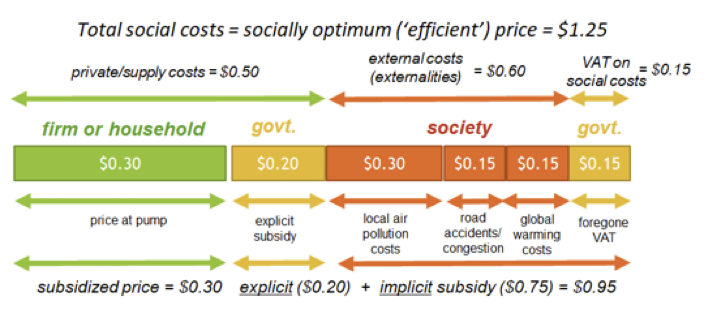
The article goes on to explain the difference between explicit and implicit subsidies, the former being the obvious direct payments to fossil fuel producers to bring down the unit cost of the fuel. The latter is a subsidy that is likely always present, vis in the practice of not charging the fossil fuel producers for the costs of pollution, climate change etc that are a consequence of their business. 

“Implicit subsidies occur when the retail price fails to include external costs, inclusive of the standard consumption tax. External costs include contributions to climate change through greenhouse gas emissions, local health damages (primarily pre-mature deaths) through the release of harmful local pollutants like fine particulates, and traffic congestion and accident externalities associated with the use of road fuels”(1)

By way of example they provide the following bar chart: 

(1) https://www.imf.org/en/Topics/climate-change/energy-subsidies