
Third Sunday of Lent

8th March 2026

Reflection with readings below 

In the reading from Exodus, the people are up  in arms that they don’t have enough fresh water to drink. Quite rightly so. They know how important water is. Without water they will not survive.   

Do we know what is important for life – or do we get distracted by populist issues such as wifi speed, foreign travel, journey times between London and Manchester, how many asylum seekers are occupying cheap hotel rooms, or the availability of strawberries in January? 

Equally do we get up in arms about what is truly important? Are we more concerned about the love-lives of pop stars or the fate of prisoners? The domestic arrangements of the royal family or the plight of steel workers in Wales?  The most recent diatribe from Nigel Farage or waiting times in our local A and E?

Returning to the necessity of water, how many of us are aware that Tehran is about to run out of drinking water? How many of us are concerned about the amount of water needed to cool AI data centres here in the UK?  

The UK already faces a projected daily water deficit of nearly 5 billion litres by 2050 –  which doesn’t include what might be needed by as yet to be built data centres. Might we expect agriculture to take precedence over data processing? 

Water shortages re not just a UK issue, but a global issue. Across the world we are collectively consuming fresh water faster than supplies can be replenished! How many of us are outraged at the amount of water needed to make a cheap t shirt  – worn today and thrown away tomorrow? Or how many of us are outraged that so much water is used to grow crops for cattle to eat so that ever greater quantities of meat can be consumed? 

If nothing else, maybe their time in the wilderness taught the Hebrews that they couldn’t just expect water to be readily available at the drop of a hat – or a stick! More precisely they would have learnt that their access to water was dependent on their understanding their relationship with God. They should expect to go through life – or through the wilderness – without engaging in a real and trusting relationship with God.

God, as creator, is the source of the wisdom we need to live sustainably, securely, happily within the limits of creation. We are not gods.  We cannot make creation conform to our demands. We have to live within the limitations of the created world. We cannot consume more water than the world can supply. We cannot discharge more pollution than the environment can absorb. We cannot take more resources from the earth than the earth can sustain.  

Where are our contemporary prophets, who, like Moses, will challenge us to think rationally, who will challenge us to understand our dependency on God? Where are the preachers, the thinkers and writers,  who will help us understand how  God wishes to  – and indeed does – relate with us, and the rest of creation? Are we ready to ‘kneel before the Lord our maker and listen to his voice’?

We can, nevertheless, draw consolation from the fact that God does not require us to be sinless for God to love us. What ever the state of our stupidity, our greed, our misplaced self-assurance, God is always willing to pay heed to our concerns, to afford us her wisdom, to show us a way forward. But we do have to want to engage with God – and that surely is what we mean by faith: the desire to be guided by God, to be in a relationship with God, to trust that God does indeed have answers to our problems. That is faith. 

The Samaritan woman had the means of taking water out of the well. She could do this day in, day out – for as long as there was water in the well.  What she hadn’t understood was that water like everything else was a gift that God had given her so that she might understand the universal nature of God, so that she might replicate God’s actions by sharing what was freely given so that all might benefit, that this water might enable eternal life not just for her and her tribe, but for everyone.

Like the Samaritan woman, we, even now in the 21st century, have a lot to learn about the life giving properties of water, and most particularly that those properties depend upon water being properly cherished and shared – to understand that all water is holy.

Exodus 17:1-7

From the wilderness of Sin the whole congregation of the Israelites journeyed by stages, as the Lord commanded. They camped at Rephidim, but there was no water for the people to drink. The people quarrelled with Moses, and said, “Give us water to drink.” Moses said to them, “Why do you quarrel with me? Why do you test the Lord?” But the people thirsted there for water; and the people complained against Moses and said, “Why did you bring us out of Egypt, to kill us and our children and livestock with thirst?” So Moses cried out to the Lord, “What shall I do with this people? They are almost ready to stone me.” The Lord said to Moses, “Go on ahead of the people, and take some of the elders of Israel with you; take in your hand the staff with which you struck the Nile, and go. I will be standing there in front of you on the rock at Horeb. Strike the rock, and water will come out of it, so that the people may drink.” Moses did so, in the sight of the elders of Israel. He called the place Massah and Meribah, because the Israelites quarrelled and tested the Lord, saying, “Is the Lord among us or not?” 

Psalm 95

1 Come, let us sing to the Lord; *
let us shout for joy to the Rock of our salvation.

2 Let us come before his presence with thanksgiving *
and raise a loud shout to him with psalms.

3 For the Lord is a great God, *
and a great King above all gods.

4 In his hand are the caverns of the earth, *
and the heights of the hills are his also.

5 The sea is his, for he made it, *
and his hands have moulded the dry land.

6 Come, let us bow down, and bend the knee, *
and kneel before the Lord our Maker.

7 For he is our God,
and we are the people of his pasture and the sheep of his hand. *
Oh, that today you would hearken to his voice!

8 Harden not your hearts,
as your forebears did in the wilderness, *
at Meribah, and on that day at Massah,
when they tempted me.

9 They put me to the test, *
though they had seen my works.

10 Forty years long I detested that generation and said, *
“This people are wayward in their hearts;
they do not know my ways.”

11 So I swore in my wrath, *
“They shall not enter into my rest.”

Romans 5:1-11

Since we are justified by faith, we have peace with God through our Lord Jesus Christ, through whom we have obtained access to this grace in which we stand; and we boast in our hope of sharing the glory of God. And not only that, but we also boast in our sufferings, knowing that suffering produces endurance, and endurance produces character, and character produces hope, and hope does not disappoint us, because God’s love has been poured into our hearts through the Holy Spirit that has been given to us.

For while we were still weak, at the right time Christ died for the ungodly. Indeed, rarely will anyone die for a righteous person– though perhaps for a good person someone might actually dare to die. But God proves his love for us in that while we still were sinners Christ died for us. Much more surely then, now that we have been justified by his blood, will we be saved through him from the wrath of God. For if while we were enemies, we were reconciled to God through the death of his Son, much more surely, having been reconciled, will we be saved by his life. But more than that, we even boast in God through our Lord Jesus Christ, through whom we have now received reconciliation.

John 4:5-42

Jesus came to a Samaritan city called Sychar, near the plot of ground that Jacob had given to his son Joseph. Jacob’s well was there, and Jesus, tired out by his journey, was sitting by the well. It was about noon. 

A Samaritan woman came to draw water, and Jesus said to her, “Give me a drink.” (His disciples had gone to the city to buy food.) The Samaritan woman said to him, “How is it that you, a Jew, ask a drink of me, a woman of Samaria?” (Jews do not share things in common with Samaritans.) Jesus answered her, “If you knew the gift of God, and who it is that is saying to you, ‘Give me a drink,’ you would have asked him, and he would have given you living water.” The woman said to him, “Sir, you have no bucket, and the well is deep. Where do you get that living water? Are you greater than our ancestor Jacob, who gave us the well, and with his sons and his flocks drank from it?” Jesus said to her, “Everyone who drinks of this water will be thirsty again, but those who drink of the water that I will give them will never be thirsty. The water that I will give will become in them a spring of water gushing up to eternal life.” The woman said to him, “Sir, give me this water, so that I may never be thirsty or have to keep coming here to draw water.” 

Jesus said to her, “Go, call your husband, and come back.” The woman answered him, “I have no husband.” Jesus said to her, “You are right in saying, ‘I have no husband’; for you have had five husbands, and the one you have now is not your husband. What you have said is true!” The woman said to him, “Sir, I see that you are a prophet. Our ancestors worshiped on this mountain, but you say that the place where people must worship is in Jerusalem.” Jesus said to her, “Woman, believe me, the hour is coming when you will worship the Father neither on this mountain nor in Jerusalem. You worship what you do not know; we worship what we know, for salvation is from the Jews. But the hour is coming, and is now here, when the true worshipers will worship the Father in spirit and truth, for the Father seeks such as these to worship him. God is spirit, and those who worship him must worship in spirit and truth.” The woman said to him, “I know that Messiah is coming” (who is called Christ). “When he comes, he will proclaim all things to us.” Jesus said to her, “I am he, the one who is speaking to you.”

Just then his disciples came. They were astonished that he was speaking with a woman, but no one said, “What do you want?” or, “Why are you speaking with her?” Then the woman left her water jar and went back to the city. She said to the people, “Come and see a man who told me everything I have ever done! He cannot be the Messiah, can he?” They left the city and were on their way to him. 

Meanwhile the disciples were urging him, “Rabbi, eat something.” But he said to them, “I have food to eat that you do not know about.” So the disciples said to one another, “Surely no one has brought him something to eat?” Jesus said to them, “My food is to do the will of him who sent me and to complete his work. Do you not say, ‘Four months more, then comes the harvest’? But I tell you, look around you, and see how the fields are ripe for harvesting. The reaper is already receiving wages and is gathering fruit for eternal life, so that sower and reaper may rejoice together. For here the saying holds true, ‘One sows and another reaps.’ I sent you to reap that for which you did not labor. Others have laboured, and you have entered into their labour.”

Many Samaritans from that city believed in him because of the woman’s testimony, “He told me everything I have ever done.” So when the Samaritans came to him, they asked him to stay with them; and he stayed there two days. And many more believed because of his word. They said to the woman, “It is no longer because of what you said that we believe, for we have heard for ourselves, and we know that this is truly the Saviour of the world.”
The water of eternal life

 17th January 2026

(Part of the underlying stress in Iran is a lack of water. Tehran and other cities are on the verge of ‘Day Zero’ – when there will literally be no water in the pipes. This is a result of climate change, over consumption and a failure to maintain traditional means of collecting and storing water).

Jesus said … “Indeed, the water I give them will become in them a spring of water welling up to eternal life.” John 4:14b

You Lord, are the source of all good things: 

We praise you.

You call us to tend and care for your creation: 

May we strive to do your will.

You have made us as brothers and sisters with all that lives: 

May we live together in peace.

A reading Ezekiel 47:1-12 

Now he brought me back to the entrance to the Temple. I saw water pouring out from under the Temple porch to the east (the Temple faced east). The water poured from the south side of the Temple, south of the altar. He then took me out through the north gate and led me around the outside to the gate complex on the east. The water was gushing from under the south front of the Temple. He walked to the east with a measuring tape and measured off fifteen hundred feet, leading me through water that was ankle-deep. He measured off another fifteen hundred feet, leading me through water that was knee-deep. He measured off another fifteen hundred feet, leading me through water waist-deep. He measured off another fifteen hundred feet. By now it was a river over my head, water to swim in, water no one could possibly walk through. He said, “Son of man, have you had a good look?”

Then he took me back to the riverbank. While sitting on the bank, I noticed a lot of trees on both sides of the river. He told me, “This water flows east, descends to the Arabah and then into the sea, the sea of stagnant waters. When it empties into those waters, the sea will become fresh. Wherever the river flows, life will flourish—great schools of fish—because the river is turning the salt sea into fresh water. Where the river flows, life abounds. Fishermen will stand shoulder to shoulder along the shore from En Gedi all the way north to En-eglaim, casting their nets. The sea will teem with fish of all kinds, like the fish of the Great Mediterranean.

“The swamps and marshes won’t become fresh. They’ll stay salty. But the river itself, on both banks, will grow fruit trees of all kinds. Their leaves won’t wither, the fruit won’t fail. Every month they’ll bear fresh fruit because the river from the Sanctuary flows to them. Their fruit will be for food and their leaves for healing.”

In the beginning

it was a mere drop of water, 

a slight dampness on the ground:

It will become in us a spring of water welling up to eternal life.

The wetness gathers, 

soaks into the ground, 

bubbles up and becomes a spring:

It will become in us a spring of water welling up to eternal life.

Overflowing, 

the spring gives birth to a stream, 

slipping and sliding and a journey begins:

It will become in us a spring of water welling up to eternal life.

Meeting with others, 

joining forces, growing in magnitude,

the stream becomes a river:

It will become in us a spring of water welling up to eternal life.

From youth to maturity 

the river grows in girth and presence, 

bearing an ever growing load:

It will become in us a spring of water welling up to eternal life.

Spilling over, spreading out, 

the river branches out into a delta 

disbursing its fertility across the land:

It will become in us a spring of water welling up to eternal life.

Returning, homing in on the tideline, 

the river pours out unhesitatingly 

into the greater depth of the sea:

It will become in us a spring of water welling up to eternal life.

From cradle to grave, may our lives be channeled by God’s wisdom.

From beginning to end, may our lives serve God’s kingdom.

From source to sea, may our lives overflow with God’s love.

Amen. 

The Lord’s Prayer 

7th Sunday of Easter

1sr June 2025

Reflection with readings below

Today’s Sunday is always slightly odd. On Thursday we celebrated the Ascension when Jesus left his disciples, removing the physicality of his presence with them, to rejoin God and the heavenly dimensions of life.  The disciples are told to wait – to wait for they are not quite sure what but something that will clearly come from God and which will give them renewed strength and  a sense of direction. This sign becomes the topic of next Sunday – Pentecost. In the meantime what of this Sunday? The readings don’t retell the Ascension story. Some churches observe this period between Ascension and Pentecost as a time of prayer, and/or of evangelism following Jesus’s injunction in Matthew’s Gospel: “Therefore go and make disciples of all nations, baptising them in the name of the Father and of the Son and of the Holy Spirit, and teaching them to obey everything I have commanded you. And surely I am with you always, to the very end of the age.”

In the first reading from Acts we hear then of Paul and Silas and their ministry as they ‘proclaim a way of salvation’. There must be something about the way that Paul and Silas live their lives and the way they go about this ministry that makes it obvious that who they are is radically different from the norm. That is what the slave girl picks up.

But today how often would people look at Christians and think there is someone who is radically different?  Or think there’s a community that lives a radically different lifestyle? 

Is salvation a way of life for us, or just a box we ticked at our baptism? 

If we were to see and express salvation as a way of living, what would it look like? I’m sure it would be a living expression of kingdom values. Throughout his ministry, Jesus is preaching that the kingdom of heaven is at hand. He is announcing in statements, telling in stories and showing in lived expressions, what the kingdom is like and what are its values. In the Ascension readings we hear of Jesus ascending, of Jesus sitting enthroned at the right hand of God – are they telling us that the Ascension inaugurates a new era in the rule of the kingdom of God?

In the passage from Acts, the jailer asks, ‘What must I do to be saved?’  

To be saved – to gain salvation – is about healing and restoration and wellbeing in this world. It is about feeling at one with who we are, not feeling overwhelmed by sin, by the ills of the world, not feeling inadequate not hopeless. It is about being confident that we can be faithful as disciples – and that Jesus has faith in us. It is about feeling we can trust that in God’s hands all will be well. It is feeling that we can be confident in what we do and say – if we what we do and say is as God desires.

In today’s gospel reading, Jesus is explaining how salvation brings an interconnectedness into our relationship with God so that we can like Jesus be at one with God, be enlivened by God’s love, and conduits for God’s glory. 

Earlier in John’s gospel we hear Jesus announce in the courts of the temple “If anyone is thirsty, let him come to Me and drink. Whoever believes in Me, as the Scripture has said: ‘Streams of living water will flow from within him.’ ”

Salvation is about life – eternal life. It flows  from within us, bursting up like a fountain. It floods our entire being. Salvation is how we live our lives, it is life as it should be lived. It is about joy and celebration, strength and trust. It is about a vitality that allows us to be radical, that allows us to live according to the kingdom values of Jesus. If we don’t live salvation as a way of life, then can we say that we are truly alive?

So maybe what I am learning is that this in between Sunday is about pausing to discern what salvation is and thus to be open to the gift of the Holy Spirit that will help make salvation not a thing of the moment but a lifelong approach to living in the world.

Acts 16:16-34

With Paul and Silas, we came to Philippi in Macedonia, a Roman colony, and, as we were going to the place of prayer, we met a slave girl who had a spirit of divination and brought her owners a great deal of money by fortune-telling. While she followed Paul and us, she would cry out, “These men are slaves of the Most High God, who proclaim to you a way of salvation.” She kept doing this for many days. But Paul, very much annoyed, turned and said to the spirit, “I order you in the name of Jesus Christ to come out of her.” And it came out that very hour.

But when her owners saw that their hope of making money was gone, they seized Paul and Silas and dragged them into the marketplace before the authorities. When they had brought them before the magistrates, they said, “These men are disturbing our city; they are Jews and are advocating customs that are not lawful for us as Romans to adopt or observe.” The crowd joined in attacking them, and the magistrates had them stripped of their clothing and ordered them to be beaten with rods. After they had given them a severe flogging, they threw them into prison and ordered the jailer to keep them securely. Following these instructions, he put them in the innermost cell and fastened their feet in the stocks.

About midnight Paul and Silas were praying and singing hymns to God, and the prisoners were listening to them. Suddenly there was an earthquake, so violent that the foundations of the prison were shaken; and immediately all the doors were opened and everyone’s chains were unfastened. When the jailer woke up and saw the prison doors wide open, he drew his sword and was about to kill himself, since he supposed that the prisoners had escaped. But Paul shouted in a loud voice, “Do not harm yourself, for we are all here.” The jailer called for lights, and rushing in, he fell down trembling before Paul and Silas. Then he brought them outside and said, “Sirs, what must I do to be saved?” They answered, “Believe on the Lord Jesus, and you will be saved, you and your household.” They spoke the word of the Lord to him and to all who were in his house. At the same hour of the night he took them and washed their wounds; then he and his entire family were baptised without delay. He brought them up into the house and set food before them; and he and his entire household rejoiced that he had become a believer in God.

Psalm 97

1 The  Lord is King;
let the earth rejoice; *
let the multitude of the isles be glad.

2 Clouds and darkness are round about him, *
righteousness and justice are the foundations of his throne.

3 A fire goes before him *
and burns up his enemies on every side.

4 His lightnings light up the world; *
the earth sees it and is afraid.

5 The mountains melt like wax at the presence of the  Lord, *
at the presence of the Lord of the whole earth.

6 The heavens declare his righteousness, *
and all the peoples see his glory.

7 Confounded be all who worship carved images
and delight in false gods! *
Bow down before him, all you gods.

8 Zion hears and is glad, and the cities of Judah rejoice, *
because of your judgments, O  Lord.

9 For you are the  Lord,
most high over all the earth; *
you are exalted far above all gods.

10 The  Lord loves those who hate evil; *
he preserves the lives of his saints
and delivers them from the hand of the wicked.

11 Light has sprung up for the righteous, *
and joyful gladness for those who are truehearted.

12 Rejoice in the  Lord, you righteous, *
and give thanks to his holy Name.

Revelation 22:12-14,16-17,20-21

At the end of the visions I, John, heard these words:

“See, I am coming soon; my reward is with me, to repay according to everyone’s work. I am the Alpha and the Omega, the first and the last, the beginning and the end.”

Blessed are those who wash their robes, so that they will have the right to the tree of life and may enter the city by the gates.

“It is I, Jesus, who sent my angel to you with this testimony for the churches. I am the root and the descendant of David, the bright morning star.”

The Spirit and the bride say, “Come.”
And let everyone who hears say, “Come.”
And let everyone who is thirsty come.
Let anyone who wishes take the water of life as a gift.

The one who testifies to these things says, “Surely I am coming soon.”

Amen. Come, Lord Jesus!

The grace of the Lord Jesus be with all the saints. Amen. 

John 17:20-26

Jesus prayed for his disciples, and then he said. “I ask not only on behalf of these, but also on behalf of those who will believe in me through their word, that they may all be one. As you, Father, are in me and I am in you, may they also be in us, so that the world may believe that you have sent me. The glory that you have given me I have given them, so that they may be one, as we are one, I in them and you in me, that they may become completely one, so that the world may know that you have sent me and have loved them even as you have loved me. Father, I desire that those also, whom you have given me, may be with me where I am, to see my glory, which you have given me because you loved me before the foundation of the world.

“Righteous Father, the world does not know you, but I know you; and these know that you have sent me. I made your name known to them, and I will make it known, so that the love with which you have loved me may be in them, and I in them.”

Lent Reflection

4th April 2022

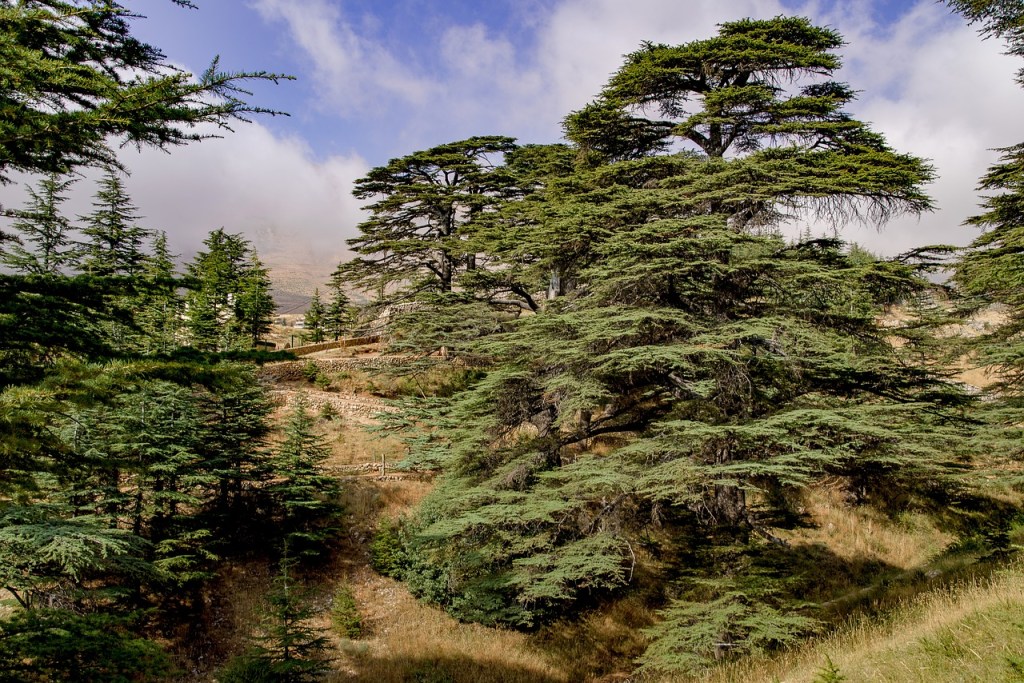
Cedar Mountain Ancient Tree Wood Countryside http://www.maxpixel

The cedar – cedrus libani – is a native of Lebanon and the eastern end of the Mediterranean. It is coniferous, able to grow in mountainous terrains, can reach a height of 35m and have a life span that can exceed 1000 years. It is often found in parks and gardens as a decorative specimen. It has a hard durable wood with a strong sweet smell – which is said to deter moths. Its resin can be used to produce a type of turpentine. 

When Solomon built the first temple in Jerusalem, cedar imported from  Lebanon was one of the key building materials used for both beams and joists, as well as for creating carved panelling to,libe the interior walls.

The cedar symbolised purification and protection, incorruptibility and eternal life.

The righteous flourish like the palm tree and grow like a cedar Lebanon. Psalm 92:12

Quietude, which some men cannot abide because it reveals their inward poverty, is as a palace of cedar to the wise … Charles H Spurgeon 

5th Sunday of Lent

3rd April 2022

Isaiah 43:16-21

Thus says the Lord,
who makes a way in the sea,
a path in the mighty waters,

who brings out chariot and horse,
army and warrior;

they lie down, they cannot rise,
they are extinguished, quenched like a wick:

Do not remember the former things,
or consider the things of old.

I am about to do a new thing;
now it springs forth, do you not perceive it?

I will make a way in the wilderness
and rivers in the desert.

The wild animals will honour me,
the jackals and the ostriches;

for I give water in the wilderness,
rivers in the desert,

to give drink to my chosen people,
the people whom I formed for myself

so that they might declare my praise.

Psalm 126

1 When the Lord restored the fortunes of Zion, *
then were we like those who dream.

2 Then was our mouth filled with laughter, *
and our tongue with shouts of joy.

3 Then they said among the nations, *
“The Lord has done great things for them.”

4 The Lord has done great things for us, *
and we are glad indeed.

5 Restore our fortunes, O Lord, *
like the watercourses of the Negev.

6 Those who sowed with tears *
will reap with songs of joy.

7 Those who go out weeping, carrying the seed, *
will come again with joy, shouldering their sheaves.

Philippians 3:4b-14

If anyone else has reason to be confident in the flesh, I have more: circumcised on the eighth day, a member of the people of Israel, of the tribe of Benjamin, a Hebrew born of Hebrews; as to the law, a Pharisee; as to zeal, a persecutor of the church; as to righteousness under the law, blameless.

Yet whatever gains I had, these I have come to regard as loss because of Christ. More than that, I regard everything as loss because of the surpassing value of knowing Christ Jesus my Lord. For his sake I have suffered the loss of all things, and I regard them as rubbish, in order that I may gain Christ and be found in him, not having a righteousness of my own that comes from the law, but one that comes through faith in Christ, the righteousness from God based on faith. I want to know Christ and the power of his resurrection and the sharing of his sufferings by becoming like him in his death, if somehow I may attain the resurrection from the dead.

Not that I have already obtained this or have already reached the goal; but I press on to make it my own, because Christ Jesus has made me his own. Beloved, I do not consider that I have made it my own; but this one thing I do: forgetting what lies behind and straining forward to what lies ahead, I press on toward the goal for the prize of the heavenly call of God in Christ Jesus.

John 12:1-8

Six days before the Passover Jesus came to Bethany, the home of Lazarus, whom he had raised from the dead. There they gave a dinner for him. Martha served, and Lazarus was one of those at the table with him. Mary took a pound of costly perfume made of pure nard, anointed Jesus’ feet, and wiped them with her hair. The house was filled with the fragrance of the perfume. But Judas Iscariot, one of his disciples (the one who was about to betray him), said, “Why was this perfume not sold for three hundred denarii and the money given to the poor?” (He said this not because he cared about the poor, but because he was a thief; he kept the common purse and used to steal what was put into it.) Jesus said, “Leave her alone. She bought it so that she might keep it for the day of my burial. You always have the poor with you, but you do not always have me.”

Reflection

The passage from Isaiah tells us that war and military strength are not the solution to problems in the kingdom of God. They are not solutions that bring in God’s reign. God’s way is new, is different, says the prophet. Perhaps not new to God but new to humans who are slow to perceive it! Wake up humans! God’s way inhabits the natural world, creating what is needed for life – water in dry areas, paths where it’s rough, things that bring life to creatures and people alike. The psalmist knows that when we recognise these occasions of restoration and transformation – those occasions when we align our ways with God’s ways – they will be times of joy and laughter and flourishing. 

How is it that we can seem to slip in and out of God’s kingdom, or more accurately, in and out of being aligned with God’s reign, God’s way? 

Paul in his letter to the Christians in Philippi, recalls how in the past he had closely cherished his Jewish heritage and assiduously followed its practices which he had been taught would keep him in alignment with God. But all that guarantee he has now forgone having found something even better: the life he knows through Jesus Christ. Faith in Christ brings resurrection – and resurrection means new life, means a new way of experiencing life, means a new way of living. It is a life not limited to this world and our mortal time frame. 

The story related In John’s Gospel takes place on the eve of Palm Sunday, on the eve of the most momentous week. Jesus, in John’s gospel, is a figure confident of his own destiny, who sees and understands how that destiny is going to pan out. Jesus has already raised  Lazarus from the dead; Jesus has declared, “I am the resurrection and the life. Anyone who believes in me will live, even after dying. Everyone who lives in me and believes in me will never ever die”. This is the eve of the week in which Jesus will ride publicly in to Jerusalem; in which he will continue to  declare his message that he is the light of the world; that through belief in him, people will have eternal life – new life which is not of this world; that he will be raised up for all to see in what will be his culminating hour of glory.  It is a week that will end with his burial. 

In the scene John depicts, there are two contrari protagonists. On the one hand Mary who it seems understands how this week will unfold, and Judas who it seems is either oblivious, or wilfully ignoring, what the state of play. Mary recognises the importance of what is going to happen and pours out this expensive ointment as her best acknowledgement of who Jesus is and of what he represents. It is her expression of adoration and love. It witnesses to her belief that what is to come will be worth so much more than this perfume. Judas, on the other hand, just wants to come across as the good guy – the one standing up for the poor. What Judas has failed to understand is that what the poor need is not just extra alms now, but system change. 

“I am the way and the truth and the life”: Jesus is the true system change. 

System change is what the world still needs. In the UK where an increasing number of people are facing poverty, what is needed is not just increased benefits, but a system change in which everyone is  awarded a wage on which they can genuinely live, in which goods are produced and sold at a price that reflect their true cost, in which animals reared as food are given genuinely good lives, in which taxes paid genuinely reflect the person/ company’s ability to pay, in which the real cost of fossil fuels is recognised and in which economic policies really do focus on zero carbon emissions. 

System change is about aligning the world’s systems to God’s ways – not just some of the time, but all of the time!