Counting On … 198

3rd December 2025

Phosphorus is another key mineral for the health of plants and animals. It derives from rocks and  through erosion finds its way into the soil, where as  soluble phosphates (HPO4 and H20P4) it is absorbed by plants, and through eating plants into plant eating creatures and so up through the food chain. Bacteria in the soil aid the absorption of phosphates.

Organic phosphorus is released back into the soil through defecation and the decay of plants and animals. During the process of decomposition the organic form of phosphorus is converted to an inorganic firm such that it can overtime  be reformed into sedimentary rocks. This comprises the natural phosphorus cycle. 

Because phosphorus improves crop yields it is added as an artificial fertiliser. This input disrupts the cycle. Excess of phosphorus is the primary cause of algal bloom in water sources, reducing the amount of oxygen present and so killing off many plants and creatures. (1)

The following data comes from Planetary Boundaries Science:-

“Before human intervention, phosphorus flows were low ~2.5 Tg P pa (tetragrams of phosphorus per year) from land to freshwater and ~1.3 Tg P pa of export to the ocean. Human activities have increased flows from land to freshwater systems through a global application of mined phosphorus to cropland of around 18.2 Tg P pa and have increased phosphorus flows to the ocean to around 4.4 Tg P pa, largely due to fertiliser use.” 

At the same time, the sage planetary boundary for phosphorus flow is between 6.2 and 11 Tg P pa. (2) 

  1. https://biologyteach.com/phosphorus-cycle/
  2. https://www.planetaryhealthcheck.org/boundary/modification-of-biogeochemical-flows/

Counting on … day 20

29th January 2025

Food waste occurs at all stages between field and the fork. 

At the field end, waste may occur because the crop has not grown to a saleable quality which could because of drought or excess water, frosts or excess heat, infestation by bugs or diseases. Food waste may occur  because of delays in harvesting (due to adverse weather) or a lack of workers or equipment. 

The increasing occurrence of adverse weather events caused by the climate crisis is going to be an issue for decades to come. Even if we can curtail carbon emissions, it will be  many decades before global temperatures will reduce to a level such that weather patterns will revert to what we would consider normal.

As regards harvesting, much of the work is done by people on short term insecure contracts earning minimal  wages. This is not good for them nor is it good for our food system. Maybe as consumers we should be willing to pay a fairer price for our food. But equally it maybe others in the supply chain need to be taking a smaller profit. The following Guardian article is interesting. But it is not just a UK issue. Similar problems happen in Spain where ‘cheap’  seasonal labour  is brought in from North Africa – https://www.ethicalconsumer.org/ethicalcampaigns/agricultural-workers-rights-almeria

“Employment tribunal hearings are due to begin this week to decide their claims for unlawful ­deduction of wages, unfair dismissal, discrimination and harassment against Haygrove, a business which runs five farms in the UK growing ­strawberries, cherries and other berries.

“It employs more than 1,000 ­people to pick fruit and uses the seasonal worker scheme, a visa programme introduced after Brexit when fruit was left rotting in the fields because there was no one to pick it. Haygrove disputes the claims.

“McAndrew said there was substantial evidence of “widespread exploitation” of people on the seasonal worker visa. Part of the reason is that growers are under extreme pressure from supermarkets to drive down prices, and seasonal workers are usually employed through third-party agencies.

“Research by the Landworkers’ Alliance into the fruit supply chain found that for a £2.30 punnet of strawberries, the farm received 50p, of which just 5p was profit, while workers received just 18p after deductions for tax, visa and accommodation.” (1)

(1) https://www.theguardian.com/global/2025/jan/26/protests-by-fruit-pickers-and-farmers-put-spotlight-on-price-of-cheap-food-in-uk?CMP=Share_iOSApp_Other

Green Tau: issue 100

14th December 2024

How we can make a just transition? Agriculture and land use

Approximately 12% (58MtCO2 as of 2020) of the UK’s greenhouse gas emissions come from farming but of that 10% more than half is methane from livestock and a further 30% is nitrous oxides from fertilisers (1). As the UK moves to a net zero economy, it is obvious that emissions from agriculture need to be reduced – the Climate Change Committee’s target is 21 MtCO2 by 2050. (Agriculture – including deliberate none cultivation of the land – offers opportunities to increase natural carbon absorption which should more than offset this remaining 21Mt of CO2).

The Climate Change Committee which draws up carbon budgets and roadmaps to advise the Government as to the means by which net zero targets can be achieved, recommended in its 2020 report Land use: Policies for a Net Zero UK, the following policy proposals:

  • Increase tree planting – increasing UK forestry cover from 13% to at least 17% by 2050 by planting around 30,000 hectares (90 – 120 million trees) of broadleaf and conifer woodland each year.
  • Encourage low-carbon farming practices – such as ‘controlled-release’ fertilisers, improving livestock health and slurry acidification.
  • Restore peatlands – restoring at least 50% of upland peat and 25% of lowland peat.
  • Encourage bioenergy crops – expanding UK energy crops to around 23,000 hectares each year.
  • Reduce food waste and consumption of the most carbon-intensive foods – reduce the 13.6 million tonnes of food waste produced annually by 20% and the consumption of beef, lamb and dairy by at least 20% per person, well within current healthy eating guidelines. (2)

In the summer of this year, 2024, the Climate Change Committee’s report on progress found that reducing emissions from agriculture and land use had slowed and that ‘total emissions from agriculture have not significantly decreased since 2008’! (3) Commenting on the Report, ADAS  notes “A key CCC recommendation is that  tree planting and peatland restoration must be accelerated. Under the CCC pathways to net zero, tree planting must be scaled up in the 2020s in order for abatement (carbon sequestration and storage) to be sufficient to meet later carbon budgets and reach net zero by 2050. This will require a doubling of current rates to get as close as possible to the targets of 30,000ha of new woodland creation per year by 2025 and 32,000ha of peatland restoration a year by 2026.” (4) As regards reducing livestock levels, whilst figures previously showed a decline, this seems to have plateaued, suggesting further focus here is needed. 

Whether through converting more arable or grass lands to woodland, restoring peatlands or by reducing livestock numbers, the farming world is going to have to face ongoing change. 

The demands of climate change, go beyond just reducing carbon emissions, and include further action in protecting land, properties and lifestyles from the impacts of increasingly adverse weather conditions and rising sea levels. Again referencing the latest CCC report ADAS notes “This latest CCC report comes after the wettest 18 months on record in England. Farmers and land managers have been among the most affected with thousands of acres of farmland flooded, crop yields down and harvesting delayed, as well as knock-on impacts into this season and likely longer-term.

“The impacts of this record rainfall highlight the urgent need to adapt to the physical risks of climate change, to avoid more costly and less effective adaptations further down the line. The CCC reports that currently the UK’s Third National Adaption programme (NAP3) lacks the ambition and pace to address the scale of climate risks we are already experiencing in the UK”. (6)

Under the terms of the Climate Change Act 2008 the UK is required to produce ‘national adaptation plans’ setting out how the government will protect the country from the impacts of climate change by   constructing flood defences, developing green spaces, cultivating drought-resistant crops, and building resilient infrastructure etc. NAP3 covers the period 2023 to 2028. To date most commentators note that the provisions made by NAP3 are inadequate, but clearly they will impact on the farming world whether through more farmland suffering the adverse consequences of droughts and floods, or through changing agricultural practices and changes to land use – eg restoring water meadows, planting more woodland and re-setting peatlands.

At the same time as the need to address climate change by transitioning to net zero, the UK also needs to address biodiversity loss which is another issue linked with the need for change in agricultural practices. As regards England (other parts of the UK have their own policies) the Parliament has noted that “the Environment Act 2021 … set legally binding biodiversity targets ….:

  • to reduce the risk of species going extinct in 2042, compared with 2022
  • to create or restore 500,000 hectares of wildlife-rich habitats by 2042
  • to ensure overall species abundance is increasing rather than decreasing by 2030, and increases by 10% by 2042, compared with 2030”(5)

These are in addition to the UK’s commitment to meet the international Convention on Biological Diversity’s ‘30 by 30 target’ – vis achieving effective conservation and management of at least 30% of land and sea by 2030.

Again these are targets which are going to impact the farming world, through adopting less intensive farming techniques, and through the restoration – and expansion of – hedgerows, ponds, woods, peatlands and meadows etc. 

Not all these changes are going to be self financing. It is possible that less intensive farming by reducing the amount – and therefore cost –  of inputs such as fertilisers, may be cost neutral, but in most cases less intensive farming will only be financially viable if the end product can be sold to,the customer at an enhanced price.  But weather restoring a pond in a field or rewetting peatland will be self financing is perhaps more doubtful. On the other hand the benefit to us as a whole will be significant – so may be we need to work out how we put a value on that benefit and how we work out who pays and how. 

It seems to me that we need a conversation that allows farmers and consumers to explore what the options are and how the transition to  climate and biodiversity friendly farming can be achieved. If farms are going to have less livestock, are we consumers going to eat less meat? If crops are grown less intensively, are we consumers willing to pay more? And is the government going to ensure that wages and benefits increase commensurately? If farmers are to convert grazing land to woodlands, are we as tax payers, willing to pay for loss of income? Might we instead see the cost as the cost of protecting our homes from flooding? Might those with the resources (financial and volunteering capacity) be willing to purchase farmland with the aim of rewilding it? Will the government provide funds to encourage new rural industries that would provide employment and maintain or reinvigorate rural communities? 

We certainly need to have these conversations urgently to ensure both a just transition and to protect our climate and environment for the wellbeing of current and future generations to come. The next five years look as if they are increasingly going to be when decisive action (not just plans) happens.

  1. https://ahdb.org.uk/knowledge-library/carbon-footprints-food-and-farming
  2. https://www.theccc.org.uk/2020/01/23/major-shift-in-uk-land-use-needed-to-deliver-net-zero-emissions/

(3) https://www.theccc.org.uk/publication/progress-in-reducing-emissions-2024-report-to-parliament/

(4)  https://adas.co.uk/news/credible-plans-and-actions-urgently-needed-to-decarbonise-uk-agriculture-sector/

(5) https://commonslibrary.parliament.uk/biodiversity-loss-uk-international-obligations/

(6) https://adas.co.uk/news/credible-plans-and-actions-urgently-needed-to-decarbonise-uk-agriculture-sector/

The Joys and Sorrows of Civilisation 

12th October 2024

There shall come forth a shoot from the stump of Jesse, and a branch from his roots shall bear fruit. Isaiah 11:1

You Lord, are the source of all good things: 

We praise you.

You call us to tend and care for your creation: 

May we strive to do your will.

You have made us as brothers and sisters with all that lives: 

May we live together in peace.

A reading:  So Paul stood up and with a gesture began to speak: ‘You Israelites, and others who fear God, listen. The God of this people Israel chose our ancestors ….. he made David their king. In his testimony about him he said, “I have found David, son of Jesse, to be a man after my heart, who will carry out all my wishes.” Of this man’s posterity God has brought to Israel a Saviour, Jesus, as he promised. Acts 13: 16, 17a, 22b,23

Reflection 

Roots secure us to the past, ensure that we are part of the continuity of creation; shoots  and branches  take our lives forward into the as yet unformed future. Without the next generation there will be no ongoing continuity. The gospels of Luke and Matthew both locate Jesus within a human family tree;  the prologue of John’s gospel locates him as co existent with the beginning of all creation. Later in John’s  gospel, Jesus affirms his coexistence with the Father and the ongoing coexistence, through him, of all believers, all God’s children. 

For gifts of past generations

We thank you God:

For the gift of fire for cooking and heating

For the gift of clean water and sewers

We thank you God:

For the domestication of cattle and horses,

Cats and dogs, sheep and pigs, 

Hens and geese

We thank you God:

For the gift of gardening and arable cultivation,

sowing and reaping, 

growing and harvesting

We thank you God:

For the gift of healing and caring, 

of medicine and surgery

For the understanding of the intricacies of mind and body 

We thank you God:

For the gift of story telling and drama, 

of art and observation 

means of sharing grief and joy.

We thank you God:

For the gift of learning and research, 

of teaching and sharing

We thank you God:

For the gift of exploration and endeavour, of travel and communication 

We thank you God:

For the gift of worship, of self realisation and of the knowledge of God.

We thank you God:

But what shall we pass on to generations to come?

Do we offer gifts or burdens?

Merciful God forgive and inspire us.

Clean air or choking smog?

Merciful God forgive and inspire us.

Living water or dying oceans?

Merciful God forgive and inspire us.

Renewables or fossil fuels?

Merciful God forgive and inspire us.

Biodiversity or widespread extinction?

 Merciful God forgive and inspire us.

Fertile soils or inhospitable dust?

Merciful God forgive and inspire us.

Balmy summers or wild fires?

Merciful God forgive and inspire us.

Snow capped mountains or drowned coastlines?

Merciful God forgive and inspire us.

Homes for all  or camps for migrants?

Merciful God forgive and inspire us.

May we be wise guardians of what we have received 

Skilful custodians of what we consume

Generous donors of what we hand on

That the future of creation will be bright and beautiful, 

fair and just.

Amen

Counting on … day 190

11th October 2024

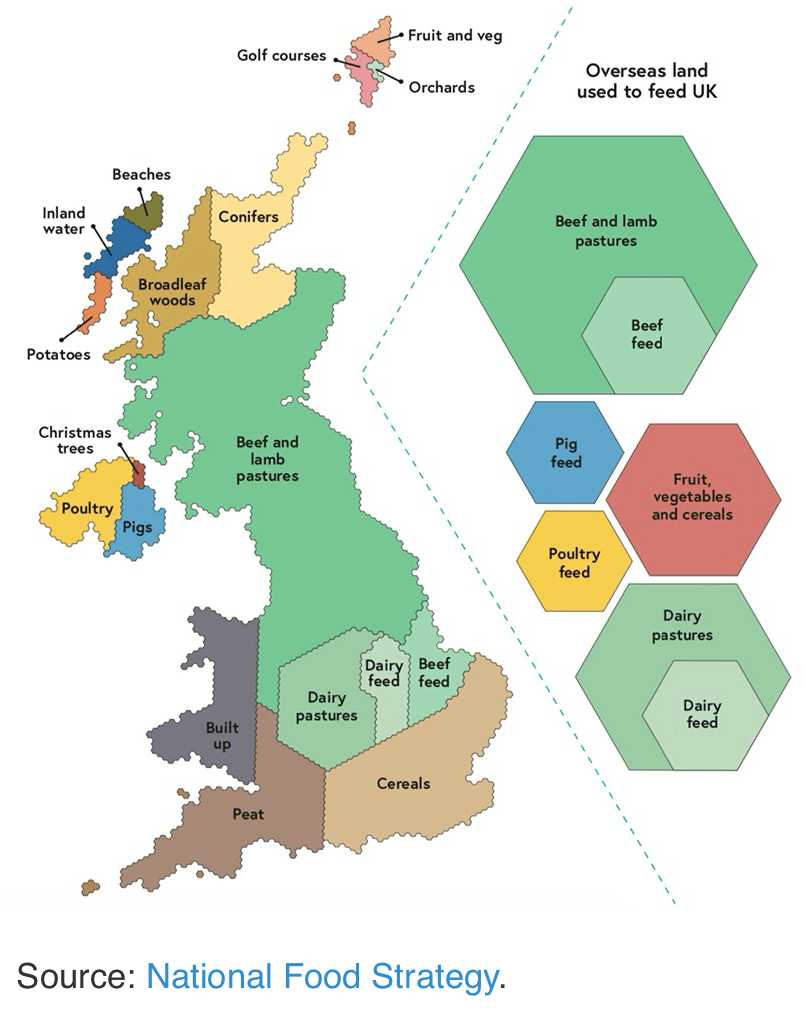
The left hand half of this diagram shows the amount of land used in the UK for different purposes – from providing grazing for beef cattle and sheep (the largest single use) to land cultivated as orchards (smallest alongside land used for growing Christmas tree!). 

The right hand half shows overseas land that we rely on (effectively use) to produce food stuffs that we import – and again land for beef and lamb production is the largest. 

Even just halving our meat consumption, would free up huge amounts of land that could be better used for rewilded biodiverse rich landscapes, as well as having space for increased horticultural production of a wide range of fruits and vegetables. 

Counting on … day 189

10th October 2024

Restoring biodiversity and protecting 30% of the UK is going to need a widespread reworking of farming practices and objectives. This will mean taking some land out of food production – eg to create peat bogs or woodlands – but on the other hand if we view land as the means of supporting not just food production but primarily as the means of supporting life, this makes sense. Should we be paying a life support tax to finance this? 

Restoring biodiversity will also mean reducing the intensity with which the land is farmed for food – widening existing, and planting new, hedges, cultivating the borders of fields as wild flower meadows, creating ponds and rewiggling rivers, reducing stocking levels (and reducing the total number of livestock to a proportionate level given that for every animal more land has to be used to grow feed crops), changing crop planting patterns to reduce the need for fertilisers that then pollute waterways etc. 

All this will mean a change in the way we eat. We need to switch to diets that are largely plant-based and dependent on locally grown crops. Diets that will in fact be both tasty and healthy.

Counting on …. Day 1.154

21st August 2023

Sometimes it is difficult to tell whether a beautiful rural landscape is the ‘natural’ one as being in its primordial state, or whether it is a ‘natural’ one this is the fusion of human activity in harmony with nature. The two may look very different eg moorlands covered with forests versus moorlands covered with grass and sheep; or low-lying land that is marshy or low-lying land that has been drained and cultivated for arable crops.

The following comments come from the Natural History Museum.

 “’What we repeatedly see in our models is that agriculture is one of the main drivers of strong biodiversity declines,’ says Katia. ‘Even when we consider different human pressures, such as human population density and road development, we always find that the most shocking biodiversity declines are across agricultural sites.

‘That is the key point, the fact is that we need to find a way to slow down agricultural expansion.’

The continued spread and intensification of farming and development in the UK over the last 200 years has meant that most landscapes have not escaped some form of human influence.

The fact that this started such a long time ago means that in some cases we think of these altered landscapes as being their natural state, when in reality they were already heavily depleted of their wildlife’”. https://www.nhm.ac.uk/discover/news/2020/september/uk-has-led-the-world-in-destroying-the-natural-environment.html

Counting on … day 1.118

12th May 2023

Interesting comments from RSPB –  “One of the latest experiments is planting wildflower strips and alleys of trees within fields. Research has already shown that planting wildflower strips helps bring beneficial insects into the fields, which is good for pollination and pest control. But this ten-year trial hopes to show the strips with trees can help in other ways too, such as:  

  • A wildlife boom – from earthworms underground to the birds in the treetops to everything in between, we hope the strips will increase beneficial wildlife including beneficial pollinators and natural pest controllers. The trial will also look to see if the trees have a negative impact on any species.  
     
  • Carbon catching trees – we know trees store carbon – but we want to find out accurate figures for how much carbon our trees can capture to help inform future work.
     
  • Make some money –  apple and cobnut trees within the alleys can provide another source of income. We’ll be keeping a close eye on whether these trees bring home the bucks as well as the bugs.”

https://www.rspb.org.uk/get-involved/activities/so-many-ways/explore-more-ways/farm-with-flower-power/

Counting on … day 1.116

10th May 2023

A report from Euro News – “The EU has approved plans for the Dutch government to buy out farmers. The scheme is part of the Netherlands’ plan to drastically slash nitrogen emissions, a major source of which is livestock farms. Farmers in the Netherlands have been staging protests over emissions reduction targets since October 2019 – The Dutch ruling coalition wants to cut emissions, predominantly nitrogen oxide and ammonia, by 50 per cent nationwide by 2030. Nearly €1.5 billion will be used to compensate farmers who voluntarily close farms located near nature reserves. Some 3,000 farms are expected to be eligible.” https://www.euronews.com/green/2023/05/03/dutch-farmers-could-be-paid-to-close-their-livestock-farms-under-new-scheme?utm_source=newsletter&utm_medium=green_newsletter&_ope=eyJndWlkIjoiMTJjMTk2MDNmOWI2YTEwZmZmMTQ0ODYyMWQ3NDJhNDcifQ==

The reduction in livestock numbers will also make a positive contribution to carbon emissions. 

Counting on … day 1.115

9th May 2023

This week is National Hedgerow Week. Hedgerows can be an excellent space where biodiversity thrives – both in terms of the range of plants that can be found there, and in terms of the number of birds, insects and small mammals that benefit from its ecosystem. Hedges can also serve as wild life corridors linking areas of rich biodiversity. Sadly many  hedgers have been lost as increasing industrialisation of farming has led to the use of larger  pieces of machinery (ploughs, sprayers, harvesters) which can only be used in large fields – ie combined smaller fields where the hedges have been removed. 

Since gardens too can be home to hedges, I was particularly attracted to the idea of creating a hedge using home grown plants – a long term project which will see a hedge replace a row of raspberries reaching the end of their fruitful lifespan. And the National Hedgrewo Week website provides just the information for doing this – https://treegrowersguide.org.uk/