Prayers for peace

9th August 2025

Turn from evil and do good; seek peace and pursue it.

You Lord, are the source of all good things: 

We praise you.

You bless us with a world that is good 

and look to us to be peace makers and peace keepers:

May we strive to do your will.

You have made us as brothers and sisters: 

May we live together in peace.

Reading Micah 4: 2- 5

  And many nations shall come and say:
‘Come, let us go up to the mountain of the Lord,
    to the house of the God of Jacob;
that he may teach us his ways
    and that we may walk in his paths.’
For out of Zion shall go forth instruction,
    and the word of the Lord from his dwelling place.

He shall judge between many peoples,
    and shall arbitrate between strong nations far away;
they shall beat their swords into ploughshares,
    and their spears into pruning-hooks;
nation shall not lift up sword against nation,
    neither shall they learn war any more;

but they shall all sit under their own vines and under their own fig trees,
    and no one shall make them afraid;
    for the mouth of the Lord of hosts has spoken.

For all the peoples walk,
    each in the name of its god,
but we will walk in the name of the Lord our God
    for ever and ever.

We cannot read words today and not weep with distress and anger at what we have seen and heard this week in Gaza and Israel.*

Lord  of mercy and healing, 

be a source of comfort to all who are suffering, 

all who are in pain, all who terrified and fearful, 

all who feel lost and without hope.

Lord in your loving mercy, restore peace on earth.

How can humans allow relationships to sink to this level of violence, hate  and revenge?

Open our hearts and minds to perceive all that eats away at peace.

Pause our snap judgments that cannot see the bigger picture.

Remove our blinkers of prejudice and hate.

Lord in your loving mercy, restore peace on earth.

How can humans created in the image of God, cause such pain and suffering on those equally created in the image of God?

Open our hearts and minds to empathise with those who suffer

Pause our urge to look away and forget

Remove our hardness of heart.

Lord in your loving mercy, restore peace on earth.

How can communities and tribes believe that they can create a better future through warfare and violence?

Open our hearts and minds – and our purses – to rebuild peace: 

To build a world where all have food and homes, 

Where all can work and all can rest,

Where all are loved and all are valued.

Lord in your loving mercy, restore peace on earth.

Devastated by our ignorance and impotence, we realise that we are not the wise and clever people we though we were. 

Transform our urge to disparage and find fault,

Transform our urge to put focus on our interests,

Transform our lack of will.

Lord in your loving mercy, restore peace on earth.

Peace is not just the absence the war. 

Peace provides clean water and sanitation.

Peace provides an ample sufficiency of healthy food.

Peace provides a loving home.

Peace provides protection from the elements.

Peace provides security from danger and freedom from fear.

Peace provides energy and resources to sustain daily occupations.

Peace provides health care.

Peace provides education.

Peace provides the freedom to worship.

Peace provides the means to listen to others and to tell your own story.

Peace encourages respect.

Peace provides the means to discuss and plan shared futures.

Peace enables fresh food to be grown and harvested.

Peace shares resources equitably.

Peace provides space to rest and time to enjoy friendship.

Peace it is a way of living that provides for the wellbeing of everyone.

Amen.

  • first written in October 2023

Counting on … day 127

8th  August 2025

We live in a time of global shortages as well as global overconsumption, so living with enough may involve re-examining what ‘enough’ looks like. 

Whilst  I can get all that my family needs, such as foods, clothes, shelter, medicine etc,  there are other people who cannot either access or afford these essentials. Should I reduce the amount  I think I need, to make more available  for others? 

Isn’t that the dilemma of Earth Overshoot Day? Here in the west in consuming what we ‘need’ for our comfortable lifestyles, we are doing so at the expense of other people, often those living in the global south. 

If for example, eating meat on a regular basis means we are ‘using’ agricultural land that could otherwise be used to grow food to better feed others or that could be better used to restore biodiversity and/ or store carbon, then should we not significantly reduce our consumption of meat? 

Enough becomes eating less meat.

As well as meat, we might consider reducing our western levels of consumption of electronic and electrical goods which use large proportions of limited resources  such as lithium and copper. These limited resources might be better used to meet the more pressing needs of others? (Or being left in the ground so as not to damage the environment).

Enough becomes consuming fewer electrical goods.

And might we also consider how much plastic we consume? Plastic use becomes yet one more reason for companies  to justify extracting more carbon-emitting oil from the ground. Plastic waste causes widespread pollution damaging both our own health and the environments of others across the globe.

Enough  becomes consuming less plastic – especially single use items and plastic packaging.

There are many such ways in which we can re-examine what enough looks like.

“Thy will be done”

26th July 2025

Those who say, ‘I love God’, and hate their sibling are liars; for those who do not love a sibling whom they have seen, cannot love God whom they have not seen. 1 John 4:20

You Lord, are the source of all good things: 

May your name be hallowed.

You call us to love every neighbour as ourself: 

May we strive to do your will.

You have made us as brothers and sisters with all that lives: 

May we live together in peace.

A reading from Matthew 25: 35-40

for I was hungry and you gave me food, I was thirsty and you gave me something to drink, I was a stranger and you welcomed me, I was naked and you gave me clothing, I was sick and you took care of me, I was in prison and you visited me.” Then the righteous will answer him, “Lord, when was it that we saw you hungry and gave you food, or thirsty and gave you something to drink? And when was it that we saw you a stranger and welcomed you, or naked and gave you clothing? And when was it that we saw you sick or in prison and visited you?”  And the king will answer them, “Truly I tell you, just as you did it to one of the least of these who are members of my family,[a] you did it to me.”

Love the Lord your God with heart and soul and mind and strength.

The migrant is a figure of hate, 

the asylum seeker despised; 

the Jew is stereotyped, 

the Muslim is vilified.

“Thy will be done”?

Have mercy on us good Lord, 

that we learn to do your will.

Love your neighbour as yourself.

The homeless lie destitute on the pavement, 

the lonely sit isolated in their homes, 

the poor queue in food banks, 

the rich are spoilt for choice.

“Thy will be done”?

Have mercy on us good Lord, 

that we learn to do your will.

Do not opposes the orphan, the widowed, nor the foreigner.

The children are reduced to bones by malnutrition, 

the widowed go hungry;

the stateless have no rights 

and the alien is deported.

“Thy will be done”?

Have mercy on us good Lord, 

that we learn to do your will.

Feed the hungry, give drink to the thirsty.

Food aid sits in compounds as Palestinians die on their feet; 

whilst those collecting water become targets for snipers.

In the West, food banks and food waste co-exist, 

whilst health service tackle obesity and malnutrition.

“Thy will be done”?

Have mercy on us good Lord, 

that we learn to do your will.

Seek justice, love mercy.

Warfare grinds on in Ukraine and the Congo, 

in Myanmar and Thailand, in Gaza and Yemen.

Justice falters where drug wars and gang violence, 

land grabs and forced migration take precedence. 

The rich and powerful have no mercy.

“Thy will be done”?

Have mercy on us good Lord, 

that we learn to do your will.

Speak out for the voiceless and rescue the oppressed.

Refugees languish unreported in North Sudan and Yemen;

Afghan women wait at borders with no hope of rescue, 

and trafficked workers remain hidden out of sight.

“Thy will be done”?

Have mercy on us good Lord, 

that we learn to do your will.

Release the prisoner, heal the sick.

Activists are imprisoned, 

political opponents jailed, 

the disabled are trapped by lack of support, 

the mentally ill are left in limbo for lack of care.

“Thy will be done”?

Have mercy on us good Lord, 

that we learn to do your will.

Tend and protect the Earth; declare the year of the Lord’s favour.

Soils are degraded through overuse, 

waters are polluted with sewage and chemical spills;

temperatures rise and glaciers melt; 

industrial farming displaces forests; 

wildlife diminishes.

“Thy will be done”?

Have mercy on us good Lord, 

that we learn to do your will.

Lord whenever we pray as Jesus taught us, 

inspire us with the vision of how things could be on Earth just as jn Heaven. 

Challenge us to live according to your will. 

Embolden us with strength to make the  changes that are needed. 

Empower us with wisdom to speak the truth to power where your will is ignored. 

And enfold us in your loving compassion.

Amen. 

remind us that how things are is not ‘Thy will’ help us understand that we are called to 

Greentau: issue 111

Earth Overshoot Day 

24th July 2025

Leviticus 25 explains that the land should have a sabbath rest every seventh year. In that year no crops would be sown and the people would live off the surplus of previous years. Farmers over the millennia have learnt that you cannot constantly expect the land to keep on producing crops year on year without fail. The land either needs to lay fallow (rest), or it needs to be sown with a restorative crop such as nitrogen fixing beans or clover, or it needs the input of artificial fertilisers (although we are now becoming aware that relying on artificial fertilisers may be a quick fix and not a long term solution), so that it may recuperate its productivity. It is a lesson we are sometimes reluctant to heed. The Dust Bowl disaster of 1930s in the USA destroyed vast acres of farm land because farming practices did not maintain the fertility of the soil. 

It is not just soil that has to be maintained. Water systems too. If we drain more water out than is replenished by precipitation or the melting of glaciers (themselves replenished by winter snow) water supplies will diminish. The Aral Sea – an inland lake – was once the fourth largest area of fresh water in the world,  but has now been reduced to nothing because more water has been extracted year on year – to irrigate local cotton crops – than the rate at which water flows were refilling the lake.

It’s hard to imagine, but we also need to maintain the atmosphere. The Earth’s atmosphere is a delicate mix of various gases, which in the right proportions maintain our climate at one with which we are comfortable. If we put too much of certain gases into the atmosphere it can upset that balance. Too much carbon dioxide, methane and other greenhouse gases, and the atmosphere traps more of heat within the Earth’s atmospheric envelope; global temperatures rise and the climate becomes more extreme and uncomfortable. We are experiencing this every year with floods, heat waves, wildfires and intense storms.

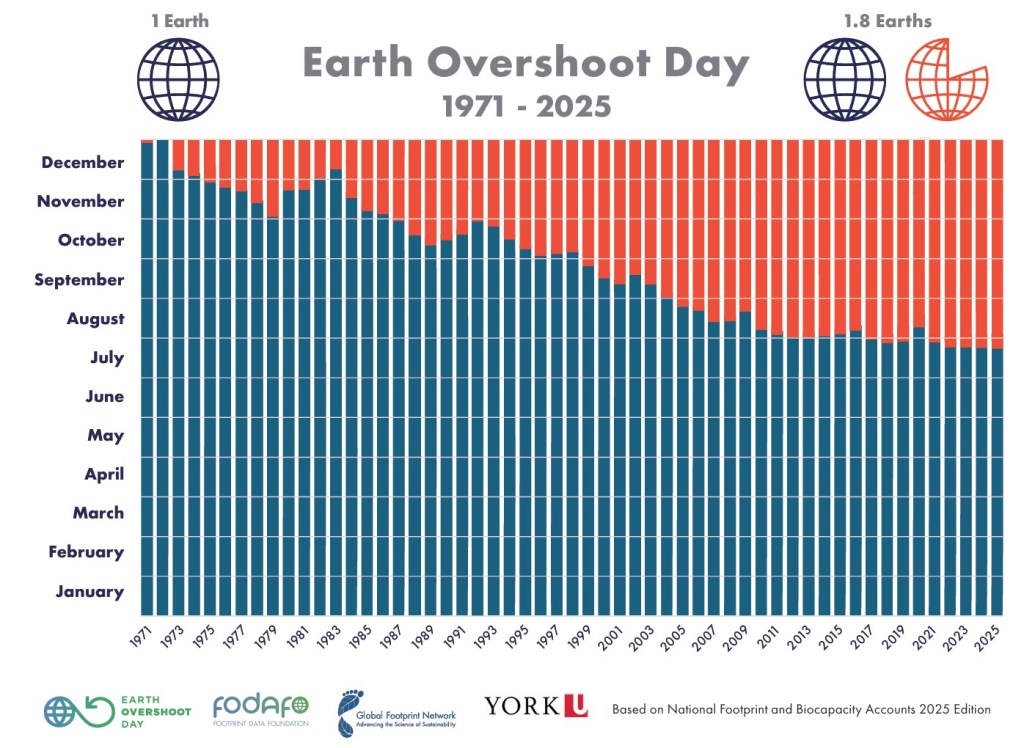
Ideally what we consume from the natural world – crops, timber, drinking water, clean air, energy – is balanced by the earth’s ability to regenerate. Prior to 1970 that was the case. Since then we have been using up the earth’s renewable resources at a rate faster than they are replenished. Scientists each year calculate that point  when we pass from credit to deficit. This is called Earth Overshoot Day. This year the predicted date is 24th July. Seven months into the year and we have already – globally – consumed as much as the earth can replenish in one year! 

Surely this state of affairs can not continue? What can we do about it and why aren’t we doing it? 

Since 1970, Earth Overshoot Day has been falling earlier and earlier each year. Only in 2020 did it reverse: the reduction in world wide consumption came about because Covid gave the earth a three week reprieve. Consuming less has to be the answer which means consuming more carefully and more sustainably. 

If we could do that in 2020 whilst coping with a pandemic, surely we could do it every year? What we must do is make sure that it is not the poor – who already lack a sufficiency – who are the ones who get to consume less; rather it must be the richer over consumers who need to change their lifestyles. And here is another caveat, to live more sustainably and fairly, will need a fundamental change in economic and political systems.

The Earth Overshoot website has details of various ways in which the global community could do this. https://www.overshootday.org/ Meantime we as individuals can make changes to our own lives  and  patterns of consumption. And we can ask or push for our churches, places of work, sports clubs, local authorities, museums, retailers, and government, to make similar reductions in consumption. We need change to happen at all levels.  

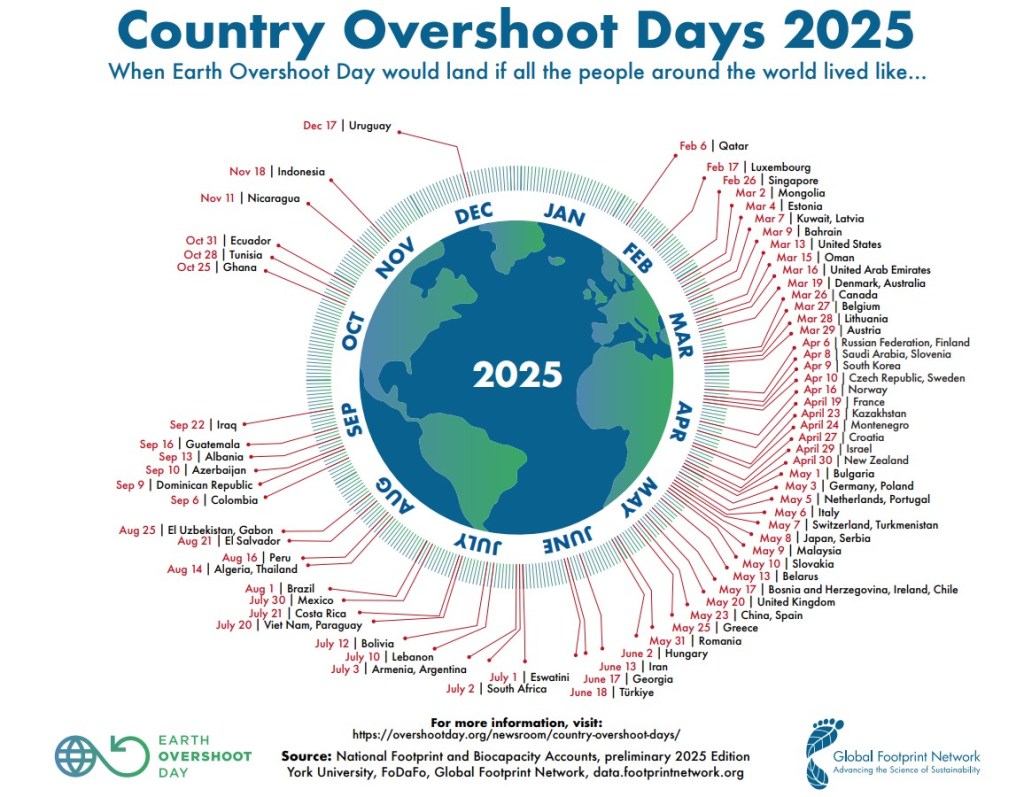
24th July is 2025’s Earth Overshoot Day at the global level. That date is the average  of each nation’s own Overshoot Day. The overshoot dates for individual nations in the diagram below range from  17th December for Uruguay (ie Uruguay pretty much balances its books,  consuming only slightly more than it can regenerate in a year) to 6th February for Qatar. What this diagram does not show are the many poorer nations who do not even use up their equivalent of one year’s resources each year – The UK’s Overshoot Day  was 20th May. We would need three United Kingdom’s to satisfy our current consumption levels; in reality we consume resources of other countries to make up the shortfall. Reducing the Earth Overshoot problem requires cooperation and understanding at a global as a well as at local levels. The Earth is a shared life-support system.

Proper 11, 5th Sunday after Trinity

20th July 2025

Reflection with readings below

In today’s reading from the prophet Amos, we hear of God’s warning to the people of the consequences of pursuing profit whilst ignoring God’s ways: vis suffering and calamity 

Do not the same threats hang over our world, over our economic and social systems today? 

Here in the UK, we  do “trample on the poor” – think of the two child benefit cap, the reduction of benefits for the disabled, the practices that favour landlords over tenants such that rents become unaffordable, those tax breaks that benefit the rich but not the poor, the low wages that benefit the employer not the employee, those subsides that benefit fossil fuels companies not energy consumers etc. And more widely we bring ruin to the poor with international policies that place heavy debt burdens on poor nations from which we benefit, with policies that do not meet the needs of those countries suffering the impact of climate change which we have caused at their expense, with trade policies that are stacked against the smaller nations and smaller companies. Truly the rich and powerful in our world use “false balances” – ie weighing scales – that favour us and not the poor.  

(NB an Ephah is a measure of weight, shekel a unit of currency).

It is not just people but the environment that we wilfully damage and we are already seeing the initial consequences of this with heatwaves and droughts, flash floods and wild fires. The Earth is a delicate ecosystem – a life support system – which is being damaged by our greed and misuse. July 24th will be 2025’s Earth Overshoot Day (last year it was 1st August). That is the day when globally we will have used up a year’s supply of the Earth’s resources. Our extraction of water will exceed the rate of renewal. Our use of the atmosphere to absorb carbon dioxide will exceed capacity (without causing further global temperature rises). Our use of the soil’s capacity to produce food will exceed the rate at which its fertility can be maintained – leading to reduced crops yields in the future. Etc etc. Do check out the Earth Overshoot website to understand more about this situation. Here in the UK, we had used up our share of the Earth’s resources by 20th May, so already our lifestyle choices are being made at the expense of poorer people across the world and future generations. 

The Earth Overshoot website has one section entitled solutions. Here it says “While our planet is finite, human possibilities are not. The transformation to a sustainable, carbon-neutral world will succeed if we apply humanity’s greatest strengths: foresight, innovation, and care for each other.” (1) Here is the invitation to live differently – and for those of us who are Christians, that surely means living according to God’s commands, living according to the values of God’s kingdom. The phrase ‘care for each other’ sharply echoes last week’s gospel story of the Good Samaritan. 

Today’s Gospel reminds us of the importance of spending time and attention on Jesus’s teachings. We can rush around being busy, thinking that being busy will solve the world’s problems, but unless we are     following Jesus – doing God’s will – our efforts may prove fruitless. We also run the risk of burnout. Burnout diminishes our ability to love our neighbours. Jesus set us the example in his own daily life of taking time out to be be in nature, to spend time with God, to be refocus and re-energised. In today’s gospel that is Jesus’s advice for Martha – and it is good advise for us too.

Maybe the extract from the Letter to the Colossians should be a reminder to us that we are not solely responsible for saving the world (a deceit I can be guilty of). Rather it is in and through Christ that salvation is being effected. Our contribution will only ever be but a small part within the the greater whole which is the body of Christ – a fellowship that is empowered by the Holy Spirit. It will be together  in Christ that we will see the salvation of life in Earth being as it is in Heaven.  

  1. https://overshoot.footprintnetwork.org/solutions/

Amos 8:1-12

This is what the Lord God showed me– a basket of summer fruit. He said, “Amos, what do you see?” And I said, “A basket of summer fruit.” Then the Lord said to me,

“The end has come upon my people Israel;
I will never again pass them by. 

The songs of the temple shall become wailings in that day,”
says the Lord God; 

“the dead bodies shall be many,
cast out in every place. Be silent!” 

Hear this, you that trample on the needy,
and bring to ruin the poor of the land, 

saying, “When will the new moon be over
so that we may sell grain; 

and the sabbath,
so that we may offer wheat for sale? 

We will make the ephah small and the shekel great,
and practice deceit with false balances, 

buying the poor for silver
and the needy for a pair of sandals,
and selling the sweepings of the wheat.” 

The Lord has sworn by the pride of Jacob:

Surely I will never forget any of their deeds.

Shall not the land tremble on this account,
and everyone mourn who lives in it, 

and all of it rise like the Nile,
and be tossed about and sink again, like the Nile of Egypt? 

On that day, says the Lord God,
I will make the sun go down at noon,
and darken the earth in broad daylight. 

I will turn your feasts into mourning,
and all your songs into lamentation; 

I will bring sackcloth on all loins,
and baldness on every head; 

I will make it like the mourning for an only son,
and the end of it like a bitter day. 

The time is surely coming, says the Lord God,
when I will send a famine on the land; 

not a famine of bread, or a thirst for water,
but of hearing the words of the Lord. 

They shall wander from sea to sea,
and from north to east; 

they shall run to and fro, seeking the word of the Lord,
but they shall not find it.

Psalm 52

1 You tyrant, why do you boast of wickedness *
against the godly all day long?

2 You plot ruin;
your tongue is like a sharpened razor, *
O worker of deception.

3 You love evil more than good *
and lying more than speaking the truth.

4 You love all words that hurt, *
O you deceitful tongue.

5 Oh, that God would demolish you utterly, *
topple you, and snatch you from your dwelling,
and root you out of the land of the living!

6 The righteous shall see and tremble, *
and they shall laugh at him, saying,

7 “This is the one who did not take God for a refuge, *
but trusted in great wealth
and relied upon wickedness.”

8 But I am like a green olive tree in the house of God; *
I trust in the mercy of God for ever and ever.

9 I will give you thanks for what you have done *
and declare the goodness of your Name in the presence of the godly.

Colossians 1:15-28

Christ Jesus is the image of the invisible God, the firstborn of all creation; for in him all things in heaven and on earth were created, things visible and invisible, whether thrones or dominions or rulers or powers– all things have been created through him and for him. He himself is before all things, and in him all things hold together. He is the head of the body, the church; he is the beginning, the firstborn from the dead, so that he might come to have first place in everything. For in him all the fullness of God was pleased to dwell, and through him God was pleased to reconcile to himself all things, whether on earth or in heaven, by making peace through the blood of his cross.

And you who were once estranged and hostile in mind, doing evil deeds, he has now reconciled in his fleshly body through death, so as to present you holy and blameless and irreproachable before him– provided that you continue securely established and steadfast in the faith, without shifting from the hope promised by the gospel that you heard, which has been proclaimed to every creature under heaven. I, Paul, became a servant of this gospel.

I am now rejoicing in my sufferings for your sake, and in my flesh I am completing what is lacking in Christ’s afflictions for the sake of his body, that is, the church. I became its servant according to God’s commission that was given to me for you, to make the word of God fully known, the mystery that has been hidden throughout the ages and generations but has now been revealed to his saints. To them God chose to make known how great among the Gentiles are the riches of the glory of this mystery, which is Christ in you, the hope of glory. It is he whom we proclaim, warning everyone and teaching everyone in all wisdom, so that we may present everyone mature in Christ.

Luke 10:38-42

As Jesus and his disciples went on their way, Jesus entered a certain village, where a woman named Martha welcomed him into her home. She had a sister named Mary, who sat at the Lord’s feet and listened to what he was saying. But Martha was distracted by her many tasks; so she came to him and asked, “Lord, do you not care that my sister has left me to do all the work by myself? Tell her then to help me.” But the Lord answered her, “Martha, Martha, you are worried and distracted by many things; there is need of only one thing. Mary has chosen the better part, which will not be taken away from her.”

Magnificat reimagined 

19th July 2025

Trust in the Lord and be doing good; dwell in the land and be nourished with truth.
 Let your delight be in the Lord and he will give you your heart’s desire.
Psalm 37:3-4

You Lord are the bread of life;

feed us with your wisdom.

Our nourishment is to do God’s will;

guide us in all we do

Whenever we eat or drink

Let it be to the glory of the kingdom of God.

A reading from Matthew 25: 34-36 (The Message)

“Then the King will say to those on his right, ‘Enter, you who are blessed by my Father! Take what’s coming to you in this kingdom. It’s been ready for you since the world’s foundation. And here’s why:

I was hungry and you fed me,
I was thirsty and you gave me a drink,
I was homeless and you gave me a room,
I was shivering and you gave me clothes,
I was sick and you stopped to visit,
I was in prison and you came to me.’” 


A canticle reimagining the Magnificat:
My soul proclaims the greatness of the Lord,
my spirit rejoices in God my Saviour;
he has looked with favour on his lowly servant.

Praise to you O God, for the rich creation of this world 

for which you have created humans to be under-gardeners.

From this day all generations will call me blessed;
the Almighty has done great things for me
and holy is his name.

You have blessed Earth with fruit bearing trees and plants, 

ensuring food throughout the seasons.

God has mercy on those who fear him,
from generation to generation.

Your wisdom guides those who, in each generation, 

have the honesty and humility  to seek it.

God  has shown strength with her arm
and has scattered the proud in their conceit,

May  each generation see the damage 

they cause when they  disdain your will. 

Casting down the mighty from their thrones
and lifting up the lowly.

Raise the spirits of those who work at the grassroots, 

give them strength to overcome the deceits of big business.

God  has filled the hungry with good things
and sent the rich away empty.

Bless the work of food banks and charities that feed the hunger, 

and teach those with wealth to be sacrificial in their giving.

God came to the aid of his servant Jacob
to remember his promise of mercy,

Help nations and communities to work together

for justice and for peace. 

God’s promise is made to our ancestors,
from Abraham and his children and for all generations to come.

May every generation to come, reap the harvest,

not of our greed, but of God’s grace .

Amen.

Trust in the Lord and be doing good; dwell in the land and be nourished with truth.
 Let your delight be in the Lord and he will give you your heart’s desire.
Psalm 37:3-4

Counting on … day 94

24th June 2025

Solar Aid is a charity that aims to provide people in developing countries with access to lighting (using LEDs) to communities that a) do not have access to the grid and b) cannot afford household sized solar panels. They describe their project as follows:-

“Just as mobile phones have revolutionised communications across Africa, leapfrogging the need for landlines, picosolar lights (aka small solar lights) are now helping to bring light and power to millions of people across the continent.

“While grid electrification is not going to reach most of rural sub-Saharan Africa in our lifetimes, the solar light revolution is taking place right now, helping light up millions of homes, which would otherwise be kept in the dark.

“The concept is simple: Small solar panels, which can be as small as the palm of your hand, convert sunlight into electricity. This in turn charges small batteries, which are used to power efficient LED lights…For the first time, families can stop using dangerous, polluting kerosene lamps and candles.” (1)

That many communities cannot even afford this form of lighting, is the reason that this charity looks to people like us to provide the money.

  1. https://solar-aid.org/bright-solutions/the-solar-light/

The Lord is my shepherd – a retelling of psalm 23

21st July 2025

He tends His flock like a shepherd; He gathers the lambs in His arms and carries them close to His heart. He gently leads the nursing ewes. Isaiah 40: 11

You Lord, are the source of all good things: 

We praise you.

You call us to tend and care for your creation: 

May we strive to do your will.

You have made us as brothers and sisters with all that lives: 

May we live together in peace.


A reflection on Psalm 23:

The Lord is my shepherd, I shall not want.

In your gift is daily bread, sustenance for each day

From you comes wisdom and understanding –

the gift of peace.


The Lord desires green pasture and clear waters,

wooded hills that clap their hands, 

streams that overflow with joy –

a  world where all may rest in peace.


The Lord restores my soul, 

forgives my sins and heals my pain.

He renews my confidence so I too 

may renew broken relationships.


The Lord leads me in right paths.

He goes before us, leading by example 

and marking the way – 

on earth as in heaven.


Even though I walk through the darkest valley, 

even though the news is of  floods and drought, 

fires and tempest, I am comforted 

for the Lord is my steadfast companion.

 
I hear of evil  – of warfare and greed, 

of persecution and oppression; 

of self-interest and self-delusion 

 – yet I  fear not evil, for the Lord is our righteousness.


You prepare a table before me 

where bread and wine will satisfy my wants. 

In the face of adversity, 

You anoint me with the Holy Spirit.
    

The goodness and mercy of the Lord 

 shall stay with me all the days of my life,
for the Lord is my shepherd 

and I shall not want. 

Prayers: 

Holy God, Shepherd of your people, 

forgive us for all the times we have strayed – 

and repeatedly strayed – 

from your ways.

Set us once again on the right path, 

the path of righteousness. 


Show us how to love our neighbour as ourself. 

Show us how to lead simple lives 

that do not steal food and resources 

from the mouths of the poor.


Show us how to tend and care for the earth 

that the  fertility of the soils and the vitality 

of pollinating insects will be restored.


Show us how to curb our greed 

that there may be an equal sharing of the earth’s gifts 

and equitable pay for all who labour. 


Show us how to unite all our brethren 

in eschewing the use of fossil fuels 

that global temperatures can be contained. 


Show us how to make space for others 

that migrants both human and creaturely 

may have space to call their own.

Amen.

Sixth Sunday of Easter

25th May 2025

Reflection with readings below

We live in a world that seems increasingly distant from the peace and harmony we associate with the idea of God’s kingdom. The world we live in is dominated by economic pressures, the pursuit of profit, aggressive demands for national security, the overriding influence of wealth and big business, the cult of the individual and the adoration of the dictator. The world we live in places limited value on nature – indeed nature is often pitched as the opposite of progress and wealth creation – and has little concern for the poor other than to tax them all the more because of their failure to boost the economy.

It is a world in which  we are reluctant to invest in the future unless we can do so on the cheap – or unless we’re building yet another flagship office complex.  It is a world in which we are reluctant to challenge greed, injustice, poverty and prejudice. It is a world in which we refuse to listen to the cry of the Earth, to recognise the damage we are wilfully inflicting on the environment in which we live and on which we rely for our survival.

Yet here we are in the season of Easter – the season of new beginnings, the inauguration of a new relationship between God and creation that is shaped by the power of the resurrection. 

Our first reading tells us Paul’s response to a vision where in response he takes the gospel to the people of Macedonia. This is a message that brings new life to those who are ready to receive it. This is a new way of life that is lived according to the values of the kingdom of God that Jesus has taught. Let’s imagine for a moment how different the world would be if everyone lived in that way, or (and this may be harder) if all of us in our church lived in that way. What if we, in the words of Lydia, might be  ‘judged to be faithful to the Lord’?

Both today’s Psalm and the reading from the Book of Revelation, tells us that God’s ways give rise to health and harmony: ‘Let your ways be known upon earth, your saving health among all nations’ and ‘the tree of life with its twelve kinds of fruit [whose] leaves … are for the healing of the nations.’ The implication is that if we live as physical beings in harmony with the physicality of creation, then we will experience this wellbeing. Such a lifestyles relies on us paying attention to the Earth – and when we do this will enable all the people to praise God. No more war and suffering, no more oppression nor prejudice – justice and love and mercy will overcome greed and selfishness and aggression.

And finally in our gospel reading, Jesus tells us to hear – to listen to – and keep his word, knowing that that word comes from God, and that it is the Holy Spirit that will teach us to understand that word. It is a word that will enable us to understand and address all the ways in which the way we live on Earth falls short of the ways of the Kingdom of God – the Easter Kingdom. We need, as Pope Francis wrote in Laudate Si, to listen to ‘the cry of the earth and the cry of the poor’.

It is with some relief that this week it seems as if our Government is finally responding to the cry of poor in Gaza. And that can be a further prompt to us to continue to pray for the people of Gaza,

to contribute financially to their need, and to write to our MPs to both thank them and press them for further action. 

May we all know Christ’s peace in our hearts and in the world around us.

Acts 16:9-15

During the night Paul had a vision: there stood a man of Macedonia pleading with him and saying, “Come over to Macedonia and help us.” When he had seen the vision, we immediately tried to cross over to Macedonia, being convinced that God had called us to proclaim the good news to them.

We set sail from Troas and took a straight course to Samothrace, the following day to Neapolis, and from there to Philippi, which is a leading city of the district of Macedonia and a Roman colony. We remained in this city for some days. On the sabbath day we went outside the gate by the river, where we supposed there was a place of prayer; and we sat down and spoke to the women who had gathered there. A certain woman named Lydia, a worshiper of God, was listening to us; she was from the city of Thyatira and a dealer in purple cloth. The Lord opened her heart to listen eagerly to what was said by Paul. When she and her household were baptised, she urged us, saying, “If you have judged me to be faithful to the Lord, come and stay at my home.” And she prevailed upon us. 

Psalm 67

1 May God be merciful to us and bless us, *
show us the light of his countenance and come to us.

2 Let your ways be known upon earth, *
your saving health among all nations.

3 Let the peoples praise you, O God; *
let all the peoples praise you.

4 Let the nations be glad and sing for joy, *
for you judge the peoples with equity
and guide all the nations upon earth.

5 Let the peoples praise you, O God; *
let all the peoples praise you.

6 The earth has brought forth her increase; *
may God, our own God, give us his blessing.

7 May God give us his blessing, *
and may all the ends of the earth stand in awe of him.

Revelation 21:10, 22-22:5

In the spirit the angel carried me away to a great, high mountain and showed me the holy city Jerusalem coming down out of heaven from God.

I saw no temple in the city, for its temple is the Lord God the Almighty and the Lamb. And the city has no need of sun or moon to shine on it, for the glory of God is its light, and its lamp is the Lamb. The nations will walk by its light, and the kings of the earth will bring their glory into it. Its gates will never be shut by day– and there will be no night there. People will bring into it the glory and the honour of the nations. But nothing unclean will enter it, nor anyone who practices abomination or falsehood, but only those who are written in the Lamb’s book of life.

Then the angel showed me the river of the water of life, bright as crystal, flowing from the throne of God and of the Lamb through the middle of the street of the city. On either side of the river is the tree of life with its twelve kinds of fruit, producing its fruit each month; and the leaves of the tree are for the healing of the nations. Nothing accursed will be found there any more. But the throne of God and of the Lamb will be in it, and his servants will worship him; they will see his face, and his name will be on their foreheads. And there will be no more night; they need no light of lamp or sun, for the Lord God will be their light, and they will reign forever and ever.

John 14:23-29

Jesus said to Judas (not Iscariot), “Those who love me will keep my word, and my Father will love them, and we will come to them and make our home with them. Whoever does not love me does not keep my words; and the word that you hear is not mine, but is from the Father who sent me.

“I have said these things to you while I am still with you. But the Advocate, the Holy Spirit, whom the Father will send in my name, will teach you everything, and remind you of all that I have said to you. Peace I leave with you; my peace I give to you. I do not give to you as the world gives. Do not let your hearts be troubled, and do not let them be afraid. You heard me say to you, `I am going away, and I am coming to you.’ If you loved me, you would rejoice that I am going to the Father, because the Father is greater than I. And now I have told you this before it occurs, so that when it does occur, you may believe.”

Third Sunday of Lent

23rd March 2023

Reflection with readings below

God does see the suffering that happens in the world and desires that it should not be so, that it should not continue. In the reading from Exodus, Moses is open to a relationship with God and understands God’s desire that the Israelites be brought out of the place where they are suffering and be released from the oppressive power of the Pharaoh. And Moses agrees to do what is necessary to effect this. 

God’s saving work did not stop with the rescue of the Israelites from Egypt, nor was Moses the last person willing to undertake  effect God’s will. Ensuring salvation is an ongoing task as in each generation we humans still fail to truly love one another; we still fail to share the Earth’s riches equitably; we still allow hate and envy and greed to distort relationships; we still fail to be open and receptive to the presence and wisdom of God. 

Last year I was invited to share in a Passover meal. The words we used came from The Legacies of Resistance: an Anti-Zionist Haggadah for a Liberation Seder, which refreshes the traditional words and thinking to reflect new theological understandings. When speaking of Egypt it used the Hebrew word ‘Mitzyrayim’ which translates literally as “a narrow place”. This is seen as “a metaphor for all

which is in opposition to life, justice, connection and sustainability.” Just as the  Passover celebrates how the people of God left Egypt – left the narrow place which confined and imprisoned them – so the Passover celebrates how we all, whether as individuals or as communities, can escape from those narrow places that confine and imprison us. 

Moses was open and receptive to seeking God, and willing to enter into a relationship with God. The psalmist too extols the virtues of seeking a close relationship with God. That is what we need to cultivate – indeed that is the enduring message that runs through the scriptures – if we are to escape the ‘narrow places’.

Today’s Gospel reading has an important message that our politicians should embrace! People who succumb to tragedy, whose lives involve suffering, are not more sinful and no less deserving of loving kindness – which is mercy – than anyone else. Rather says Jesus, those who are suffering, those whose lives do not seem to be flourishing, are all the more deserving of loving care so that they can live fruitful lives. People who are struggling because of disabilities, people who are struggling because of a lack of opportunities, people who are struggling because of because they are victims of an intolerant system, people who are struggling because they lack the physical necessities for daily life – they need to be given care and opportunities and the necessary wherewithal so that they can thrive as children of God. And those who have in abundance should be willing to give to those who do not – whether through self motivated generosity or through a just taxation system. 

We should not be creating systems that constrict and trap people in ‘narrow places’ whether that is in within social and economic systems of the UK or globally.  We need both in just and effective systems that provide aid and development for those who are in need. We need just and effective systems that enable trade and finance to flourish for the equal benefit of all we need just and effective systems that establish and enforce international agreements, ending war and conflict. We also need a culture in which we all act out of generosity, with love and empathy and compassion.  

We must, to quote Micah, “act justly and to love mercy and to walk humbly with God.”

Exodus 3:1-15

Moses was keeping the flock of his father-in-law Jethro, the priest of Midian; he led his flock beyond the wilderness, and came to Horeb, the mountain of God. There the angel of the Lord appeared to him in a flame of fire out of a bush; he looked, and the bush was blazing, yet it was not consumed. Then Moses said, “I must turn aside and look at this great sight, and see why the bush is not burned up.” When the Lord saw that he had turned aside to see, God called to him out of the bush, “Moses, Moses!” And he said, “Here I am.” Then he said, “Come no closer! Remove the sandals from your feet, for the place on which you are standing is holy ground.” He said further, “I am the God of your father, the God of Abraham, the God of Isaac, and the God of Jacob.” And Moses hid his face, for he was afraid to look at God.

Then the Lord said, “I have observed the misery of my people who are in Egypt; I have heard their cry on account of their taskmasters. Indeed, I know their sufferings, and I have come down to deliver them from the Egyptians, and to bring them up out of that land to a good and broad land, a land flowing with milk and honey, to the country of the Canaanites, the Hittites, the Amorites, the Perizzites, the Hivites, and the Jebusites. The cry of the Israelites has now come to me; I have also seen how the Egyptians oppress them. So come, I will send you to Pharaoh to bring my people, the Israelites, out of Egypt.” But Moses said to God, “Who am I that I should go to Pharaoh, and bring the Israelites out of Egypt?” He said, “I will be with you; and this shall be the sign for you that it is I who sent you: when you have brought the people out of Egypt, you shall worship God on this mountain.”

But Moses said to God, “If I come to the Israelites and say to them, ‘The God of your ancestors has sent me to you,’ and they ask me, ‘What is his name?’ what shall I say to them?” God said to Moses, “I am who I am.” He said further, “Thus you shall say to the Israelites, ‘I am has sent me to you.’” God also said to Moses, “Thus you shall say to the Israelites, ‘The Lord, the God of your ancestors, the God of Abraham, the God of Isaac, and the God of Jacob, has sent me to you’:

This is my name forever, and this my title for all generations.”

Psalm 63:1-8

1 O God, you are my God; eagerly I seek you; *
my soul thirsts for you, my flesh faints for you,
as in a barren and dry land where there is no water.

2 Therefore I have gazed upon you in your holy place, *
that I might behold your power and your glory.

3 For your loving-kindness is better than life itself; *
my lips shall give you praise.

4 So will I bless you as long as I live *
and lift up my hands in your Name.

5 My soul is content, as with marrow and fatness, *
and my mouth praises you with joyful lips,

6 When I remember you upon my bed, *
and meditate on you in the night watches.

7 For you have been my helper, *
and under the shadow of your wings I will rejoice.

8 My soul clings to you; *
your right hand holds me fast.

1 Corinthians 10:1-13

I do not want you to be unaware, brothers and sisters, that our ancestors were all under the cloud, and all passed through the sea, and all were baptised into Moses in the cloud and in the sea, and all ate the same spiritual food, and all drank the same spiritual drink. For they drank from the spiritual rock that followed them, and the rock was Christ. Nevertheless, God was not pleased with most of them, and they were struck down in the wilderness.

Now these things occurred as examples for us, so that we might not desire evil as they did. Do not become idolaters as some of them did; as it is written, “The people sat down to eat and drink, and they rose up to play.” We must not indulge in sexual immorality as some of them did, and twenty-three thousand fell in a single day. We must not put Christ to the test, as some of them did, and were destroyed by serpents. And do not complain as some of them did, and were destroyed by the destroyer. These things happened to them to serve as an example, and they were written down to instruct us, on whom the ends of the ages have come. So if you think you are standing, watch out that you do not fall. No testing has overtaken you that is not common to everyone. God is faithful, and he will not let you be tested beyond your strength, but with the testing he will also provide the way out so that you may be able to endure it.

Luke 13:1-9

At that very time there were some present who told Jesus about the Galileans whose blood Pilate had mingled with their sacrifices. He asked them, “Do you think that because these Galileans suffered in this way they were worse sinners than all other Galileans? No, I tell you; but unless you repent, you will all perish as they did. Or those eighteen who were killed when the tower of Siloam fell on them–do you think that they were worse offenders than all the others living in Jerusalem? No, I tell you; but unless you repent, you will all perish just as they did.”

Then he told this parable: “A man had a fig tree planted in his vineyard; and he came looking for fruit on it and found none. So he said to the gardener, ‘See here! For three years I have come looking for fruit on this fig tree, and still I find none. Cut it down! Why should it be wasting the soil?’ He replied, ‘Sir, let it alone for one more year, until I dig around it and put manure on it. If it bears fruit next year, well and good; but if not, you can cut it down.'”