Counting on … day 137

30th July 2024

Who to bank with?

If Barclays is such a major funder of fossil fuels, who should one bank with? Are all banks equally dubious?

There are in fact plenty of other banks that have better ethical credentials. Several groups have researched this and have web sites where you can compare different banks and some will even enable you to make the switch to a greener bank.

https://www.switchit.green/

https://justmoney.org.uk/ – this one has a particular Christian edge with specific information for churches and charities

https://www.mymothertree.com/ – this group can work with businesses and bigger charities 

Green Tau: issue 83

Oil, profits and how to bring about change

14th November 2023

Following on from last week’s Green Tau, it seems that Shell – and other oil and gas companies – have no intention of cutting back on the amount of fossil fuels that they plan to extract and sell. If this becomes a reality, then the planet faces a grim future with rising temperatures and increasingly violent weather patterns that will make large parts of the earth uninhabitable. 

Is there anything that can be done to deflect and reverse this scenario? At present so many systems seem designed to perpetuate the profitability and financial attractiveness of fossil fuels. 

For example,  most buildings are heated via gas fired boilers, most vehicles are powered by petrol. Swopping to a different system of heating and powering vehicles is expensive, with the need for investment in new distribution networks, new manufacturing plants, newly trained staff both to make and maintain the new equipment – plus, of course, the need for customers to have sufficient resources to make the switch. 

Whilst at the same time, oil and gas companies are huge, having grown over many decades into international corporations, dominating our economies and therefore command great influence in the financial worlds – far more so than say a new, still small renewables company. 

There is also the inertia that comes from years practice. Customers, financiers, governments etc have been used to working with the oil and gas industry for so long, that change feels counter intuitive and difficult. The longer we have done something one way, the harder it is for us to imagine there being any other way.

Nevertheless there are ways of changing the system.

Government Action –

1. Remove government subsidies. Many governments, not just here in the UK, subsidise the fossil fuel industries, in part to keep their own economies competitive. But these subsidies are large and distort the market price of fossil energy. Recently 25,000 plus climate protestors in the Netherlands blockaded a motor way for ten days to persuade their government to review its continued payment of subsidies to the Dutch fossil fuel industry. (This is something we too should campaign for).

2. Increase subsidies to support renewable energy and so tip the markets away from fossil fuels. If governments can be persuaded to eliminate fossil fuel subsidies, it would be appropriate to equally ask that that money be diverted to both subsidise renewables, and to support those in our society who are suffering from fuel poverty.

3. Enforce stringent windfall taxes to recoup the money that the fossil fuel industry earns purely because of war and other global uncertainties. These events, because they lead to higher prices for oil and gas but have no effect on the cost of production, enable companies to receive increased profits at zero cost. Such windfall tax revenues should then be used to reimburse those vulnerable communities that have lost most because of the climate crisis.

4. Ban advertising for fossil fuels. Over recent years cigarette advertising has been banned to encourage consumers to make  more healthy choices and to reduce the cost to the NHS of the health issues caused by cigarette smoke. Fossil fuels cause even more damage to health and an even greater costs to society as jobs, homes, infrastructure, farming etc suffer from the adverse effects of the climate crisis.

5. By the same logic there should be a ban preventing fossil fuel companies from sponsoring sporting and cultural events. Such sponsorship has the additional concern that it portrays the sponsors as worthy upholders of what we value as a society – where as in fact their businesses are destroying what we hold dear.

6. Agree and impose a global tax on aviation fuel. At present aviation fuel – unlike petrol and diesel is not taxed. It would be too easy for airlines to avoid the tax if introduced state by state, by refuelling at airports where no tax was imposed.

7. Pro-active government advertising to encourage consumers to reduce consumption of fossil fuels.  Plus Government support to enable consumers to switch to green energy suppliers, to replace gas boilers with heat pumps, to replace car journeys with active travel (walking, cycling) or with public transport etc. 

8. Government legislation to ban internal flights where railways can provide the same connections. The EU is already gradually introducing legislation to achieve this in Europe.

9. Pro active  messaging from the government to show that they are committed to a speedy switch to renewable energy – certainty on the direction and speed of travel is important for the financial markets and those investing in green technologies. 

10. Legislation to require all businesses and organisations to have a net zero transition plan that encompasses scope 1, 2 and 3 emissions. Government support, to enable small concerns to undertake this, would be necessary. 

Businesses and organisations 

1. Pro-actively engaging in drawing up and implementing net zero transition plans to reduce their consumption of fossil fuels and their green house gas emissions.

2. Refusing to promote or advertise fossil fuels companies and products. The Guardian newspaper for example does not carry adverts for airlines. 

3. Cutting ties with companies that support the fossil fuel industries, such as banks, and insurance companies.

4. Supporting, developing and/or investing in renewable energy and zero carbon products. Seeking out alternative materials that can substitute for fossil fuels.

5. Giving support to activist groups seeking to persuade more reluctant organisations to adopt climate friendly policies.

Consumers

1.Wherever we can (depending on our financial position) to opt not to buy fossil fuel products – eg by switching to green energy suppliers, reducing petrol consumption by, for example, walking or cycling, using public transport, car sharing, using an electric car, by not flying, by replacing boilers with heat pumps etc, and by cutting back or avoiding products made from oil – such as plastics but also vinyl products, polyester etc. (For a comprehensive and amazing list see https://www.energy.gov/sites/prod/files/2019/11/f68/Products%20Made%20From%20Oil%20and%20Natural%20Gas%20Infographic.pdf)

2. Use our voting power  to elect a government that is pro the wellbeing of the climate and environment and anti the damaging actions of the fossil fuel industry. This applies to local as well as national elections. In between elections, email your representatives if you feel they are not sufficiently supporting the well-being of the environment.

3. Target all companies with ties to the fossil fuel industry such  as banking and insurance, to urge them to cut their ties and support instead the renewable energy sector.

4. We can as individuals and as campaign groups be vocal in telling the truth about emissions from the fossil fuel industry and so counter their green washing.

5. Switch our bank, pensions, insurance etc to companies who are not supporting the fossil fuel industry.

Green Tau issue 82

Oil, Profits and the need for change

3rd November 2023

Yesterday Shell announced their interim profits of £5.1bn for the period July to September. This was up on the previous quarter but down compared with this quarter last year when their profits were over £7bn.

According to a report made by Reuters, in order to compete with its fellow oil producers, Shell will be aiming to increase its dividend by 20% and to make overall payouts of between 35-40% of its cash flow. To this end the new CEO Wael Sawan aims to maintain Shell’s oil output at 1.5 million barrels per day. While this is less than the 2.6 million bpd produced in 1998, Sawan’s plan is to maintain this 1.5 million bpd until 2030! With oil prices again rising due to the conflict in the Middle East, increasing profits and dividends seem secure – and Sawan has said that shifting to a low-carbon economy cannot come at the expense of profits. (1)

The Guardian has reported that Shell plans to invest $40 billion in oil and gas production between now and 2035, and between $10bn and $15bn in “low-carbon” products including biofuels and carbon capture. (2) Carbon capture is important to Shell as it aims to reduce its carbon emissions between now and 2050. However it must be noted that Shell only includes scope 1 and 2 emissions in these targets – ie they intend to reduce the emissions arising from the production of oil and gas, with for example carbon capture being used to offset emissions they cannot remove. What is not covered in Shell’s net zero aspirations are the emissions released by the oil and gas once they have been sold  and used – scope 3 emissions. Other oil companies do the same, each competing to claim whose oil is least carbon intensive or greenest!

In 2022 Shell’s scope 1 and 2 emissions were 58 million tonnes CO2e, but its scope 1,2 and 3 emissions were in the region of 1.6 billion tonnes CO2e. Global emissions for CO2e are about 40 billion tonnes of which fossil fuels contribute about 37 billion tonnes. There is no getting away from the fact that fossil fuels are drivers of climate change. And equally that companies like Shell have no intention of phasing out oil from their business plans.

Meanwhile the International Energy Agency ( IEA) has said that if we are to achieve our net zero emissions by 2050 there must be no more development of new oil or gas. There is already enough fossil fuels available from the existing sites for the world’s economies to use as they transition to net zero.

However oil and gas typically produces a return of 10-20% whilst renewables only yield 5-8%. Our lifestyles are still deeply dependent on the oil economy and often it seems simpler to pay more for the fuel than to readjust tey way we live and work. Equally it would seem that the markets cannot reflect in their prices the risk and/ or cost of a climate catastrophe. Surely then it is time for the markets to be regulated for the benefit of everyone. Such regulations would need to be clear, precise and universal to be effective. Individual nations are unlikely to make such regulations in isolation. Hence the need for regulatory agreements to be reached at, for example, COP28.

It is also important that the nations at COP28 agree to a sharp and complete phasing out of fossil fuels. The agreement will need to clearly define when and how fossil fuel production is to be reduced to zero. It will effect some countries more than others – especially those who have previously become dependant on oil money. It will affect jobs, both those directly employed in the extraction of fossil fuels, and those employed in the processing of this raw material. It will also affect investment markets, potentially reduce the amount of funds accruing to pension funds, insurance companies etc. Ensuring a smooth and fair transition is important.

The IMF reports, “The end of oil thus makes economic transformation imperative. Oil-rich countries must diversify to become resilient to the changes in energy markets. An appropriate governance framework to manage proceeds from oil in good and bad times has always been important to fostering economic diversification. But with stranded assets a new risk, radical shifts in governance in oil-dependent economies are urgent. Dubai, for example, facing the depletion of its oil reserves, transformed itself into a global trade hub. Countries and businesses reliant on these markets must formulate policies to address this transformation, including the development of renewable energy.” (Arezki 2020) (4) 

What does not and will not help, is prolonging the viability of oil companies. In particular the use of government subsidies should be withdrawn universally. Instead windfall taxes should be levied to fund reparations to communities disproportionately affected by climate change. 

Last year Ethical Consumer reported “Currently, the UK’s tax regime makes it the most profitable country in the world to develop big offshore oil and gas projects. Most spending on oil and gas exploration can be offset against tax, as it is classified as ‘research and development’. Almost all spending on new fields can be offset in the first year of development, and companies can claim tax relief for decommissioning offshore installations. Since the Paris Agreement, the government has provided £13.6 billion in subsidies to the UK oil and gas industry. From 2016 to 2020 companies received £9.9 billion in tax relief for new exploration and production, including £15 million of direct grants for exploration, and £3.7 billion in payments towards decommissioning costs.” (4) 

From research commissioned by the Liberal Democrats, the Guardian reported that since 2015, whilst renewable energy received £60bn in subsidies, fossil fuel companies received close to £80bn. (5) No wonder the investment returns on fossil fuels exceeds that from renewables!

And in 2022, Energy Voice reported  that “Shell received net rebates of over $121 million (£92m) from the UK government last year, the largest total from any country in which it operates. In total, Shell received rebates of more than $131m (£100m) from HM Revenue and Customs, according to its latest Payments to Governments report, released Tuesday. This was offset by fee payments to regulators, including more than $10.5m (£8m) to the Oil and Gas Authority (now the North Sea Transition Authority), and over $120,000 (£91,000) to the Crown Estate Scotland.” (6) Is the UK government actively paying oil companies to damage our climate?!

The IEA reports “‘The IEA has long advocated removing or at least reducing fossil fuel subsidies because they distort markets, send the wrong price signals to users, widen fiscal deficits in developing economies, and discourage the adoption of cleaner renewable energies. Their expansion is particularly worrying at a time when we should be redoubling efforts to cut wasteful consumption and accelerate clean energy transitions. Reforming prices is a political challenge, but it is also economically and environmentally vital.” (7)

The overarching aim of the climate COPs is to limit the extent of climate change and its impact on the world. To this end numerous agreements have been made since COP21 in Paris in 2015, to reduce net emissions to zero by 2050. This scientists thought would keep global temperature increases below 1.5C. However it now seems that with emissions still rising, we may pass this threshold much sooner. Samantha Burgess, the deputy director of the European Union’s Copernicus Climate Change Service (C3S), noted that September 2023 would be one for the record books. “This extreme month has pushed 2023 into the dubious honour of first place – on track to be the warmest year and around 1.4°C above pre-industrial average temperatures.” (8)

The failure of governments and oil companies to phase down the production of fossil fuels is surely morally if not criminally wrong? In the next Green Tau I will be looking at campaigns and actions that aim to address this. 

(1) – https://www.reuters.com/business/energy/shell-pivots-back-oil-win-over-investors-sources-2023-06-09/

(2) – https://www.theguardian.com/business/2023/jun/14/shell-drops-target-to-cut-oil-production-as-ceo-guns-for-higher-profits?CMP=Share_iOSApp_Other

(3) – https://www.imf.org/external/pubs/ft/fandd/2021/06/the-future-of-oil-arezki-and-nysveen.htm

(4) –  https://www.ethicalconsumer.org/energy/paid-pollute-fossil-fuel-subsidies-uk-what-you-need-know

(5) – https://www.theguardian.com/environment/2023/mar/09/fossil-fuels-more-support-uk-than-renewables-since-2015

(6) – https://www.energyvoice.com/oilandgas/north-sea/400886/uk-government-hands-shell-more-than-92m-in-2021/

(7)  – https://www.iea.org/reports/oil-2021

(8) – https://news.un.org/en/story/2023/10/1141937

Counting on …. Day 1.199

23rd October 2023

“Climate activists are sometimes depicted as dangerous radicals.  But, the truly dangerous radicals are the countries that are increasing the production of fossil fuels.” So said the UN Secretary-General António Guterres last year at the launch of the third IPCC report.

Last week the Intercontinental Hotel in Park Lane hosted the Energy Intelligence Forum – an international gathering of influential figures from the oil and financial industries – formerly known as the Oil and Money Conference. These people hold great power with very little reference to either democratic decision making or alternative view points. The decisions they make, and the strategies they plan, will have a big impact on what happens in the world, on the future of wellbeing of people, the environment and the climate. 

In opposition to this Fossil Free London and other groups such as Extinction Rebellion, Greenpeace and Christian Climate Action, organised protests outside the hotel and at selected headquarters of oil and financial institutions across London. With our future at stake, it was imperative right to call out the injustice of what was happening. The IPPC and IEA have both presented the world with the scientific evidence that carbon emissions are causing the climate crisis, and that the urgent response must be cutting back now on fossil fuels extraction and use, as we all transition to net zero. And yet, regardless of this, the oil industry is continuing to expand its operations, and the financial world is continuing to invest in and to insure these projects – using what is ultimately our money.  

On the Monday evening, the eve of the conference, Christian Climate Action held an act of worship out on the street opposite the hotel’s main entrance. Using words from the most recent papal encyclical,  Laudate Deum (Praise God). It is so called, because the Pope says that when human beings claim to take God’s place, they become their own worst enemies. In the worship we bore witness to the injury and injustice that the oil industry is causing in the world, and in between prayerful silences we sang  praises to God using the Taize chant ‘Laudate omens gentes’.

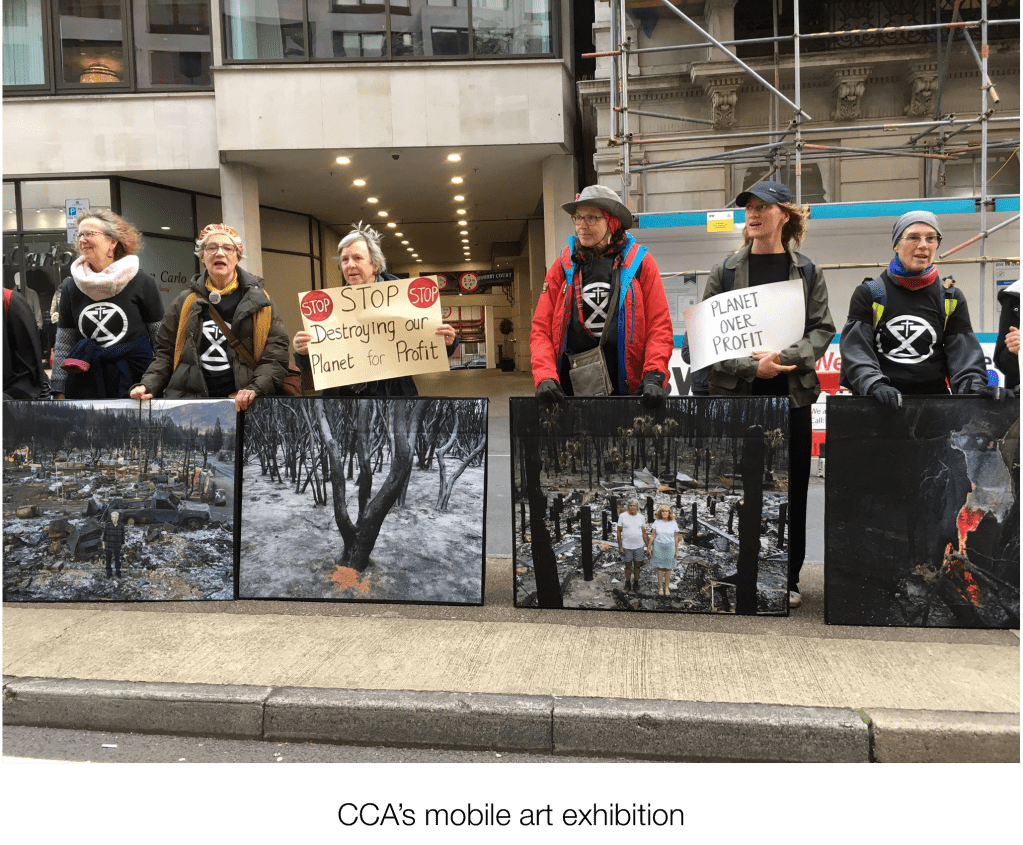
Tuesday CCA again gathered in the street opposite the hotel with a series of photographs – a mobile art exhibition – each an illustration of the effects of wild fire on the environment and people’s lives. Fossil Free London and others blockaded the hotel entrance – the hotel had erected high fences along the whole area restricting the entrance to a meter wide gate way which was  easily blocked by protestors preventing guests from entering or leaving. A samba band played, people sang and chanted, and speeches were delivered – the key speaker was Greta Thunberg. Mid morning a group from Greenpeace abseiled down from a top floor window, unfurling a banner down the front of the hotel. The conference delegates could not have gone unaware of the opposition to their plans for an oil fuelled future. Indeed the CEO of Shell had to make his speech by equivalent of zoom. By the early afternoon the police had imposed a section 14 notice on the street, authorising them to remove all protestors from the site. 

The Christian Climate Action group set off on a pilgrimage around Mayfair stopping to pray at the offices of a number of ‘Earth Wreckers’ – companies involved in financing, supporting or exploiting fossil fuels and thereby directly or indirectly polluting the world with carbon emissions. (For more information about Earth Wreckers visit – http://umap.openstreetmap.fr/en/map/wreckers-of-the-earth-2021_409815#12/51.5222/-0.1234)

On Wednesday action was taken further afield to the City of London. Ten companies associated with the West Cumbrian Coal Mine and the East Africa Crude Oil Pipeline were targeted, to protest against their involvement in funding these highly polluting projects. Christian Climate Action together with representatives of other faiths and a group from XR Scientists, peacefully entered and sat down in the foyer of 52 Lime Street – a modern glass and steel tower block that houses Chaucer, the UK subsidiary of China Re and a potential insurer of EACOP. Sat together in the middle of the space – allowing office workers to continue in and out of the building – we sang Buddhist and faith songs and shared an agape of bread and ‘good’ olive oil. 

Within half an hour the police arrived and stood round us, watching. Then with such joy and hope, we saw the XR procession, that was marching between each of the sites, arrive with hundreds of supporters, flags and banners, and a samba band. They waved to us through the plate glass windows and cheered, and we sang and waved back. When they marched on, a contingent from CCA stayed on outside both protesting and praying. The building’s security staff obviously wished us to leave, but the police having taken advice from the CPS, took the view that as our protest was peaceful, they had no grounds for arresting us. After some discussion within the group, we agreed that we would stay until 3 o’ clock. So at 3 o’ clock we stood up, tidied up our banners and picnic lunch and still singing, walked out. We had made our point. 

Despite the rain, we returned to the Intercontinental Hotel that evening for a further act of worship, this time led by various representatives of the Faith Bridge -Buddhist, Muslim, Jewish, Quaker and Christian.

Christian Climate Action continued with its support of other groups on the Thursday, targeting amongst others, the offices of J P Morgan. I meanwhile held my weekly hour long vigil outside Shell’s headquarters. 

For information about Christian Climate Action visit – https://christianclimateaction.org/

Green Tau: issue 83

20th October 2023

Oily Money and Uganda

In 2006 oil was discovered in Uganda. Total ( French oil company) and CNOOC  (Chinese oil company) bought the rights to extract this crude oil. However there has been considerable objection on many grounds. One of the key objections to the project is the statement issued by the International Energy Agency two years ago, that, to keep within the agreed net zero carbon emissions targets, no new oil and gas fields should be opened.  This oil field is likely to produce over its lifetime 1.4 bn barrels – approximately equivalent to what France would consume in two years: not huge but not insignificant either – and would emit some 34 million tonnes of CO2 a year.

Another objection to the scheme is the threat to the environment. The oil field lies under both Lake Albert and the adjacent Murchinson Falls National Park, both of which are key areas maintaining  important ecological habitats and in particular those of migratory fauna. Already test drilling has led to pollution of the lake, affecting fish stocks. 

Once extracted, the  plan is to heat the crude oil to 50C (to ensure it flows) and despatch it via a 900 mile pipeline through Uganda and Tanzania to a refinery at port of Tanga on the India Ocean. The pipeline could carry one 800 million barrels of oil a year. The East Africa Crude Oil Pipeline – EACOP – is a joint project comprising Total who have a 62% share, CNOOC with an 8% share, and TPDC (Tanzanian) and UNOC (Ugandan) each with a 15% share.

A further objection centres around the local people who have, and are being, forcibly removed from the land – both in the vicinity of the proposed oil field and along the route of the pipeline. So far some 60,000 Ugandan farmers and householders have been displaced. Often poor, their land used for growing food had been key in preventing extreme deprivation. Whilst they have received some financial compensation, it has often been inadequate and frequently taken 4 years to materialise. 

The original construction timetable was for work to start in 2016 and to be completed within 3 years, but opposition has continued to delayed this. The project has, for example, been condemned by the European Parliament. As of August this year, the proposed start date is now 2024. 

Total and CNOOC still need to raise $3 bn to finance the pipeline. Two banks, Standard Bank and ICBC, are still potential funders for the pipeline. Eight other international banks have declined to confirm their willingness, whilst twenty six (including Barclays and Deutsche Bank) have declined outright – https://www.stopeacop.net/banks-checklist.

In addition the project needs to underwriten by insurers. Whikst seven, including Lloyds of London and Chaucer, have not yet ruled out providing insurance, but a further twenty three insurers (including Zurich and Ava) have declined. https://www.stopeacop.net/insurers-checklist

Many campaign groups –  Money Rebellion, Coal Action Network, Stop Eacop, Extinction Rebellion, Christian Climate Action, Stop Rosebank, and Just Stop Oil, are involved in opposing EACOP and most recently by targeting the would-be financiers of the project. 

Oil projects, like this one in Uganda, are often presented as a way for poor countries to grow their economies and improve the wellbeing of their citizens. But in reality most of the money goes to the larger, overseas investors, and the number of local jobs created is small. The following abridge article on some of the economic alternatives comes from the StopEAOP web site.

 “For example, Uganda’s tourism industry accounts for about 7% of the country’s gross domestic product and provides over 600,000 jobs. In contrast, EACOP is expected to create only 200-300 permanent jobs. Despite being a major economic sector and job creator in Uganda, tourism is often overlooked or underestimated, with only about 0.4 percent of the government budget allocated to it….The agriculture sector employs more people than any other sector: it is the backbone of the economy and fuels the country. Yet the small farmers who make this vital industry work are neglected. Support for the sector accounts for just under 3 percent of the government’s budget, yet the sector generates nearly 25 percent of the gross domestic product. There is a real opportunity to increase economic strength and resilience by investing in and supporting small-scale sustainable agriculture … Sustainable industries like renewable energy and electric transportation are already well established in the region, but with increased support from international investors, the sector has incredible potential [wind, solar, hydro and geothermal] … The clean energy sector will also benefit the agriculture sector, as decentralised renewable energy deployment can increase yields and incomes for small-scale farmers by improving solar irrigation and electrifying other agricultural activities such as cold storage and processing. In addition, investments in the clean energy sector create a significant number of permanent jobs in the manufacturing sector. For example, Kiira Motors, a state-owned vehicle manufacturer, will employ 14,000 Ugandans to produce 5,000 electric buses and other vehicles per year.” https://www.stopeacop.net/beyond-oil

Another concern is that poor countries like Uganda, often take on increased foreign debts in the expectation that future oil revenues will repay the interest, but delays in getting to the production stage can increase the debt burden and extra costs an reduce the returns, all increasing the country’s ongoing debt problem. Uganda spends more than 50% of its GDP financing foreign loans. 

To read more about how debt is affecting wellbeing in Uganda read this Amnesty International report – https://www.amnesty.org/en/latest/campaigns/2023/09/building-resilience-public-debt-management-and-health-financing-in-ugand/

Debt Justice is leading the campaign, alongside other charities, to cancel the unfair burden of debt being borne by countries such as Uganda – https://debtjustice.org.uk/wp-content/uploads/2023/08/Debt-fossil-fuel-trap-report-2023.pdf

Counting on …. Day 1.193

13th October 2023

“Money makes the world go round” goes the saying. But where does that money come from? National and international banks, the World Bank, the investment arms of pension and insurance companies – all looking for a healthy financial return. Choosing where to invest, gives these organisations a highly influential role in shaping the world. If they invest in airlines, then airplanes are built. If they invest in oil, then oil wells are dug. If they invest in wheat and palm oil, then wheat and oil palms are grown – clearing away rainforest if that is in the way. 

But surely they could alternatively invest in wind turbines? Or solar panels? Or railways? Or indigenous crops? Or public health schemes? Or education systems? 

 Who decides? Could it be us?

Currently there are various campaigns encouraging us as individuals to choose banks/ pension funds/ insurance policies that work in favour of, rather than against, the environment. 

It could also be us if we choose to press the bigger players – big banks, the insurance companies, national charities, churches and dioceses – to similarly opt for financial arrangements that benefit the environment and transition away from fossil fuels. Christian Aid earlier this year announced its decision to drop Barclays as its bank, whilst many National Trust members still object to the Trust’s continued use of Barclays.

Faith for the Climate has been pressing Lloyds of London to end their insurance of fossil fuel projects. XR and CCA continue to campaign against Barclays – Europe’s largest fossil fuel investing bank. 

There are also campaigns to persuade sporting and art event organise against accepting sponsorship from environmentally unfriendly investors – eg opposing Barclays’ sponsorship of Wimbledon.

 Counting on … day 305

10th September 2022

Refocusing our environmental lifestyle should also include our finances. We can in small ways influence the environmental protection that financial world gives through our choice of bank, mortgage lender, insurance provider and pension fund. All these financial institutions invest money (our money in fact) to gain a return that finances their product. Where they invest their money can impact the environment. For example if they invest in companies that produce fossil fuels, they are financing the continued production of green house gases. If they invest in companies that manufacture plastic packaging, they are financing the continued production of the commonest form of litter. If they invest in companies that produce tobacco, they are financing the continued production of an addictive and carcinogenic commodity. 

For more insight into the environmental issues around banks see this Ethical Consumer report. They also provide ratings for different financial institutions covering current accounts, savings accounts and mortgages etc. To access these you will need to be a subscriber. 

https://www.ethicalconsumer.org/money-finance/how-your-bank-could-be-funding-global-deforestation-climate-disaster

For more information on pensions and pension funds see https://makemymoneymatter.co.uk/ which strongly advocates swopping your pension as the most effective way of tackling climate change. (However if, like me, you don’t have a portable pension this won’t be possible. Nevertheless you can still keep asking your pension provider to adopt an environmentally responsible approach to its investment strategy). 

Good with Money is another useful website  https://good-with-money.com/

Counting On … day 21

The title Counting On has the meaning of counting and also of someone or something we are relying upon. In the character of this blog, it is who or what we are relying on to  resolve the crises that threaten our world, our ecosystems.

Money can be significant both in adding to these crises and in alleviating them. Banks who look after our  current and savings accounts, also act as lenders. Depending on where and to whom they lend, they can contribute negatively or positively in achieving, for example,  net zero carbon emissions. How does your bank measure up? 

There are now a number of websites who will give you a rating for your bank and if need be, advise you of alternative banks that may offer a more responsible approach. 

https://www.switchit.money/ This web site will also give advice on the performance of energy supply companies too.