Counting on … 186

13th November 2025

Here in the UK whilst the Labour Party in its last manifesto promised ‘no new oil and gas’ there is still uncertainty as to how this is to be implemented. Exploration licences for oil fields such as Rosebank and Jackdaw had already been issued. The former to Equinor (Norwegian) and Ithaca (Israeli), and the latter to Shell. However before any oil and gas can be extracted a development license is needed. The development license issued for Rosebank was challenged in court as it took into account only scope 1 and 2 emissions and not scope 3 emissions – these being the emissions released when the oil and gas are used and which are clearly far greater than scope 1 and 2 being those related to the extraction of the fuels. 

Equinor and Ithaca have submitted a revised application but as yet we don’t know whether or not the UK government will approve this. If the licence is approved, the subsequent greenhouse gas emissions would significantly undermine the UK’s net zero carbon budget.

For more information and to sign a petition and/ or write to Kier Starmer – https://www.stopcambo.org.uk/

Green Tau: issue 99

9th December 2024

How we can make a just transition?

Globally we know we have to reach net zero greenhouse gas emissions by 2050 – at the latest – if we are to curb the inexorable rise in temperatures, the associated increase in extreme weather events and any of the various tipping ecological points that would accelerate this process.

Here in the UK our government has set a target of reducing emissions by 68% (compared with 1990 values) by 2030 and by 81% by 2035 and ultimately by 100% by 2050.

To achieve these targets we need to reduce sharply our use of fossil fuels to heat our buildings (including cooling in the summer), to run our transport systems (vehicles, trains, airplanes etc), to generate electricity, and in various industrial processes such as making steel. 

Such changes will impact is all. For householders it will include having to add more insulation to their homes and replacing gas boilers with electrically based heating. And for tenants, hopefully such alterations will be carried out by their landlords. For commercial and institutional buildings there will equally be the need to replace gas with electric heating and cooling systems, as well as upgrading thermal insulation. Such buildings may well have the scope to install solar panels and batteries so that they can generate their own electricity. The managers of such buildings may also want to reflect on how staff, users and customers travel to and from their premises to enable these to become more sustainable in their use of energy.

For car drivers it will be switching to electric cars or, even better, switching to public transport and active travel. For delivery drivers it will be switching to cycles for small, local loads and electric vehicles for larger ones. For the railway it will be investing in further electrification of the rail network and potentially developing battery units for short, smaller capacity branch lines. For airlines it must mean reducing the number of flights as there really is no green alternative to aviation fuel, although for short flights serving outlying islands battery planes may be a developmental opportunity. 

For the energy sector, it will include continuing to develop and expand renewable energy sources (solar, wind and tidal) to provide all the extra green electricity that will be needed by other sectors, and to provide the necessary infrastructure to support that and to enable individual households, businesses and communities to develop their own generation capacity. 

For industrial processes it will be switching to new methods of production such as using electric arc furnaces for steel making and for cement production developing new chemical formulations that avoid releasing large amounts of CO2. 

These changes will also have impacts on jobs with some people needing to retrain for new careers – for example oil rig workers retraining to build and maintain offshore wind turbines, car workers might switch to building public transport rolling stock, airline staff might switch to working in the rail industry,  blast furnace workers might retrain as installers of heat pumps and thermal insulation, or switch to manufacturing double glazing units, solar panels, and wind turbines etc. 

These changes will need considerable financial investment, which must mean shifting money  currently invested in supporting carbon intensive industries and projects, to these low carbon sustainable alternatives. And this will mean a shift in thinking by those who work in the financial markets – bankers, financiers, investment managers, pensions and insurance fund managers, etc. 

These changes will also need government support, both in terms of legislation that will deliberately shift markets in the right direction, and in terms of subsidies, switching these away from carbon intensive industries and towards the green alternatives. And this will be a key role in achieving the carbon emission targets. Our capitalistic economic system is not well equipped to create the change we need. It is not well equipped to reflect the risks and damage caused by carbon intensive industries and products. Nor is it well equipped to ensure that those responsible for the damage already caused should pay for all necessary remedial and restorative action. 

Earlier this week – 5th December – Shell and Equinor announced a plan to combine their operations in the North Sea to more effectively extract the remaining oil and gas reserves for ‘decades’ to come! This would ensure their continuing profit levels and in particular share dividends. How can it be economic to extract more carbon emitting oil and gas over those very same decades when we as a nation – and globally – are struggling to reduce our carbon emissions to net zero? 

And how can it be that our government will provide subsidies to these oil companies to enable them to develop these projects? It is calculated that with tax breaks and subsidies, the UK could pay upward of 90p in the pound for the cost of developing the Rosebank oil field. 

And how can it be that these oil companies can talk about – and use this in their advertising – that they are maintaining the UK’s energy security, and that they are keeping homes warm –  and neglecting to point out that the cost of what they provide is at an increasing to customers and the environment – as if only gas and oil could achieve energy security? 

What we need for a just transition is:

  •  proactive action taken by the government to create and safeguard a transition via legislation that is fair to the working population, that is fair to householders, and that ensures a level and consistent playing field for businesses
  • Proactive action taken by the government to redirect subsidies so that they support and enhance the transition to renewables and ensure that the price to the consumer is affordable in the short term. (In the long term re-newables will be cheaper)
  • Proactive action by the financial world to shift finances from the old carbon intensive industries to the growing low carbon, sustainable ones
  • Proactive action by companies and organisations to ensure their operations are shifting at pace to achieve net zero.

A key part in this transition can be found in the Climate and Nature Bill – the CAN Bill – which is a private member’s bill that is currently making its way through Parliament. We can show our support for this via the Zero Hours web page and by asking our individuals MPs to back the bill when it comes for its second reading on 24th January – https://www.zerohour.uk/climate-and-nature-bill/

For more information 

Counting on …day 55

28th February 2024

The UK’s Third Carbon Budget

Hot of the press comes an update for yesterday’s item. The Climate Change Committee published today their letter to Graham Stuart MP Minister of State for Energy Security and Net Zero: 

 “We are pleased to review your final figures showing that the UK’s Third Carbon Budget, covering the period 2018 to 2022, was successfully met with emissions 391 MtCO2e and 15% below the level of the budget (2,544 MtCO2e). ”

The letter goes on to emphasise the importance of increasing – not decreasing – the urgency and energy with which the net zero target is pursued: “Future carbon budgets will require an increase in the pace and breadth of decarbonisation. It is essential that an ambitious path of emissions reduction is maintained towards Net Zero.”

The letter also notes that “There has been good progress in the decarbonisation of electricity supply, driven by a faster than expected phase-out of coal. Industrial emissions also fell due to reduced output. However, most of the surplus in the Third Carbon Budget was due to predominantly external factors. In most other sectors, such as transport and buildings, the UK is not on track and progress will need to accelerate rapidly.” 

To read the full letter – https://www.theccc.org.uk/wp-content/uploads/2023/09/Advice-on-the-Third-Carbon-Budget-carry-over.pdf

Counting on … day 53

26th February 2024

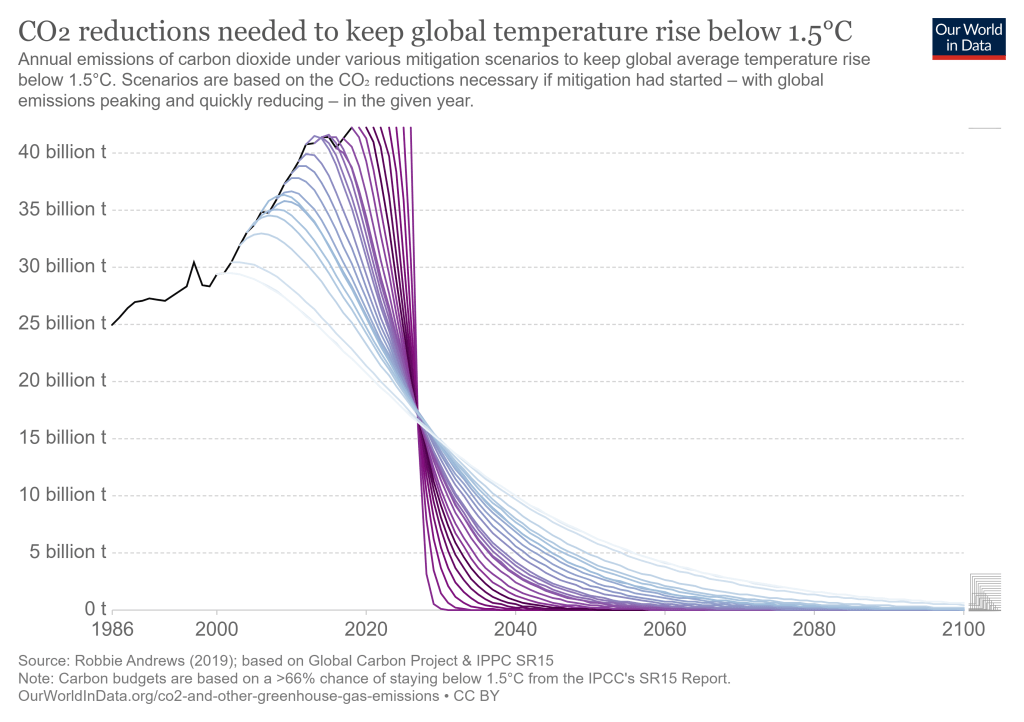
To keep the world within the desired 1.5C of warming, the carbon dioxide concentration in the atmosphere has to be kept below 500ppm. To achieve this the ambition agreed at COPxx in Paris in 2015 is to reduce global carbon emissions by 45% by 2030 and to net zero by 2050. 

In 2015 global carbon dioxide emissions were just over 35 billion tonnes, in 2019 emissions reached 37 billion tonnes, and having dropped back to 35 billion tonnes in 2020 during covid, emissions are again back up at 37 billion tonnes (2022).

Each year that passes without meeting these targets means that to achieve the 2030 and 2050 targets becomes even more difficult as we have to cut back emissions even more steeply. This is vividly shown in the graph below. 

Proper 28, 19th November 2023

Reflection (readings are below)

On Thursday I took part in an interfaith service praying for climate justice – we gathered beneath the statue of Robert Clive outside the Foreign Office, as we reflected on how our actions have a global impact. 

One, a rabbi, told us a story that when God first created Adam, God took him on a tour of all the trees in the garden of Eden, showing both how beautiful and how useful they all were. And then God told Adam that all this had been created for him – for humanity. ‘Make certain’, said God, ‘that you do not ruin and destroy all this, for there is no one to mend it after you!’ 

We are not children, said the rabbi, that someone else will tidy up our mess. We are adults and have to take responsibility to mend what we have damaged. 

Today’s readings have the theme of judgment. The prophet Zephaniah talks of the impending ‘day of reckoning’. A  day when our pluses and minuses, successes and failures, are weighed up.

And in today’s Gospel Jesus tells a parable in which a master judges whether his servants have been trustworthy custodians of what he gave them.

In just under two week COP28 will get underway. One of the key agenda items is to address the outcome of the global stocktake – an assessment of progress that has been made by the nations against the targets in the Paris agreement. The report itself was published in September with the conclusion that  although progress had been made, it was nowhere near enough, and that achieving net-zero emissions required “systems transformation” across all sectors and contexts, including scaling up renewable energy and phasing out fossil-fuel projects.

It feels as if we are fast approaching a day of reckoning. How will we be judged? Will it be shown that we have taken sufficient care of the earth God has given us? 

To return to Zephaniah, it will not be enough that we ourselves have gained wealth, built ourselves comfortable homes and vineyards. Judgement of the earth will be more subtle – it is not a question have we got enough wealth, a safe home and a fruitful vine – that is just to be complacent – but have we ensured that the earth’s wealth has been fairly shared with our neighbours? Have we ensured that it has been garnered in such a way as to not to destroy the earth – and all the trees – that God has given us? 

The jury is out.

The words of UN Secretary-General António Guterres’ opening remarks to the Climate Ambition Summit in September, sounds as forceful as those of Zephaniah. “…and our task is urgent. Humanity has opened the gates of hell. Horrendous heat is having horrendous effects.  Distraught farmers watching crops carried away by floods; sweltering temperatures spawning disease; and thousands are fleeing in fear as historic fires rage.

Climate action is dwarfed by the scale of the challenge… But, the future is not fixed.  It is for leaders like you to write it…We must make up time lost to foot-dragging, arm-twisting and the naked greed of entrenched interests raking in billions from fossil fuels.”

So while we have time, we must take action. The Psalm reminds us that God is our refuge, our port of call for help. We must ask God “ to teach us to number our days that we may apply our hearts to wisdom.” If we trust in God, we should allow God to shape our actions, to guide our thoughts and to inflame our hearts with love. 

We must not be complacent, but rather we must, in the words from Thessalonians, be awake and sober. We must put on ‘the breastplate of faith and love, and for a helmet the hope of salvation’ and that salvation comes through Jesus. A few weeks ago we reflected on the Beatitudes and the teachings that Jesus gives to us his apprentices, that we should love without counting the cost, be truthful without counting the cost, be faithful without counting the cost and stand up for what is right without counting the cost.

If we and all people of faith can accept our responsibility to care for the earth and for our neighbours, then, in the words of the Hindu swami at Thursday’s Interfaith service, we, the people of faith, will be a fighting force for good, a force that can change the world.

António Guterres closed his speech saying, “The future of humanity is in your hands.  One summit will not change the world.  But, today can be a powerful moment to generate momentum, that we build on over the coming months.”

Zephaniah 1:7,12-18

Be silent before the Lord God!
For the day of the Lord is at hand;

the Lord has prepared a sacrifice,
he has consecrated his guests.

At that time I will search Jerusalem with lamps,
and I will punish the people

who rest complacently on their dregs,
those who say in their hearts,

“The Lord will not do good,
nor will he do harm.”

Their wealth shall be plundered,
and their houses laid waste.

Though they build houses,
they shall not inhabit them;

though they plant vineyards,
they shall not drink wine from them.

The great day of the Lord is near,
near and hastening fast;

the sound of the day of the Lord is bitter,
the warrior cries aloud there.

That day will be a day of wrath,
a day of distress and anguish,

a day of ruin and devastation,
a day of darkness and gloom,

a day of clouds and thick darkness,
a day of trumpet blast and battle cry

against the fortified cities
and against the lofty battlements.

I will bring such distress upon people
that they shall walk like the blind;
because they have sinned against the Lord,

their blood shall be poured out like dust,
and their flesh like dung.

Neither their silver nor their gold
will be able to save them
on the day of the Lord’s wrath;

in the fire of his passion
the whole earth shall be consumed;

for a full, a terrible end
he will make of all the inhabitants of the earth.

Psalm 90:1-8, 12

1 Lord, you have been our refuge *
from one generation to another.

2 Before the mountains were brought forth,
or the land and the earth were born, *
from age to age you are God.

3 You turn us back to the dust and say, *
“Go back, O child of earth.”

4 For a thousand years in your sight are like yesterday when it is past *
and like a watch in the night.

5 You sweep us away like a dream; *
we fade away suddenly like the grass.

6 In the morning it is green and flourishes; *
in the evening it is dried up and withered.

7 For we consume away in your displeasure; *
we are afraid because of your wrathful indignation.

8 Our iniquities you have set before you, *
and our secret sins in the light of your countenance.

12 So teach us to number our days *
that we may apply our hearts to wisdom.

1 Thessalonians 5:1-11

Now concerning the times and the seasons, brothers and sisters, you do not need to have anything written to you. For you yourselves know very well that the day of the Lord will come like a thief in the night. When they say, “There is peace and security,” then sudden destruction will come upon them, as labor pains come upon a pregnant woman, and there will be no escape! But you, beloved, are not in darkness, for that day to surprise you like a thief; for you are all children of light and children of the day; we are not of the night or of darkness. So then let us not fall asleep as others do, but let us keep awake and be sober; for those who sleep sleep at night, and those who are drunk get drunk at night. But since we belong to the day, let us be sober, and put on the breastplate of faith and love, and for a helmet the hope of salvation. For God has destined us not for wrath but for obtaining salvation through our Lord Jesus Christ, who died for us, so that whether we are awake or asleep we may live with him. Therefore encourage one another and build up each other, as indeed you are doing.

Matthew 25:14-30

Jesus said, “It is as if a man, going on a journey, summoned his slaves and entrusted his property to them; to one he gave five talents, to another two, to another one, to each according to his ability. Then he went away. The one who had received the five talents went off at once and traded with them, and made five more talents. In the same way, the one who had the two talents made two more talents. But the one who had received the one talent went off and dug a hole in the ground and hid his master’s money. After a long time the master of those slaves came and settled accounts with them. Then the one who had received the five talents came forward, bringing five more talents, saying, ‘Master, you handed over to me five talents; see, I have made five more talents.’ His master said to him, ‘Well done, good and trustworthy slave; you have been trustworthy in a few things, I will put you in charge of many things; enter into the joy of your master.’ And the one with the two talents also came forward, saying, ‘Master, you handed over to me two talents; see, I have made two more talents.’ His master said to him, ‘Well done, good and trustworthy slave; you have been trustworthy in a few things, I will put you in charge of many things; enter into the joy of your master.’ Then the one who had received the one talent also came forward, saying, ‘Master, I knew that you were a harsh man, reaping where you did not sow, and gathering where you did not scatter seed; so I was afraid, and I went and hid your talent in the ground. Here you have what is yours.’ But his master replied, ‘You wicked and lazy slave! You knew, did you, that I reap where I did not sow, and gather where I did not scatter? Then you ought to have invested my money with the bankers, and on my return I would have received what was my own with interest. So take the talent from him, and give it to the one with the ten talents. For to all those who have, more will be given, and they will have an abundance; but from those who have nothing, even what they have will be taken away. As for this worthless slave, throw him into the outer darkness, where there will be weeping and gnashing of teeth.’”

Green Tau: issue 83

Oil, profits and how to bring about change

14th November 2023

Following on from last week’s Green Tau, it seems that Shell – and other oil and gas companies – have no intention of cutting back on the amount of fossil fuels that they plan to extract and sell. If this becomes a reality, then the planet faces a grim future with rising temperatures and increasingly violent weather patterns that will make large parts of the earth uninhabitable. 

Is there anything that can be done to deflect and reverse this scenario? At present so many systems seem designed to perpetuate the profitability and financial attractiveness of fossil fuels. 

For example,  most buildings are heated via gas fired boilers, most vehicles are powered by petrol. Swopping to a different system of heating and powering vehicles is expensive, with the need for investment in new distribution networks, new manufacturing plants, newly trained staff both to make and maintain the new equipment – plus, of course, the need for customers to have sufficient resources to make the switch. 

Whilst at the same time, oil and gas companies are huge, having grown over many decades into international corporations, dominating our economies and therefore command great influence in the financial worlds – far more so than say a new, still small renewables company. 

There is also the inertia that comes from years practice. Customers, financiers, governments etc have been used to working with the oil and gas industry for so long, that change feels counter intuitive and difficult. The longer we have done something one way, the harder it is for us to imagine there being any other way.

Nevertheless there are ways of changing the system.

Government Action –

1. Remove government subsidies. Many governments, not just here in the UK, subsidise the fossil fuel industries, in part to keep their own economies competitive. But these subsidies are large and distort the market price of fossil energy. Recently 25,000 plus climate protestors in the Netherlands blockaded a motor way for ten days to persuade their government to review its continued payment of subsidies to the Dutch fossil fuel industry. (This is something we too should campaign for).

2. Increase subsidies to support renewable energy and so tip the markets away from fossil fuels. If governments can be persuaded to eliminate fossil fuel subsidies, it would be appropriate to equally ask that that money be diverted to both subsidise renewables, and to support those in our society who are suffering from fuel poverty.

3. Enforce stringent windfall taxes to recoup the money that the fossil fuel industry earns purely because of war and other global uncertainties. These events, because they lead to higher prices for oil and gas but have no effect on the cost of production, enable companies to receive increased profits at zero cost. Such windfall tax revenues should then be used to reimburse those vulnerable communities that have lost most because of the climate crisis.

4. Ban advertising for fossil fuels. Over recent years cigarette advertising has been banned to encourage consumers to make  more healthy choices and to reduce the cost to the NHS of the health issues caused by cigarette smoke. Fossil fuels cause even more damage to health and an even greater costs to society as jobs, homes, infrastructure, farming etc suffer from the adverse effects of the climate crisis.

5. By the same logic there should be a ban preventing fossil fuel companies from sponsoring sporting and cultural events. Such sponsorship has the additional concern that it portrays the sponsors as worthy upholders of what we value as a society – where as in fact their businesses are destroying what we hold dear.

6. Agree and impose a global tax on aviation fuel. At present aviation fuel – unlike petrol and diesel is not taxed. It would be too easy for airlines to avoid the tax if introduced state by state, by refuelling at airports where no tax was imposed.

7. Pro-active government advertising to encourage consumers to reduce consumption of fossil fuels.  Plus Government support to enable consumers to switch to green energy suppliers, to replace gas boilers with heat pumps, to replace car journeys with active travel (walking, cycling) or with public transport etc. 

8. Government legislation to ban internal flights where railways can provide the same connections. The EU is already gradually introducing legislation to achieve this in Europe.

9. Pro active  messaging from the government to show that they are committed to a speedy switch to renewable energy – certainty on the direction and speed of travel is important for the financial markets and those investing in green technologies. 

10. Legislation to require all businesses and organisations to have a net zero transition plan that encompasses scope 1, 2 and 3 emissions. Government support, to enable small concerns to undertake this, would be necessary. 

Businesses and organisations 

1. Pro-actively engaging in drawing up and implementing net zero transition plans to reduce their consumption of fossil fuels and their green house gas emissions.

2. Refusing to promote or advertise fossil fuels companies and products. The Guardian newspaper for example does not carry adverts for airlines. 

3. Cutting ties with companies that support the fossil fuel industries, such as banks, and insurance companies.

4. Supporting, developing and/or investing in renewable energy and zero carbon products. Seeking out alternative materials that can substitute for fossil fuels.

5. Giving support to activist groups seeking to persuade more reluctant organisations to adopt climate friendly policies.

Consumers

1.Wherever we can (depending on our financial position) to opt not to buy fossil fuel products – eg by switching to green energy suppliers, reducing petrol consumption by, for example, walking or cycling, using public transport, car sharing, using an electric car, by not flying, by replacing boilers with heat pumps etc, and by cutting back or avoiding products made from oil – such as plastics but also vinyl products, polyester etc. (For a comprehensive and amazing list see https://www.energy.gov/sites/prod/files/2019/11/f68/Products%20Made%20From%20Oil%20and%20Natural%20Gas%20Infographic.pdf)

2. Use our voting power  to elect a government that is pro the wellbeing of the climate and environment and anti the damaging actions of the fossil fuel industry. This applies to local as well as national elections. In between elections, email your representatives if you feel they are not sufficiently supporting the well-being of the environment.

3. Target all companies with ties to the fossil fuel industry such  as banking and insurance, to urge them to cut their ties and support instead the renewable energy sector.

4. We can as individuals and as campaign groups be vocal in telling the truth about emissions from the fossil fuel industry and so counter their green washing.

5. Switch our bank, pensions, insurance etc to companies who are not supporting the fossil fuel industry.

Counting on … day 1.208

3rd November 2023

Another industry highly dependent on energy is the steel industry. Traditionally that has come from coal, but electric furnaces are providing a less environmentally damaging alternative, producing what is termed ‘green steel’. Providing investment to enable British based steel plants to switch is becoming an election issue. The Guardian reported that “Labour is promising to invest £3bn in smoothing the green transition should it win power at the next election. This is substantially more than the offers made by Mr Sunak’s government to Tata Steel and the Chinese Jingye Group, the respective owners of the Port Talbot works and British Steel. As Sir Keir pointed out, with the right kind of backing and vision from Westminster, domestic steel production can become a crucial component in meeting Britain’s clean power targets. That, in turn, will help protect good, well-paid jobs in regions that desperately need them. Britain is set to require more, not less, steel as it builds net zero machinery and infrastructure at pace. That can be a catalyst for industry renewal, if a committed government shows the drive and imagination to make it so. New public procurement rules, for example, could ensure the use of clean British steel in the manufacture of wind turbines, rather than reliance on imports from abroad.” https://www.theguardian.com/commentisfree/2023/oct/24/the-guardian-view-on-labour-and-the-steel-industry-how-to-forge-a-better-future?CMP=Share_iOSApp_Other

Nothing is straight forward. To add to this story, it seems that switching to electric furnaces has to further knock on effects. First the furnace needs fewer people to operate it, so the switch comes with redundancies. We should be aspiring to a just transition to net zero which means we should be looking to create jobs for those facing redundancy. This could involve reskilling people for work in the green sector eg building and installing wind turbines, heat pumps, solar panels, etc. Second – and which is a positive really – electric furnaces don’t produce steel from iron ore but by recycling steel and iron.

Green Tau issue 82

Oil, Profits and the need for change

3rd November 2023

Yesterday Shell announced their interim profits of £5.1bn for the period July to September. This was up on the previous quarter but down compared with this quarter last year when their profits were over £7bn.

According to a report made by Reuters, in order to compete with its fellow oil producers, Shell will be aiming to increase its dividend by 20% and to make overall payouts of between 35-40% of its cash flow. To this end the new CEO Wael Sawan aims to maintain Shell’s oil output at 1.5 million barrels per day. While this is less than the 2.6 million bpd produced in 1998, Sawan’s plan is to maintain this 1.5 million bpd until 2030! With oil prices again rising due to the conflict in the Middle East, increasing profits and dividends seem secure – and Sawan has said that shifting to a low-carbon economy cannot come at the expense of profits. (1)

The Guardian has reported that Shell plans to invest $40 billion in oil and gas production between now and 2035, and between $10bn and $15bn in “low-carbon” products including biofuels and carbon capture. (2) Carbon capture is important to Shell as it aims to reduce its carbon emissions between now and 2050. However it must be noted that Shell only includes scope 1 and 2 emissions in these targets – ie they intend to reduce the emissions arising from the production of oil and gas, with for example carbon capture being used to offset emissions they cannot remove. What is not covered in Shell’s net zero aspirations are the emissions released by the oil and gas once they have been sold  and used – scope 3 emissions. Other oil companies do the same, each competing to claim whose oil is least carbon intensive or greenest!

In 2022 Shell’s scope 1 and 2 emissions were 58 million tonnes CO2e, but its scope 1,2 and 3 emissions were in the region of 1.6 billion tonnes CO2e. Global emissions for CO2e are about 40 billion tonnes of which fossil fuels contribute about 37 billion tonnes. There is no getting away from the fact that fossil fuels are drivers of climate change. And equally that companies like Shell have no intention of phasing out oil from their business plans.

Meanwhile the International Energy Agency ( IEA) has said that if we are to achieve our net zero emissions by 2050 there must be no more development of new oil or gas. There is already enough fossil fuels available from the existing sites for the world’s economies to use as they transition to net zero.

However oil and gas typically produces a return of 10-20% whilst renewables only yield 5-8%. Our lifestyles are still deeply dependent on the oil economy and often it seems simpler to pay more for the fuel than to readjust tey way we live and work. Equally it would seem that the markets cannot reflect in their prices the risk and/ or cost of a climate catastrophe. Surely then it is time for the markets to be regulated for the benefit of everyone. Such regulations would need to be clear, precise and universal to be effective. Individual nations are unlikely to make such regulations in isolation. Hence the need for regulatory agreements to be reached at, for example, COP28.

It is also important that the nations at COP28 agree to a sharp and complete phasing out of fossil fuels. The agreement will need to clearly define when and how fossil fuel production is to be reduced to zero. It will effect some countries more than others – especially those who have previously become dependant on oil money. It will affect jobs, both those directly employed in the extraction of fossil fuels, and those employed in the processing of this raw material. It will also affect investment markets, potentially reduce the amount of funds accruing to pension funds, insurance companies etc. Ensuring a smooth and fair transition is important.

The IMF reports, “The end of oil thus makes economic transformation imperative. Oil-rich countries must diversify to become resilient to the changes in energy markets. An appropriate governance framework to manage proceeds from oil in good and bad times has always been important to fostering economic diversification. But with stranded assets a new risk, radical shifts in governance in oil-dependent economies are urgent. Dubai, for example, facing the depletion of its oil reserves, transformed itself into a global trade hub. Countries and businesses reliant on these markets must formulate policies to address this transformation, including the development of renewable energy.” (Arezki 2020) (4) 

What does not and will not help, is prolonging the viability of oil companies. In particular the use of government subsidies should be withdrawn universally. Instead windfall taxes should be levied to fund reparations to communities disproportionately affected by climate change. 

Last year Ethical Consumer reported “Currently, the UK’s tax regime makes it the most profitable country in the world to develop big offshore oil and gas projects. Most spending on oil and gas exploration can be offset against tax, as it is classified as ‘research and development’. Almost all spending on new fields can be offset in the first year of development, and companies can claim tax relief for decommissioning offshore installations. Since the Paris Agreement, the government has provided £13.6 billion in subsidies to the UK oil and gas industry. From 2016 to 2020 companies received £9.9 billion in tax relief for new exploration and production, including £15 million of direct grants for exploration, and £3.7 billion in payments towards decommissioning costs.” (4) 

From research commissioned by the Liberal Democrats, the Guardian reported that since 2015, whilst renewable energy received £60bn in subsidies, fossil fuel companies received close to £80bn. (5) No wonder the investment returns on fossil fuels exceeds that from renewables!

And in 2022, Energy Voice reported  that “Shell received net rebates of over $121 million (£92m) from the UK government last year, the largest total from any country in which it operates. In total, Shell received rebates of more than $131m (£100m) from HM Revenue and Customs, according to its latest Payments to Governments report, released Tuesday. This was offset by fee payments to regulators, including more than $10.5m (£8m) to the Oil and Gas Authority (now the North Sea Transition Authority), and over $120,000 (£91,000) to the Crown Estate Scotland.” (6) Is the UK government actively paying oil companies to damage our climate?!

The IEA reports “‘The IEA has long advocated removing or at least reducing fossil fuel subsidies because they distort markets, send the wrong price signals to users, widen fiscal deficits in developing economies, and discourage the adoption of cleaner renewable energies. Their expansion is particularly worrying at a time when we should be redoubling efforts to cut wasteful consumption and accelerate clean energy transitions. Reforming prices is a political challenge, but it is also economically and environmentally vital.” (7)

The overarching aim of the climate COPs is to limit the extent of climate change and its impact on the world. To this end numerous agreements have been made since COP21 in Paris in 2015, to reduce net emissions to zero by 2050. This scientists thought would keep global temperature increases below 1.5C. However it now seems that with emissions still rising, we may pass this threshold much sooner. Samantha Burgess, the deputy director of the European Union’s Copernicus Climate Change Service (C3S), noted that September 2023 would be one for the record books. “This extreme month has pushed 2023 into the dubious honour of first place – on track to be the warmest year and around 1.4°C above pre-industrial average temperatures.” (8)

The failure of governments and oil companies to phase down the production of fossil fuels is surely morally if not criminally wrong? In the next Green Tau I will be looking at campaigns and actions that aim to address this. 

(1) – https://www.reuters.com/business/energy/shell-pivots-back-oil-win-over-investors-sources-2023-06-09/

(2) – https://www.theguardian.com/business/2023/jun/14/shell-drops-target-to-cut-oil-production-as-ceo-guns-for-higher-profits?CMP=Share_iOSApp_Other

(3) – https://www.imf.org/external/pubs/ft/fandd/2021/06/the-future-of-oil-arezki-and-nysveen.htm

(4) –  https://www.ethicalconsumer.org/energy/paid-pollute-fossil-fuel-subsidies-uk-what-you-need-know

(5) – https://www.theguardian.com/environment/2023/mar/09/fossil-fuels-more-support-uk-than-renewables-since-2015

(6) – https://www.energyvoice.com/oilandgas/north-sea/400886/uk-government-hands-shell-more-than-92m-in-2021/

(7)  – https://www.iea.org/reports/oil-2021

(8) – https://news.un.org/en/story/2023/10/1141937

Counting on … day 1.207

2nd November 2023

It is not just individuals that are trying to make the shift to net zero, but businesses too. And they likewise find the lack of government support and direction frustrating. 

Last week the Guardian reported that, “Miles Roberts, the company’s chief executive, said British government decarbonisation policy has lacked the clarity of European rivals, meaning DS Smith[ a FTSE 100 paper packaging company] has moved ahead with a €90m (£78m) investment in a paper mill in Rouen, northern France …Roberts said: “If you are committed to carbon neutral, and it is far more attractive to invest in those solutions elsewhere, what you’ll see is manufacturing decline in the UK.” https://www.theguardian.com/business/2023/oct/22/uk-must-offer-businesses-certainty-over-green-energy-says-boss-of-ftse-100-firm?CMP=Share_iOSApp_Other

Counting on … day 1.204

30th October 2023

Next year will be an election year and already people and organisations are thinking about what policies we want and need from a new government. Here are thoughts from the National Trust:  “The next general election will have a profound impact on all our futures. Nature and our climate are facing an emergency. The Trust has a long history of contributing to the challenges of the day: from the need for green spaces for Victorian city dwellers, to the post-war dissolution of country houses and collections, to the over-development of Britain’s coastline. This means acting as partner, friend and critic to governments, while never straying into party politics.
“The legal commitments to reach net zero by 2050 and reverse the decline of nature by 2030, require concerted action and we are looking for the policies to match.”

In particular they pick out cleaning our rivers and protecting them rom further pollution; building up a workforce and retrofitting all our pre 1920 buildings with insulation to maintain comfortable internal temperatures whilst reducing energy costs; and re greening the UK so that everyone is within a 15 minute walk of a green space. 

https://www.nationaltrust.org.uk/services/media/national-trust-issues-critical-manifesto-asks-to-protect-nature-and-heritage-for-everyone