Forgive our oily sins

6th September 2025

“I am the resurrection and the life. Those who believe in me, even though they die, will live, and everyone who lives and believes in me will never die.” John 11:25-26

You Lord, are the source of all good things: 

We praise you.

You call us to tend and care for your creation: 

May we strive to do your will.

You have made us as brothers and sisters with all that lives: 

May we live together in peace.

A reading from Deuteronomy 30: 15-29

See, I have set before you today life and prosperity, death and adversity. If you obey the commandments of the Lord your God that I am commanding you today, by loving the Lord your God, walking in his ways, and observing his commandments, decrees, and ordinances, then you shall live and become numerous, and the Lord your God will bless you in the land that you are entering to possess. But if your heart turns away and you do not hear, but are led astray to bow down to other gods and serve them,  I declare to you today that you shall perish; you shall not live long in the land that you are crossing the Jordan to enter and possess.  I call heaven and earth to witness against you today that I have set before you life and death, blessings and curses. Choose life so that you and your descendants may live

 A response – 

When oil is pumped from the ground 

it leaves a sticky trail 

that reappears 

as polluted soil, polluted water and polluted air. 

It never becomes nothing. 

Living God, 

Forgive our sinful ways and restore life.

When seeds are sown in the ground, 

the energy of the sun is absorbed 

and reappears as waving heads of corn.

It never becomes nothing. 

Living God, 

Praise to you for the  generosity that gives life.

When oil becomes petrol it powers the car 

but then reappears 

as an exhaust that pollutes the air and pollutes our lungs.

It never becomes nothing. 

Living God, 

Forgive our sinful ways and restore life.

When the corn is cut the grain is milled

and the straw reappears as mulch, 

and the grain reappears as bread.

It never becomes nothing.

Living God, 

Praise to you for the  generosity that gives life.

When oil becomes plastic it can become anything –

but then reappears 

as pollution in the rivers and pollution in the seas,  

it reappears 

as micro particles in  the air we breath, the water we drink and the food we eat – 

it even reappears in our blood!

It never becomes nothing. 

Living God, 

Forgive our sinful ways and restore life.

When the bread is shared and the people fed, 

the energy reappears 

as hearts that love, 

as hands that heal and as minds that learn, 

as feet that walk alongside and as shoulders that share the load. 

It never becomes nothing. 

Living God, 

Praise to you for the  generosity that gives life.

The Grace.

Green Tau: issue 86

5th February 2024

Banking on a better future

The world – people, animals, plants, birds, economies, agriculture, water supplies etc – is already suffering from the effects of climate change and this is a crisis that will continue to grow (exponentially) unless action is taken. The major contributor of the greenhouse gases cause this, is fossil fuels. 

The IPCC AR6 Synthesis Report (2023) states  “Limiting human-caused global warming requires net zero CO2 emissions. Cumulative carbon emissions until the time of reaching net-zero CO2 emissions and the level of greenhouse gas emission reductions this decade largely determine whether warming can be limited to 1.5°C or 2°C (high confidence). Projected CO2 emissions from existing fossil fuel infrastructure without additional abatement would exceed the remaining carbon budget for 1.5°C (50%) (high confidence)”. https://www.ipcc.ch/report/ar6/syr/resources/spm-headline-statements/

In other words, our current production levels and use of fossil fuels will, cumulatively (because they build up and remaining in the atmosphere for generations), cause global temperatures rises in excess of 1.5C.  (In 2023 the global temperature rise was 1.2C above the average for NASA’s baseline period (1951-1980))

For more insight into the urgency of the situation, see https://www.theguardian.com/environment/2023/mar/20/ipcc-climate-crisis-report-delivers-final-warning-on-15c?CMP=Share_iOSApp_Other

The IPPC’s report goes on to to say “Finance, technology and international cooperation are critical enablers for accelerated climate action. If climate goals are to be achieved, both adaptation and mitigation financing would need to increase many-fold. There is sufficient global capital to close the global investment gaps but there are barriers to redirect capital to climate action.”

Finance is key but it will only be effective if it is targeting projects that reduce emissions. One would expect therefore to be seeing an ongoing g and rapid transfer of money away from fossil fuel projects and into the support of renewable energy. Yet in January 2023 Reuters reported “The share of bank finance going to renewable energy rather than fossil fuels has little changed in six years, raising questions about how fast lenders are pushing energy clients to become greener, according to research published Tuesday. Since 2016 renewable energy has taken 7% of a total $2.5 trillion in bank loans and bond underwriting for energy activities, according to a report commissioned by environmental groups including Sierra Club and Fair Finance International.” https://www.reuters.com/business/sustainable-business/bank-funding-renewables-stagnates-vs-oil-gas-report-2023-01-24/

A report, Banking on Climate Chaos, records that fossil fuel financing from the world’s 60 largest banks reached $5.5 trillion in the six years since the Paris Agreement, 2015, and 2022. Of these JP Morgan, the worst bank overall, financed $39 billion in 2022, so totalling $434 billion between 2016 – 2022. Top rating amongst the European banks was Barclays, which took seventh place in the league table, having $190.5 billion over the time frame. 

Barclays provides finance to numerous oil companies including Exxon, Shell, BP, Chevron, Total, and Equinor. This is finance that supports both existing and new projects. Yet there is no space in the world’s carbon budgets for this continuing increase in emissions. “Potential emissions from fossil fuels already in production or under construction – the wells already drills or being drilled – already takes the world well past 2C of global warming… world cannot afford any fossil fuel expansion…”  https://www.bankingonclimatechaos.org/

Not surprisingly a number of climate concerned groups are pushing for change – both of banks that they stop financing the fossil fuel industry, and of customers that they stop using these highly destructive banks. 

It is often argued that moving one’s money out of Barclays will have no impact as it will merely be replaced by money from elsewhere. I’m not sure that that can always be true – there must at some point be a finite sum of money to be banked. But turning it round, the money you move can then be invested by a greener bank to support renewable energy and other beneficial projects – and this indeed might be money they would otherwise not get. And don’t worry of the amount you are banking with is small: for every £ deposited, banks will lend a multiple amount. Even if that multiplier was  only 2 it would double the financial contribution that you money makes to green investments.

Here in the UK Make My Money Matter is calling on individuals to “green their money” as well as encouraging students and alumni to call on their universities to switch to  sustainable  banks – https://makemymoneymatter.co.uk/

Another useful website is ‘switch it green’  helping people find a better bank – https://www.switchit.green/about

Just Money offers another  perspective on the issue, this time from a Christian view point, and has advice and resources for churches and charities wishing to switch to green banking.  

I have been involved with Christian Climate Action’s ongoing campaign to encourage charities to switch to greener banks – especially those charities whose remit encompasses people and places adversely affected by the climate crisis. To date Christian Aid, Greenbelt and Oxfam have all declared their decision to switch away from Barclays Bank. Read more on this at – https://www.churchtimes.co.uk/articles/2024/2-february/news/uk/more-charities-sever-ties-with-barclays-over-stance-on-fossil-fuels

And it is not just charities that are being asks to reconsider their banking arrangements. The same ask is being made of churches and dioceses. Christians are called to care for creation and to love their neighbour – which are actually overlapping  vocations – and switching to a bank that does not pursue profit through the financing of fossil fuels,  is one of the easier steps  they can take!

Prayer vigil outside Oxfam’s headquarters.

Green Tau issue 82

Oil, Profits and the need for change

3rd November 2023

Yesterday Shell announced their interim profits of £5.1bn for the period July to September. This was up on the previous quarter but down compared with this quarter last year when their profits were over £7bn.

According to a report made by Reuters, in order to compete with its fellow oil producers, Shell will be aiming to increase its dividend by 20% and to make overall payouts of between 35-40% of its cash flow. To this end the new CEO Wael Sawan aims to maintain Shell’s oil output at 1.5 million barrels per day. While this is less than the 2.6 million bpd produced in 1998, Sawan’s plan is to maintain this 1.5 million bpd until 2030! With oil prices again rising due to the conflict in the Middle East, increasing profits and dividends seem secure – and Sawan has said that shifting to a low-carbon economy cannot come at the expense of profits. (1)

The Guardian has reported that Shell plans to invest $40 billion in oil and gas production between now and 2035, and between $10bn and $15bn in “low-carbon” products including biofuels and carbon capture. (2) Carbon capture is important to Shell as it aims to reduce its carbon emissions between now and 2050. However it must be noted that Shell only includes scope 1 and 2 emissions in these targets – ie they intend to reduce the emissions arising from the production of oil and gas, with for example carbon capture being used to offset emissions they cannot remove. What is not covered in Shell’s net zero aspirations are the emissions released by the oil and gas once they have been sold  and used – scope 3 emissions. Other oil companies do the same, each competing to claim whose oil is least carbon intensive or greenest!

In 2022 Shell’s scope 1 and 2 emissions were 58 million tonnes CO2e, but its scope 1,2 and 3 emissions were in the region of 1.6 billion tonnes CO2e. Global emissions for CO2e are about 40 billion tonnes of which fossil fuels contribute about 37 billion tonnes. There is no getting away from the fact that fossil fuels are drivers of climate change. And equally that companies like Shell have no intention of phasing out oil from their business plans.

Meanwhile the International Energy Agency ( IEA) has said that if we are to achieve our net zero emissions by 2050 there must be no more development of new oil or gas. There is already enough fossil fuels available from the existing sites for the world’s economies to use as they transition to net zero.

However oil and gas typically produces a return of 10-20% whilst renewables only yield 5-8%. Our lifestyles are still deeply dependent on the oil economy and often it seems simpler to pay more for the fuel than to readjust tey way we live and work. Equally it would seem that the markets cannot reflect in their prices the risk and/ or cost of a climate catastrophe. Surely then it is time for the markets to be regulated for the benefit of everyone. Such regulations would need to be clear, precise and universal to be effective. Individual nations are unlikely to make such regulations in isolation. Hence the need for regulatory agreements to be reached at, for example, COP28.

It is also important that the nations at COP28 agree to a sharp and complete phasing out of fossil fuels. The agreement will need to clearly define when and how fossil fuel production is to be reduced to zero. It will effect some countries more than others – especially those who have previously become dependant on oil money. It will affect jobs, both those directly employed in the extraction of fossil fuels, and those employed in the processing of this raw material. It will also affect investment markets, potentially reduce the amount of funds accruing to pension funds, insurance companies etc. Ensuring a smooth and fair transition is important.

The IMF reports, “The end of oil thus makes economic transformation imperative. Oil-rich countries must diversify to become resilient to the changes in energy markets. An appropriate governance framework to manage proceeds from oil in good and bad times has always been important to fostering economic diversification. But with stranded assets a new risk, radical shifts in governance in oil-dependent economies are urgent. Dubai, for example, facing the depletion of its oil reserves, transformed itself into a global trade hub. Countries and businesses reliant on these markets must formulate policies to address this transformation, including the development of renewable energy.” (Arezki 2020) (4) 

What does not and will not help, is prolonging the viability of oil companies. In particular the use of government subsidies should be withdrawn universally. Instead windfall taxes should be levied to fund reparations to communities disproportionately affected by climate change. 

Last year Ethical Consumer reported “Currently, the UK’s tax regime makes it the most profitable country in the world to develop big offshore oil and gas projects. Most spending on oil and gas exploration can be offset against tax, as it is classified as ‘research and development’. Almost all spending on new fields can be offset in the first year of development, and companies can claim tax relief for decommissioning offshore installations. Since the Paris Agreement, the government has provided £13.6 billion in subsidies to the UK oil and gas industry. From 2016 to 2020 companies received £9.9 billion in tax relief for new exploration and production, including £15 million of direct grants for exploration, and £3.7 billion in payments towards decommissioning costs.” (4) 

From research commissioned by the Liberal Democrats, the Guardian reported that since 2015, whilst renewable energy received £60bn in subsidies, fossil fuel companies received close to £80bn. (5) No wonder the investment returns on fossil fuels exceeds that from renewables!

And in 2022, Energy Voice reported  that “Shell received net rebates of over $121 million (£92m) from the UK government last year, the largest total from any country in which it operates. In total, Shell received rebates of more than $131m (£100m) from HM Revenue and Customs, according to its latest Payments to Governments report, released Tuesday. This was offset by fee payments to regulators, including more than $10.5m (£8m) to the Oil and Gas Authority (now the North Sea Transition Authority), and over $120,000 (£91,000) to the Crown Estate Scotland.” (6) Is the UK government actively paying oil companies to damage our climate?!

The IEA reports “‘The IEA has long advocated removing or at least reducing fossil fuel subsidies because they distort markets, send the wrong price signals to users, widen fiscal deficits in developing economies, and discourage the adoption of cleaner renewable energies. Their expansion is particularly worrying at a time when we should be redoubling efforts to cut wasteful consumption and accelerate clean energy transitions. Reforming prices is a political challenge, but it is also economically and environmentally vital.” (7)

The overarching aim of the climate COPs is to limit the extent of climate change and its impact on the world. To this end numerous agreements have been made since COP21 in Paris in 2015, to reduce net emissions to zero by 2050. This scientists thought would keep global temperature increases below 1.5C. However it now seems that with emissions still rising, we may pass this threshold much sooner. Samantha Burgess, the deputy director of the European Union’s Copernicus Climate Change Service (C3S), noted that September 2023 would be one for the record books. “This extreme month has pushed 2023 into the dubious honour of first place – on track to be the warmest year and around 1.4°C above pre-industrial average temperatures.” (8)

The failure of governments and oil companies to phase down the production of fossil fuels is surely morally if not criminally wrong? In the next Green Tau I will be looking at campaigns and actions that aim to address this. 

(1) – https://www.reuters.com/business/energy/shell-pivots-back-oil-win-over-investors-sources-2023-06-09/

(2) – https://www.theguardian.com/business/2023/jun/14/shell-drops-target-to-cut-oil-production-as-ceo-guns-for-higher-profits?CMP=Share_iOSApp_Other

(3) – https://www.imf.org/external/pubs/ft/fandd/2021/06/the-future-of-oil-arezki-and-nysveen.htm

(4) –  https://www.ethicalconsumer.org/energy/paid-pollute-fossil-fuel-subsidies-uk-what-you-need-know

(5) – https://www.theguardian.com/environment/2023/mar/09/fossil-fuels-more-support-uk-than-renewables-since-2015

(6) – https://www.energyvoice.com/oilandgas/north-sea/400886/uk-government-hands-shell-more-than-92m-in-2021/

(7)  – https://www.iea.org/reports/oil-2021

(8) – https://news.un.org/en/story/2023/10/1141937

Counting on …. Day 1.199

23rd October 2023

“Climate activists are sometimes depicted as dangerous radicals.  But, the truly dangerous radicals are the countries that are increasing the production of fossil fuels.” So said the UN Secretary-General António Guterres last year at the launch of the third IPCC report.

Last week the Intercontinental Hotel in Park Lane hosted the Energy Intelligence Forum – an international gathering of influential figures from the oil and financial industries – formerly known as the Oil and Money Conference. These people hold great power with very little reference to either democratic decision making or alternative view points. The decisions they make, and the strategies they plan, will have a big impact on what happens in the world, on the future of wellbeing of people, the environment and the climate. 

In opposition to this Fossil Free London and other groups such as Extinction Rebellion, Greenpeace and Christian Climate Action, organised protests outside the hotel and at selected headquarters of oil and financial institutions across London. With our future at stake, it was imperative right to call out the injustice of what was happening. The IPPC and IEA have both presented the world with the scientific evidence that carbon emissions are causing the climate crisis, and that the urgent response must be cutting back now on fossil fuels extraction and use, as we all transition to net zero. And yet, regardless of this, the oil industry is continuing to expand its operations, and the financial world is continuing to invest in and to insure these projects – using what is ultimately our money.  

On the Monday evening, the eve of the conference, Christian Climate Action held an act of worship out on the street opposite the hotel’s main entrance. Using words from the most recent papal encyclical,  Laudate Deum (Praise God). It is so called, because the Pope says that when human beings claim to take God’s place, they become their own worst enemies. In the worship we bore witness to the injury and injustice that the oil industry is causing in the world, and in between prayerful silences we sang  praises to God using the Taize chant ‘Laudate omens gentes’.

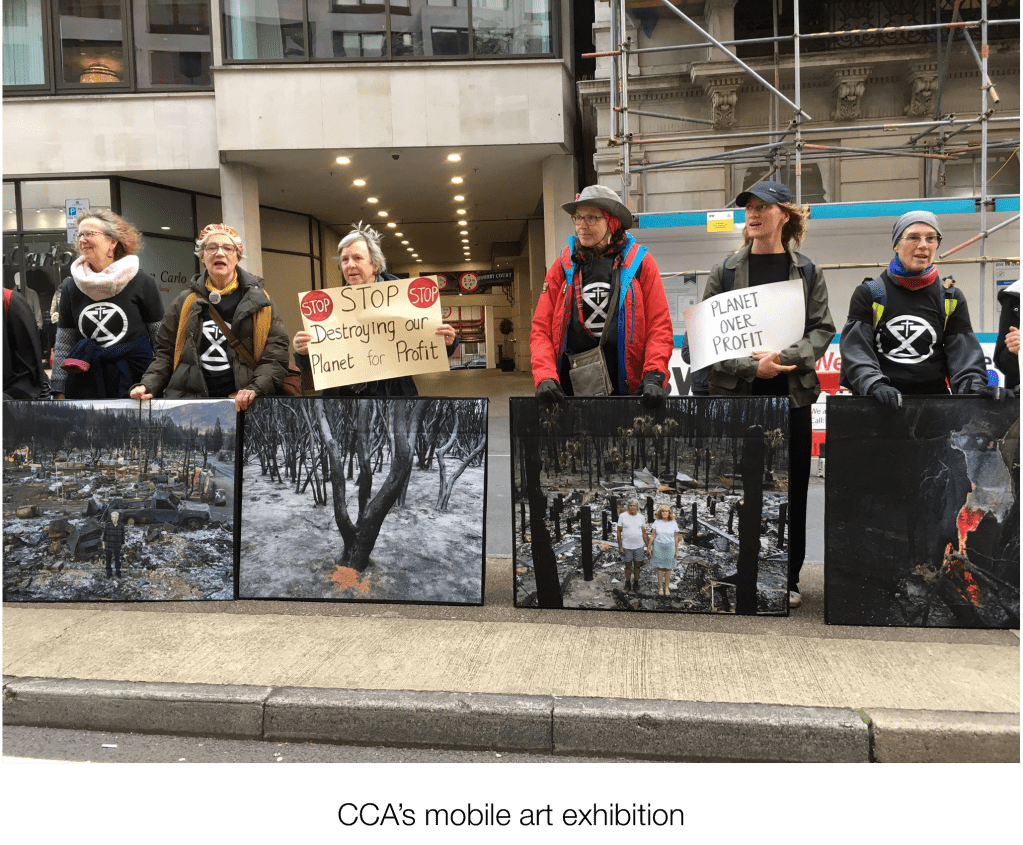
Tuesday CCA again gathered in the street opposite the hotel with a series of photographs – a mobile art exhibition – each an illustration of the effects of wild fire on the environment and people’s lives. Fossil Free London and others blockaded the hotel entrance – the hotel had erected high fences along the whole area restricting the entrance to a meter wide gate way which was  easily blocked by protestors preventing guests from entering or leaving. A samba band played, people sang and chanted, and speeches were delivered – the key speaker was Greta Thunberg. Mid morning a group from Greenpeace abseiled down from a top floor window, unfurling a banner down the front of the hotel. The conference delegates could not have gone unaware of the opposition to their plans for an oil fuelled future. Indeed the CEO of Shell had to make his speech by equivalent of zoom. By the early afternoon the police had imposed a section 14 notice on the street, authorising them to remove all protestors from the site. 

The Christian Climate Action group set off on a pilgrimage around Mayfair stopping to pray at the offices of a number of ‘Earth Wreckers’ – companies involved in financing, supporting or exploiting fossil fuels and thereby directly or indirectly polluting the world with carbon emissions. (For more information about Earth Wreckers visit – http://umap.openstreetmap.fr/en/map/wreckers-of-the-earth-2021_409815#12/51.5222/-0.1234)

On Wednesday action was taken further afield to the City of London. Ten companies associated with the West Cumbrian Coal Mine and the East Africa Crude Oil Pipeline were targeted, to protest against their involvement in funding these highly polluting projects. Christian Climate Action together with representatives of other faiths and a group from XR Scientists, peacefully entered and sat down in the foyer of 52 Lime Street – a modern glass and steel tower block that houses Chaucer, the UK subsidiary of China Re and a potential insurer of EACOP. Sat together in the middle of the space – allowing office workers to continue in and out of the building – we sang Buddhist and faith songs and shared an agape of bread and ‘good’ olive oil. 

Within half an hour the police arrived and stood round us, watching. Then with such joy and hope, we saw the XR procession, that was marching between each of the sites, arrive with hundreds of supporters, flags and banners, and a samba band. They waved to us through the plate glass windows and cheered, and we sang and waved back. When they marched on, a contingent from CCA stayed on outside both protesting and praying. The building’s security staff obviously wished us to leave, but the police having taken advice from the CPS, took the view that as our protest was peaceful, they had no grounds for arresting us. After some discussion within the group, we agreed that we would stay until 3 o’ clock. So at 3 o’ clock we stood up, tidied up our banners and picnic lunch and still singing, walked out. We had made our point. 

Despite the rain, we returned to the Intercontinental Hotel that evening for a further act of worship, this time led by various representatives of the Faith Bridge -Buddhist, Muslim, Jewish, Quaker and Christian.

Christian Climate Action continued with its support of other groups on the Thursday, targeting amongst others, the offices of J P Morgan. I meanwhile held my weekly hour long vigil outside Shell’s headquarters. 

For information about Christian Climate Action visit – https://christianclimateaction.org/

Green Tau: issue 83

20th October 2023

Oily Money and Uganda

In 2006 oil was discovered in Uganda. Total ( French oil company) and CNOOC  (Chinese oil company) bought the rights to extract this crude oil. However there has been considerable objection on many grounds. One of the key objections to the project is the statement issued by the International Energy Agency two years ago, that, to keep within the agreed net zero carbon emissions targets, no new oil and gas fields should be opened.  This oil field is likely to produce over its lifetime 1.4 bn barrels – approximately equivalent to what France would consume in two years: not huge but not insignificant either – and would emit some 34 million tonnes of CO2 a year.

Another objection to the scheme is the threat to the environment. The oil field lies under both Lake Albert and the adjacent Murchinson Falls National Park, both of which are key areas maintaining  important ecological habitats and in particular those of migratory fauna. Already test drilling has led to pollution of the lake, affecting fish stocks. 

Once extracted, the  plan is to heat the crude oil to 50C (to ensure it flows) and despatch it via a 900 mile pipeline through Uganda and Tanzania to a refinery at port of Tanga on the India Ocean. The pipeline could carry one 800 million barrels of oil a year. The East Africa Crude Oil Pipeline – EACOP – is a joint project comprising Total who have a 62% share, CNOOC with an 8% share, and TPDC (Tanzanian) and UNOC (Ugandan) each with a 15% share.

A further objection centres around the local people who have, and are being, forcibly removed from the land – both in the vicinity of the proposed oil field and along the route of the pipeline. So far some 60,000 Ugandan farmers and householders have been displaced. Often poor, their land used for growing food had been key in preventing extreme deprivation. Whilst they have received some financial compensation, it has often been inadequate and frequently taken 4 years to materialise. 

The original construction timetable was for work to start in 2016 and to be completed within 3 years, but opposition has continued to delayed this. The project has, for example, been condemned by the European Parliament. As of August this year, the proposed start date is now 2024. 

Total and CNOOC still need to raise $3 bn to finance the pipeline. Two banks, Standard Bank and ICBC, are still potential funders for the pipeline. Eight other international banks have declined to confirm their willingness, whilst twenty six (including Barclays and Deutsche Bank) have declined outright – https://www.stopeacop.net/banks-checklist.

In addition the project needs to underwriten by insurers. Whikst seven, including Lloyds of London and Chaucer, have not yet ruled out providing insurance, but a further twenty three insurers (including Zurich and Ava) have declined. https://www.stopeacop.net/insurers-checklist

Many campaign groups –  Money Rebellion, Coal Action Network, Stop Eacop, Extinction Rebellion, Christian Climate Action, Stop Rosebank, and Just Stop Oil, are involved in opposing EACOP and most recently by targeting the would-be financiers of the project. 

Oil projects, like this one in Uganda, are often presented as a way for poor countries to grow their economies and improve the wellbeing of their citizens. But in reality most of the money goes to the larger, overseas investors, and the number of local jobs created is small. The following abridge article on some of the economic alternatives comes from the StopEAOP web site.

 “For example, Uganda’s tourism industry accounts for about 7% of the country’s gross domestic product and provides over 600,000 jobs. In contrast, EACOP is expected to create only 200-300 permanent jobs. Despite being a major economic sector and job creator in Uganda, tourism is often overlooked or underestimated, with only about 0.4 percent of the government budget allocated to it….The agriculture sector employs more people than any other sector: it is the backbone of the economy and fuels the country. Yet the small farmers who make this vital industry work are neglected. Support for the sector accounts for just under 3 percent of the government’s budget, yet the sector generates nearly 25 percent of the gross domestic product. There is a real opportunity to increase economic strength and resilience by investing in and supporting small-scale sustainable agriculture … Sustainable industries like renewable energy and electric transportation are already well established in the region, but with increased support from international investors, the sector has incredible potential [wind, solar, hydro and geothermal] … The clean energy sector will also benefit the agriculture sector, as decentralised renewable energy deployment can increase yields and incomes for small-scale farmers by improving solar irrigation and electrifying other agricultural activities such as cold storage and processing. In addition, investments in the clean energy sector create a significant number of permanent jobs in the manufacturing sector. For example, Kiira Motors, a state-owned vehicle manufacturer, will employ 14,000 Ugandans to produce 5,000 electric buses and other vehicles per year.” https://www.stopeacop.net/beyond-oil

Another concern is that poor countries like Uganda, often take on increased foreign debts in the expectation that future oil revenues will repay the interest, but delays in getting to the production stage can increase the debt burden and extra costs an reduce the returns, all increasing the country’s ongoing debt problem. Uganda spends more than 50% of its GDP financing foreign loans. 

To read more about how debt is affecting wellbeing in Uganda read this Amnesty International report – https://www.amnesty.org/en/latest/campaigns/2023/09/building-resilience-public-debt-management-and-health-financing-in-ugand/

Debt Justice is leading the campaign, alongside other charities, to cancel the unfair burden of debt being borne by countries such as Uganda – https://debtjustice.org.uk/wp-content/uploads/2023/08/Debt-fossil-fuel-trap-report-2023.pdf

Counting on …. Day 1.173

15th September 2023

Yesterday I joined a multi faith group to hand over a letter to Lloyd’s of London asking them to cease insuring new oil projects. Whilst companies such as Lloyd’s finance/ financially enable oil projects, the exploration and production of oil will continue- and indeed will be seen as socially acceptable by the wider public. All parts of the fossil fuel industry need to be challenged and changed, if we as global community, are going to reduce carbon emissions to safeguard the environment.

For the text of the letter see – https://www.quaker.org.uk/documents/lloyds-of-london-faith-letter-2023-04-24 

Counting on … day 1.172

14th September 2023

On Wednesdays I kneel for an hour’s vigil outside Shell’s Headquarters. I first began this when the campaign group Fossil Free London held weekly pickets outside the building protesting at Shell’s continuing exploration and production of oil. At all stages of oil production damages the environment – whether that is the leaking of oil that has pollute the Niger Delta; the noise from underwater explosions that disorientates whales off the coast of South Africa; the flailing of oil wells that releases methane into the atmosphere ( a gas which rapidly increases global warming); leaks from pipelines and tankers that pollute the sea and coat seabirds an oily slick; the air pollution from diesel and petrol engines; the global warming from the release of CO2 when oil is burned as energy; and the pollution of all areas of our planet by fragments of plastic. We need on some many counts to press oil companies to rapidly phase out the production of oil and instead develop renewable energy supplies.

Counting on …. Day 1.127

14th July 2023

Having yesterday talked about tipping points and a succession of divestment announcements, it now appears that approvals for the Rosebank oil field may be delayed.

“Rosebank, the UK’s largest undeveloped oil and gas field, is highly unlikely to be approved in time for parliamentary recess, amid growing concerns from regulators over electrification and net zero compatibility across the industry.

City A.M. understands the site, which has to be green-lit by the Offshore Petroleum Regulator for Environment and Decommissioning (OPRED) and the North Sea Transition Authority (NSTA), is now not expected to be sanctioned until August at the earliest….

“When completed, Rosebank is expected to produce up to 500m barrels of oil and gas equivalent over its operating lifetime – which could begin as soon as 2027.  This has made the project the subject of intense controversy, with climate groups and energy transition advocates calling for the project to be rejected amid fears it would jeopardise the country’s climate ambitions. 

City A.M. has learned that the NSTA has written directly to oil and gas companies operating in the North Sea, warning them of the importance of electrification for new offshore platforms across future projects…

“Regulators are determined for new developments, including oil and gas fields, to have a clear pathway for the green energy transition – as the UK races to reach net zero over the next three decades and decarbonise its electricity grid by 2035.” https://www.cityam.com/rosebank-faces-fresh-delay-amid-regulator-concerns-over-industry-net-zero-goals/

Green Tau: issue 58

30th November 2022

Who benefits from fossil fuel investment? 

The big oil companies are expanding their exploitation of gas and oil reserves in response to the short falls in supply from Russia. The rapid rise in gas prices is prompting some African nations to consider developing the gas reserves under their land. To  explore and develop these reserves investment is needed and, it seems, is  readily available from western investors. 

In some ways it is not illogical. If you are a company whose raison d’être is finding, extracting and selling oil, that if you hear of new oil deposits, you go after them. Ditto if you are an investment company that has always invested in oil because it has always earns large dividends, then that is what you keep on doing. People and companies are wary of change, or perhaps become so immersed in the comfort of where they are, that they don’t look outside their own silo to be aware that change is already happening. This can be short sighted. Vis a vis oil, there are two black clouds on the horizon. Peak oil – that point in. Time when demand for oil will start to drop and co to use to drop. Many commentators suggest that we have already passed peak oil back in 2019. The decline in oil use arises when cars switch from petrol to electrical power (something that is happening aster than expected), as more plastics are made from recycled plastic rather than virgin oil, as users of oil become more efficient in their use of an expensive raw material,  and as users find renewable energy is cheaper. The second dark cloud is the climate crisis. As concern about the crisis takes root more people, companies and countries are going to be cutting back on their use of oil in an attempt to limit global temperature rises. If such moves are not successful then the world will experience rising sea levels, widespread drought, extremes of weather and widespread loss of life and incomes. And this of itself will severely reduce demand for oil. Either way it seems that long term the future for the oil industry is not good – but for in the short term their dominance of the global economic systems shields them. This has been highlighted by the war in Ukraine.  So the oil industry continues to be heavily subsidised by governments. “Since the Paris Agreement, the government has provided £13.6 billion in subsidies to the UK oil and gas industry. From 2016 to 2020 companies received £9.9 billion in tax relief for new exploration and production, including £15 million of direct grants for exploration, and £3.7 billion in payments towards decommissioning costs.” https://www.ethicalconsumer.org/energy/paid-pollute-fossil-fuel-subsidies-uk-what-you-need-know

So we are seeing large numbers of oil companies and oil investors focusing on exploring and  extracting oil and gas from the African continent. Despite the long term risks of declining demand, these companies seem convinced that there is money to be made. The idea of making rich profits from oil is certainly seen as attractive by some governments in Africa – oil would seem to offer rewards in licence fees and taxes. But who will benefit? Possibly governments, big businesses, banks and the like. Probably not the ordinary person in the street, the small scale farm or business, and definitely not the rich biodiverse  natural environment. 

Given the high price of oil, the availability of more oil will more likely benefit the big users of oil in the western world, not the person on the street in Luganda or Accra or Windhoek, not the small farm and the rural villager, nor the small businesses. What they need is cheap and accessible electricity , electricity that can be produced locally without reliance on an expensive national grid, electricity that comes from local wind turbines and solar panels? What they need is a move away from polluting vehicles and power plants. What they don’t need is the pollution and disturbance caused by drilling for oil,  building pipeline and running oil refineries. 

What the nations of Africa do need is investment in renewable energy. Ideally not in large projects such as hydro electric dams but in multiple smaller scale projects that will connect to and supply local towns and communities. 

“The potential for wind and solar is 400 times larger than Africa’s total fossil fuel reserves and it comes pollution-free and creates more jobs, but there is finance gap…That is why there is so much attention at this COP to changing the global capital allocation system,” Mr Gore

What the nations of Africa need is protection for their remaining areas of natural habitat – rain forests, wetlands and savannahs. Again this is an area in need of large scale investment that will protect habitats and provide sustainable incomes for local people. 

 “The area of land allocated to oil and gas activity in Africa is set to quadruple, threatening critical forests that help combat climate change, according to a new report by two environmental groups. Rainforest Foundation UK and Sacramento, California-based Earth InSight used mapping technology to show that gas and oil blocks overlap with about 30% of the continent’s dense tropical forests and more than a third of the Congo Basin, the world’s second-largest rainforest after the Amazon. The Democratic Republic of Congo, which accounts for about 60% of the basin, launched a bidding round  in July for 30 oil and gas permits, several of which overlap with the basin. Congo, one of the world’s poorest countries, has defended its right to explore for oil and develop its economy.” KBloomberg UK 

Can the big fossil fuel companies reinvent themselves? Can they recalibrate their raison d’être as energy companies?  Can they become suppliers of renewable energy technology that can enable communities to control their own energy sources? Can they create new business models that can invest the money from our banks, pensions funds and insurers, to protect and enhance the natural environment? 

Counting on …day 95 

15th February 2022

Refilling cars with petrol at a service station is common practice.

What if it was the same with oils for cooking and eating? An olive oil pump? You may find that you can! Refill stores often stock different sorts of oil with which customers refill their bottles. As this grows in popularity, let’s also make a point of asking for organic and fairly traded oils.