Counting on … day 200

9th  December 2026

Ocean health: acidification 

One of the nine planetary boundaries is ocean acidification. If the oceans become too acidic it endangers marine life and therefore the lives of the rest of us who are dependent on healthy oceans. 

The 2025 Planetary Health Check showed that this planetary boundary has been breached: since the start of the industrial era, the oceans’ acidity has increased by 30-40% destabilising this important  Earth systems. (1) 

What is ocean acidification?

“For millions of years, the ocean has acted as Earth’s carbon sponge, quietly absorbing carbon dioxide (CO₂) from the air. But that natural partnership has turned toxic in the age of fossil fuels.

“As humanity has pumped unprecedented levels of CO₂ into the atmosphere, the oceans have taken in more and more of it—now absorbing roughly a quarter of all carbon emissions. But this uptake comes at a cost. When carbon dioxide dissolves in seawater, it undergoes a chemical transformation, forming carbonic acid. That acidification strips the ocean of carbonate ions—essential building blocks for creatures like corals, clams, and countless shell-forming organisms.

“As their calcium carbonate shells thin and weaken, so too do the coral reefs and underwater habitats they support. A weakened foundation means collapsing ecosystems—once-thriving marine gardens reduced to skeletal remains.” (2) 

(1) https://www.stockholmresilience.org/research/planetary-boundaries.html

(2)  https://www.sciencenewstoday.org/parts-of-earths-oceans-have-quietly-crossed-a-dangerous-threshold

Counting On … 198

3rd December 2025

Phosphorus is another key mineral for the health of plants and animals. It derives from rocks and  through erosion finds its way into the soil, where as  soluble phosphates (HPO4 and H20P4) it is absorbed by plants, and through eating plants into plant eating creatures and so up through the food chain. Bacteria in the soil aid the absorption of phosphates.

Organic phosphorus is released back into the soil through defecation and the decay of plants and animals. During the process of decomposition the organic form of phosphorus is converted to an inorganic firm such that it can overtime  be reformed into sedimentary rocks. This comprises the natural phosphorus cycle. 

Because phosphorus improves crop yields it is added as an artificial fertiliser. This input disrupts the cycle. Excess of phosphorus is the primary cause of algal bloom in water sources, reducing the amount of oxygen present and so killing off many plants and creatures. (1)

The following data comes from Planetary Boundaries Science:-

“Before human intervention, phosphorus flows were low ~2.5 Tg P pa (tetragrams of phosphorus per year) from land to freshwater and ~1.3 Tg P pa of export to the ocean. Human activities have increased flows from land to freshwater systems through a global application of mined phosphorus to cropland of around 18.2 Tg P pa and have increased phosphorus flows to the ocean to around 4.4 Tg P pa, largely due to fertiliser use.” 

At the same time, the sage planetary boundary for phosphorus flow is between 6.2 and 11 Tg P pa. (2) 

  1. https://biologyteach.com/phosphorus-cycle/
  2. https://www.planetaryhealthcheck.org/boundary/modification-of-biogeochemical-flows/

Counting on … 197

2nd December 2025

The imbalance of the nitrogen cycle also causes air pollution. Whilst nitrogen based fertilisers in the soil and water are being consumed by various microbes, processing nitrites in to become a nitrates which can be absorbed  by the plants, nitrogen oxide (NO) is released as a bi-product. (1)

Nitrogen oxide, like carbon dioxide, is a greenhouse gas, but with 300 times the warming potential. 

Nitrogen  oxide readily reacts with other gases in the atmosphere to form nitrogen dioxide which is a healthy hazard inflaming airways and increasing susceptibility to respiratory infections and allergens.

Together nitrogen oxide and nitrogen dioxide are nitrous oxides or NOx. (2)

Whilst agriculture is the main source of nitrous oxides, they are also emitted  through the burning of fossil fuels – including from petrol and diesel power vehicles, diesel powered shipping and railway engines,  and from aviation. 

(1) https://www.bbc.co.uk/future/article/20210603-nitrous-oxide-the-worlds-forgotten-greenhouse-gas

(2) https://www.gov.uk/government/statistics/emissions-of-air-pollutants/emissions-of-air-pollutants-in-the-uk-nitrogen-oxides-nox

(3) https://ourworldindata.org/emissions-by-sector

Counting on … 195

26th  November 2025

How can the potential harm caused by novel entities be curbed?

  • Reduce the sheer number of synthetic chemicals produced globally
  • Where possible substitute naturally occurring alternatives
  • Ensure novel entities are recycled as a part of a closed circular economy.
  • Ensure no leakage of novel entities into air, water or soil systems
  • Continue to evaluate  the risks posed by each novel entity. 

As consumers we can try and avoid products that utilise novel entities but in reality we will have to accept that they are so engrained into our systems, that we will not always be able to avoid them. Nevertheless doing what we can will help highlight the issue for others.

Counting on … 194

25th  November 2025

Returning to a focus on planetary boundaries (see https://greentau.org/2025/10/22/counting-on-170/) one boundary  that may not automatically spring to mind is that of ‘novel entities’. A novel entity is a substance created by humans from synthetic chemicals and/or natural chemicals that processed in wholly new ways to produce a new – ‘novel’ – entity. Or it is something created by us by modifying the genetics of living organisms or the like, again producing a completely new entity. (1) 

Examples of novel entities includes:

  • numerous synthetic fertilisers, insecticides and pesticides – whilst these may increase harvests they also pollute soil and water and kill off pollinators and other essential insects. DTD is one such infamous example. 
  • chloroflurocarbons – these were used in fridges and aerosols before being restricted,  because they were damaging the ozone layer. 
  • PFAs which are petrol based chemicals that offer amazing properties in resisting heat, oil, water, grease et such that they have been widely used in creating non-stick cooking ware, waterproof clothing, stain resistant and fire retardant fabrics etc. However they also cause infertility and various cancers, and have such a long life (remaining active pollutants) such that they are termed ‘forever chemicals’.
  • BPA (Bisphenol A) is widely used in hard plastics cups, baby bottles, toys, food boxes,  etc and can linings. It too can damage fertility, disrupt hormones, and cause eye damage, skin reaction and respiratory irritation. 
  • Artificial food additives are used to enhance flavour, smell, texture or shelf-life of foods, with the word artificial indicating that these are synthetic rather than natural ingredients. Whilst they are regulated for safety, there is still evidence that they can harm health. For example, the consumption of artificial sweeteners is linked to both cancer and cardiovascular diseases, and nitrates and nitrites (found in products such as bacon) may also have links to these diseases.
  • Genetically modified organisms includes such things as golden rice (a GM rice that produces Beta-carotene); Bt Crop Maize which is toxic to certain pests; and AquAdvangage salmon that grow at twice the rate of conventional salmon. Again there are concerns around links between GM food and cancer, allergic reactions etc but before they enter the food chain there are safety assessments to be passed. Another concern is that GMO will disrupt the DNA of their natural counterparts. And with F1 hybrid plants we already know that their seeds have a lower germination success rate.
  • Plastics generally – much has been written about the problems with plastics, that they hang around in the environment for centuries, and that when they break down into micro and nano-particles they enter into every part of our bodies and into every part of the global environment. As yet we don’t know whether the impact on humans is neutral or harmful. We do know that plastic does maim and  kill wildlife and damage ecosystems.

Novel entities are widespread in the world – The Chemical Abstracts Service maintains a database of chemical names which has identified 204 million new chemicals! (2) – yet what we don’t know is the extent to which they are damaging the world’s environment. It is therefore instructive to read this from a report by the American Chemical Society:-

 “We submit that the safe operating space of the planetary boundary of novel entities is exceeded since annual production and releases are increasing at a pace that outstrips the global capacity for assessment and monitoring.” (3)

  1. https://www.stockholmresilience.org/research/planetary-boundaries.html
  2. https://planet-tracker.org/wp-content/uploads/2024/09/Novel-Entities.pdf
  3. https://pubs.acs.org/doi/10.1021/acs.est.1c04158

Counting on … 179

4th November 2025

Planetary Health Diet

The EAT-LancetCommission is a global, interdisciplinary group of world-leading researchers with expertise in nutrition, health, agriculture, sustainability, social justice, and policy – working together towards a healthy, sustainable, and just food system. (1) In 2019 this group’s research developed the Planetary Health Diet being a diet that is both healthier for us and for the planet.  It is a dietary outline that can be adapted to suit different cultural traditions and different social contexts – in other words it is a diet that everyone could follow with out difficulty. 

“The PHD is rich in plants: whole grains, fruits, vegetables, nuts, and legumes comprise a large proportion of foods consumed, with only moderate or small amounts of fish, dairy, and meat recommended.” (2)

This year their research was updated producing the 2025 EAT-Lancet Commission Report. This report demonstrates that the PHD could both bring the human behaviour back within safe planetary boundaries as well as cutting greenhouse gas emissions. 

This 2025 report outlines eight areas where transformation can lead to positive outcomes.  Protect and promote traditional healthy diets –

  • Create accessible and affordable food environments that increase demand for healthy diets
  • Implement sustainable production practices that store carbon, create habitat, and improve water quality and availability
  • Halt agricultural conversion of intact ecosystems
  • Reduce food loss and waste
  • Secure decent working conditions across the food system
  • Ensure meaningful voice and representation for food systems workers
  • Recognise and protect marginalised groups (3)
  1. https://eatforum.org/eat-lancet

(2) https://eatforum.org/eat-lancet/the-planetary-health-diet/

(3) https://eatforum.org/update/eat-lancet-commission-warns-food-systems-breach-planetary-limits/

Feast of All Saints

2nd November 2025

Reflection with readings below

All Saints tide is a time for celebrating what it is to be a holy community, a community shaped by God. It is a community that stretches back to the beginning of time when God first created living beings. It is a community that encompasses both past generations and the generations to come.

Each generation has in turn taken from and given back to the earth with the intention of passing on a better future for the generations to come.  Each generation has been guided by sages and prophets – by those who have learnt from the past,  by those who can see into the future and by those in tune with the wisdom of God. Not every generation has succeeded in passing on a better life to their offspring, but overtime we can see how life has improved for many people.

However now in the first few decades of the 21st century, human greed and folly – and to an extent – human ignorance, look set to hand onto our children and our children’s children, a much more depleted, more polluted, more damaged world than our parents handed onto us. 

Of the nine planetary boundaries that ensure a comfortable and sustainable existence, seven have been exceeded. In terms of climate change we are now heading for 2C of heating and ever increasing extreme weather events. In terms of the oceans, acidity levels and rising temperatures are already causing the bleaching of coral reefs. In terms of water systems, over extraction of ground water, shifting rainfall patterns and loss of glaciers is already leading to water shortages. Many parts of the world had seen significant losses of biodiversity which is leading to the collapse of ecosystems that maintain soil fertility, ensure clean air and water, pollinate crops etc. Of the various novel chemicals we have introduced, plastic nano particles are now to be found in very part of the planet from the icecaps of mountains to the bottom of ocean trenches, and even in the cells in our bodies. And all this is due to human activity. 

What is perhaps more distressing is that most people are either unaware or unconcerned about this! 

The Letter to the Ephesians talks about the inheritance we have received in Christ. The gospel that Jesus taught, the power of healing that he brought, the gifts of wisdom that he shared, weren’t just for that generation but for all generations. The gospel message is even today the hope of salvation, the hope that we can turn things around and hand on to the next generations a world that is being healed and restored. And we must make sure that that message is heard, that that wisdom is relearnt, and that the damage we have caused is healed. 

The words of today’s Gospel – the Beatitudes – is a reminder how far apart God’s ways and humanity’s ways have become. And how radically we must change direction. “Love your enemies, do good to those who hate you, bless those who curse you, pray for those who abuse you. If anyone strikes you on the cheek, offer the other also; and from anyone who takes away your coat do not withhold even your shirt. Give to everyone who begs from you; and if anyone takes away your goods, do not ask for them again. Do to others as you would have them do to you.” 

How can we find ways of putting these directions into practice? How can we find ways – with stories and parables, with positive actions – to enthuse others to hear and respond? How can we transform a whole generation? The church,  as Jesus’s agents of change, has a lot of work to do! 

Let’s sing praises to God as we celebrate All Saints Tide, as we celebrate all who have gone before us. And let’s pray for God’s blessing as we determine to pass on a goodly inheritance to the generations to come.

Daniel 7:1-3,15-18

In the first year of King Belshazzar of Babylon, Daniel had a dream and visions of his head as he lay in bed. Then he wrote down the dream: I, Daniel, saw in my vision by night the four winds of heaven stirring up the great sea, and four great beasts came up out of the sea, different from one another. 

As for me, Daniel, my spirit was troubled within me, and the visions of my head terrified me. I approached one of the attendants to ask him the truth concerning all this. So he said that he would disclose to me the interpretation of the matter: “As for these four great beasts, four kings shall arise out of the earth. But the holy ones of the Most High shall receive the kingdom and possess the kingdom for ever—for ever and ever.”

Psalm 149

1 Hallelujah!
Sing to the Lord a new song; *
sing his praise in the congregation of the faithful.

2 Let Israel rejoice in his Maker; *
let the children of Zion be joyful in their King.

3 Let them praise his Name in the dance; *
let them sing praise to him with timbrel and harp.

4 For the Lord takes pleasure in his people *
and adorns the poor with victory.

5 Let the faithful rejoice in triumph; *
let them be joyful on their beds.

6 Let the praises of God be in their throat *
and a two-edged sword in their hand;

7 To wreak vengeance on the nations *
and punishment on the peoples;

8 To bind their kings in chains *
and their nobles with links of iron;

9 To inflict on them the judgment decreed; *
this is glory for all his faithful people.
Hallelujah!

Ephesians 1:11-23

In Christ we have also obtained an inheritance, having been destined according to the purpose of him who accomplishes all things according to his counsel and will, so that we, who were the first to set our hope on Christ, might live for the praise of his glory. In him you also, when you had heard the word of truth, the gospel of your salvation, and had believed in him, were marked with the seal of the promised Holy Spirit; this is the pledge of our inheritance toward redemption as God’s own people, to the praise of his glory.

I have heard of your faith in the Lord Jesus and your love toward all the saints, and for this reason I do not cease to give thanks for you as I remember you in my prayers. I pray that the God of our Lord Jesus Christ, the Father of glory, may give you a spirit of wisdom and revelation as you come to know him, so that, with the eyes of your heart enlightened, you may know what is the hope to which he has called you, what are the riches of his glorious inheritance among the saints, and what is the immeasurable greatness of his power for us who believe, according to the working of his great power. God put this power to work in Christ when he raised him from the dead and seated him at his right hand in the heavenly places, far above all rule and authority and power and dominion, and above every name that is named, not only in this age but also in the age to come. And he has put all things under his feet and has made him the head over all things for the church, which is his body, the fullness of him who fills all in all.

Luke 6:20-31

Jesus looked up at his disciples and said:

“Blessed are you who are poor,
for yours is the kingdom of God.

“Blessed are you who are hungry now,
for you will be filled. 

“Blessed are you who weep now,
for you will laugh. 

“Blessed are you when people hate you, and when they exclude you, revile you, and defame you on account of the Son of Man. Rejoice in that day and leap for joy, for surely your reward is great in heaven; for that is what their ancestors did to the prophets.” 

“But woe to you who are rich,
for you have received your consolation. 

“Woe to you who are full now,
for you will be hungry. 

“Woe to you who are laughing now,
for you will mourn and weep. 

“Woe to you when all speak well of you, for that is what their ancestors did to the false prophets.

“But I say to you that listen, Love your enemies, do good to those who hate you, bless those who curse you, pray for those who abuse you. If anyone strikes you on the cheek, offer the other also; and from anyone who takes away your coat do not withhold even your shirt. Give to everyone who begs from you; and if anyone takes away your goods, do not ask for them again. Do to others as you would have them do to you.

Counting on … 172

24th October 2025

Inequalities and planetary boundaries

We  cannot continue to consume more and more and still believe that both the world will continue to provide all the resources we need and that somehow those same limited resources can provide everyone else in the world with the same level of good living. If we are to address both local and global inequalities and live within the Earth’s planetary boundaries, we in the richer echelons of the economic system must consume less. This does not mean that we have to lower our living standards but rather adapt them. We can have good living standards whilst consuming less. 

Counting on … 171

23rd October 2025

Planetary boundaries and Earth overshoot day

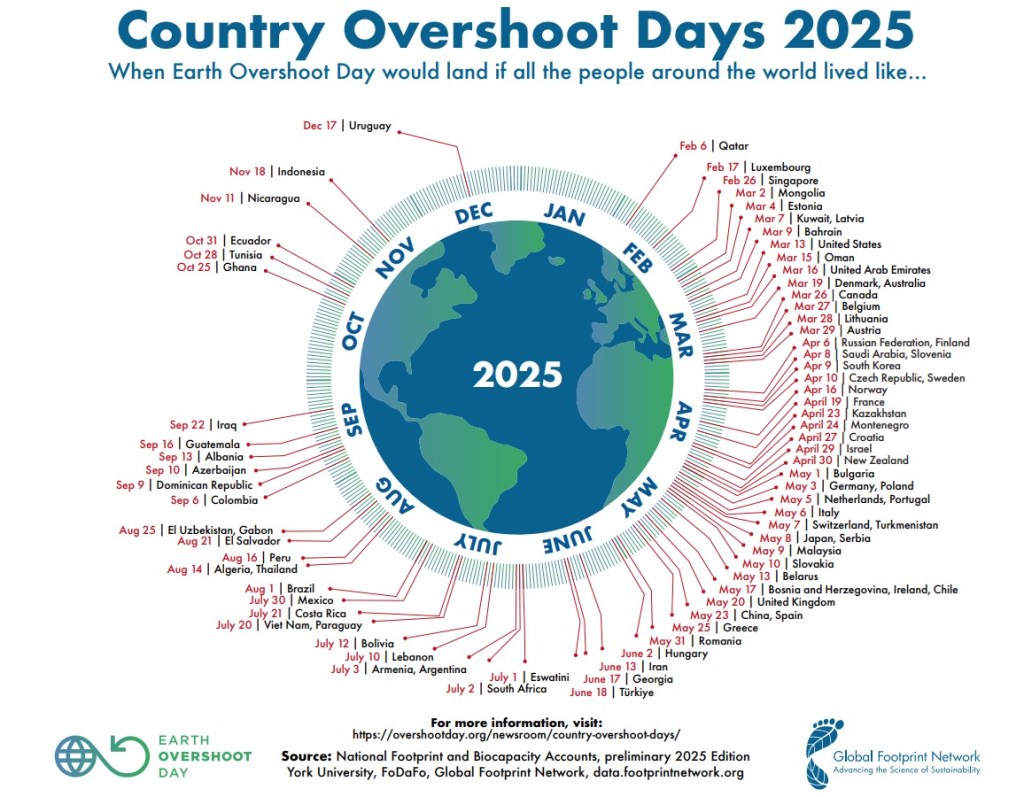
Every year the Global Footprint Network calculates the date by which humans will have consumed a year’s worth of the Earth’s resources. Further consumption after that date uses resources at a faster rate than by which they can be replenished – in other words for that remaining part of the year our consumption takes us beyond safe planetary boundaries.

This is a global calculation. Individual nations – and indeed individuals themselves – will be consuming at different rates. Specifically there are some nations who consume far more then others and will have consumed their share of the Earth’s resources much earlier than the global Earth overshoot day – eg Qatar, the USA, Belgium inter alia. Whilst there are other nations who consume far less and may not even consume their share of the Earth’s resources before the year’s end – eg Burundi and Bhutan. 

Clearly those nations who consume over and above the global average need to reduce their consumption, but would be enough if they reduced their consumption to that average?  Not really because those levels of consumption would only stay within the limits of our planetary boundaries if the poorer nations were content to continue to under consume. In reality those poorer nations should be able to benefit from the better living standards that accrue from having satisfactory levels of food, education, healthcare, sanitation, housing, transportation etc. 

Consumption levels for the richer nations need to fall substantially if everyone is to have a good standard of living. 

Counting on … 170

22nd October 2025

What are planetary boundaries? 

The following explanations, including reference to their current safe status or not, comes from the Stockholm Resilience Centre.  

Climate change: Increased greenhouse gases and aerosols in Earth’s atmosphere trap heat that would otherwise escape into space. The climate change planetary boundary assesses the change in the ratio of incoming and outgoing energy of the Earth. More carbon dioxide in the atmosphere and more trapped radiation causes global temperatures to rise and alters climate patterns. This boundary is transgressed, and CO2 concentrations are rising.

Novel entities: Technological developments introduce novel synthetic chemicals into the environment, mobilise materials in wholly new ways, modify the genetics of living organisms, and otherwise intervene in evolutionary processes and change the functioning of the Earth system. The amount of synthetic substances released into the environment without adequate safety testing places novel entities in the high-risk zone.

Stratospheric ozone depletion: Ozone high in the atmosphere protects life on Earth from incoming ultraviolet radiation. The thinning of the ozone layer, primarily due to human-made chemicals, allows more harmful UV radiation to reach Earth’s surface.  Total ozone is slowly recovering because of the international phasing-out of ozone-depleting substances since the late 1980s. Ozone depletion is therefore currently in the Safe Operating Space.

Atmospheric aerosol loading: Changes in airborne particles from human activities and natural sources influence the climate by altering temperature and precipitation patterns. Although large-scale air pollution already causes changes to monsoon systems, forest biomes and marine ecosystems, the global metric used in the planetary boundaries framework – interhemispheric difference in atmospheric aerosol loading – places this process just within the Safe Operating Space.

Ocean acidification: The acidity of ocean water increases (its pH decreases) as it absorbs atmospheric CO2. This process harms organisms that need calcium carbonate to make their shells or skeletons, impacting marine ecosystems, and it reduces the ocean’s efficiency in acting as a carbon sink. The 2025 Planetary Health Check showed that the Ocean Acidification boundary has been breached for the first time. Since the start of the industrial era, the ocean’s surface pH has fallen by around 0.1 units, a 30-40% increase in acidity, pushing marine ecosystems beyond safe limits and degrading the oceans’ ability to act as Earth’s stabiliser.

Modification of biogeochemical flows: Nutrient elements like nitrogen and phosphorus are crucial for supporting life and maintaining ecosystems. Industrial and agricultural processes disrupt natural cycles and modify the nutrient balance for living organisms. This boundary is transgressed, because both the global phosphorus flow into the ocean and the industrial fixation of nitrogen (converting stable nitrogen from the atmosphere into bioreactive forms) have disrupted global biogeochemical flows.

Freshwater change: The alteration of freshwater cycles, including rivers and soil moisture, impacts natural functions such as carbon sequestration and biodiversity, and can lead to shifts in precipitation levels. Human-induced disturbances of both blue water (e.g. rivers and lakes) and green water (i.e. soil moisture) have exceeded the planetary boundary.

Land system change: The transformation of natural landscapes, such as through deforestation and urbanization, disrupts habitats and biodiversity and diminishes ecological functions like carbon sequestration and moisture recycling. Globally, the remaining forest areas in tropical, boreal, and temperate biomes have fallen below safe levels.

Biosphere integrity: The diversity, extent, and health of living organisms and ecosystems affects the state of the planet by co-regulating the energy balance and chemical cycles on Earth. Disrupting biodiversity threatens this co-regulation and dynamic stability. Both the loss of genetic diversity and the decline in the functional integrity of the biosphere are outside safe levels.