Counting on … 177

31st October 2025

When I googled (using Ecosia) “How much single use plastic is bought for Halloween” the first response was from Amazon: “Buy Halloween Plastic: Shop Halloween Plastic Now”!!!

I’m sure it doesn’t occur to people as they decorate their homes with hazard tape, fake gossamer cobweb material, plastic bones and the like, that much (if not all) of this plastic is going to end up polluting the environment. 

Even as it hangs there, fluttering in the wind, it will be shedding micro-particles (especially the cobweb material that will likely snag on twigs), and gathered up and binned next week it will invariably end up in landfill where micro- and nano-plastic particles will leak into the air and the water system. En route bits of plastic will be blown away to ‘decorate’ tree and fences, or be ‘eaten’ by animals, or will wrap themselves in a stranglehold around other creatures.

Nor do I think it occurs to them how this sale and purchase of single use plastic feeds the profits of oil industries seeking to find ongoing markets for their lethal product. Nor do I think it occurs to them that many of these items will have been made in sweat shops in far distant parts of the world.

Green Tau: issue 117

16th October 2025

What are the problems with plastic? 

Is plastic simply a litter problem?

“Plastic is a useful everyday item but has grown to become a global problem. Every year the world produces over 460 million tonnes of plastic, 90% of  which pollutes almost all areas of our planet, it can be found at the bottom of the ocean, and on our tallest mountains. This pollution can cause harm to habitats and wildlife, impact livelihoods of people around the globe, and carries growing risks to human health. At the current rate, global plastic pollution could triple by 2040 unless we act now” – a quote from WWF. (1)

Could the answer be ‘more recycling’? 

Yet last week an article in the Guardian reported that “in the past two years 21 plastic recycling and processing factories across the UK have shut down due to the scale of exports, the cheap price of virgin plastic and an influx of cheap plastic from Asia, according to data gathered by industry insiders.” (2) The UK now exports 600,000 tonnes of used plastic – making it the third largest in the world. Rather than being recycled within the UK, this plastic ends up in countries with neither the infrastructure nor the legal safety constraints to ensure that it is recycled without injuring either the environment or the local populace. The plastic is typically  either burnt or allowed to build up in huge waste heaps where it invariably finds its way into rivers and oceans. Much of the UK’s plastic waste is exported to Turkey where, the Guardian reported two people are crushed, ripped, or burned to death in this work every month. 

A combination of legislation to end the export plastics waste and taxes to discourage the use of virgin instead of recycled plastic is clearly needed. Rather than letting them close, recycling facilities should be seems as essential parts of the UK’s infrastructure: “If we were to stop exporting plastic waste, and we were to meet our increased recycling target of a 65% recycling rate for municipal waste by 2035, we would need to build 40 new factories across the UK – 20 of them would be sorting facilities and 20 would be processing facilities turning the material back into products,” said an industry source.

Or could the answer be ‘make less plastic’?

Earlier this year, an international gathering sought to agree a global plastics treaty. Work on this treaty began back in 2022 when growing scientific evidence highlighted the risks posed to humans (and other living organisms) by the toxic chemicals that can leach out of plastic as it breaks down. The ambition was not merely to ensure higher levels of recycling, but to to curb in absolute terms the amount of plastic produced globally each year. Plastic production had risen from 2 million tonnes in 1950 to 475 tonnes in 2022. However the treaty was successfully opposed by the large oil-producing nations and members of trade associations representing plastic producers. (3) 

What if plastic pollution is a health problem too?

This week there was another newspaper article this time reporting on the spread of plastic into our bodies. “Microplastics have been found almost everywhere: in blood, placentas, lungs – even the human brain. One study estimated our cerebral organs alone may contain 5g of the stuff, or roughly a teaspoon.” (4)  

What are micro plastics and where do they come from?

Microplastics are fragments of plastic that is between 1 nanometer and 5 millimetres wide. They come from two main sources:-

  • plastics specifically manufactured as microbeads which are added to face ashes, shower bells and other personal care products – they make the liquid both smooth and  sufficiently thick that it does run off like water. Think of the difference say between an antiseptic hand spray and an antiseptic hand-gel. These are known as primary microplastics.
  • Plastic particles that derive from the disintegration of larger plastic items – eg plastic film and wrapping, takeaway containers, synthetic clothes , care tyres, paints and plastic turf etc.. These plastic particles may be shed as drinking from plastic bottles and take away cups (more plastic is shed when heat is present such as with hot drinks or microwaved food), from wearing and washing clothes, from friction between roads and tyres etc.  These are known as secondary microplastics. (5)

Both types of microplastic can pass into water systems, can be present in the air we breathe, and can pass into the food chain and so into the food we eat. Microplastics are to be found all over the world – from the hops of mountains to the depths of the oceans and everywhere in between. 

Nanoplastics are even smaller – less than 1,000 nanometers in diameter, or 100 times smaller than the diameter of a human hair. They are small enough to slip through the walls of the cells in our bodies and can be found in our blood, lungs, brains, bones, the placenta and breast milk. (6) 

Do these pieces of plastic harmful?

We don’t yet know whether having such buts of plastic in our bodies is good for us (unlikely), neutral or harmful. Nor do we know whether there is a limit below which they are not harmful but above which they might be. It is possible that they may aggravate complaints such as asthma, dementia, cardiovascular disease, cancers etc. (7) The issue is further complicated as plastics contain toxins such as bisphenols (BPA), alkyphenols, and phthalates and dioxins etc, which are also thus passing into our bodies. 

It is not just human bodies that maybe adversely affected. Micro and nanoplastics are already known to be adversely impacting the health wild life – eg damaging the gut biomes of seabirds, increasing the number of pathogens present and reducing antibiotic resistance.  (8) 

Should we panic? 

No. We don’t yet know enough to know how dangerous, or not, micro and nanoplastics are. We don’t know whether or not our bodies have a way of eliminating such particles from our bodies. And realistically there is no way we can avoid ingesting these particles given their presence in very part of the environment. 

In many instances using plastics can be lifesaving with benefits outweighing the – as yet unclear – disadvantages. For example the use of plastic syringes to give vaccines, plastic pipes to provide clean drinking water, plastic bags for collecting blood donations, waterproofing coats that keep us warm and dry.

But we could cut back on our use of plastic

 We can reduce our exposure to plastic particles by reducing the amount of unnecessary plastic we have around us and by adjusting how we use those plastics. For example we might use a reusable water bottle and a reusable cup when out and about (and often cafes give discounts when you bring your own take away cup). You might use glass or metal dishes for storing food and wax wraps or foil instead of cling film. You might use wooden spoons and chopping boards rather than plastic one; metal colanders and metal washing up bowls etc. Equally you might avoid body care products with microbeads and use solid or liquid alternatives. You could try a milk delivery service and get milk in glass bottles rather than plastic cartons. And following that line of thought, you may have a local refill store that allows you to buy various food ingredients and household items without the need for lots of plastic packaging. 

There are plenty of guides on line about switching to a plastic free life. eg https://friendsoftheearth.uk/plastics/living-without-plastic and some of my earlier blogs have explored this topic – https://greentau.org/tag/plastic-free/ and https://greentau.org/2022/01/27/eco-tips-zero-waste/

However we should remember that not everyone can afford the plastic alternatives – a metal drinks bottle can  cost more that a plastic one. A sliced loaf in a plastic bag will be cheaper than it paper wrapped alternative. 

What about changing the system?

If we are going to be fair for everyone and everything – wildlife, ecosystems, future generations, then the whole system needs to be changed. 

Nations need to agree on a workable plastics treaty that will cut the amount of plastic produced. The plastics industry needs to develop alternative safe and sustainable substitutes. Governments need to implement a combination of legislation, taxation and investment to ensure that the changes needed do actually happen.

We can advocate for change by supporting groups like Friends of the Earth and Greenpeace, and we can raise awareness about the issue by talking with others – particularly if they are intrigued about the efforts we are making to reduce our use of plastic! 

  1. https://www.wwf.org.uk/learn/environment/plastic-pollution
  2. https://www.theguardian.com/environment/2025/oct/09/britain-2bn-recycling-industry-export-plastic-waste
  3. https://www.bbc.co.uk/news/articles/cvgpddpldleo
  4.  https://www.theguardian.com/environment/2025/oct/12/plastic-inside-us-microplastics-reshaping-bodies-minds?CMP=Share_iOSApp_Other
  5.  https://www.unep.org/news-and-stories/story/everything-you-should-know-about-microplastics
  6.  https://ukhsa.blog.gov.uk/2025/03/12/nanoplastics-are-everywhere-what-is-the-health-impact-of-these-tiny-particles/
  7.  https://www.bbc.co.uk/future/article/20250723-how-do-the-microplastics-in-our-bodies-affect-our-health
  8.  https://www.nature.com/articles/s41559-023-02013-z

Counting on … day 127

8th  August 2025

We live in a time of global shortages as well as global overconsumption, so living with enough may involve re-examining what ‘enough’ looks like. 

Whilst  I can get all that my family needs, such as foods, clothes, shelter, medicine etc,  there are other people who cannot either access or afford these essentials. Should I reduce the amount  I think I need, to make more available  for others? 

Isn’t that the dilemma of Earth Overshoot Day? Here in the west in consuming what we ‘need’ for our comfortable lifestyles, we are doing so at the expense of other people, often those living in the global south. 

If for example, eating meat on a regular basis means we are ‘using’ agricultural land that could otherwise be used to grow food to better feed others or that could be better used to restore biodiversity and/ or store carbon, then should we not significantly reduce our consumption of meat? 

Enough becomes eating less meat.

As well as meat, we might consider reducing our western levels of consumption of electronic and electrical goods which use large proportions of limited resources  such as lithium and copper. These limited resources might be better used to meet the more pressing needs of others? (Or being left in the ground so as not to damage the environment).

Enough becomes consuming fewer electrical goods.

And might we also consider how much plastic we consume? Plastic use becomes yet one more reason for companies  to justify extracting more carbon-emitting oil from the ground. Plastic waste causes widespread pollution damaging both our own health and the environments of others across the globe.

Enough  becomes consuming less plastic – especially single use items and plastic packaging.

There are many such ways in which we can re-examine what enough looks like.

Counting on … day 102

4th July 2025

Fast fashion is as destructive of our environment as fast tech and is fuelled by many of the same features. Fast fashion is cheap (in terms of purchase price only – its lifetime cost is considerably more when factoring in disposal); its new and trendy and it – and its advertising – is designed to attract our attention; it’s intended to have a short life. 

Yet just like fast tech, fast fashion produced vast amounts of waste that cannot easily be recycled. And like fast tech, a lot of the materials used in production are plastic based (ie synthetic fibres, plastic zips etc). Instead discarded clothing ends in landfill sites, in incinerators, clogging up oceans, and strewn across deserts. 

Again we need to ask ourselves: Do I need this item of clothing? Should I buy the cheapest, or should I look for the durable, repairable option? Will I value it?

And we also need to ask questions about the system that allows so many cheap (and not so cheap) items of clothing to be produced and as quickly discarded. Does the fashion industry  need to be held to accountable? Should manufacturers also be responsible for end of life disposal or recycling of garments? Should manufacturers be reviewing how much plastic goes into their garments? And on a related issue, should manufacturers be reviewing how much they pay those who actually do the making?  Cheap products are often cheap because wages are cheap.

Further reading –

Counting on … day 100

2nd July 2025

Plastic recycling is now much more common place, with local authorities making collections of certain frequently used items such as plastic bottles, margerine and other food tubs, shampoo bottles etc. Soft plastics can be recycled if they are kept separate from more rigid plastics – and some supermarkets have collection points for these. However there is, apparently, no guarantee that plastics going into a recycling bin will be recycled (sometimes it is cheaper and easier to incinerate the waste which causes air pollution). Nor are there many effective closed loop recycling programmes – each a system where a plastic bottle, for example, is recycled and returns as a ready to use plastic bottle. It is often cheaper to make a plastic bottle from virgin oil based polymers than from recycled plastic. 

These problems are a further incentive for us to reduce the plastic we use so rescuing the problem at source. If we don’t buy things that come in  plastic bottles, plastic tubs and tubes, in plastic wrappers etc then we reduce the amount of plastic that is in circulation before it becomes a problem. 

Further reading –

Counting on … day 101

3rdJuly 2025

Plastic waste pollution doesn’t just come from single use items; it also comes from ‘fast tech’ – cheap plastic-encased electronic items that whilst not single use are quickly discarded. Eg hand held fans, electric toothbrushes, mini torches, fairy lights, head phones and ear buds. (1)

Conventional thinking goes:-

Being cheap we don’t worry of it breaks – we just throw it in the bin (from where it will go to landfill)

Being cheap we buy it as a fun gift whether it’s needed or not.

Being cheap we don’t worry about buying another if we forgot to pack it.

Being cheap, well discard last year’s model because this year’s looks so much nicer.

Being cheap we don’t try and look after it or to mend it if it breaks.

The problem of plastic pollution needs us to ask: Do I need this product? Should I buy the cheapest, or should I look for the durable, repairable option? Will I value this product?

(1) https://www.theguardian.com/commentisfree/2021/aug/02/throwaway-culture-products-repair-reuse-recycle-obsolete?CMP=Share_iOSApp_Other

Counting on … day 222

26th November 2024

Is it possible to adopt a zero plastic lifestyle?

As with oil and gas, much of our economy is tied into the use of plastics – plastic has very many useful characteristics being light weight,  mouldable, waterproof, rustproof etc. To avoid plastic is therefore difficult – it is used in making shoes and clothes, household goods, toys, medical equipment, plumbing pipe etc. But there was a time when we didn’t have plastics but still made useful things, and we have many chemists and engineers who are developing plastic alternatives whilst retaining many of the advantages of plastic.

What we can do is to make a conscious effort to avoid plastic wherever possible. We don’t need to buy sweets or sandwiches or vegetables wrapped in plastic. We don’t need to buy plastic toothbrushes or combs or washing up bowls. We don’t need to use plastic cups and bottles. 

And whilst plastic recycling isn’t the answer, whilst we still have plastic in circulation, reusing what we already have (and keeping it in good condition) and recycling what we don’t need, is still a good thing to do. 

Counting on … day 101

7th May 2024

Plastic is such an invasive pollutant. A few years ago we kept a tally over a week of how much plastic was coming into the house and then worked out whether there were ways of avoiding such plastic in the future. Sometimes the solution was simple – not putting fruit in a plastic bag at the supermarket. Sometimes it needed a little more research – finding a toilet paper that didn’t come wrapped in plastic (we now buy recycled paper toilet roll from Naked Sprout, a B Corp, which comes in a cardboard box). 

More importantly the solution was a change in attitude – don’t buy it if it’s wrapped in plastic whether it’s a cake in the cafe or a pen in the stationers. And of habit – taking a keep cup or refillable water bottle when out and about. 

We’re not plastic totally free – my husband enjoys sliced supermarket bread and even vegan butter and margarine come in plastic packaging. During the Big Plastic Count we totalled 6 pieces of plastic.

Further reading –

https://friendsoftheearth.uk/plastics/living-without-plastic

https://www.plasticfreejuly.org/ (an international campaign that originated in Australia)

If you’re have a strong community link – https://plasticfree.org.uk/2022/01/28/plastic-free-communities-impact-report/

And if you want to find another way of reducing plastic this campaign is about reducing financial support for the plastics industry – https://justmoney.org.uk/speak-out/dont-bank-on-plastics/

Counting on …day 1.114

18th May 2023

The United Nations Environment Programme is called on all countries to reduce their plastic consumption by 80% by 2040. Plastics are problem items because they are made from oil and thus come with an inbuilt unsustainable carbon footprint, and because much of the plastic is not recycled and instead causes pollution – especially in marine areas.

To cut our use of plastics, we will need to cut our dependency on plastic packaging. Our local cafe which also has its own coffee roasting business now supplies beans packaging free. The beans are stored in silos and you simply decant them into your own container (the cafe also sell reusable tins). Simple!

Green Tau: issue 50

1st September 2022

There is no ‘away’ in a throw-away society 

We can go away on holiday to the sea side, to the mountains, to a tropical islands or a city of culture. We take away 3 from 5, or 99 from 100, and get a number. When we look away, we look in the  opposite direction. But where is away on a throw-away society?

It is said that if Henry VIII had had a plastic toothbrush it would still exist today – plastics take

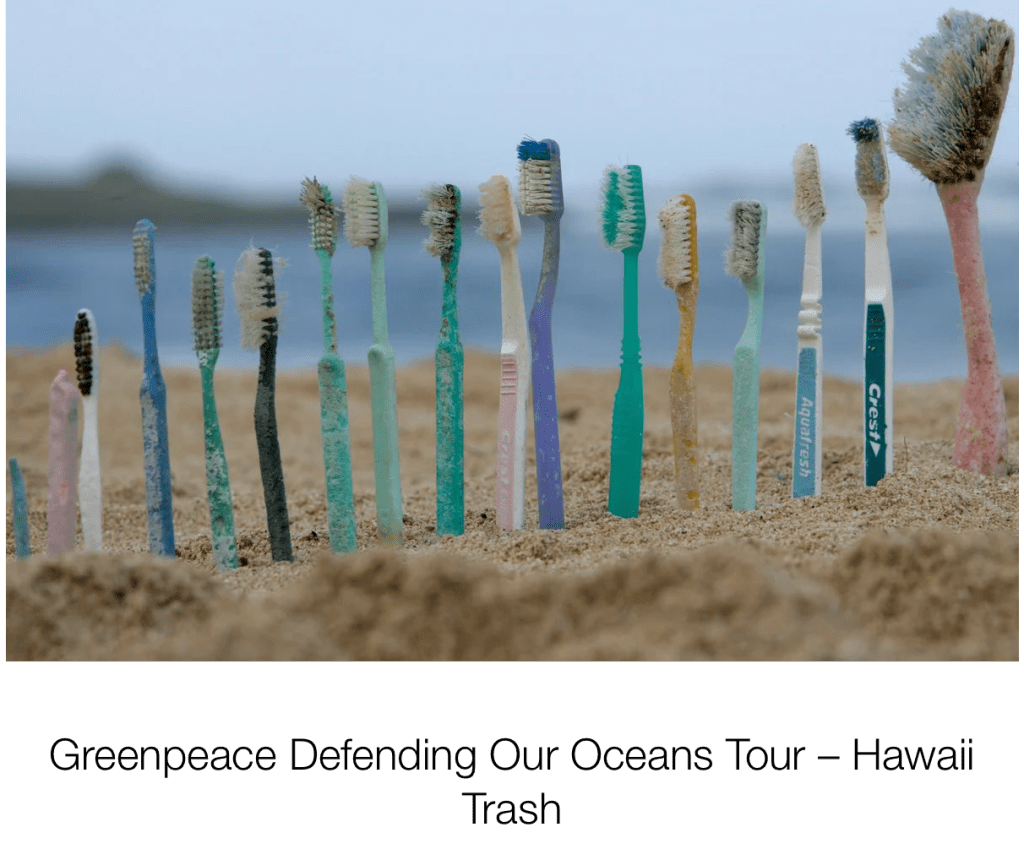
400-500 years to biodegrade. In the UK we throw away in excess of 200 million toothbrushes every year. These end up in landfill, incinerators or in the ocean. As they degrade they release toxins into the water or – in the case of the incinerator – into the air. 

Plastic waste is a global issue even though most of it originates in the developed world. As plastic degrades it breaks into smaller and smaller pieces. These end up in the digestive systems of various creatures, but especially so in sea creatures, in the ice on remote mountains, and in the water we all drinks. Plastic particles can even transfer from mother to foetus through the placenta.  You cannot throw plastic away. It always goes somewhere!  There is nowhere where it can be ‘away’ from us. 

Terracycle and Colgate together offer a recycling scheme for plastic toothbrushes,  toothpaste tubes and caps, floss containers and packaging and electric toothbrush heads. So for any plastic toothbrushes etc that you are currently using, there is at least one means of ensuring that the ‘away’ to which they go is to be recycled into another product rather than polluting the environment meant. Colgate also sells a toothbrush made from 100% recycled plastic with 100% plant-based nylon bristles which maybe helping to close the loop on this product. Hopefully we can all act now – whether by using a recycled or a bamboo toothbrush – to prevent this ‘mound’ of ex-toothbrushes from continuing to grow 

One of the easiest plastics to recycle is PET (polyethylene terephthalate) which is the type of plastic used to make drinks bottles – type 1 plastic as marked inside the recycle triangle. This can be recycled to create another plastic bottle – an rPET bottle. You may be able to find rPET bottles used for Buxton Spa and Evian water and for Coca Cola but most bottles are still made from virgin PET. (PET plastic cannot be recycled indefinitely without the addition of a proportion of new plastic resin so recycling isn’t the complete answer).

It is estimated that an average of 35.8 million plastic bottles are used every day in the UK, but only 19.8 million are recycled (https://www.recyclenow.com/recycle-an-item/plastic-bottles). For a little more than half of PET bottles, ‘away’ means a new life as recycled plastic, but for the remainder ‘away’ may still be landfill, the incinerator or the ocean. 

For other plastics the recycling rates are not as rosey. HDPE plastic – high density poly ethylene – is widely used for plastic bags, milk bottles, shampoo and laundry bottles etc. Whilst it can be recycled into more bottles, drain pipes, plastic sheeting etc, only 12% of all plastic bags are recycled and 28% of milk and water bottles are recycled (https://www.plasticexpert.co.uk/plastic-recycling/hdpe-plastic-recycling/). 

Other plastics are even less likely to be recycled. Polystyrene for example – whilst it can be recycled, there are very few recycling plants (apparently there is one in Cardiff but none in London!) and no kerb side collections. Other plastics can be hard to recycle because they are a composite of several materials which are hard to separate – this has long been the case with coffee cups made from paper and lined with polythene. There are now an increasing number of recycling facilities for such cups. An optimistic estimate suggests that 1 in 25 disposable coffee cups are recycled (https://www.recycling-magazine.com/2019/10/01/reducing-coffee-waste/). But for most coffee cups ‘away’ means landfill, incinerator or the ocean.

Despite all these health threatening ‘aways’ which is where waste most plastic goes, we are still producing more and more new plastic every year. According to the OECD global plastics production doubled between 2000 to 2019 to reach 460 million tonnes. Much of this is used for packaging (146 million tonnes in 2015 (https://ourworldindata.org/grapher/plastic-production-by-sector)

It is a scary thought that there is no real ‘away’ where we can throw what we wish to discard. What happens to all the shoes, the clothes, the half empty paint tins and paint brushes, the punctured inner tubes and bike tyres, car tyres, shower curtains, kitchen sinks, soft toys, the leaky hot water bottle etc that we will throw throw away during our life times. Sometimes there be recycling options but not always and even then one wonders what the end product is. We have a foam mattress bought when we were first married. It is probably coming near to the end of its useful life as a mattress but I do not think there is any safe ‘away’ where we can send it. Were we buying that same mattress now I know we think and choose differently. 

Whenever we acquire new things, we need to consider what will be its destination when it is has ceased to be useful in its current formation. Can this pair of trainers be recycled even though it comprises several materials? Will it just end up as road fill? Can this polyester running shirt be recycled into a new shirt? Can this iron/ kettle/ printer be recycled, its metal,and plastic parts separated and reprocessed? 

Should this be solely our responsibility as consumers? The Extended Producer Responsibility is an approach that says that the manufacture must take on responsibility for their products when they re@ch their end of life. This would refurbishing and/ or recycling the product. Placing the responsibility manufacturer should encourage more sustainable designs and manufacturing processes.  Such policies are slowly be introduced in a number of countries. As a result of current legislation European manufacturers, including British ones, are responsible for taking back and recycling in all batteries, and waste electronics and electrical equipment – The Waste Electrical and Electronic Equipment Directive is the European Community Directive or WEEE. 

I am hoping that such a scheme will be introduced for mattresses (and applied retroactively)