Counting on … day 49

2nd January 2022

Winter is a time for pruning various plants including apple and pear trees. Pruning helps them stay healthy and concentrates the plant’s energy for the coming year. It also helps maintain a manageable shape.  Traditionally this accompanied by wassailing – blessing the trees and making loud cheerful music to re awaken them so that they would produce plenty of fruit. 

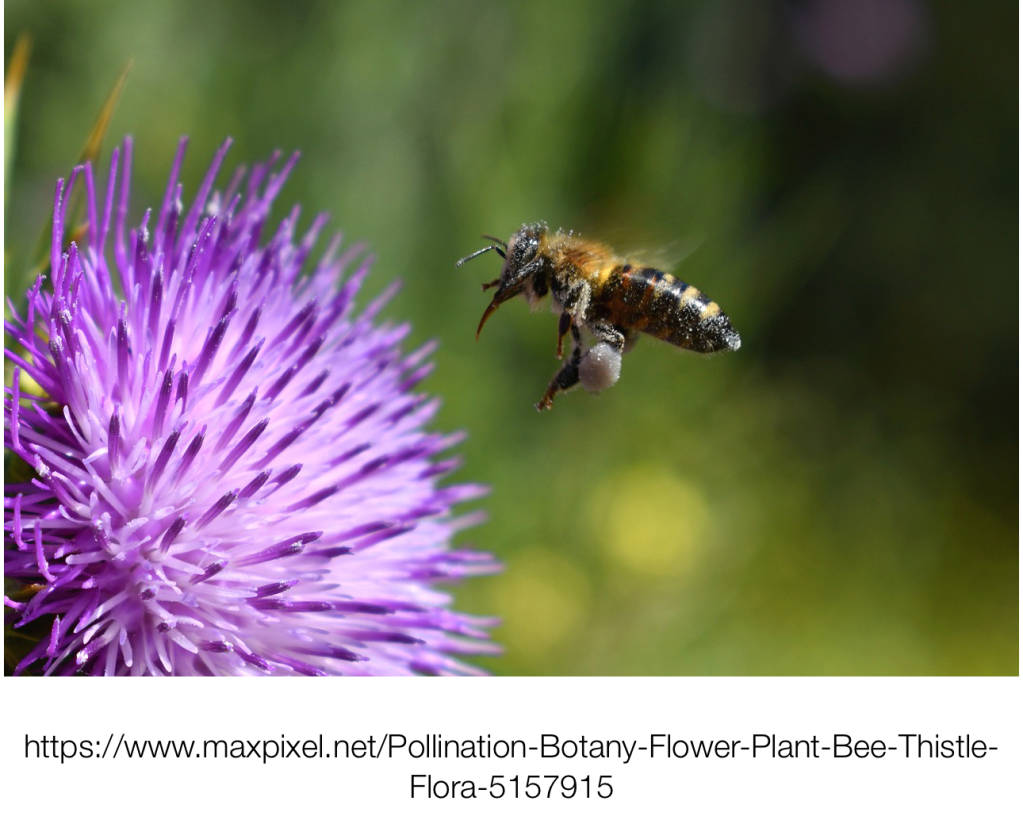
It is a good reminder that we do count on the fertility of fruit trees and their successful pollination by  bees and other insects to ensure a rich and varied diet.


Fourth Sunday of Advent

19th December 2021

Micah 5:2-5a

You, O Bethlehem of Ephrathah,
who are one of the little clans of Judah,

from you shall come forth for me
one who is to rule in Israel,

whose origin is from of old,
from ancient days.

Therefore he shall give them up until the time
when she who is in labor has brought forth;

then the rest of his kindred shall return
to the people of Israel.

And he shall stand and feed his flock in the strength of the Lord,
in the majesty of the name of the Lord his God.

And they shall live secure, for now he shall be great
to the ends of the earth;

and he shall be the one of peace.

Canticle: The Magnificat, Luke 1:46-55

My soul proclaims the greatness of the Lord,

my spirit rejoices in God my Savior; *
for he has looked with favour on his lowly servant.

From this day all generations will call me blessed: *
the Almighty has done great things for me, and holy is his Name.

He has mercy on those who fear him *
in every generation.

He has shown the strength of his arm, *
he has scattered the proud in their conceit.

He has cast down the mighty from their thrones, *
and has lifted up the lowly.

He has filled the hungry with good things, *
and the rich he has sent away empty.

He has come to the help of his servant Israel, *
for he has remembered his promise of mercy,

The promise he made to our fathers, *
to Abraham and his children for ever.

Hebrews 10:5-10

When Christ came into the world, he said,

“Sacrifices and offerings you have not desired,
but a body you have prepared for me;

in burnt offerings and sin offerings
you have taken no pleasure.

Then I said, ‘See, God, I have come to do your will, O God’
(in the scroll of the book it is written of me).”

When he said above, “You have neither desired nor taken pleasure in sacrifices and offerings and burnt offerings and sin offerings” (these are offered according to the law), then he added, “See, I have come to do your will.” He abolishes the first in order to establish the second. And it is by God’s will that we have been sanctified through the offering of the body of Jesus Christ once for all.

Luke 1:39-45

In those days Mary set out and went with haste to a Judean town in the hill country, where she entered the house of Zechariah and greeted Elizabeth.

When Elizabeth heard Mary’s greeting, the child leaped in her womb. And Elizabeth was filled with the Holy Spirit and exclaimed with a loud cry, “Blessed are you among women, and blessed is the fruit of your womb. And why has this happened to me, that the mother of my Lord comes to me? For as soon as I heard the sound of your greeting, the child in my womb leaped for joy. And blessed is she who believed that there would be a fulfilment of what was spoken to her by the Lord.”

Reflection 

The prophet Micah describes the Bethlehem as one of the smallest of the clans of Judah – as if each town in the lands belonging  to Judah was a subset – or in terms of the Scottish clan system, a ‘sept’ – of the tribe of Judah. This would for example make Joseph, who was a of the tribe of Judah, a member of the  sept of Bethlehem being his home town. 

God’s chosen one, says Micah, will come from this little clan – we might thus describe him as  one of the little people. But despite this, he will establish his rule and will bring together all his fellows – all the other little people – and, shepherd-like, feed them. And for feed, we might understand this to be not just with food but with the all that will sustain them. And  who are these  little people? Those whose work is often overlooked, who do not wield power  or influence, those who are not valued, who are seen as dispensable – labourers and factory workers, carers and shop staff, those with mental or physical disabilities,  those who are homeless, jobless, stateless , and children especially those from poor backgrounds. And there are others who are also ‘little people’. Those who are humble, self deprecating, those who are child-like and transparent, those who do not boss others around, who do not think they have an inherent superiority or importance, those who willingly relinquish power and wealth. These are the little people that Christ comes for, these are the ones he calls to be his people, his sheep. 

And it seems to me, that anyone can become a little person. For we can all become child-like, become humble and open, we can all let go of power and wealth, of our sense of status and self importance. 

And when everyone becomes a little person, then will we have peace! 

The Magnificat reminds us that Mary was one of the little people. A woman – not even with the status of being a wife, a young person with no special status, a resident of Nazareth (a not very important place).. Someone who could describe themselves as a lowly  servant, but equally sufficiently honest to see that in God eyes they were important. In this paean, Mary understands that God plans for the ‘big’ people – those who are self important, proud, privileged, powerful, the rich, those indifferent to others – to be transformed – reformed – as little people. And this is how the hungry will be fed. This is how God’s will from the beginning of time is to be fulfilled. 

We have only to look around the world and see that if all the ‘big’ people became little people, then there would be food and resources for everyone. Will this happen this Christmas? 

The writer of Hebrews tells us that Christ was not to be the recipient of sacrifices and burnt offerings, but to be the recipient of a body. The human body is a gift we have all been given, from Adam onwards. It is a gift to be treasured and to be used aright: ‘See, God, I have come to do your will, O God’ says Christ. This response echoes that of Mary – ‘let it be to me according to your word.’- and contrary to Adam’s ignoring of God’s will. We too are invited to respond like Mary, like Christ,  and to offer ourselves – in our bodies – to be incarnate doers of God’s will. The writer of Hebrews further reminds us, that as Christ has shared our humanity, so our bodies too have been made holy. 

And in the passage from Luke’s gospel, we hear how Christ in the process of becoming full  incarnate –  a growing embryo in Mary’s womb. – is already transforming the world. The unborn John leaps in Elizabeth’s womb – just as I am sure, Elizabeth too leapt, if not physically, then metaphorically, recognising intuitively the astounding fact of God’s presence with them in human form. Will we leap with joy this Christmas as once again we re-member that God is present with us in our human body?

Counting On … day 23

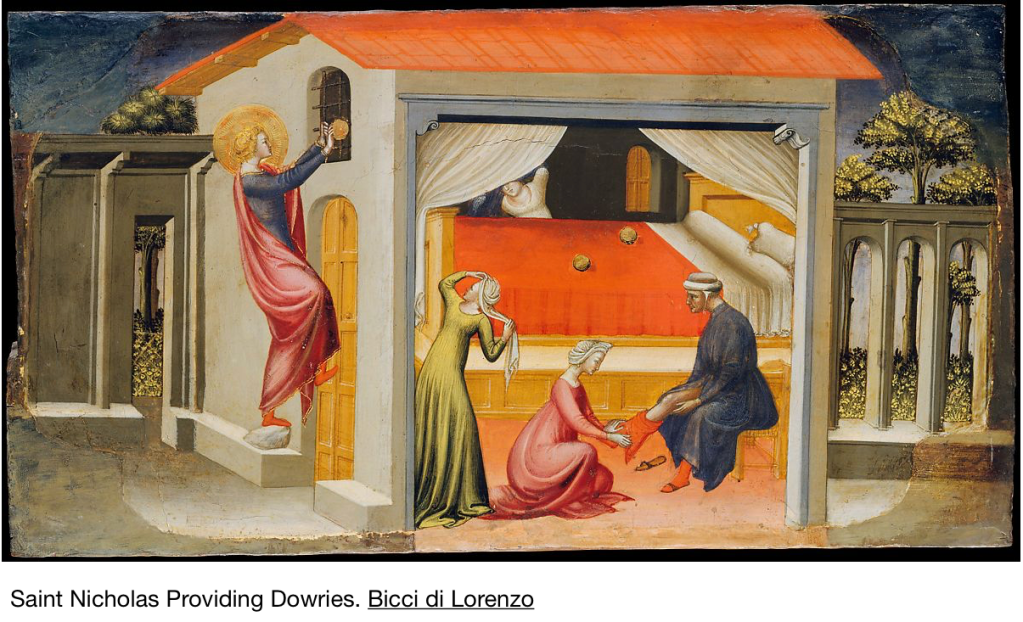
In the last people were often reliant for their survival on the generosity of others. The young man, who became St Nicholas, lost both his parents due to a plague. Maybe he realised that money itself was not a guaranteed source of security. Instead he turned to the advice of Jesus and sold his inheritance and gave the proceeds to those in need. One such recipient was a poor widower with three unmarried daughters. With no money, he could not afford dowries nor could he afford to look after them. The remaining option was slavery. Nicholas came under cover of dark and threw three bags of money through the window of their house, and saved the family from destitution. 

Some 1700 years later and people still find themselves trapped in poverty and needing to count on the generosity of others. This time of year many charities that provide relief look to us for funds.  
A gift secretly given, needing no receipt.

A gift freely bestowed -no strings attached

A gift that meets your needs, no questions asked, 

nor application forms to fill

A gift to free your children from poverty

A gift to restore – not diminish – your pride

A gift you do not have to earn.

St Nicholas’s gift.

 Counting On …. Day 13

26th November 2021

Today is the feast day of St. Egelwine, a 7th century prince who became a hermit and lived in Athelney. He was noted for his prayerfulness. 

Today apparently is also Cake Day. Combine the two: bake a cake and then take some time out to sit quietly and appreciate the calm of not being drawn into the commercial whirl wind of Black Friday.

Counting On …. Day 9

22nd November 2021

Eco Church recommends creating a communal Christmas card scheme. Rather than each person sending a card to everyone else, individuals write one Christmas card to everyone! This is then posted on a communal notice board in church.

From the Wallingford Benefice notices: “ Christmas Card Scheme – A big thank you for your positive response to our communal Christmas card scheme this year. There were over 40 cards sent in total and displayed in the nave of St Mary’s, the ringing chamber and choir vestry. Assuming each person who took part would have sent 15 cards this means we have saved in the region of 600 cards! A great result for our environment. Would anybody like to reuse the Christmas cards and create gift tags for next year? Or perhaps you can think of a more creative ‘reuse’ option for our communal Christmas cards!”

Skip and Skitter

Now is the sky blue!

Now is it framed 

by a fretwork of branches 

where leaves still linger –

some as big as dinner plates 

some as small as butterflies. 

Jackdaws riddle the earth 

harvesting riches that lay below.

And squirrels skip and skitter 

their autumn dance.

All is now, and now, and now!

But tomorrow, next week, next year? 

Merciful God will they still be there?

Will our apathy, 

our slowness to act, 

our aversion to change 

allowed all this 

to be threatened, 

diminished, and 

evicted from life?

Have mercy.

But not just mercy –

rather prod us, prompt us, 

push us into action.

Renew our hearts and minds,

reverse our expectations

so that we change the future 

and once more 

be restorers of creation.

Amen. 

This prayer or psalm gives a seasonal update to one written in the summer

Counting On …

3rd November 2021

The topic for COP26 today is finance. 

In order to tackle climate change finance is needed, both state and private finance. This comes in the form of investment needed to facilitate the transfer from carbon-based to green technologies, and to train those who will work in these new industries; to transfer from animal based agriculture to plant based agriculture, and from a meat and diary based food industry to a plant based food industry; the need to invest in restoring, enlarging and maintaining  carbon sequestering land and seascapes; the need to adapt existing and build new infrastructure to cope with the changes in climate that are already happening such as flooding and heat waves, including paying for those individuals and groups who cannot afford to pay for these adaptions themselves; to develop the new systems and infrastructure needed to cope with the future changes in the climate which have already been locked into world and which may increase if global temperatures rise significantly above the current 1C increase.  

Poorer countries and small island states are in particular need of support from affluent countries like ours. The intention – although not yet the fact – is that developed nations will be supplying $1 billion to finance support for these more vulnerable nations. 

Counting On …day 394

1st December 2022

Collage: The Kinship of Creation

Kinship of all creation: we are all interconnected, dependant upon each other, bound into a finely wrought ecosystem that abounds in beauty. Pray that the interests of all our kindred will be valued and protected.

Climate change is affecting all parts of the world, from the Artic southwards. it affects people, plants and creatures alike.

Reindeer herd, Canada © Peter Ewins / WWF-Canada  

Reindeer numbers across the Arctic have fallen by more than half in the past two decades. They survive by migrating to find food, using their hooves to dig through the snow to eat the nutritious lichen buried underneath. But climate change means herds must swim across previously frozen rivers and many young calves drown – and rising temperatures mean more rain, covering plants with ice instead of snow, making grazing harder.
https://www.wwf.org.uk/updates/11-arctic-species-affected-climate-change

://www.wwf.org.uk/updates/11-arctic-species-affected-climate-chang

And from The Guardian: 30 Oct 2021, Gennadiy Shukin Taymyr, north Russia

I was born in 1962 in a family of deer herders in Taymyr, on a peninsula in the very far north of Russia. I am part of the Dolgan community: we are an indigenous Russian group and there are about 6,000 left of us living in the tundra.

Growing up, the Soviet Union tried to deny us our traditional way of life, but since then climate change has become the biggest challenge to our survival. Our community lives by hunting, fishing and herding deer. Scientists say that Taymyr has the most rapid temperature increase in Russia, and we can really feel it.

Because of the warmer winters, we have seen that deer are giving birth earlier in the year. Many are born too weak and don’t survive the long journeys they have to make. This means there is much less deer for us to hunt and it hurts the whole ecosystem.

Rivers and lakes that we use for fishing have also started to dry out. Others are too polluted after all the big oil and gas plants have sprung up over the years in our lands. Some days we don’t catch any fish at all.

For generations, we have sold the food we caught to local towns and cities to buy basic products like sugar and wheat. Without animals, we cannot survive.

Big craters are also forming because the Arctic permafrost is starting to melt under our feet. This means the routes that we have used for decades to travel, hunt and fish have to be adjusted as whole roads have sunk. It is also dangerous as you never know where the next crater will form.

Our ecosystem is changing quickly: animals like sables that I have never seen before in my life have appeared in the tundra. And now we also have to deal with giant mosquitoes and bugs that attack our livestock. The summers are becoming unbearable. It’s madness.

The young people see that climate change is making our traditional way of life impossible and they are forced to move to the bigger cities to find jobs, which are often low-paid. Our culture is disappearing.

https://www.pressreader.com/uk/the-guardian-supplement/20211030/281732682701562

Count Down

Action 99: Pray. Green Christian’s co-Chaplain, Andrew Norman, will be leading simple and contemplative-style prayers for 10 minutes at 8am every morning from 1-12 November, based on “Why Faith Matters at COP26”.

+ Register for zoom prayers for COP26 +

(https://us02web.zoom.us/meeting/register/tZApcuugqDovHdzejfpqPLtc1ZZEfOVVy_gm%20)

This is the last of the Count Down series! For the next two weeks there will be a daily image and prayer relating to the COP26 agenda, ‘Counting On …’

Sunday Reflection

31st October 2021, 4th before Advent

Deuteronomy 6:1-9 https://bible.oremus.org/?ql=502594426 Hebrews 9:11-14 https://bible.oremus.org/?ql=502594518 Mark 12:28-34 https://bible.oremus.org/?ql=502594610

Reflection 

The text of Deuteronomy offers the people a quid pro quo: if you obey this command, then your days will be long, all will go well with you and you will multiply – ie dwell in growing number – in a land flowing with milk and honey. Wow! Who would not want that?

And what is the the qualifying command? That you love God with your total being, with the totality of your existence. The lawyerly minded might then ask for clarification: what is it to love God? For the writer of Deuteronomy, the answer has already been given. It is to keep all God’s statutes and ordinances which Deuteronomy details. To love God is to do that which God wants, to live life the way God directs. There is a great simplicity and logic in this. It is what one might expect when we read the creation stories, for they tell us that God created a world that was good, which was full of life and which was created so that that life in all its forms might multiply and flourish. To live in harmony in such a creation is surely to live in accordance with the creator’s intentions. 

Yet the fact that something is highly desirable and is straightforward to achieve, doesn’t necessarily mean that is what will happen. We know from reading the rest of the Bible that the people of Israel had great difficulty in sticking to following the ways of God. And we can clearly see when we look around the world now and see suffering, war, greed, destruction, deceit … that humanity still finds this a hard task. 

The Letter to the Hebrews uses much of the imagery and ideas of the Pentateuch, envisaging Jesus as the ultimate high priest – the one who mediates between humans (and indeed not just humans but creation too as we will see later) and God. The writer describes Jesus as the high priest of ‘the good things that have come’. Again the message that what God is and does give us, is good! He is also the high priest who, through his own death, has redeemed us for all ‘dead works’ so that we can worship the living God. Again a message that picks up the same message as that in Deuteronomy:  the desire that we should be in tune with God. To worship is to recognise the worth God, to offer our understanding of God’s nature. Jesus enables us to worship God not only because he embodies the nature of God in human form, but also because he redeems us from ‘dead works’: those things that come between us and God and between us and the rest of creation – those things that lead to suffering, war, greed, destruction, deceit. Jesus both aids our relationship with God and the resulting enjoyment of what is good in the world, and removes those stumbling blocks that damage that relationship. 

The passage from Mark continues on the theme of the kingdom of God and how one might access it. (A few weeks ago we heard of the rich man whose love of his wealth impeded his access). In today’s episode, the dialogue between the scribe and Jesus probe what  is involved in coming close to – and entering – the kingdom of heaven. The answer is two fold: loving God and loving neighbour. If we were to return to the creation stories, and in particular that set in the Garden of Eden, we would see that these as the subtext of that story. Whilst Adam and Eve and their companions – all the creatures God had created and which Adam had named – followed that two fold lifestyle, they enjoyed the fruitful life in the Garden. And maybe that too was a land flowing with milk and honey. But when they all respectively failed to love God and their neighbours, their companions, they found themselves living in a place of hardship and pain and enmity. 

And isn’t that still where we find ourselves today? As the delegates gather for COP26 and all the non delegates arrive in person or via zoom, we come to a crunch point in the wellbeing of the world. Over the decades and indeed the centuries, we have not loved our fellow neighbours, both our human brothers and sisters, and our creaturely brothers and sisters. We have not loved our common home but have allowed greed and cruelty, envy and ignorance to damage and despoil the land where we live. 

Let us pray earnestly that our global leaders will make the right decisions. Equally let us pray that we too as responsible individuals will do all we can to live penitent lives, truly loving God and neighbour  with all our being.