Amnesty defines nonviolent direct action as actions that do not make use of physical force against an individual, do not cause others to fear the immediate use of violence, nor advocate violence of discrimination. NVDA is an umbrella term that includes civil disobedience as well as activities… [such as] letter writing and collecting petition signatures, to rallies, demonstrations and media stunts, and extending to higher risk activities such as banner drops [&] sit-ins…” (1)
People typically turn to NVDA when they feel that they are not being listened to, that the response being taken is too slow, or to raise awareness about an issue. This is particularly true of the climate crisis where activists feel that the actions being taken by businesses, organisations and governments are not sufficient in response to the scale of the threat. In the past NVDA has been used by the suffragettes and the suffragists, by civil rights groups, by anti nuclear protesters and by the anti apartheid movement, to name but a few.
A frequent comment addressed to activists is, that rather than disrupting the public by walking down a road or blockading an oil refinery, they should use the ballot box to effect the change they want to see. But is that possible? Does our democracy pay attention to us as citizens?
I frequently write to my MP about issues such as the CAN Bill and the Rosebank oil field, asking her to support the former and oppose the latter. But mine is only a small voice amongst many, and even though in principal she does support the CAN Bill, that has not been enough to see the Bill pass into law – it was widely opposed by the Labour Party.
Many people voted for the Labour Party in 2024 and the party won a substantial majority. In their manifesto Labour’s biggest spending commitment was to be an additional £23.7bn for green measures (a figure already cut back from an earlier promise of £28bn a year). Once in government that sum has been cut back again and again. For example the £13.2bn to be spent on upgrading the nation’s homes will now include £5bn of loans nor grants. And of the £8bn pledged for GB Energy, £2.5bn is in now going into Great British Nuclear (conveniently renamed GB Energy – Nuclear). (1) Manifesto promises are not binding: they may suggest the sort of things the party will pursue when in power but that is all. As individual voters our only remedy is to write to our MP or the relevant minister and ask that they adhere to their promises – or to take protest action! Otherwise we just have to wait another five years and hope the then government will be better at delivering on its promises.
So who does influence government policy?
Think tanks
Think tanks “are open organisations, built around a permanent base of researchers or experts, whose mission, on the one hand, is to develop analyses, summaries and ideas on an objective basis with a view to inform the conduct of private or public strategies in the general interest; on the other hand, to actively debate issues within their field of competence.” (2) Think tanks may be funded by private or charitable donations or from government funds. Some are transparent about their funding, others less so. Some are aligned to particular political parties, others are apolitical.
Based on research for the period 2015-2021, Overton identified the following as possibly the top ten think tanks cited in government policy documents. (3)
However there are caveats. Does measuring which think tank is most cited in government documents a good indicator of their ability to influence government policy? Some areas of policy making generates a higher proportion of publicly available documents – eg public health and welfare, whilst others – such as defence – do not. And you can’t count the number of citations in a document you can’t access. There will also be think tanks that have considerable influence but don’t produce reports that are cited. Not present in Overton’s list are think tanks such as the Institute of Economic Affairs and the Adam Smith Institute yet thwir ideas featured large during Liz Truss’s short term as prime minister.(4) One of the questions around the more extreme right wing think tanks is the source of their funds and to what extent their research is influenced by wealthy individuals. (5)
Certainly think tanks do influence government policy but they are not accountable to the ballot box.
Economists
Economists and economic theories certainly influence government policy making, either because the respective political party has grown up with a particular economic tradition or because its current leader and/ chancellor has a favourite economic model. Most think tanks will include economic analysis too. NB If you have read Kate Raworth’s book on Doughnut Economics, you may well question the value of much other advice that comes from traditional and neo-liberal economists.
Scientists
Scientists do advise governments especially in the area of climate change and biodiversity loss – eg members of the Climate Change Committee – and areas of health such as we saw during Covid when the Chief Medical Officer, Chris Whitty, who was directly advising the government. However, as Whitty later reported, his advice was then adjusted by the political agenda: “… he had been personally sceptical about making covid vaccination a condition of employment for some healthcare staff in England. He said that the policy was “100% a political decision” that was essentially about balancing two risks and rights against one another: “the risk to the person who is being cared for versus the risk to the individual that their right to essentially not have a medical procedure, or lose their job, is protected.” As a doctor, he argued that there was “a big difference” between a “professional responsibility” to protect patients from giving them communicable diseases, including vaccinating staff, and “legally mandating it so that you lose your job if not.”” (6)
Scientists who contribute to the work of the Climate Change Committee face similar problems. Their role is to present the scientific facts and suggest policies that will meet the demands of net zero but they cannot require government to follow a particular course of action. Whilst the CCC has repeatedly cautioned against expanding airports in the UK, because of their significant adverse impact on carbon reduction targets, they have not been asked to assess the carbon emissions arising from building additional ways at Heathrow and Gatwick, despite government announcements that these expansions would take place. (7)
Political advisers and civil servants
“Civil servants are government employees responsible for implementing and executing public policies… [setting] guidelines and regulations to address societal concerns… Civil servants possess valuable knowledge and experience necessary for the formulation and implementation of policies…They bridge the gap between elected officials and the implementation of policies, providing continuity and expertise throughout political transitions. Furthermore, civil servants provide valuable insights into the practical implications of potential policy changes, considering the administrative capacity, budgetary constraints, and legal framework.” (8)
Political advisers (known as special advisers or ‘spads’) are political appointees. Special advisers are appointed to provide a particular skill or fill a particular role on a short term basis. The appointment may be short term and, since they are appointed by the relevant minister loose their appointment when that minister leaves office. They are not bound by the same rules of impartiality as civil servants – however various codes of practice now exist regulate the powers they can exert. (9) Special advisers can significantly influence government policy -for better or worse. This following commentary comes from the New Statesman:-
“Dominic Cummings made Boris Johnson. Against all odds, he won him the 2016 EU referendum. He finagled a 2019 general election for Johnson when parliamentary opposition to Brexit was making a second referendum look increasingly likely. He won him that election by “flipping” scores of traditional Labour seats. It was a Faustian bargain. To achieve all that Johnson – formerly a liberal-minded, immigrant-supporting, pro-business mayor of London – had to sell his soul by lying, fanning xenophobia, fomenting ugly nationalism, undermining democratic institutions and embracing a crude and shameless populism. Cummings had no scruples about how he won.” (10)
As with think tanks, special advisers also have no accountability to the electorate.
Lobbyists
“Lobbying is the process of trying to persuade the government, or a political party, to change their policies. The term originates from the lobby of the House of Commons where you could go to try and persuade your MP to adopt a certain position. Lobbying is an important part of the British political process and is sometimes very controversial.” (11)
Lobbying takes two forms – in-house lobbying where charities, corporations or other organisations employ full-time lobbyists, and outsourced where similar groups will employ an outside firm of lobbyists to act on their behalf.
Historically lobbying was unregulated – it was equated with free speech – but the Lobbying Act (2014) does imposes some restrictions. However (!) these only apply to individuals or firms acting on the behalf of a third party whilst in-house lobbyists are not included. Some £2bn a year is spent on lobbying and the feedback from big businesses and other organisations such as the NFU, is that it works. Governments do adapt their policies in response to successful lobbying. (12) (NB Do watch this illustrative video clip about lobbying – https://youtu.be/04BlQh4du5I?si=bItDobvoZ3N40JJC)
An investigation by Global Witness revealed an increasing number of meetings between fossil fuel representatives and government ministers. “UK government ministers met with representatives from the oil and gas sector at least 343 times in 2023, according to Global Witness analysis of data collected by Transparency International UK.That’s equivalent to 1.4 meetings per working day of the year and marks an increase from the 330 meetings held in 2022.” (13)
Over this period 2022 and 2023 the UK’s reliance on fossil fuels led to rising fuel prices, increasing fuel poverty and rising profits for oil companies, yet the government consistently back-tracked on its climate commitments ! (14)
For those with money, lobbying is an effective tool to change government policy. An yet again it has no accountability to the ballot box.
Unions
Unions were established to improve their members working conditions and pay through lobbying their employers – and through nonviolent direct action such as striking. With increasing amounts of legislation surrounding employment rights and the powers of unions, unions are another group who lobby government to influence policy. In the autumn of 2024 a new bill – The Employment Rights Bill – was introduced, repealing and replacing the Trade Union Act 2016 which had been the latest development in restricting union powers. This Bill should receive Royal Assent and become law this autumn.
The following commentary from the TUC shows how think tanks and reports from economists, can influence government policy. “The move comes in the wake of growing evidence that a strong union workplace presence is good for workers and for the economy. Voices that previously promoted deregulation, such as the Organisation for Economic Cooperation and Development, have noted the benefits of collective bargaining for productivity, industrial change, equality and employment. A recent Cambridge University study of labour laws over the last 50 years found that strong employee representation laws consistently led to higher employment. Laws that protected rights to take industrial action meanwhile appeared to contribute to higher unemployment, productivity and to workers getting a higher share of national income. Likewise a NIESR study found that a strong union presence boosted productivity.” (15)
Unions do have power to influence government policy, and whilst not being accountable to voters generally, are accountable to their own members. Maybe groups such as environmentalists and climate activists should form the equivalent of a union to increase the power of their voice.
Public Opinion and the Media
Public opinion, according to Wikipedia, is “the collective opinion on a specific topic or voting intention relevant to society. It is the people’s views on matters affecting them.”
Public opinion is assessed through surveys and opinion polls. Professor Kuha professor in LSE’s Department of Statistics and an expert in survey methodology describes opinion polls as “a survey of public opinion from a particular sample group, and as such can be useful in informing politicians about the views of specific groups of people. In practice, pollsters need to balance the cost of polling a large sample against the reduction in sampling error, and so a typical compromise for political pollsters is to use a sample size of 1,000-10,000 respondents” and that “polls act as a feedback mechanism which could affect parties’ policy choices, whereas nearer to an election, they are feedback mechanism on how the campaign is going”. (16)
This suggests that, depending on who carries out the opinion poll (are they impartial or do they represent a certain viewpoint or position), what questions are asked and which sample group is surveyed, a degree of bias may appear in the poll. This article from YouGov explores some of the issues around the phrasing of survey questions (17)
Furthermore that bias may then serve to feed what underlies the initial bias. This feedback loop is often triggered by selective reporting by media outlets. This article from the Conversation, notes that the “traditional media selects which polls to emphasise from a large pool of results. Sometimes outlets do this with an eye to make interesting news or pander to the expectations of the public. The latter means that journalists may decide not to publish a poll showing an unexpected result, for example, even if they believe it to be true, out of concern that readers might see them as less credible.” (18)
Immigration is currently seen as a key public concern. Prior to the EU referendum concern about migration peaked as a top issue for 56% of respondents. Following the referendum this dropped steadily from 48% of respondents to just 6% in April 2020. Since then that figure has again been rising reaching 38% in October 2024. The Migration Observatory however also noted that “During this period, immigration has been prominent in the news, with record net migration figures hitting the headlines as well as irregular immigration and the issue of housing asylum seekers featuring large in the political agenda.” (19)
In response to this shift in public opinion, the current government and a number of small rightwing parties have shifted their policies to ones less sympathetic towards migrants. It would that public opinion polls and media interest can influence government policy. The opposite is also true.
21st April of this year (Environment Day) a global journalism collaboration – Covering Climate Now – released the results of a world wide survey to assess people’s responses to the climate crisis, revealing that, surprisingly, 89% of respondents were concerned and want their governments to take stronger climate action. From this they have launched the 89 Percent Project which seeks to explore why there is such a silent majority. (20) The Project will be releasing more findings later this month – but, nevertheless, it is not a issue that has made much headway in the media and nor has it made any impact (so far) on government policy in the UK.
Conclusion
Who gets to influence government policy? Those with the biggest lobbying budgets! Those who can get the attention of the media! Individual citizens can only hope to influence government policy if they can band together as a large, strong, well advised and vocal lobbying group.
This is not to undervalue the importance of voting at elections because each party does have at least mind a set of ideas it will implement if they are in power.
Requires public authorities, like the police, to act in a way that is compatible with your rights. The police also have the legal obligation to help protests take place. A legal obligation is something that the law requires you to do. It’s not optional.
Allows you to bring a claim in UK courts when your rights are not respected.” (1)
Liberty goes on to explain that the right to protest is not without some limitations, principally that the police can curtail or limit the right to protest if there are other legal laws to be considered (eg the Police, Crime, Sentencing and Courts Act 2022) or to prevent crime and disorder, to protect public health or to protect the rights of others. Nevertheless these limits must be proportionate. What police may do – rather than banning a protest – is impose restrictions on that protest.
So for example when I am part of CCA’s regular vigil outside Parliament, the police many ask what are plans are, how many people we expect and how long we intend staying. Or for example a march such as the Palestinian Solidarity March, will be required to follow a specific route and start and finish at specified times. (Protests that involve moving as opposed to stationary protests typically need to be pre-arranged with the police).
Liberty’s webpage has more information about rights and legal restrictions around protest.
“As we seek to… be faithful to our baptism, let us reflect on what challenges to our faithfulness and integrity the coming hours may bring, and pause respectfully before the many unknowns of our future.” – from the book of Uncommon Prayer.
Today’s gospel has the famous story of the Good Samaritan but the story begins not with the Samaritan but with a lawyer who wants to a) outwit Jesus, and b) to demonstrate his own righteousness. The conversation proceeds – and in this Gospel’s telling of the story, it is Jesus’s protagonist who declares that the Law – the means to eternal life – is summed up in the two commandments that you should love God with all your being and love your neighbour as yourself. The lawyer (perhaps because he is a lawyer) wants to tease out the scope of these commands and so asks ‘Who is my neighbour?’
But Jesus, rather than answering the question, invites the young man to consider what it is to be a good neighbour. For what the lawyer must do to be a good neighbour is of more importance that who or who not should merit his love. In the Kingdom of God, ‘everyone is my neighbour’.
To be a good neighbour is to show mercy – ie loving kindness – to those in need.
This brings is to the questions raised by the above prayer: how might our faithfulness and integrity be challenged by the coming hours?
The first reading from Amos is all about measuring faithfulness and integrity. A plumb line is a length of string to which twine end is attached a weight. By holding the top and letting the string hang, weighed down by the weight, you have a perfectly vertical line with which you can judge whether a wall has been built true to the vertical. And if it hasn’t, then like the house built on sand in Jesus’s parable, it is going to fall down! In this passage, Amos is being asked by God to challenge the northern kingdom of Israel as to their faithfulness and integrity in building their nation in accordance with God’s ways, for God has found them to have fallen short. This failure to build properly will lead to the terminal breakdown of the nation with destruction and loss of land and buildings, and death and exile of its people.
As many protesters (modern prophets calling out the lack on integrity and action re the genocide in Gaza, the illegal settlement of Palestinian lands, climate crisis and the injustice which it highlights, biodiversity loss and the misuse of the Earth’s resources…) today know, their’s are voices that those in authority wish to silence, their’s are the causes people want to ignore, they are the individuals wrongly imprisoned, and in some countries, the ones who will be brutally murdered.
So let us pause and reflect whether we will be good neighbours today. And if we feel timid or ill-prepared, let us pray for the empowerment of God’s Spirit and the guidance of Jesus’s example.
Let us pause and reflect whether the institutions we belong to – including the church – will act with integrity. Let us pause and reflect whether our government, our nation, will act with integrity. Let us pause and reflect whether international companies and organisations will act with integrity.
And if not let us be prophet and call out the injustices we see.
Postscript
Practical ways of expressing our faith and integrity re the awful crisis affecting Palestinian people in Gaza and the West Bank
Pray
Become better informed about the history of Palestine
Fast in solidarity with Palestinians
Support campaign groups such as Sabeel-Kairos, Christians for Palestine, Christian Aid etc
Writing to your MP, ask for action such as banning the export of any arms to Israel, and the recognition of the Palestinian State
Boycott companies linked to the Israeli state and human rights abuses.
Donate to one of the many organisations providing aid for Palestinians, including planting olive trees
This is what the Lord God showed me: the Lord was standing beside a wall built with a plumb line, with a plumb line in his hand. And the Lord said to me, “Amos, what do you see?” And I said, “A plumb line.” Then the Lord said,
“See, I am setting a plumb line in the midst of my people Israel; I will never again pass them by;
the high places of Isaac shall be made desolate, and the sanctuaries of Israel shall be laid waste, and I will rise against the house of Jeroboam with the sword.”
Then Amaziah, the priest of Bethel, sent to King Jeroboam of Israel, saying, “Amos has conspired against you in the very centre of the house of Israel; the land is not able to bear all his words. For thus Amos has said,
`Jeroboam shall die by the sword, and Israel must go into exile away from his land.'”
And Amaziah said to Amos, “O seer, go, flee away to the land of Judah, earn your bread there, and prophesy there; but never again prophesy at Bethel, for it is the king’s sanctuary, and it is a temple of the kingdom.”
Then Amos answered Amaziah, “I am no prophet, nor a prophet’s son; but I am a herdsman, and a dresser of sycamore trees, and the Lord took me from following the flock, and the Lord said to me, `Go, prophesy to my people Israel.’
“Now therefore hear the word of the Lord.
You say, `Do not prophesy against Israel, and do not preach against the house of Isaac.’
Therefore thus says the Lord:
`Your wife shall become a prostitute in the city, and your sons and your daughters shall fall by the sword, and your land shall be parcelled out by line;
you yourself shall die in an unclean land, and Israel shall surely go into exile away from its land.'”
Psalm 82
1 God takes his stand in the council of heaven; * he gives judgment in the midst of the gods:
2 “How long will you judge unjustly, * and show favour to the wicked?
3 Save the weak and the orphan; * defend the humble and needy;
4 Rescue the weak and the poor; * deliver them from the power of the wicked.
5 They do not know, neither do they understand; they go about in darkness; * all the foundations of the earth are shaken.
6 Now I say to you, ‘You are gods, * and all of you children of the Most High;
7 Nevertheless, you shall die like mortals, * and fall like any prince.'”
8 Arise, O God, and rule the earth, * for you shall take all nations for your own.
Colossians 1:1-14
Paul, an apostle of Christ Jesus by the will of God, and Timothy our brother,
To the saints and faithful brothers and sisters in Christ in Colossae:
Grace to you and peace from God our Father.
In our prayers for you we always thank God, the Father of our Lord Jesus Christ, for we have heard of your faith in Christ Jesus and of the love that you have for all the saints, because of the hope laid up for you in heaven. You have heard of this hope before in the word of the truth, the gospel that has come to you. Just as it is bearing fruit and growing in the whole world, so it has been bearing fruit among yourselves from the day you heard it and truly comprehended the grace of God. This you learned from Epaphras, our beloved fellow servant. He is a faithful minister of Christ on your behalf, and he has made known to us your love in the Spirit.
For this reason, since the day we heard it, we have not ceased praying for you and asking that you may be filled with the knowledge of God’s will in all spiritual wisdom and understanding, so that you may lead lives worthy of the Lord, fully pleasing to him, as you bear fruit in every good work and as you grow in the knowledge of God. May you be made strong with all the strength that comes from his glorious power, and may you be prepared to endure everything with patience, while joyfully giving thanks to the Father, who has enabled you to share in the inheritance of the saints in the light. He has rescued us from the power of darkness and transferred us into the kingdom of his beloved Son, in whom we have redemption, the forgiveness of sins.
Luke 10:25-37
Just then a lawyer stood up to test Jesus. “Teacher,” he said, “what must I do to inherit eternal life?” He said to him, “What is written in the law? What do you read there?” He answered, “You shall love the Lord your God with all your heart, and with all your soul, and with all your strength, and with all your mind; and your neighbour as yourself.” And he said to him, “You have given the right answer; do this, and you will live.”
But wanting to justify himself, he asked Jesus, “And who is my neighbour?” Jesus replied, “A man was going down from Jerusalem to Jericho, and fell into the hands of robbers, who stripped him, beat him, and went away, leaving him half dead. Now by chance a priest was going down that road; and when he saw him, he passed by on the other side. So likewise a Levite, when he came to the place and saw him, passed by on the other side. But a Samaritan while traveling came near him; and when he saw him, he was moved with pity. He went to him and bandaged his wounds, having poured oil and wine on them. Then he put him on his own animal, brought him to an inn, and took care of him. The next day he took out two denarii, gave them to the innkeeper, and said, `Take care of him; and when I come back, I will repay you whatever more you spend.’ Which of these three, do you think, was a neighbour to the man who fell into the hands of the robbers?” He said, “The one who showed him mercy.” Jesus said to him, “Go and do likewise.”
Let there be no hate in your heart for your neighbour; but make protest to your neighbours, so that they may be stopped from doing evil. Leviticus 19:17
You Lord, are the source of all good things:
We praise you.
You call us to love every neighbour as ourself:
May we strive to do your will.
You have made us as brothers and sisters with all that lives:
May we live together in peace.
A reading from Luke 3: 7 – 14, 18 John said to the crowds that came out to be baptised by him, ‘You brood of vipers! Who warned you to flee from the wrath to come? Bear fruits worthy of repentance. Do not begin to say to yourselves, “We have Abraham as our ancestor”; for I tell you, God is able from these stones to raise up children to Abraham. Even now the axe is lying at the root of the trees; every tree therefore that does not bear good fruit is cut down and thrown into the fire.’
And the crowds asked him, ‘What then should we do?’In reply he said to them, ‘Whoever has two coats must share with anyone who has none; and whoever has food must do likewise.’ Even tax-collectors came to be baptised, and they asked him, ‘Teacher, what should we do?’He said to them, ‘Collect no more than the amount prescribed for you.’ Soldiers also asked him, ‘And we, what should we do?’ He said to them, ‘Do not extort money from anyone by threats or false accusation, and be satisfied with your wages.’
So, with many other exhortations, he proclaimed the good news to the people.
A responsethat we too may proclaim the good news, speaking truth to power:
Heavenly God, mother and father of all,
Hear our prayers of grief and puzzlement
as we see a world filled with hate and suffering,
a world where speaking truth is condemned,
a world where money and profit hold sway.
In your mercy hear our prayer
and let those in positions of power hear our cry
Heavenly God, mother and father of all,
Soften the hearts of those who inflict evil on their neighbours,
those who withhold food from the hungry,
who withhold water from the thirsty,
who withhold shelter from the homeless,
who withhold medical aid from the injured.
In your mercy hear our prayer
and let those in positions of power hear our cry
Heavenly God, mother and father of all,
Soften the hearts of those who support wrong doing,
those who license armaments that kill and maim,
those who finance military operations that target civilians,
those who facilitate operations that terrorise and displace local populations.
In your mercy hear our prayer
and let those in positions of power hear our cry
Heavenly God, mother and father of us all,
Break down the walls that divide
the world of commerce from the world of life,
that separate the pursuit of profit from the pursuit of wellbeing,
that separate the experiences of those who have from those who do not,
that separate expediency from moral imperatives.
In your mercy hear our prayer
and let those in positions of power hear our cry
Heavenly God, mother and father of all,
Enflame the hearts of those who turn away,
who choose not to see the horror,
who ignore the suffering of their fellow human and creaturely beings,
who disregard the cries for help.
In your mercy hear our prayer
and let those in positions of comfort to hear our cry
Heavenly God, mother and father of all,
Empower our hearts and minds
so that we may always pronounce the good news,
that we may always speak truth to power,
that we may always protest for the rights of the poor and forgotten,
that we may always act out of love and compassion.
According to a recent report in the Guardian, banks including Barclays, HSBC, NatWest and Lloyds have poured more than £75bn into companies developing huge fossil fuels projects with the potential of producing 420bn tonnes of carbon emissions. That would be equivalent to more than 10 years of current global carbon dioxide emissions. (1)
Banks and fossil fuel companies are clearly working together to wreck our green and sustainable global environment. How do we as ‘powerless’ – when compared to the financial clout of these businesses – individuals respond?
Yesterday (Wednesday 7th May 2025) Barclays held its AGM at the QEII conference centre just off Parliament Square. The building itself was barricaded off – a barrier reinforced on the inner face by a large number of private security officers (the kind of thing that big businesses can buy) and further reinforced on the outer face by large numbers of police officers. Their objective being to ensure that proceedings were not disrupted by any protest – even though the UK still (just about) upholds the right for people to undertake peaceful protest.
A sizeable crowd of protestors had squeezed into the limited space that lay between the QEII barricades and the barricades that enclosed the extensive gas repairs being carried out in front of the Methodist Central Hall. Palestinian flags flew high, placards announced “Barclays – Don’t Bank on Apartheid” and protestors accompanied by a drum as protestors chanted slogans highlighting and castigating Barclays for their involvement in financing the genocide in Gaza.
Meanwhile stage left a small group of Buddhists and Christians from Buddhists XR and Christian Climate Action, spent several minutes checking in with each other as they prepared for an extended period of silent protest. Circling round us were more police officers who then followed as in pairs we quietly walked carrying our various banners across to the QEII centre. We found a space on the street where we could face the conference centre, and enter into a period of silent meditative prayer and reflection.
Can you hold a silent protest when surrounded by fellow protestors chanting and drumming? Would it not be as easier undertaking if one moved to a quieter spot away from the protest? Yes and yes. Moving to a quieter spot would have made our focus easier, but not being in the heart of the protest would have made it harder. Rather the noise and clamour focused our minds on the scale of the outrage – the unjust and implacable way that big money rides roughshod over other people’s lives – that we were all protesting against.
Once focused, the hour and half we were there was tangibly channelling a power into space that would not otherwise have been present. And the contrast between our silence and the noise of the other protesters added to the overall impact of the action.
Did the shareholders listen? Did the CEO and the board of Barclays take note of what was going on? Will they search in their hearts and consider the morality of financing activities that make the world a worse place? Will they look beyond the profits and bonuses they make, to consider the many lives they are destroying? Will the power they wield, immunise them from feelings of guilt?
We may not know the answers but we do know that we have asked the right questions.
Over a thousand people sat in the road outside the Royal Courts of Justice to protest at the deliberate diminution of the right to protest in the UK. Inside the Courts an appeal was being heard brought by 16 climate protesters challenging the severity of the sentences they had been given.
As we sat in silence on the road in three orderly lines back to back, police offices walked up and down the lines, stopping to address individuals asking them to move. ‘We recognise your right to protest but this is a live road’. ‘What can we do to make you move?’ ‘Please move to the designated protest area in between the church of St Clement Dane and the court house’. ‘A section 14 notice may be imposed on this section of road and then we may arrest you’. ‘You might spend hours in a police cell.’
This was a silent vigil so most chose not to respond to the police. Instead maintaining the silence with eyes downcast, we resolutely continued to sit in the road.
Yes we were blocking the road. Yes we were preventing vehicles from using that section. Why? Because – yes – this was a protest. And what is a protest if it does not cause some degree of disruption?
The reason for any protest is to raise awareness – to draw people’s attention – to an issue in order to effect change. This the protest was about the failure of the system to allow justifiable and reasonable protest.
Over the last few years the right to protest has been has been crushed and demonised by the government through new laws, by judges through punitive interpretation of laws and sentencing guidelines, and by corporate interests through their ability to drop quiet words into significant ears, and their ability to afford the cost of legal actions and injunctions.
Where once walking peacefully along a street was considered a valid means of protest, it is now designated as ‘public nuisance’. Where once sitting and blocking a road was considered a valid means of protest, it is now designated as a ‘disruption of national infrastructure’. Have we reached a situation where you can only protest by staying quietly on the pavement, well away from anyone or anything you might disrupt?
Protest is meant to disrupt. It is meant to irritate. It is there to draw attention to a situation that needs to change. Yes, protest has to be proportionate. Yes, protest has to target the appropriate audiences. Yes, protest has to be based on valid claims.
The climate crisis is the biggest existential crisis that we humans have ever faced. A delayed car journey diminishes into insignificance compared with the potential loss of life of millions of people.
The climate crisis has no favourites, it can and will continue to affect us all. There is no audience that can argue that it doesn’t threaten them.
The climate crisis is a scientifically hypothesised, modelled and proven crisis. There is no valid data that proves otherwise.
And yet since the rise of Extinction Rebellion in 2018, and subsequent groups such as Insulate Britain and Just Stop Oil, governments, judges and the Criminal Prosecution Service have gone out of their way in refuting that the actions being taking by these groups represents genuine protest.
Protesting about the right to protest is vitally important in an era when we face not only the existential crisis of climate change but also the threat of oppressive right wing politics that is beginning to dominate the world.
Whilst governments and local authorities have significant roles to play in shaping how we both live with and tackle the climate crisis, businesses also play a major role. Just as we question and hold elected representatives to account, so we can question and hold to account those who lead and manage large businesses and organisations. We should be able to feel confident that they are acting in the best interests of everyone.
You can write direct to companies and ask what they are doing. You can read reports in journals, like Ethical Consumer, that carry out research as to which companies are behaving most responsibly – and adjust which products you buy. You can sign on-line petitions.
I have written to Pure to ask if their plastic margerine tubs are made from recycled plastic (there is little point in recycling plastic if we don’t then reuse the recycled plastic). I have written to Waitrose asking what they are doing as a company to reach net zero. I have written to Nikwax to ask if they could supply their clothes cleaning and waterproofing liquids as a refill.
The National Gallery began when in 1824 the British Government bought, on behalf of the nation, 38 paintings from the heirs of the late John Julius Angerstein, a business man and art collector. Thus it is that the National Gallery’s collection is owned by the government on behalf of the British public. Its constitution states “The Gallery’s aim is to care for the collection, to enhance it for future generations, primarily by acquisition, and to study it, while encouraging access to the pictures for the education and enjoyment of the widest possible public now and in the future.”
It goes on to describe it audience as:
Frequent and occasional visitors to the Gallery in London
Those who see its pictures while they are on loan elsewhere, both inside and outside the UK, and those who know the collection through publications, multimedia and TV
Those who live nearby as well as those who live further away in the United Kingdom and overseas
Every age group – from children to pensioners
The socially excluded and the privileged; the uninformed and the specialist; and those with special needs
The National Gallery certainly aims takes seriously its particular role of caring for a collection of art works that belongs to the British people, and making it fully accessible to them.
Like many museums and art galleries, the National Gallery undertakes a responsibility to facilitate and enhance the educational use of the collection for the benefit of people of all ages and backgrounds. It hosts exhibitions, school visits, workshops and talks, tours, musical events, sketching sessions etc as well as producing many publications relating to the collection. It makes full use of digital technology and the further opportunities that that affords.
Chris Michaels, the director of digital, communications and technology at the National Gallery, spoke at ‘greenloop 22’ – a visitor attractions conference focusing on sustainability – spoke about the practical steps the National Gallery is taking to respond to the climate crisis – such as making positive choices about which electricity supplier to use. He also spoke of ways in which the Gallery could go beyond such operational steps.
“It concerns thinking about how we, as storytelling institutions, can start to think about the future and make sure that the stories we tell live in that future the right way. To me, very simply, art finds new relevance in this time of crisis.”
He expanded on this with examples. “If you look at Canaletto now, if climate change progresses at the speed it is now, and if we don’t make things better, this Venice will disappear beneath the waters for good.
“If we think about artists even as recent as Monet, painting in the late 19th century, there is a picture he famously painted from when he was staying at the Savoy in London. The hazy skies in the picture were also products of climate change, even at that time. This landscape, too, will vanish as London potentially disappears beneath the waters.”
He concluded, “Climate change and the climate crisis, for museums, becomes a storytelling frame to understand the new relationship between art history and our futures. Those hazy skies and their meaning are something I keep coming back to in terms of the way they change our understanding of the past and of the future.” (2)
This September the first UK Museum COP was held at Tate Modern. It issued the following statement: “As leaders of the UK museums, we feel a responsibility to speak out about the current climate and biodiversity crisis and call upon UK politicians and businesses to accelerate action to mitigate this crisis before it is too late. We are already around or beyond crucial tipping points: global temperatures are higher than they have ever been since humans emerged as a species, and extinctions are occurring at around a thousand times the normal rate. There is an existential threat to the world we have become accustomed to.
“Museums are institutions with a long-term view. Many have collections relating to the Earth’s five previous mass extinction events, and we are now in the midst of the sixth, the Anthropocene. UK museum leaders feel they have an ethical obligation to take action to alleviate that damage.”
They went on “We will [u]se relevant collections, programmes and exhibitions to engage audiences with the climate crisis and inspire them to take positive action …” (3)
Clearly there is a growing awareness of the role that museums and art galleries can take in advancing the debate about climate change and in shaping how the public responds to this crisis. But is this growing awareness leading to action at a fast enough pace to be of use? Or are they likely to be overtaken by events?
In some instances they already have. The National Gallery, the Royal Academy, the Courtauld, and the Kelvingrove Art Gallery have all been targeted by Just Stop Oil activists have used popular paintings to make the point that very little – in proportion to the scale of the emergency – is being done to address the climate crisis. Their actions seek both to raise awareness in the wider public, and to call upon the art galleries themselves to demand action from the Government. Similar actions have also been carried by climate activists in France, Germany, Austria, Italy, Spain,Norway, Canada, and Australia.
What would happen if rather than closing down these actions, museums and art galleries choose to work with activists as they seek to press for responsible climate action? Several museums in Germany have done just this, working with the group Letzte Generation (Last Generation). At the Hamburger Kunsthalle, activists took over the foyer for a non-violent resistance, reading essays and conversing with visitors. Similar essays actions took place at the Ludwig Museum in Cologne, the Museum of Ethnology in Leipzig, the Zeppelin Museum in Friedrichshafen, the Rostock art gallery, the European Hansemuseum in Lübeck and the Museum for Communication in Nuremberg. (4)
Works of art, as well as have great value in inspiring thoughts and new ideas, often have spiritual values too. Indeed many were created for religious purposes to aid and encourage worship.
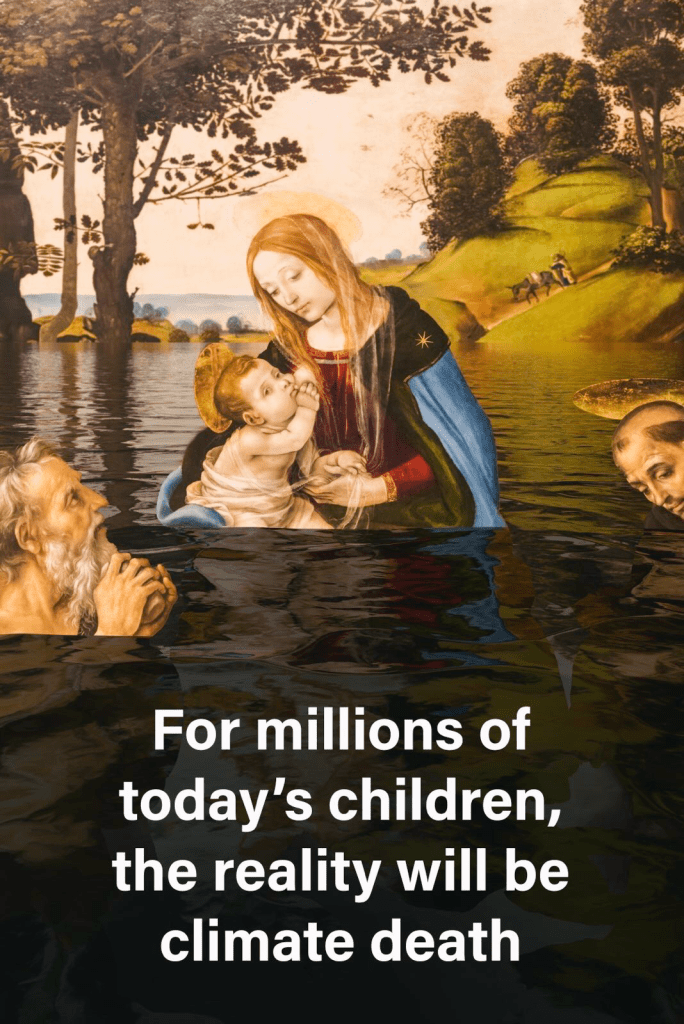
Last week I took part in an action at the National Gallery with others from Christian Climate Action. We gathered in front of a painting of ‘The Madonna and child with saints Jerome and Dominic’ by Filippino Lippi, where we unrolled a copy of the picture which had been digitally altered to show flood waters that half submerged the characters. This we held as a statement was read out describing how for many Christmas is not a time of joy, because their lives are threatened by the effects of climate change. As we knelt prayerfully we sang a version of Silent Night – the acoustics were wonderful.
“Why did members of Christian Climate Action gather prayerfully beside a nativity painting at London’s National Gallery, with a different picture to reveal?
“As Christians we celebrate the birth of Jesus, born in poverty as a refugee, to show us the way of love and peace, and justice which is love in action. Christmas is still for the children. But today, world leaders are failing them. As governments profit from weapons and from fossil fuels, babies are born into climate chaos as well as war. In this painting, the baby – like his mother but unlike Jesus and Mary – is white, but we remember those brown and black babies born in the Global South still waiting for climate reparations and most at risk of unliveable heat, hunger, drought, flooding and displacement. We honour those born into poverty here in the UK as inequality widens, and all the world’s children whose future is at risk while the adults in charge pursue yet more oil and gas. We grieve that after 28 COPs, world emissions in 2023 have reached a record high to match all the heat records broken month after month.
“Only with change for good can the young find hope. Christmas lights can’t dispel their darkness. Along with inflatable Santas, magical snowmen and red-nosed reindeer, art like this is hollow and fake. The altered image we held beside Lippi’s painting shows the terrifying reality children face. Sentiment, tradition and festivity won’t save us. The science is clear that new gas, oil or coal will accelerate climate breakdown. We can’t serve God unless we serve that truth. Unless we work for life, justice and peace – with love.
“One billion children – almost half of the world’s child population – live in countries that are climate-vulnerable. A third of the world’s child population is impacted by both the climate crisis and poverty.
“According to UNICEF, extreme weather has internally displaced at least 43 million children in the last six years – the equivalent of 20,000 children a day being forced to abandon their homes and schools.”
“Climate activists are sometimes depicted as dangerous radicals. But, the truly dangerous radicals are the countries that are increasing the production of fossil fuels.” So said the UN Secretary-General António Guterres last year at the launch of the third IPCC report.
Last week the Intercontinental Hotel in Park Lane hosted the Energy Intelligence Forum – an international gathering of influential figures from the oil and financial industries – formerly known as the Oil and Money Conference. These people hold great power with very little reference to either democratic decision making or alternative view points. The decisions they make, and the strategies they plan, will have a big impact on what happens in the world, on the future of wellbeing of people, the environment and the climate.
In opposition to this Fossil Free London and other groups such as Extinction Rebellion, Greenpeace and Christian Climate Action, organised protests outside the hotel and at selected headquarters of oil and financial institutions across London. With our future at stake, it was imperative right to call out the injustice of what was happening. The IPPC and IEA have both presented the world with the scientific evidence that carbon emissions are causing the climate crisis, and that the urgent response must be cutting back now on fossil fuels extraction and use, as we all transition to net zero. And yet, regardless of this, the oil industry is continuing to expand its operations, and the financial world is continuing to invest in and to insure these projects – using what is ultimately our money.
On the Monday evening, the eve of the conference, Christian Climate Action held an act of worship out on the street opposite the hotel’s main entrance. Using words from the most recent papal encyclical, Laudate Deum (Praise God). It is so called, because the Pope says that when human beings claim to take God’s place, they become their own worst enemies. In the worship we bore witness to the injury and injustice that the oil industry is causing in the world, and in between prayerful silences we sang praises to God using the Taize chant ‘Laudate omens gentes’.
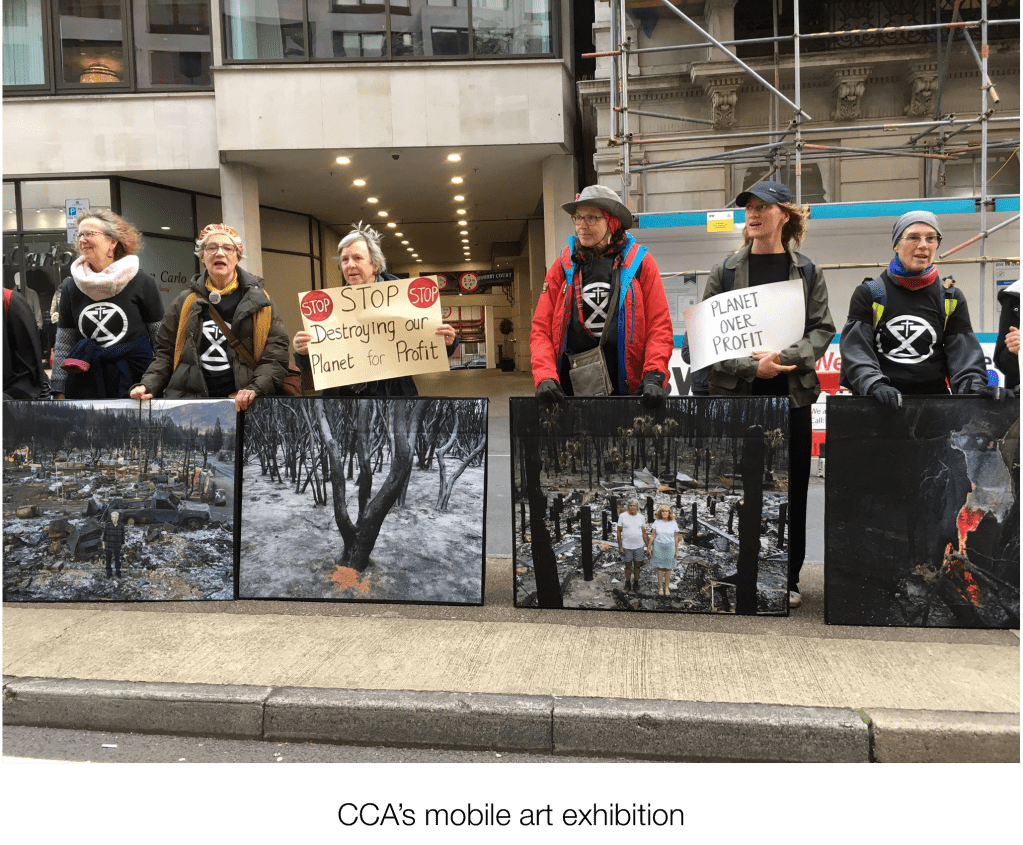
Tuesday CCA again gathered in the street opposite the hotel with a series of photographs – a mobile art exhibition – each an illustration of the effects of wild fire on the environment and people’s lives. Fossil Free London and others blockaded the hotel entrance – the hotel had erected high fences along the whole area restricting the entrance to a meter wide gate way which was easily blocked by protestors preventing guests from entering or leaving. A samba band played, people sang and chanted, and speeches were delivered – the key speaker was Greta Thunberg. Mid morning a group from Greenpeace abseiled down from a top floor window, unfurling a banner down the front of the hotel. The conference delegates could not have gone unaware of the opposition to their plans for an oil fuelled future. Indeed the CEO of Shell had to make his speech by equivalent of zoom. By the early afternoon the police had imposed a section 14 notice on the street, authorising them to remove all protestors from the site.
The Christian Climate Action group set off on a pilgrimage around Mayfair stopping to pray at the offices of a number of ‘Earth Wreckers’ – companies involved in financing, supporting or exploiting fossil fuels and thereby directly or indirectly polluting the world with carbon emissions. (For more information about Earth Wreckers visit – http://umap.openstreetmap.fr/en/map/wreckers-of-the-earth-2021_409815#12/51.5222/-0.1234)
On Wednesday action was taken further afield to the City of London. Ten companies associated with the West Cumbrian Coal Mine and the East Africa Crude Oil Pipeline were targeted, to protest against their involvement in funding these highly polluting projects. Christian Climate Action together with representatives of other faiths and a group from XR Scientists, peacefully entered and sat down in the foyer of 52 Lime Street – a modern glass and steel tower block that houses Chaucer, the UK subsidiary of China Re and a potential insurer of EACOP. Sat together in the middle of the space – allowing office workers to continue in and out of the building – we sang Buddhist and faith songs and shared an agape of bread and ‘good’ olive oil.
Within half an hour the police arrived and stood round us, watching. Then with such joy and hope, we saw the XR procession, that was marching between each of the sites, arrive with hundreds of supporters, flags and banners, and a samba band. They waved to us through the plate glass windows and cheered, and we sang and waved back. When they marched on, a contingent from CCA stayed on outside both protesting and praying. The building’s security staff obviously wished us to leave, but the police having taken advice from the CPS, took the view that as our protest was peaceful, they had no grounds for arresting us. After some discussion within the group, we agreed that we would stay until 3 o’ clock. So at 3 o’ clock we stood up, tidied up our banners and picnic lunch and still singing, walked out. We had made our point.
Despite the rain, we returned to the Intercontinental Hotel that evening for a further act of worship, this time led by various representatives of the Faith Bridge -Buddhist, Muslim, Jewish, Quaker and Christian.
Christian Climate Action continued with its support of other groups on the Thursday, targeting amongst others, the offices of J P Morgan. I meanwhile held my weekly hour long vigil outside Shell’s headquarters.





 The Green Tau