Counting on …day 81

31st January 2022

When my clothes wear out – beyond repair – I bag them up and take them, labelled as rags for recycling, to the local charity shop. I then try and buy clothes made from recycled materials to square the circle/ close the loop. This is harder than you would think! 

One company that does take back its own clothes so that they can be both recycled and reused, is Rapanui. (NB the recycling of the old clothes and the manufacture of new ones takes place in India).

“The fashion industry is a linear model where resources are taken and turned into waste. Lowering impact or buying less slows fast fashion down but it doesn’t change the outcome. We are fundamentally different because circular design is applied at every stage. Unlike recycled clothing, which only works to slow down the process, a circular economy is designed for products to be returned and remade again and again. Meaning they will never go to waste. Get your year off to the best start by helping us in sending back your old Rapa products. We make new products from the material we recover, and the cycle itself is renewable. With your help, we can work towards ending waste for good.”

 Counting on … day 72

24th January 2022

Bin collection day. Today our landfill bin is going out. This is its first outing for about 7 months. Some years ago we experimented with zero waste. Whilst we our waste output is not zero, we have been able to substantially reduce it – and at the same time we have not seen an increase in the amount that goes into our recycling bins.

Our bin is also part of the Bin Twinning scheme. https://www.bintwinning.org/

The Green Tau: issue 31

Zero Waste – why?

24th January 2022

Zero Waste is the idea that nothing should end up as land fill, in an incinerator or being washed out to sea/ caught in a tree/ blown onto a mountain top as rubbish. Whatever is left after we have consumed something should be recyclable so that nothing is wasted. Zero waste means not buying/ consuming more than you need. Zero waste means cradle-to-cradle or closed loop design of all we consume. 

Why is waste an issue? 

Waste that we throw away has to be disposed of. Historically waste was buried in midden heaps or burnt on the household fire or thrown onto the street or into a nearby river. The amount of waste was generally  small enough that this was not impractical. As towns grew and as the amount of things people could acquire and casually discard grew, so waste became a problem. As long as amongst  the waste there were things that could  be recycled for financial gain, there were people who would take on the waste problem. In the 18th century urban areas had business known as ‘dust yards’ where rubbish was collected and sorted to,extract what could be resold – bones for knife handles and glue, coal ash for bricks etc. When waste became a potential health hazard, the authorities intervened. In 1846 the Nuisance Removal and Disease Prevention Act set up the first regulatory waste management system operate by municipal boards. The Public Health Act of 1875 required all householders to put their rubbish in bins for weekly collection. 

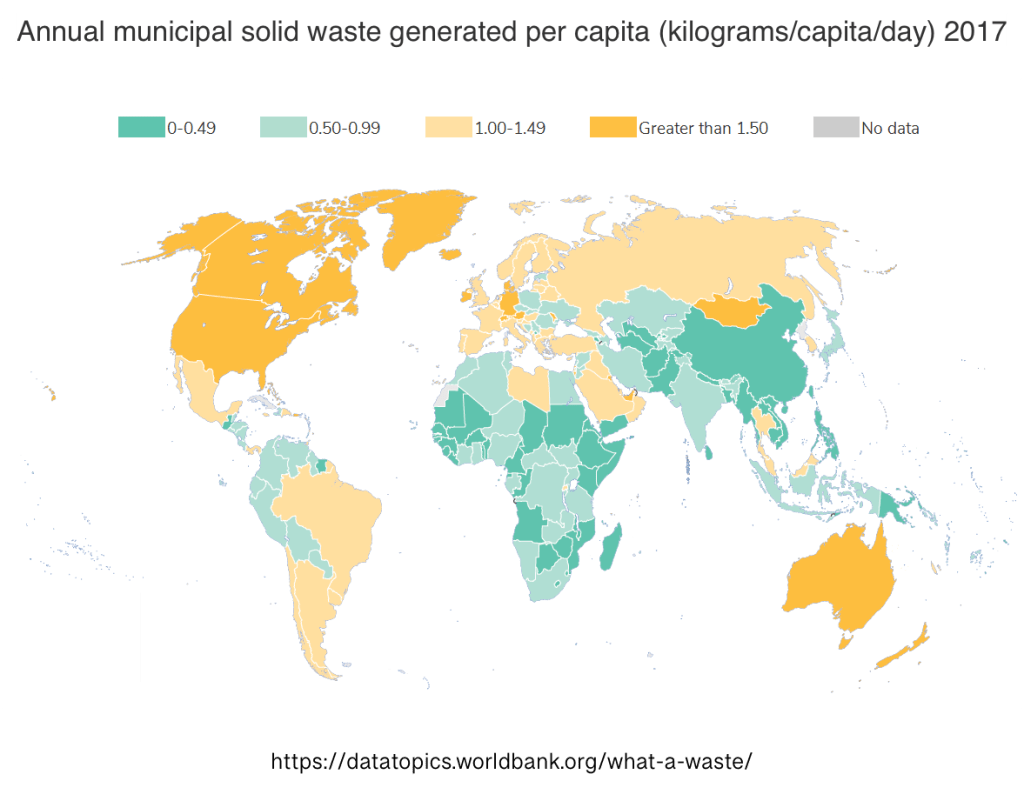
Having a system for taking waste away doesn’t reduce the amount of waste produced. The amount of waste we produced has grown exponentially. Globally (circa2016) we produce 2.01 billion tonnes of municipal waste a year (ie waste from households, shops and small businesses collected by local authorities – as opposed to waste generated on an industrial scale such as in mining, farming , manufacturing). The average of  0.74 kg per per person per day masks a range from 0.11kg to 4.55kg. Typically it is the less developed countries that generate least waste whilst it is nations such as Denmark, the USA, New Zealand, the most. Here in the UK we averaged 392kg (2017) down from 425kg in 2010. As more countries become increasingly developed/ westernised, the World Bank estimates that average per capita waste will increase to 3.4kg per day by 2050 – a projected annual total of 3.4 billion tonnes.  

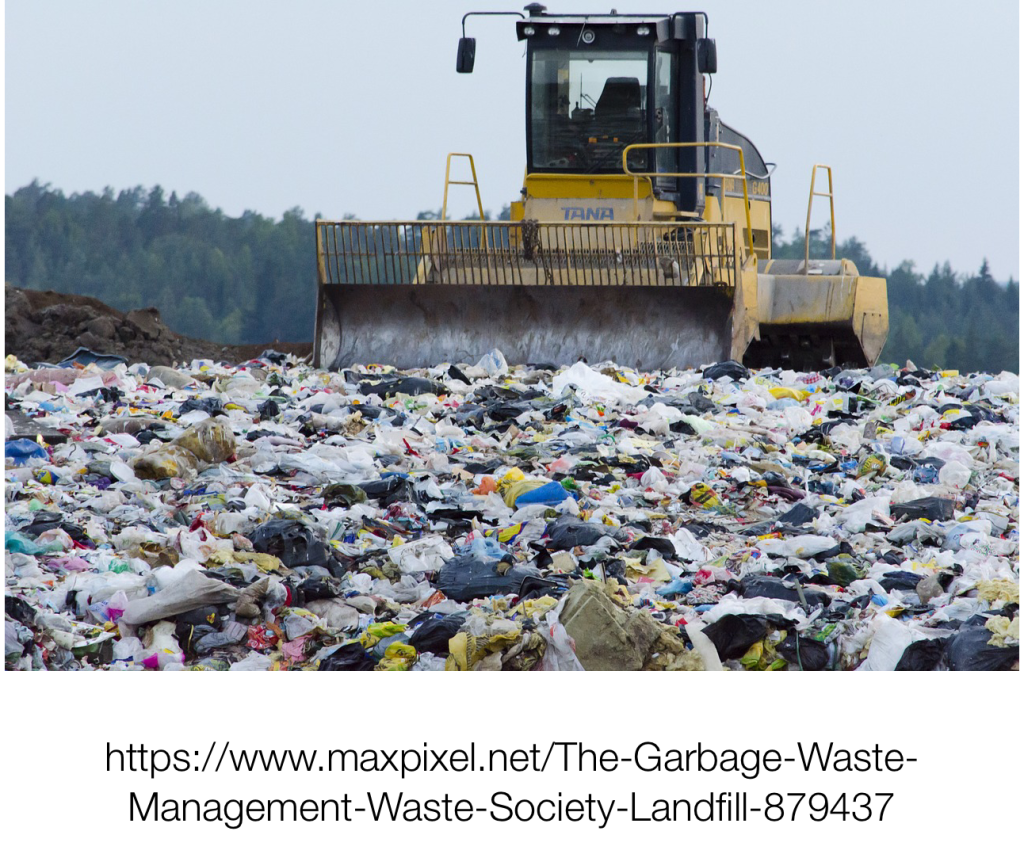
Waste and its disposal can cause various pollution and health concerns. Uncollected waste can be a source of infection. It can attract vermin and scavengers that may further transmit infections. It can block drains and water ways causing flooding. It can produce chemicals that pollute water supplies. It can create unpleasant odours as well dangerous gases that irritate and damage lungs or that can enter the blood steam and cause further forms of ill health. It can be blown across land, lodging in trees and branches where it may injure wildlife as well domesticated animals (n Richmond Park deer die each year from eating rubbish). It can end up in the middle of oceans or on remote mountain tops. It may end up as waste polluting the seas – this is especially true of discarded marine nets.

Most waste is collected but that doesn’t eradicate the health and pollution risks. Most will either be incinerated producing noxious fumes and health debilitating small particulates as well as CO2, or goes into some form of landfill which depending upon the level of safeguards in place, will still be a cause of much pollution. Buried waste in landfill also produces methane. Globally only 13.5% of municipal waste is recycled (https://datatopics.worldbank.org/what-a-waste/trends_in_solid_waste_management.html).

The world’s stock of resources – in particular raw materials such as minerals, but also things such as water, timber, peat, helium gas – is finite. We cannot carry on manufacturing and consuming at current levels. In 2021 Earth Overshoot Day – the day when we have consumed as many resources as the world can annually regenerate – fell on 29th July (https://www.overshootday.org/). On the one hand we need to find ways of consuming less, and in the other  – or at the same time – we need to ensure we extract and recycle as much as we can from what we throw away. This imperative to use less and recycle more applies as much to industry as it does to individual consumers. And much of the burden must lie within the industries, for it is here that designs can be adapted so as a) to use less resources and b) to ensure ease of recycling when the product reaches its end of life. 

What is needed is cradle-to-cradle or closed-loop  design, production and recycling. Whilst the onus for this lies with the industries, consumers do have a role to play. We can do our research and only buy, where possible, items that come from closed-loop system. This could be milk in glass bottles that are collected and reused by the milk company. It could be clothes that the maker takes back when they expire and use to create new clothes. It could be paper or cardboard that are collected and processed into new paper and cardboard. We can be conscientious about collecting, sorting and recycling everything we use. And on the way, we can extend the life of the things we use by reusing and repairing them. We can aim for a 100% zero waste lifestyle.

Counting on day 66

19th January 2022

This is the time of year when I start to empty and reshape my compost heaps. I hope to find  inside the compost bins well rotted vegetable matter, with red worms and wood lice wriggling around the edges where the material is not so well decomposed. I scoop out what is ready for use, placing it around the base of fruit trees, under the raspberry canes, around currant bushes and on top of the rhubarb patch. I make sure it is not piled up against the trunks of the trees. Then I leave it for the worms in the soil to  pull the compost down into the soil where it will nourish the plants for the coming season. 

Last year we put in the compost bins the compostable ‘plastic’ bags and compostable ‘plastic’ food bowls. Whilst I can see that they are breaking down, the decay process is much slower than it is for plant materials. What hasn’t decayed has gone back into the bin for a second season. 

If you haven’t the space for a compost bin, you might like to try a worm bin. See the Urban Worm’s website for instructions on making a worm bin and for the offer of free tiger worms to live in it – 

 Counting on …day 61

15th January 2022

We count on the recycling crews to take away our recyclable waste and our landfill waste. To ease their workload we can help by ensuring that what we place in the recycling bin is clean, compacted (squashed, flatten, stacked) to prevent stuff overflowing, and in the correct bin. 

Is there a ‘Maria Kondo’ tidy recycling bin award?

Counting on …day 58

11th January 2022

Monday and Tuesday are our local recycling days when the lorries and crew collect paper, & card, food waste, metal, glass and some plastics – as well as unrecycled waste that goes to landfill. It is a job the  crew do in all weathers, pulling and lifting boxes and bins into the back of the lorry, and in summer the food waste can be pretty smelly. It is a pretty thankless job: we would all be lost without it, but we are seldom out and about when the crew comes by to say thanks. We used to call them dustbin men, then refuse collectors, but neither of those describe their current role nor the important that role has in tackling climate change and ensuring scarce materials are recycled for future use. 

Perhaps we should call them “recyclists”. 

Counting on … day 54

7th January 2022

Real (as opposed to plastic) and rootless Christmas trees will  probably now be on their way for recycling. Most local authorities provide a collection service, taking the trees to be ‘chipped’ into small pieces which can then be turned into compost or used as a mulch.  Sometimes the trees may be put to  alternative uses such as securing sand dunes or stabilising river banks. You can recycle them at home,  leaving them in a corner of the garden where overtime they will decay and in the meantime may provide a shelter for birds and insects. Or you can speed up the process by chopping off the branches and – once the needles have gone brown – use them as mulch around plants that like an acid soil – eg raspberries. 

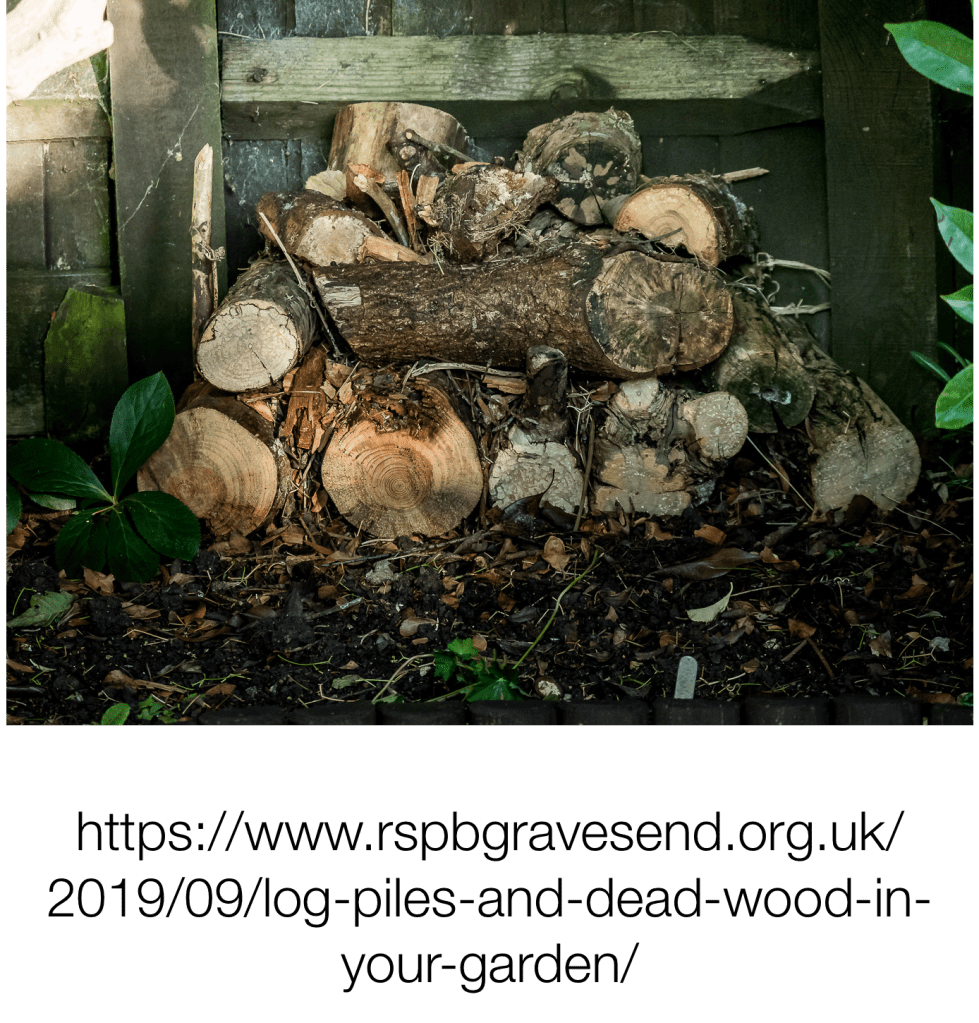
The trunk you can use to make, or to add to, a log pile for garden wild life. For more nature friendly ideas for the garden see – https://greentau.org/2021/10/04/eco-tips-10/

 Counting on … day 37

21st December 2021

Christmas is often a time when we have more to recycle and possibly a reduced collection service. Both recycling bins and recycling lorries have a limited capacity in terms of volume. Now is a good time to see your recycling box as a Tetris puzzle. By careful stacking, interlacing and flattening, how much can you fit it? 

Recycling

Paper and card: fold and flatten and place in recycling bin. In the Borough of Richmond, this is the blue box. Cardboard and paper should be clean with plastic tape removed. It should be dry and  free from paint and glue etc – although Richmond’s recycling company says small amounts are not a problem.

Glass: jars and bottles should be rinsed clean before going into the recycling box. In Richmond this is the black box. Lids can be left in place.

Tins: steel and aluminium tin food and drinks can all be recycled. Clean and flatten them (if possible) before placing them in the recycling bin. Again in Richmond this is the black box. You can also recycle aerosol cans. Aluminium foil can also be recycled. Ensure it is clean and squash the foil together to make one lump. This prevents small pieces of foil getting lost.

Batteries and light bulbs: these can usually be recycled at the stores where they are sold. In East Sheen batteries can be recycled at Waitrose, Boots and Robert Dyas and the latter also recycle light bulbs.

Plastics 

Milk cartons and bottles, shampoo and laundry/ cleaning liquid bottles,  ice-cream and margerine tubs, food trays, and yogurt, dessert or cream tubs: these should be cleaned and flattened before being placed in your recycling box. In Richmond this is the black box.  

Plastic bags: these can be recycled at most supermarkets along with other thin plastic wrappings such as from around magazines and toilet rolls, bubble wrap, bread bags and bags for frozen foods.

Scrunchable or soft plastics: these can be recycled at some supermarkets including some Tesco and Sainbury stores and most Co-ops. Local to East Sheen this includes Tesco Metro in Richmond (ask at the customer services desk) the Coop store in Putney and the Coop service station at Roehampton Vale. These plastics include biscuit and sweet wrappers, crisp packets, cling film, plastic bags for salads, pouches from both food and cleaning products, as well as the previously described plastic bags.

Blister packs from medicines etc: these can be recycled at Superdrug – ask at the pharmacy counter.

Polystyrene and plastic foam: these plastics cannot currently be recycled.

Compostable plastic-looking bags: some manufactures pack their newspaper, magazine, dried goods etc in bags made from corn starch or similar. This is not plastic and must not go in with plastics for recycling. It will be clear.y marked as compostable and should go into your garden compost bin or your food recycling bin. Domestic compost heaps don’t reach high temperatures and these bags may take a couple of seasons to break down – be patient!

Compostable cutlery, cups and bowls etc: these may look like plastic, especially the cutlery. They should be marked as compostable and should go into your garden compost bin or your food recycling bin.

Pens: worn out pens including felt tip pens and highlighters are recycled via TerraCycle and can be dropped off at your local Ryman store. 

Postage stamps: you will probably get more of these at this time of year. They are often collected by charities as a means of raising funds. Eg RNIB https://www.rnib.org.uk/donations-and-fundraising/fundraising-your-community/stamps-appeal  and Against Breast Cancer https://www.againstbreastcancer.org.uk/recycling/used-stamps/