
Counting on … day 93

23rd June 2025

Developing countries have a growing need for energy but that should not be seen as an opportunity to promote fossil fuels – to do so traps those countries in the fossil fuel system. Rather these countries should be afforded the opportunity of developing systems that use clean renewable energy – wind and solar, electric vehicles, electric (or direct solar) cooking facilities etc.

“In the coming years most of the additional demand for new electricity will come from low- and middle-income countries; we have the opportunity now to ensure that much of the new power supply will be provided by low-carbon sources.” (1) 

Such clean renewable energy will also be a) cheaper and b) afford the countries energy security as they will not be reliant on imported oil and gas – or even if they have indigenous supplies, not subject to the fluctuating prices for fossil fuels set by global markets.

For a report from this year’s IEA summit: “Participants at the Summit emphasised the importance of energy access and affordability as fundamental to national and international security. With nearly 700 million people worldwide still lacking electricity and over 2 billion without access to clean cooking, addressing energy poverty was highlighted throughout the Summit as a key challenge to overcome. Delegates acknowledged that affordability concerns are growing even in advanced economies, where low-income households are disproportionately affected by energy costs.” (2)
(1) https://www.climatechangenews.com/2025/05/30/civil-society-groups-push-back-on-fossil-gas-funding-as-african-development-bank/

(2) https://www.iea.org/news/at-london-summit-energy-sector-leaders-usher-in-a-new-era-of-energy-security

More info https://www.who.int/news/item/12-06-2024-progress-on-basic-energy-access-reverses-for-first-time-in-a-decade

Counting on … day 78

5th June 2025

Energy security 

Interestingly the International Energy Agency was set up in 1074 during the then oil crisis with a mandate to ensure oil security. Since then it has expanded that role to include the security of natural gas, electricity and renewable energy supply chains. These supply chains – as experienced in recent years – are at risk from conflicts, embargoes, adverse weather, terrorism, cyberattack, and failures of national and international grid systems. 

Amongst other measures, the IEA requires member countries to hold specific stock levels of oil to mitigate against disruption and spikes in cost. 180 million barrels of oil had to be released when Russia launched its invasion of Ukraine. That conflict and its impact on both oil prices  and the supply and cost of gas, shook many countries as they became acutely aware of their reliance on these energy sources. In response many countries have sought to increase access to locally produced renewable energy. 

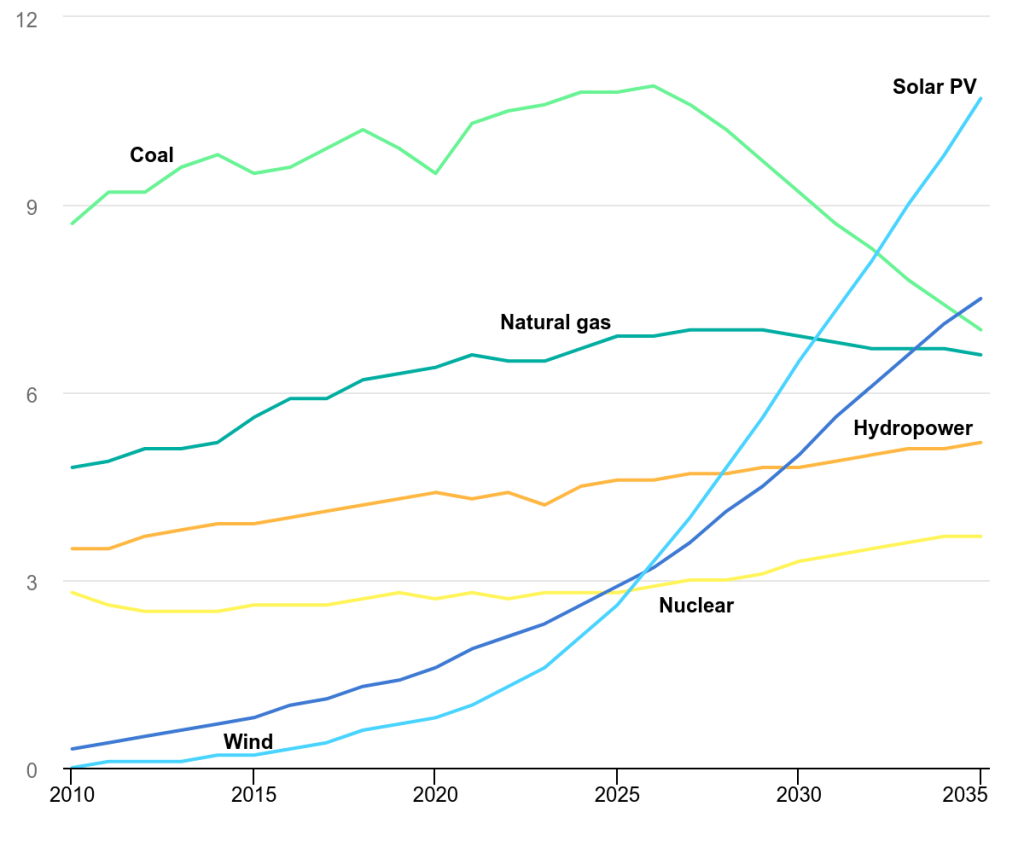
Developing renewable energies – such as wind, solar and hydro – as well as developing large scale battery storage and enhancing the capacity of the grid are key components in ensuring a secure energy supply. This will become all the more important as the demand for electricity increases. The IEA reported this year that “[b]etween now and 2035, electricity demand is set to grow six times as fast as overall energy demand as a result of factors like the adoption of electric vehicles, air conditioning use, the digitalisation of the economy, the uptake of artificial intelligence and progress on expanding electricity access. Its share in final energy consumption is projected to double by 2050.” (1) 

In the energy mix needed to secure this demand the IEA predicts that the use of gas will gradually decrease, whilst solar and wind will play a rapidly increasing role. Whilst oil and gas will be part of the global energy mix going forward, it will be so at a diminishing rate. Long term energy security lies with renewables, and faced with increasing demand for electricity, what is essential in making that increased volume  secure, is investment now in the renewables sector – generation, storage and grid capacity. 

  1. https://www.iea.org/topics/energy-security

Counting on … Day 46

22nd April 2025

Today is Earth Day.

Earth Day was first observed in 1970. The Earth Day organisation aims to “broaden, educate and activate the environmental movement worldwide.” Each year has its own theme; this year’s is entitled “Our Power, Our Planet” and is a call to expand renewable energy so as to triple clean electricity by 2030. 

The Earth Day organisation has a fact sheet and a petition:-

“We call on global leaders to commit to:

  • Tripling renewable energy generation by 2030: Advancing clean energy sources like solar, wind, geothermal, tidal and hydropower. This ambitious target supports global climate goals set out in the Paris Agreement, opened for signatures on Earth Day 2016.
  • Cutting greenhouse gas emissions: Rapidly transitioning to renewable energy is the key to reducing greenhouse gas emissions, fighting climate change and lowering energy prices for everyone.
  • Phasing out fossil fuels: The renewable energy sector has taken off globally but the world is still producing more CO2 than ever before because of our over reliance on fossil fuels. This needs to end with meaningful policies supporting the rapid growth of renewable energy and energy efficiency. The world economy must favor renewable energy, ensuring that the “beginning of the end” of fossil fuels is realized
  • Investing in clean energy infrastructure: In 2022 the fossil fuel industry was subsidized globally to the tune of $7 trillion. We must realign these subsidies to support the growth of desperately needed renewable energy, including infrastructure to accelerate the transition. We need smart grids, new high voltage transmission lines, local distribution networks and long term battery storage. This will drive economic, environmental, and energy security benefits.

This will pave the way to: 

  • Providing affordable, sustainable power for everyone. Bringing electricity to homes, schools and hospitals worldwide, and ensuring energy access and equity for all. 
  • Creating millions of new jobs in the energy industry. Driving economic growth globally.
  • Prioritizing health and health equity by reducing fossil fuel induced pollution and improving air and water quality. Shifting away from fossil fuels will protect human health worldwide 

The transition to renewable energy is about creating a future where everyone can thrive. Let’s use the power of the Earth Day network and our global movement to demand urgent action from governments, businesses, and communities around the world.

This petition will be presented to the United Nation’s leadership and delegates at the UNFCCC Conference of Parties 30 (COP 30) in November 2025.”

Petition:- https://action.earthday.org/our-power-our-planet-renewable-energy-petition


Counting on … day 90

19th April 2024

How sustainable is wind power? 

The following comes from a report by the German broadcaster, Deutsche Welle (DW).

“On average, wind turbines are operated for about 25 years. During this time, they generate 40 times more energy compared to the energy required for the production, operation and the disposal of a wind power plant.

“So-called upstream emissions, generated mostly through the production of carbon-intensive steel and cement, are included in the overall carbon balance of a wind turbine’s life cycle.

An onshore wind turbine that is newly built today produces around 9 grams of CO2 for every kilowatt hour (kWh) it generates, according to according to the UBA. A new offshore plant in the sea emits 7 grams of CO2 per kWh.

“Compared with other technologies, wind power does well in terms of carbon emissions. By comparison, solar power plants emit 33 grams CO2 for every kWh generated. Meanwhile, power generated from natural gas produces 442 grams CO2 per kWh, power from hard coal 864 grams, and power from lignite, or brown coal, 1,034 grams.” (1)

But what about the renewability of the turbines? Can their component parts be recycled so conserving the materials used? Wind turbines have a lifespan of 30+ years. At present the number being decommissioned is small but will grow – DW suggests that by 2050 up to 50,000 wind farms in Germany alone will need replacing. Whilst to some extent the concrete for the bases can be crushed and recycled as hardcore etc, and the steel and other minerals from pylons can be recycled, recycling the blades is less easy as they are a composite of glass fibre, plastic, carbon etc. Old blades may end up in landfill. However – “The first recyclable rotor blades for large offshore plants are currently being produced in Denmark. By 2030, the plant constructor Siemens Gamesa plans to only sell recyclable rotor blades: from 2040 the production of the company’s wind power plants is expected to be completely carbon neutral.” (1)

Nevertheless, wind power is one of the least environmentally damaging sources of energy.

  1. https://www.dw.com/en/how-sustainable-is-wind-power/a-60268971

Counting on … day 89

18th April 2024

How Renewable are Renewables?

Many things are renewable as in they can be naturally replaced – timber is a renewable resource in that for every tree used/ consumed, another tree can be grown. Water is a renewable resource in that once used it can be recaptured and reused: this might be through the natural water cycle of evaporation, transpiration, condensation and rainfall, or through collecting and cleaning waste water for further use. Fish for use as food is a renewable resource – this supply of food is maintained through the natural reproductive processes of the fish. 

However the renewability of things isn’t necessarily limitless. 

If oceans are overfished, the rate at which new fish are born and mature will not keep pace with the rate at which fish are caught. Eventually there will be no fish.

If trees are felled faster than the rate at which new trees reach maturity – which can be  40 to 150+ years depending on the species – the landscape will become deforested. 

If an ecosystem is not maintained, more can be lost through evaporation in a locality than falls as rain. Without forests in the middle of large continents, rainfall in these areas would be negligible reducing the landscape to desert. If rainforests are cleared, rainfall in those areas will be diminished reducing the landscape to bare earth.

Solar energy is a renewable energy source – the sun is constantly producing heat – as is wind, as the earth’s weather system continues to be generate wind. (Sometimes resources such as sunshine, wind, tides and geothermal energy are known as perpetual resources).

 But whilst solar and wind energy are constant/ renewable, the means by which we capture that energy may not be as readily replaced. Solar panels that convert the sun’s energy into electricity are  made of non-renewable minerals – silicon, silver, aluminium, and copper. Wind turbines that capture the wind’s energy converting it into electricity are made of large amounts of non renewable materials such as steel and carbon fibre.

The source of the energy is renewable but not always the means by which we capture the energy.

Here is an interesting blog describing how solar panels are made – https://blog.ucsusa.org/charlie-hoffs/how-are-solar-panels-made/

and wind turbines – https://blog.ucsusa.org/charlie-hoffs/how-are-wind-turbines-made/

Counting on … day 85

12th April 2024

Fossil Fuel Subsidies -2

“Since the Paris Agreement, the government has provided £13.6 billion in subsidies to the UK oil and gas industry. From 2016 to 2020 companies received £9.9 billion in tax relief for new exploration and production, including £15 million of direct grants for exploration, and £3.7 billion in payments towards decommissioning costs.” https://www.ethicalconsumer.org/energy/paid-pollute-fossil-fuel-subsidies-uk-what-you-need-know

Research from 2023 commissioned by the Liberal Democrats showed that between 2015 and 2020 renewable energy received £60bn in subsidies whilst fossil fuels received £80bn. In 2020/1 fossil fuels received £1bn whilst renewable energy received a mere £1m!  https://www.theguardian.com/environment/2023/mar/09/fossil-fuels-more-support-uk-than-renewables-since-2015

Such subsidies are the explicit subsidies. As far as I know, renewable energy generation does not produce pollutants or other harmful side effects. Whereas we as citizens and tax payers are also paying for the implicit subsidy of fossil fuels through ill health caused by pollution from fossil fuels, as well as ill health caused by excess temperatures; through the extra cost thus imposed on the health service; from the extra cost of food as more harvests fail; and the extra cost of repairing buildings and infrastructure affected by extreme wind/ rain and temperatures. 

According to Kisters (an international environmental data and insights organisation that focuses on gathering and reporting data on the water, weather, energy, environment and IT sectors) “the cost of natural disasters in the UK is rising by 11.2 per cent a year, while the UK’s GDP grew by 4.3 per cent in 2022 (according to the Office for National Statistics)…Floods are the most expensive risk the UK faces at present, with the cost of dealing with extreme flooding projected to rise to $217.2bn by 2030-2039 without intervention. But an increasing number of extreme storms also poses a threat. Between 2010 and 2019 storms cost the UK around $1.6bn, but by 2030-2039 this is estimated to rise to $3.8bn. In 2020-29, Kisters predicts the UK government will spend $43.8bn on dealing with the effects of all climate-caused natural disasters.” https://www.newstatesman.com/spotlight/sustainability/climate/2023/12/extreme-weather-natural-disasters-uk-economy-government

Counting on … day 78

3rd April 2024

Biofuels are fuels derived from biomass such as plant material, food waste, algae, or animal waste. There are two forms of biofuel – 

“Bioethanol is an alcohol made by fermentation, mostly from carbohydrates produced in sugar or starch crops such as maize, sugarcane, or sweet sorghum. Cellulosic biomass, derived from non-food sources, such as trees and grasses, is also being developed as a feedstock for ethanol production. Ethanol can be used as a fuel for vehicles in its pure form (E100), but it is usually used as a gasoline additive to increase octane ratings and improve vehicle emissions.

And “Biodiesel is produced from oils or fats using transesterification. It can be used as a fuel for vehicles in its pure form (B100), but it is usually used as a diesel additive to reduce levels of particulates, carbon monoxide, and hydrocarbons from diesel-powered vehicles.” (https://en.wikipedia.org/wiki/Biofuel)

Brazil is the largest producer of bioethanol and the EU is the largest producer of biodiesel. 

Both forms of biofuel differ from fossil fuels in that they are produced from organic materials being grown now as opposed to using organic materials that were decomposing millions of years ago.  

Both produce greenhouse gas emissions but less than do fossil fuels. Biofuels may be made using only waste materials, but often are made from crops that have been specifically grown for this purpose. This may have the affect of diverting land that would otherwise be used for growing food, or may involve deforestation to create new crop lands. 

Drax power station which burns timber as a biofuel to generate electricity uses wood pellets. Although wood pellets can be made from waste wood, most of the pellets that are burnt at Drax are made from whole trees that were once growing in virgin forests in South Carolina and British Columbia. These are then imported to the UK. For more information- https://www.bbc.co.uk/news/science-environment-68381160

Counting on … day 61

7th March 2024

“The International Energy Agency Agency (IEA) is a Paris-based autonomous intergovernmental organisation, established in 1974, that provides policy recommendations, analysis and data on the global energy sector. The 31 member countries and 13[1] association countries of the IEA represent 75% of global energy demand… The core activity of the IEA is providing policy advice to its member states and Associated countries to support their energy security and advance their transition to clean energy.[3] Recently, it has focused in particular on supporting global efforts to accelerate clean energy transition, mitigate climate change, reach net zero emissions, and prevent global temperatures from rising above 1.5 °C.” (https://en.wikipedia.org/wiki/International_Energy_Agency)

It seems strange that the membership does not include any of the oil states from the Middle East, and very few African nations who surely have an equally vested interest in energy security. 

Back in 2021, the IEA declared that the exploitation and development of new oil and gas fields must stop if the world was to stay within safe limits of global heating and meet the goal of net zero emissions by 2050. It is thus worrying that so many countries and so many companies have since then continued to grant licences and develop new oil and gas fields. The UK’s current government is even proposing to increase the frequency with which it issues new licenses!

This message was reinforce in 2023 when, having noted the strong growth in clean energy provision, the IEA reported that whilst there was no longer a need to maintain current investment levels in fossil fuels, investment in oil and gas was in fact twice what would be necessary to achieve net zero emissions targets. (https://origin.iea.org/reports/world-energy-outlook-2023)

On the plus side, the IEA’s report of March this year on clean energy, notes: “The deployment of solar PV, wind power, nuclear power, electric cars, and heat pumps from 2019 to 2023 avoids around 2.2 billion tonnes (Gt) of emissions annually. Without them, the increase in CO2 emissions globally over the same period would have been more than three times larger.” (https://www.iea.org/reports/clean-energy-market-monitor-march-2024

Counting on … day 1.131

18th July 2023

What should the fossil fuel industries be doing? 

Christina Figueres, former Executive Secretary of the UN Framework Convention on Climate Change, diplomat and renowned climate leader, says “Let’s remember what the industry could and should be doing with those trillions of dollars: stepping away from any new oil and gas exploration, investing heavily into renewable energies and accelerating carbon capture and storage technologies to clean up existing fossil fuel use. Also, cutting methane emissions from the entire production line, abating emissions along their value chain and facilitating access to renewable energy for those still without electricity who number in their millions.”

Counting on … day 1.104

28th April 2023

An article from the We Mean Business website points to the importance of switching from fossil to renewal energy to limit the rise in global temperatures. It is hoped that this will be the basis of the outcomes from the G7 meeting in Japan next month

“The Group of Seven nations’ energy ministers agreed this week to accelerate the phase out of all fossil fuels as an essential step in our efforts to limit global temperature rise to 1.5°C.

To replace them with clean energy in the timescale required means immediately repurposing billions of dollars’ worth of fossil fuel subsidies that G7 nations still offer.

In 2021, G7 fossil fuel subsidies came to over $80 billion. Redirecting this capital towards scaling up renewables, increasing energy efficiency and supporting communities affected by this transition will put our climate goals within reach.”


https://www.wemeanbusinesscoalition.org/blog/to-phase-out-fossil-fuels-the-g7-must-stop-subsidising-them/?utm_source=Climate+Weekly&utm_campaign=1805d3d517-EMAIL_CAMPAIGN_2023_04_21_02_34_COPY_01&utm_medium=email&utm_term=0_-947741a97e-%5BLIST_EMAIL_ID%5D