Counting on … day 85

12th April 2024

Fossil Fuel Subsidies -2

“Since the Paris Agreement, the government has provided £13.6 billion in subsidies to the UK oil and gas industry. From 2016 to 2020 companies received £9.9 billion in tax relief for new exploration and production, including £15 million of direct grants for exploration, and £3.7 billion in payments towards decommissioning costs.” https://www.ethicalconsumer.org/energy/paid-pollute-fossil-fuel-subsidies-uk-what-you-need-know

Research from 2023 commissioned by the Liberal Democrats showed that between 2015 and 2020 renewable energy received £60bn in subsidies whilst fossil fuels received £80bn. In 2020/1 fossil fuels received £1bn whilst renewable energy received a mere £1m!  https://www.theguardian.com/environment/2023/mar/09/fossil-fuels-more-support-uk-than-renewables-since-2015

Such subsidies are the explicit subsidies. As far as I know, renewable energy generation does not produce pollutants or other harmful side effects. Whereas we as citizens and tax payers are also paying for the implicit subsidy of fossil fuels through ill health caused by pollution from fossil fuels, as well as ill health caused by excess temperatures; through the extra cost thus imposed on the health service; from the extra cost of food as more harvests fail; and the extra cost of repairing buildings and infrastructure affected by extreme wind/ rain and temperatures. 

According to Kisters (an international environmental data and insights organisation that focuses on gathering and reporting data on the water, weather, energy, environment and IT sectors) “the cost of natural disasters in the UK is rising by 11.2 per cent a year, while the UK’s GDP grew by 4.3 per cent in 2022 (according to the Office for National Statistics)…Floods are the most expensive risk the UK faces at present, with the cost of dealing with extreme flooding projected to rise to $217.2bn by 2030-2039 without intervention. But an increasing number of extreme storms also poses a threat. Between 2010 and 2019 storms cost the UK around $1.6bn, but by 2030-2039 this is estimated to rise to $3.8bn. In 2020-29, Kisters predicts the UK government will spend $43.8bn on dealing with the effects of all climate-caused natural disasters.” https://www.newstatesman.com/spotlight/sustainability/climate/2023/12/extreme-weather-natural-disasters-uk-economy-government

Counting on … day 68

18th March 2024

What are the risks of climate change?

Here in the UK the risks include:-

  • Extremes of temperatures. Excess deaths during the heatwave of 2022, exceeded 4500 persons. Deaths due to heat will rise as peak temperatures rise. There is also the risk that the higher temperatures will enable disease-carrying insects to migrate north leading to outbreaks of dengue fever and Zika virus. Cold temperatures also cause deaths many of which could be prevented if homes were better insulated.
  • Flooding. Extreme weather events such as strong winds and storms, together with heavier rainfall (warmer air absorbs more moisture) flooding is an increasing occurrence, damaging homes, infrastructure such  as roads and railways, buildings such as schools and hospitals, etc. Storms and strong winds also damage power cables and cause power outages.
  • Extremes of temperature and flooding adversely affect agricultural output and the increased risk of food shortages. The UK imports about 60% of its food, so our food supplies are also dependent on the impact of climate change on food producing countries in other parts of the world.
  • Rising sea levels due to melting icecaps is already threatening coastal communities as well as increasing the risk of flooding  around and upstream of estuaries.
  • Droughts are an increasing feature of climate change with hotter drier summers. For  a nation that is used to having a constant supply of water for drinking, washing, cleaning cars, filling swimming pool, watering lawns and irrigating agricultural crops, using less water is a challenge.
  • Any disruption of normal life due to heat waves, flooding, storms etc affects business output, disrupts education, delays hospital treatments, interrupts deliveries to supermarkets etc.

These are some of the risks and impacts of the climate crisis that we are experiencing in the UK. In other more vulnerable parts of the world, the impacts are even greater.

For more reading – https://www.theguardian.com/world/2023/sep/22/heat-related-deaths-2022-hit-highest-level-record-england?CMP=Share_iOSApp_Other

https://www.theguardian.com/global-development/2023/dec/11/climate-crisis-could-cause-10000-extra-uk-deaths-a-year-by-2050-says-health-body?CMP=Share_iOSApp_Other

Green Tau issue 82

10th October 2023 

“No one expects the Spanish Inquisition!”

“No one expects the Spanish Inquisition!”- the catch phrase from one of the Monty Python sketches. At bizarre moments in innocent situations the red clothed members of the Spanish Inquisition would suddenly leap out ejaculating “No one expects the Spanish Inquisition!”

The same is true of the climate crisis. No one expects the climate crisis to interrupt their daily life. Yet it does. A sudden torrential storm, a flash flood, an unseasonal heat wave, a spark and a forest fire destroys a town.

No one expected storm Daniel to devastate the farm land of Thessaly, or to inundate the town of Derna in Libya. No one expected a storm to kill 11 in the Western Cape. Olive farmers in Spain did not expect heat waves and droughts to devastate 2/3 of their harvest. Holiday makers on Rhodes did not expect to be surrounded by wild fires. No one expected that wildfires would still be burning in Alberta in October. No one expected more than a month’s rainfall in 36 hours causing flooding across communities as far apart as Greenock and Aviemore. 

Do we think of these extreme weather events as freak events that won’t be repeated? Do we see them as things that happen elsewhere in the world  but not here? Do we see them as something that would never happen to me?

If we don’t expect them, then we are as unlikely to plan for them. That perhaps is too easily the situation in which we and our politicians find ourselves. And so we all carry on as if such extreme weather events will never happen to us and that our lives will not be disrupted. 

How you rate the risk of the likelihood of an extreme weather event probably depends on how much you know about the climate crisis. The more you know, the more you will have come to understand that the risks are high, and are growing each year that we allow carbon emissions to expand. The science is clear. 

It is less easy to predict is when and where these extreme events will happen, but the effects will be significant.  Herein is the problem. How does one convey the degree of risk, the degree of disruption that the climate crisis will cause of one cannot be specific about time and place?

This is why some groups, such as Just Stop Oil, choose actions that will disrupt daily life now. The disruption is a taster on a very small scale of the disruption we, the public, will face when we are the focus of an extreme weather event. Groups like Just Stop Oil are warning us that the climate crisis will cause massive disruption far worse than a 15 minute road delay road or interrupted theatre performance, and that we are doing nothing at the appropriate scale to prevent it. 

We should be demanding that serious action be taken now by the government, by big businesses, by investors. We should be embracing and calling for the carbon budgets and strategies recommended by the Climate Change Committee to be implemented at once and at speed.

For the CCC report of the government’s current progress in meeting tey current Carbon budget, see – https://www.theccc.org.uk/wp-content/uploads/2023/06/Progress-in-reducing-UK-emissions-2023-Report-to-Parliament-1.pdf

For the CCC’s budget for 2033-37 (ie the period for which we should be planning now –  https://www.theccc.org.uk/wp-content/uploads/2020/12/Policies-for-the-Sixth-Carbon-Budget-and-Net-Zero.pdf

For a further article on understanding net zero targets see – https://greentau.org/2023/05/30/green-tau-issue-70/

Counting on ….day 99 

19th February 2022

As we adapt to the climate changes which have already happened, we will get used to days when the weather is so extreme – whether through wind, heat, snow, rain – that we have to stay at home. We will accept that work and social plans will have to be flexible, that travel will not always be possible. We will by habit, keep phones charged, have torches that work, spare food in the pantry. The USA and Canada have ‘snow days’ when snow forecasts trigger planned school closures: we’ll have ‘extreme weather days’. 

Green Tau: biodiversity and food production

October 2021

Last week’s Green Tau weekly began a mini series looking at biodiversity. We noted that despite the relative smallness of humanity in terms of global biomass, we humans are dramatically and drastically altering the planet’s biodiversity. This week I want to look at the impact food production has on biodiversity. 

Over the millennia humans have domesticated both animals and plants, selecting and breeding species, and developed farming practices that would best provide food. In the process, humans extended their control over land that had previously been wild, which in turn has limited the land available for wild animals and plants. 1000 years ago, less than 4% of habitable land was farmed. This increased over the centuries, and particularly so from the mid 1800, when the area of farmed increased from under 25%  to the current 50%. (Habitable land is land not covered by glaciers, 10%, nor barren land such as deserts, sand dunes, bare rock, salt flats etc, 19%). In Europe the area of farmed land is now declining slightly, whereas it is continuing to expand in Africa, Asia, China and parts of South America.

Currently there is much media coverage about the clearance of the rain forests in Brazil to create new agricultural land plus accompanying access roads. This process destroys unique habitats with the loss of many plants, animals, birds and insects etc. It also destroys the millennia old way of life of indigenous people.  It is easy to see how such expansion of farming land exacerbates biodiversity loss. The same problem also arises in Africa, Asia and China. Mangroves have also been cleared to make way for shrimp farms, palm oil plantations and rice fields. 

A perhaps previously ignored consequence of expanding farming into previous areas of wilderness, is the increased contact between wild and domesticated animals. This allows diseases to spread more rapidly between the different species. What might be an insignificant virus infecting a wild animal can become a highly infectious virus in domestic animals. These virus can then spread to humans. Such zoonotic diseases include the Ebola virus, SARS and the current Covid 19.

Over the millennia, much of the UK has also been deforested to make way for farm land. Tree coverage  in the UK stands at about 12% which is much lower than most other countries in Europe. Top of the league is Finland with over 50% tree cover; Spain and Portugal are around 35%; France, Germany and Switzerland around 30%. As trees provide a great many habitats for other plants, birds, animals and insects, as well being good stores of carbon, the government’s climate advisers now recommend  tree cover should be increased to 17-19%. As well as planting new trees, it is also important that existing trees are protected: it takes many years for a tree to reach maturity and whilst they are still saplings they do not provide much habitat for other wild life. 

It is not only trees that have been cleared to make way for farming in the UK. Wetland areas such as marshes and bogs, have been drained. This destroyed the unique habitats of many different plants, insects and animals. In the same way, clearing hedgerows has had a detrimental affect on biodiversity. There is now a growing awareness of the importance of restoring and maintaining a diverse range of habitats to support different plants and creatures. Where the area of a particular habitat becomes too small, it may fail to maintain populations of plants and creatures at a viable level. However creating a corridors between habitats enables larger populations to be supported. Hedgerows perform this task on a small scale, as can railway lines and road verges.

Not only has farmland been expanding over the centuries, but what is farmed has changed. Increasing global trade, colonialism and the intensification of farming, has produced a agricultural system that now grows a very limited number of plant species. Two thirds of the world’s food comes from just nine plants: sugar cane, maize, rice, wheat, potatoes, soybeans, oil-palm fruit, sugar beet and cassava. 

Such a concentration makes our food supply vulnerable to the effects of climate change and diseases. This year’s durum wheat crop has been much reduced because of  exceptionally dry conditions in Canada (the harvest is down by a third) and wet ones in Europe. Nearly half of all the bananas grown in the world are one variety, Cavendish, even though there are approximately 999 other varieties. The Cavendish banana is now threatened by a fungus which could wipe it out.  

This over concentration on a limited number of species has meant that many local and older plant varieties have been marginalised – another form of biodiversity loss. However the value of such plants is now being recognised. They can provide alternative crops better suited to local growing conditions and/or changing climatic conditions. Such species include quinoa, which  can be grown at high altitudes, teff which like quinoa can be grown at high altitudes and where water supplies are limited, millet which can tolerate high temperatures, and einkorn which needs less nitrogen – ie can grow in less fertile soils – than wheat.

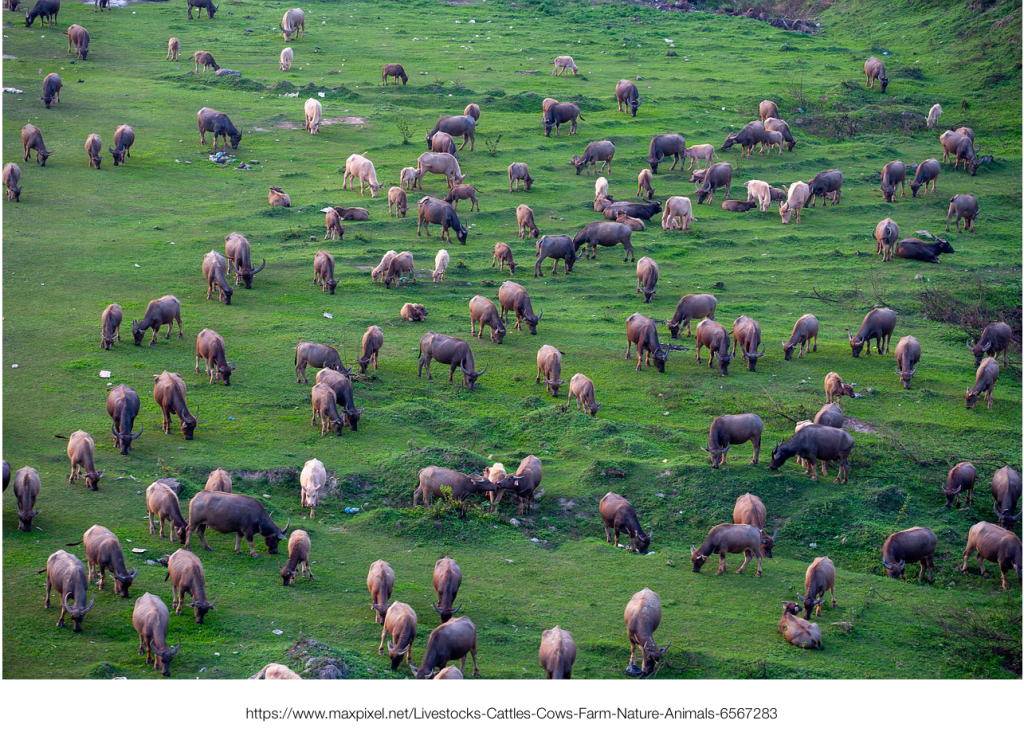
The same pattern of concentration occurs in animal farming too. Nearly all the world’s diary cows are based on one single breed, the Holstein. As with arable crops, there are advantages of protecting and promoting rare and ancients breeds of farm animals. But in terms of biodiversity what is more incredible is the sheer biomass of farm animals. They account for 60% of all mammals on the planet (of which cattle and buffalo  account for 40%); we humans account for 36% whilst the remaining wild mammals a mere 4%.

Globally 77% of agricultural land is used to raise livestock. This includes land used to grow animal feed. Yet this 77% produces less than  20% of the world’s calories. Land used for livestock could be better used to produce plant based food that would feed a greater number of people and/ or rewilded to increase biodiversity. Factoring in the carbon footprint of livestock, especially cattle, there are even more benefits to be gained from reducing livestock levels. 

Keeping Warm in Winter

  1. Wear layers of clothes. Each layer will trap air that is warmed by your body. Every layer is another layer of insulation. 
  2. Wear thermal underwear or alternatively wear extra leggings and T-shirts which will save having to buy more clothes.  
  3. Outside wear a hat, gloves and scarf – and why not do the same inside? Historically people have often worn hats inside – neat bonnets, Tudor caps,  Monmouth caps, smoking hats, head squares and scarves, beanies and berets. 
  4. Cosy socks and slippers are pluses too – make sure your winter shoes and boots are big enough to allow for warm/ thick socks. If you have thin socks, double up and wear two pairs.
  5. Close curtains and pull down blinds at dusk, for once  the sun sets temperatures will drop. Drawing your curtains will keep the warmth in the room. The more layers between you and the outside, the better the insulation. You might have blinds and curtains for example. Alternatively you can get extra thermal linings to hang behind your curtains. 
  6. If overnight your bedroom has remained warm, allow that warmth to permeate the rest of the house before opening the windows to air the room.
  7. If windows are draughty, you can seal the gaps with a proprietary stick on strip.  
  8. If your doors are draughty or if they are not very thermally efficient (maybe with lots of glass) you can hang a curtain to pull across at night time. You can make a sausage shaped door stop  to prevent draughts that come under a door, or if it is an external door you could fix on a draught excluder. 
  9. Take exercise – it will warm you up. If you get cold through sitting still, even running up and down the stairs a few times will help. 
  10. Wrap up well and have a brisk walk. 
  11. Have plenty of hot drinks and at least one hot meal a day. 
  12. Use a hot water bottle in bed – you can also use one if you are sitting down for a while, either under your feet or on your lap. Equally if you are sitting still for a while, have a blanket to put over your knees. Or if you are watching TV you might  wrap yourself in a blanket.
  13. Make a hand warmer – this could be a cotton bag filled with uncooked rice  that you heat for a few seconds in a microwave. You will find plenty of DIY instructions on line. Or you could use a small heat resistant bottle or jar, fill it with hot water and wrap it in a sock. 
  14. Our own body heat will  heat up a room. Plan your day so that you spend most of it in one room rather than heating up several spaces. 
  15. With all these measures, you should be able to turn your thermostat down so reducing your carbon footprint. Similarly use the controls on your heating to limit the number of hours you need the heating on. During the day, especially if the sun is shining, or if you are active, you will not need extra heating.

Green Tau: a reflection on integrity

This week (September 2021) saw a stand off between Christian climate activists and the clergy in St Paul’s cathedral over the Church of England’s continued investment in companies profiting from fossil fuels. It has distressed me greatly.

Woe to you … you tithe mint and rue and other herbs, and neglect justice and the love of God; it is these you ought to have practiced, without neglecting the other. (Luke 11: 42)

Is it that the Pharisees that Jesus was addressing have become so bogged down in the minutiae that they can’t see the bigger picture? Had they become so concerned that all the ‘t’s be crossed and the ‘i’s dotted that they could no longer read what the writing said? They could only see the spelling mistakes but not the story. 

Is it that they found it is easier to address the needs of personal hygiene than issues of  social justice, poverty and victimisation that were prevalent ills of the world in which they lived? Did they find it easier to keep washing their hands before meals than to address the luxury lifestyle enjoyed by Herod Antipas at the expense of the rural poor.  

Is it that by observing the smaller and easier religious requirements, that they could to all outward appearances be seen as upright exemplars of their faith and so earn the honour and respect of their fellow believers. Perhaps the observances of small things gave the impression of great integrity – if they so routinely practice these small religious acts how much more must they be observing the full law?

Yet Jesus sees through the outer show. He has seen that inside the polished exterior they are full of greed and wickedness (Luke 11:40). He is critical of them for their lack of love and disregard for justice. Whilst they have sought the best seats in the synagogue and respectful greetings in the market place, Jesus has been focused on the work of feeding the hungry, healing the sick, releasing the imprisoned, validating the forgotten, turning social expectations upside down, calling for a turning away from unsustainable lifestyles – and bringing in the kingdom of God. 

Jesus and his disciples knew from experience that doing God’s will meant getting hands dirty, getting down alongside the sick, withstanding jeers, taking the lower place, and ultimately to be self sacrificing. Such a lifestyle is not always easy, and do we not all want some degree of love and respect? Yet equally experience tells us that if we have confidence in God, even when we are ill-treated, scorned, marginalised, we will still find joy in doing God’s will.

Notice that in Jesus’s reply he reminds the Pharisees that doing the small things should have been an ‘and also’ to the exercise of love and justice. Paying attention to the small things as well as the large is about integrity. For this reason we see Jesus coming to be baptised alongside his fellow country folk. We see Jesus going regularly to the synagogue and taking his turn to read the scripture. We see Jesus observing the traditions of Passover. But for Jesus outward actions do not take the place of an inward commitment to the kingdom of God. 

At the present time the single most overwhelming disaster facing the world – God’s world – is human-made climate change. The effects of the rise in global temperatures is already being felt, and the accelerating affect that ongoing temperature rises will create is predictable. Plants and creatures unable to adapt are rapidly becoming extinct. Humans too are struggling and failing to adapt.

The elderly cannot readily cope with extremes of temperature and death rates are rising. The poor cannot afford to adapt their homes to improve insulation levels nor can they afford house insurance against flooding and fires as these becomes more frequent. Not can the poor readily move to more amenable climes. Islanders and those living along river deltas cannot stop rising sea levels from destroying their homes. Farmers cannot adapt practices quick enough to cope with extreme weather conditions. Young children cannot survive as drinking water supplies dwindle to nothing.

All this because we did not pay heed to the warnings, we did not stop polluting the atmosphere with more and more carbon dioxide. Instead we have kept our focus on our everyday habits – school run refuel the car, laundry in the tumble dryer, Sunday lunch roast beef, half term holiday in the sun- and ignored the long term direction of the climate crisis. We have not wanted to admit our responsibility for climate change, not even accepting that we might have been unknowingly guilty of causing harm. Nor have we wanted to change our lifestyles, our habits of a life time – to forgo our metaphorical seats in the synagogue – or loose the respectful comfort of western citizenship.

Surely, we said, this problem is so big it must be a problem for governments, big businesses and world organisations to deal with? It must be their responsibility not ours. And if they act as if there is no emergency, no urgency to act, should we not follow their lead and let things sort themselves out?

We are happy to do the small things, to reuse our plastic carrier bags, recycle the newspapers, buy an eco friendly hammock for the garden and make sure our new T-shirt is made from organic cotton. But to address the big problem, to seek love and justice for the earth and all its inhabitants, is beyond what we can even imagine. 

But in the background there have been people calling for and working for change. People who see the problem for what it is and see the scale and urgency of the changes needed. People who are prepared to stand up and stand out and say it like it is. 

And where in all this is the church? Where in all this are those who are followers of Christ? Where is the leadership, the penitence, the will to turn things round? Why are we still counting out our tithe of mint and rue whilst supporting a vast carbon producing, fossil fuel dependent economy?

Since writing this reflection, all dioceses in the Church of England, the Church Commissioners and the Church of England Pensions Board have divested from fossil fuels. (Note added July 2026)

Count Down


 Action 8: The climate crisis is affecting the whole world. Sometimes in the UK it can seem as if the effects of the crisis are minimal – although recent flash floods and heat waves are changing this -so why not  choose a country somewhere else in the world -eg in the Pacific or the Arctic – and find out how life there is being changed.

Far away and near at hand

The floods were far away

Now there near at hand. 

How long before I wet my feet 

and take a stand?


The heat was far away.

Now it’s close to home.

How long before I own the fact 

and finally begin to act?


Hurricanes were tropical.

Now they’re topical.

How long before I feel my guilt 

and understand the world we’ve built? 


Our climate is changing –

Far away and near at hand. 

Holy God, redeem our failings

and strengthen our resolve:

far away and near at hand.