We often think of the Yorkshire moors and the fells of the Lake District as being naturally wild areas. But in fact they are areas shaped by human intervention and in particular by livestock grazing, and sometimes this is depressing localised biodiversity. For example over stocking with sheep can lead to a lack of plant diversity including a lack of tree saplings, with a detrimental impact on insects and birds, and the increased risk of flooding and landslides.
However things could be different as Rewild Britain explains in their web site –
Rewiggling rivers – allowing them to follow their natural winding tendency – and allowing them to spill out into their local floodplain, has the same affect as a rain garden but in a larger scale. This Rewilding benefits biodiversity and reduces unpredictable flood risks. The following is from Thames21:-
“ Reintroducing a more natural system that creates space for increased water flow means less flooding and reduces the pressure on London’s struggling drainage system. Improvements like installing reed beds not only create new habitats for wildlife, but help to trap pollutants before they flow downstream.
“Removing barriers and concrete channels, and creating beautiful new wetland areas brings rivers back into the heart of communities; makes them more biodiverse and improves the wellbeing levels of people who visit them. Those living near the river restoration projects across London report a better community spirit as the amount of shared space, and opportunities for volunteering and community action, have increased.”(1)
We should be encouraged that so much work is happening and so be encouraged to press for and support the so much more that could be done!
Rewilding describes the process of recreating or restoring natural environments where nature is given a helping hand – for example by introducing a small number of pigs or cattle to replicate the activities of their wild forebears. In this way the hope is to allow the natural environment to recover the form it would have had before being reshaped by humans. Notable examples include the Knepp Estate but also less well known ones such as Ennerdale in the Lake District and the Sussex Kelp Recovery Project – ocean and sea beds are just as much in need of restoration as natural environments.
Whilst not pristine, are there other environments where the impact of humans is minimal such that we can consider them to be natural? Perhaps here we mean a landscape or ecosystem shaped by nature not humans? Perhaps we mean a landscape that was once shaped by humans but has now reverted to one free of human contact?
One such example would be Monks Wood Experimental Station – a four hectare arable field next to a research station which was ploughed after the last crop had been harvested and was then abandoned. It was left without any human interference to see what would happened. Kenneth Mellanby, the then director of the Station, wrote “It might be interesting to watch what happens to this area if man does not interfere. Will it become a wood again, how long will it take, which species will be in it?”
Sixty years later and the results can be seen – “a structurally complex woodland with multiple layers of tree and shrub vegetation, and accumulating deadwood as the habitat ages. This complexity offers niches for a wide variety of woodland wildlife, from fungi and invertebrates in the dead logs and branches, to song thrushes, garden warblers and nuthatches which nest in the ground layer, understorey and tree canopy.” https://www.positive.news/environment/rewilding-sixty-years-ago-scientists-let-a-farm-rewild-heres-what-happened/
For a change of emphasis, I plan over the next few weeks to look at some of the things we do as a household to live more sustainably. Maybe what we do might prompt some thoughts for you, and maybe you will have some ideas to share as well.
I follow a vegan diet and as I am the main cook, all home cooking is vegan!
Vegan diets have a smaller carbon footprint and cause less damage to the climate – research suggests somewhere in the region of 75% less! The food grown for vegan diets uses less water and less land – largely because of the significant amounts of land and water needed to grow feed for farm animals. Needing less land has two benefits – first the ability to grow more food for a growing population, and second the ability to set aside more farm land for rewilding and restoring levels of biodiversity.
I also chose a vegan diet on the grounds of animal welfare. Even eating a vegetarian diet involves the slaughter of young animals – principally male chicks and male calves – as well as the likelihood that the females will have stressful lives of repeated birthing.
I can see that for some people raising low intensity livestock can be a key part of a farm’s ecology, and that eating small amounts of meat and dairy would be consistent with that.
Yorkshire Rewilding comments “Whether you have a patio, an allotment, a grand estate or oodles of passion, you CAN make a difference. Rewilding works at every scale. The real power lies in joining the dots — connecting the places and people working towards a common goal: a Yorkshire teeming with life at every level.” https://www.yorkshirerewildingnetwork.org.uk/
The same is true for other areas. Here in Richmond parks and various streams and rivers, including the Thames forms a network of green spaces and green corridors which favours biodiversity. Richmond is also an area with plenty of gardens and allotments and they too could be areas for re-wilding and nature positive cultivation. The London Wildlife Trust writes “There are over three million gardens in Greater London – 3,267,174 to be precise. That’s an area of 37,942.09 hectares*. In the face of climate change and habitat fragmentation, this massive expanse of green space has enormous untapped potential for both people and wildlife. However, worrying research by London Wildlife Trust shows that London’s gardens are changing from green to grey.”
I have recently spent a few days away in Settle in North Yorkshire. Settle is a small and active town, located on the Settle to Carlisle railway so easily accessible by train. Whilst here we have enjoyed exploring the local area follow some of the numerous footpaths. The Yorkshire Dales are traditionally appreciated as vast expanses of open moorland, green fields crisscrossed with dry stone walls, and sheep! And that is certainly what you find here. Being spring, the fields are full of lambs – gambling about in pairs but still keeping in close proximity to mum.
But it hasn’t always been so. In the past farming was more diverse and included beef and dairy cattle, poultry, and arable crops, as well as the cultivation of trees such as willows for basket making. Diversity in farming lends itself to diversity in the environment. One writer commenting on current biodiversity in the Yorkshire Dales, noted that more diversity is to be found along the roadsides and verges than in the fields. From my observation that is true – on a roadside I might count as many as a dozen plants (I am no expert) in few meters, whereas in the fields I was seeing just the occasional dandelion and celandine amidst the short cropped grass. Sheep do eat everything! Even more rewarding where the sections of footpath, river and railway banks where all grazing animals had been excluded. Here there were bluebells, primroses, cowslips, violets, lady’s smock, buttercups, daisies, and wood anemones – and in large number!
Sheep farming has become a monoculture form of agriculture and it is to the detriment of biodiversity. In some areas, tree planting is happening which benefits biodiversity. Over the couple of days we were walking we saw only one pair of buzzards and they were circling above a copse (which may have been coincidental). Elsewhere we came across a notice telling us that trees had been planted on the banks of the Ribble to shade the water to mitigate the effects of rising temperatures. If water temperatures rise above 22C for a week or more fish die! The Ribble is currently still home trout and salmon.
Without sheep the landscape would return to a mix of grass and woodland – and would therefore also be a greater storer of carbon. Such a landscape would be as attractive for walkers. Walkers and tourism is an important part of the local economy, but can it bring in enough money to support a rich and diverse local economy? One of the things that sadden me as we walked, were the disused barns and farm houses. The smaller farms may have ceased to be economic some while ago, and equally with a shift from mixed farming to sheep farming with bought-in animal feed, many of these buildings are surplus to requirement and inconveniently placed vis a vis roads and services. Could they become homes for people who prefer to work remotely? This is apparently one way in which remote islands are gaining an influx of younger people. Or should we accept their decline as part of the natural cycle and see them as potential new habitats in the same way that dead trees support an ongoing stream of life as they decay into their locality?
Should we, as tax payers, pay farmers to become nature wardens? They could enable the rewilding of greater parts of the landscape, repair the dry stone walls – which are as a valid part of our heritage as ancient castles – maintain pathways and mark them at regular intervals to encourage people to use not just the well-known routes but the lesser used ones too. In essence such people would be employed to maintain the health of our environment and be as important as those in the NHS who maintain people’s health.
My husband is a railway enthusiast so we took the train to see the Ribblehead viaduct. Now embedded into its moorland environment, where the grasses and mosses have covered over any remaining marks of the building site that enabled its construction, it is a thing of beauty. It is an industrial artefact that has come to lend grandeur to an otherwise commonplace wild landscape. It is probably as much photographed as the nearby Three Peaks. I wonder if this windswept area could also absorb into its identity silvery white turbine blades. Wind farms could generate energy to support the local economy – and maybe too, an electrified railway line.
In Scotland a local community has bought land from the Buccleuch estate in order to rewild the land restoring its habitat to support enhanced biodiversity.
THE STORY SO FAR
Who: Langholm Initiative: Margaret Pool (former Chair); Jenny Barlow (Estate Manager) Where & when: Dumfries and Galloway, Scotland, from 2019 What: Community buyout of former grouse moor to be managed as a nature reserve How: Clearing conifer plantations; creating new woodlands; conserving precious habitats and fostering nature recovery, planning new sustainable economic activities Future potential income: Tourism, educational and research activities, regenerative farming, possible renewable power Ecosystem benefits: Nature recovery on over-grazed hillsides; conservation of rare valley woodland; peat restoration; wetland conservation; soil recovery; flood prevention. https://www.rewildingbritain.org.uk/explore-rewilding/meet-the-rewilders/meet-the-rewilders-langholm
Support wildlife and rewilding projects to increase biodiversity, and improve the health of our environment and our own selves. The RSPB, the Wildlife and Wetlands Trust, the National Trust, the Woodlands Trust, the Wildlife Trusts, A Rocha, plus even more local groups such as the Friends of Palewell Common are part of a growing trend to take responsibly our all calling to care for the natural world.
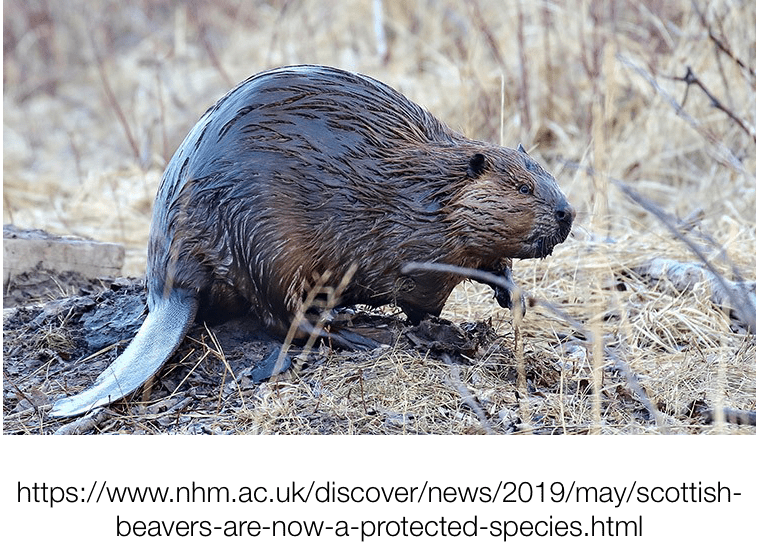
Reintroducing previously native species such as the beaver. Beavers are useful members of our natural ecosystem especially in shaping and managing rivers and preventing flooding. Beavers, hunted to extinction 400 years ago, have been reintroduced into the wild in about 20 locations across the UK.

 The Green Tau