
Proper 22 16th Sunday after Trinity 

5th October 2025

Reflection with readings below

Habakkuk faces a world in which everything seems to be going awry. All he sees is violence and wrong doing, destruction and the failure of justice. He cries out to God and it seems as if God is not listening. How true does that feel today? Do we not feel like giving up? Giving up on the world where everything seems to be set against doing what is right? Giving up in a world where God seems absent? Can we nevertheless be like Habakkuk and stay in post, keeping up the watch, and wait on God’s word?

How did Habakkuk manage to stay strong? Because he had faith. He had a faith that came out of the close relationship he had with God – “the righteous live by their faith”.

Habakkuk and the Psalmist must have had great patience. They seem to be able accept that they must wait for justice to prevail without any idea of the timescale involved; that they must maintain this patient waiting without not get angry or frustrated! I don’t think we even know if Habakkuk saw the return of peace to the land. He wrote in the period between the  conquest of Nineveh which presaged the end of the Assyrian Empire and before the final conquest of Jerusalem by the Babylonians. Certainly he couldn’t have lived to see the rebuilding of Jerusalem.

So how the do we respond to the words of Jesus in the Gospel: “If you had faith the size of a mustard seed, you could say to this mulberry tree, `Be uprooted and planted in the sea,’ and it would obey you.”?

What is faith and where does it come from? Synonyms for faith include trust, confidence, credence, conviction, hope, belief, expectation, hopefulness, optimism and assurance. The word faith has a strong connection with religious or spiritual belief although it is also used to describe the relationship a servant and their master, between a knight and their Lord, between a partisan and their political leader – or political creed. Faith it would seem is about relationships. For Habakkuk it was the relationship between the righteous and God. For  Christians, faith is, I think, our relationship with God that has developed through our relationship with Jesus. 

Where does it come from? It’s certainly not something you can buy! Nor is it something you just stumble across.  Rather I think it is something that we all have as a gift from God. We understand God to be the creator – the source point – of all that lives. And we understand that God blessed all that she created, and I would suggest that in both creating and blessing us, God has placed in each of us a seed of faith – one that can never die. On the other hand we each have in our own ways the capacity to enable that seed to flourish enabling our relationship with God to depend and expand – or we can suppress and hide it and try and ignore any relationship with God. (Last week I spoke about the close relationship that prophets have with God).

I’m not sure about faith that can uproot a tree and plant it in the sea but that maybe a hyperbole challenging us to be amazed at what faith can achieve. 

Yesterday was the feast of St Francis. During one of the crusades, Francis through his deep faith and his belief that war was contri to God’s will, set out for Damietta where the Crusaders and the Muslims forces were battling with one another in an attempt to secure control of the Holy Land.  With only one companion Francis set off on foot for the Sultan’a camp, crossing no-man’s land, with the hope of speaking with the Sultan and  finding a basis for peace. His faith – a faith that says continue against the odds because God is with you – took him right to the Sultan’s tent. Whether because of his humility, or his determination or maybe because of his poor and bedraggle appearance,  Sultan spoke with Francis. Whilst the outcome wasn’t peace, the Sultan acquired a new respect for this small Christian figure and granted him safe passage back home. 

This week a flotilla of little sailing boats reached the waters off Gaza. These boats were crewed by volunteers from around the world who had faith that what ever one does, doing what is right is more important than doing what is safe or tactful, and who had determined to address the painfully acute shortages being faced by the people on Gaza by taking medicines and baby milk and other essentials supplies across the Mediterranean and into Gaza, regardless of the Israeli blockade and the attacks they received on the way (also likely from Israeli forces). They arrived off the coast of Gaza on Thursday morning to be blasted by water canon and surrounded by Israeli vessels who then boarded the boats and arrested all the crew.

As yet we don’t know what the long term impact of the flotilla will be but it has sparked many voices of protest and outrage across the world at what the Israeli government is continuing to do in terrorising the people of Gaza. 

Over the last ten days 6 people have been on trial for climbing on motorway gantries in 2023 which they did to highlight the climate crisis and the lack of an adequate response by those in authority. They too have a faith that, what ever one does, doing what is right is more important than doing what is safe or what is popular. In the knowledge that the current trajectory of the world is for at least 2, and possibly more, degrees of warming – which will cause even more suffering with increased risks of floods, droughts, wild fires, crop failures and heat waves – they were not willing to sit back and do nothing while more and more people risk loss of homes and livelihoods and death. At the outset the judge ruled that there were no legal defences that they could use – not even the defence of necessity in the face of a greater threat. All six spoken eloquently and from the heart, remaining faithful to the cause of what is right. All six were found guilty. 

As Mother Theresa said, we “aren’t called to be successful; we’re called to be faithful”.

Like Habakkuk we cannot not remain faithful even when things are going awry, when the future looks impossible, nor even when our chances of ‘success’ are pitiful. We can’t always see the bigger picture. We can’t always see what lies ahead of us. But we do know we can always faithfully do that which is  asked of us: to love mercy, to seek justice and to walk humbly with God.

The Book of Habakkuk ends with these verses: 

Though the fig tree does not blossom,

    and no fruit is on the vines;

though the produce of the olive fails

    and the fields yield no food;

though the flock is cut off from the fold

    and there is no herd in the stalls,

yet I will rejoice in the Lord;

    I will exult in the God of my salvation.

God, the Lord, is my strength;

    he makes my feet like the feet of a deer,

    and makes me tread upon the heights. Habakkuk 3:17-19

Habakkuk 1:1-4, 2:1-4

The oracle that the prophet Habakkuk saw.

O Lord, how long shall I cry for help,
and you will not listen? 

Or cry to you “Violence!”
and you will not save? 

Why do you make me see wrong-doing
and look at trouble? 

Destruction and violence are before me;
strife and contention arise.

So the law becomes slack
and justice never prevails.

The wicked surround the righteous–
therefore judgment comes forth perverted.

I will stand at my watchpost,
and station myself on the rampart; 

I will keep watch to see what he will say to me,
and what he will answer concerning my complaint. 

Then the Lord answered me and said:

Write the vision;
make it plain on tablets,
so that a runner may read it.

For there is still a vision for the appointed time;
it speaks of the end, and does not lie. 

If it seems to tarry, wait for it;
it will surely come, it will not delay.

Look at the proud!
Their spirit is not right in them,
but the righteous live by their faith.

Psalm 37:1-10

1 Do not fret yourself because of evildoers; *
do not be jealous of those who do wrong.

2 For they shall soon wither like the grass, *
and like the green grass fade away.

3 Put your trust in the Lord and do good; *
dwell in the land and feed on its riches.

4 Take delight in the Lord, *
and he shall give you your heart’s desire.

5 Commit your way to the Lord and put your trust in him, *
and he will bring it to pass.

6 He will make your righteousness as clear as the light *
and your just dealing as the noonday.

7 Be still before the Lord *
and wait patiently for him.

8 Do not fret yourself over the one who prospers, *
the one who succeeds in evil schemes.

9 Refrain from anger, leave rage alone; *
do not fret yourself; it leads only to evil.

10 For evildoers shall be cut off, *
but those who wait upon the Lord shall possess the land.

2 Timothy 1:1-14

Paul, an apostle of Christ Jesus by the will of God, for the sake of the promise of life that is in Christ Jesus,

To Timothy, my beloved child:

Grace, mercy, and peace from God the Father and Christ Jesus our Lord.

I am grateful to God– whom I worship with a clear conscience, as my ancestors did– when I remember you constantly in my prayers night and day. Recalling your tears, I long to see you so that I may be filled with joy. I am reminded of your sincere faith, a faith that lived first in your grandmother Lois and your mother Eunice and now, I am sure, lives in you. For this reason I remind you to rekindle the gift of God that is within you through the laying on of my hands; for God did not give us a spirit of cowardice, but rather a spirit of power and of love and of self-discipline.

Do not be ashamed, then, of the testimony about our Lord or of me his prisoner, but join with me in suffering for the gospel, relying on the power of God, who saved us and called us with a holy calling, not according to our works but according to his own purpose and grace. This grace was given to us in Christ Jesus before the ages began, but it has now been revealed through the appearing of our Saviour Christ Jesus, who abolished death and brought life and immortality to light through the gospel. For this gospel I was appointed a herald and an apostle and a teacher, and for this reason I suffer as I do. But I am not ashamed, for I know the one in whom I have put my trust, and I am sure that he is able to guard until that day what I have entrusted to him. Hold to the standard of sound teaching that you have heard from me, in the faith and love that are in Christ Jesus. Guard the good treasure entrusted to you, with the help of the Holy Spirit living in us.

Luke 17:5-10

The apostles said to the Lord, “Increase our faith!” The Lord replied, “If you had faith the size of a mustard seed, you could say to this mulberry tree, `Be uprooted and planted in the sea,’ and it would obey you.

“Who among you would say to your slave who has just come in from plowing or tending sheep in the field, `Come here at once and take your place at the table’? Would you not rather say to him, `Prepare supper for me, put on your apron and serve me while I eat and drink; later you may eat and drink’? Do you thank the slave for doing what was commanded? So you also, when you have done all that you were ordered to do, say, `We are worthless slaves; we have done only what we ought to have done!'”
Green Tau: issue 108

16th June 2025

A different take on ‘chastity’

“Members of the Third Order fight against all such injustice in the name of Christ, in whom there can be neither Jew nor Greek, slave nor free, male nor female; for in him all are one. Our chief object is to reflect that openness to all which was characteristic of Jesus. This can only be achieved in a spirit of chastity, which sees others as belonging to God and not as a means of self-fulfilment.”

At the same workshop I mentioned in  Green Tau 107, we also reflected on the above. This is the  Franciscan (TSSF – Third Order of the Society of St Francis) principle given for day 8. Its understanding of chastity as not making use of someone else, not using someone else as a means of fulfilling our desires, is noteworthy. Making use of other people is something that is easily done, and often unconsciously. 

For example when we buy a cup of coffee, is our desire for the drink being satisfied through the exploitation of underpaid coffee workers in distant parts of the world? Is it being met by the exploitation of café staff who scrape by on a zero hours contract and the minimum wage? 

The teaching of St Francis (which itself follows the understanding gained from Genesis 2, Job 38 and psalms 19 and 104 etc) is that all parts of creation – birds and animals, sun and moon, wind and fire, and all manner of plants – and not just fellow humans, are our brothers and sisters and should be respected and treated as such, for they are all created by God and each praises God. So when we are asked to see ‘others as belonging to God and not as a means of self-fulfilment’ then included in all those others, are birds and animals, sun and moon, wind and fire, and all manner of plants etc. We should not be using or exploiting that which God has created as our brethren here on Earth.

For example, if we think to buy a dog, we should not see having that dog as a means of satisfying our own needs – maybe for companionship or protection or as an instagram prop – but as a brother or sister worthy of respect and care.

Or for example, if we buy a pint of milk, we should consider whether our desire for milk is being met by a system that sees a cow as a milk-producing machine that will be slaughtered at at the age of 4 to 6 years. 

Or for example, when we fly or drive a petrol car, we should consider whether our desire for travel is being met by a system that sees the atmosphere as a useful place to dispose of greenhouse gas emissions even though that space is already over full. 

We don’t live in a perfect world, and many of the systems within which we live are not ones we can readily change – but that should not stop us being aware of the times when we are exploiting others and when we can, changing the way we behave, and when we can’t pressing for change.

For the full set of principles and objectives visit https://tssf.org.uk/tssf-downloads/about-the-third-order/the-principles-of-the-third-order/

Counting on … day 1.186

4th October 2023

Today is the Feast of St Francis. He is well known for his insight that all of creation is interconnected and equal in the sight of God. Thus he spoke of brother Sun and sister Mother Earth.  Not surprisingly St Francis is names the patron saint of the environment. St Francis was equally concerned about peace making, calling for peace whether that was between neighbours or between the saracens and the crusaders.  

Caring for the environment and peace making go hand in hand. Failure to care for the environment leads to conflict; conflict damages the environment. 

To be an environmentalist is to be a peacemaker.

 Counting on …day 364

30th October 2022 

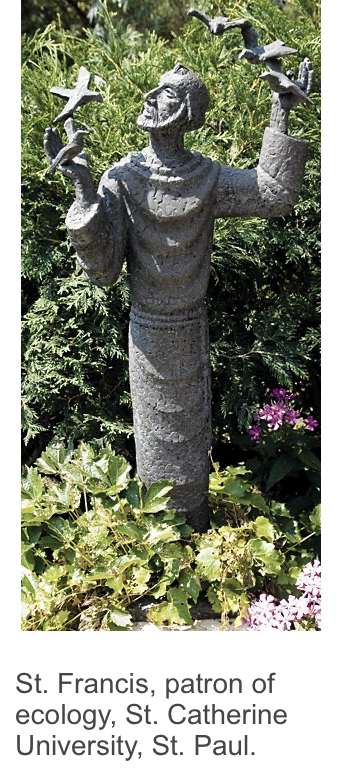
In 1979 St Francis was declared the patron saint of ecology reflecting his deep sense of the connectedness of all aspects of creation and in which all creation lives to praise God. Francis undertook very radical changes in his lifestyle in order that he could be true to his understanding of God, and yet – or because of this – he was also full of joy. 

Counting on …day 328 

4th October 2022

Today is the feast of St Francis, patron saint of ecology. Like the writers of the Old Testament and Jesus, Francis understood the innate connectedness that humanity shares with the rest of creation. It is a connectedness created by God. When we live in harmony we worship God; when we live in disharmony we grieve God. 

Laudate Si: discussion notes 1

These notes were first produced in the autumn of 2021 for our ecumenical house group. They are based around the encyclical letter written by Pope Francis. You don’t have to have read the encyclical to use the discussion notes but I would recommend it as worth reading. The encyclical is available to read on line – https://www.vatican.va/content/francesco/en/encyclicals/documents/papa-francesco_20150524_enciclica-laudato-si.html

Introduction.

“Laudate Si – care of our common home” is an encyclical written by Pope Francis in 2015 in response to the various environmental crises facing the world. This was the same year that produced the Paris Agreement on Climate Change and the UN’s Sustainable Development Goals. The former set goals to keep the rise in global temperature (compared with pre industrial levels) to within at least 2C  and ideally less than 1.5C, as being the only way to substantially reduce the effects of climate change. This reduction was to be achieved by cutting green house gas emissions with a target of net zero emissions by 2050. (The Agreement included 5 yearly interim targets for the period to 2030). The latter SDGs set 17 interlinked goals which are intended to produce a good and sustainable future for everyone. With a target date of 2030, these goals include an end to poverty, an end to hunger, gender equality, quality education for all, peace and justice and the institutions to maintain them etc. 

Into this focus on reducing the impact of climate change and of creating a sustainable way of living that would benefit the whole world, Pope Francis’s encyclical brings a welcome theological dimension for protecting the earth and its human society.  It also brings in the equally theological understanding that humans have a responsibility to act to ensure these changes happen.

Five plus years later, that need for action is still there. This autumn the COP26 climate conference – the successor to the conference  that produced the 2015 Paris Agreement – will be taking place in Glasgow. It will need to lay out clear targets and specific plans for their implementation, to ensure the whole world does indeed become net zero carbon by 2050 and that global temperature increases are kept within the 1.5C safety range. Can we once again take the message from Laudate Si and use it to bring about the changes needed? 

In 2020 Cafod launched its Reclaim our Common Home campaigns (https://cafod.org.uk/Campaign/Reclaim-our-common-home) which draws heavily on the themes covered by Laudate Si. The campaign calls on individuals, organisations and government to take action to:-

  • RECLAIM nature so that everyone can breathe clean air and be protected from the threat of climate disasters.
  • RECLAIM the world’s land and resources so they are more fairly distributed and all our brothers and sisters around the world can live in dignity.
  • RECLAIM power so that everyone can be involved in decision making and have control over their own lives.

 What’s in a name? 

Laudate Si, meaning praise be, is the repeated refrain from the Canticle of the Creatures written by St Francis circa 1225 (see page 5 for a copy). Its verses call on the listener (and the cantor) to praise creation, identifying each part of creation as one of humanity’s many siblings, from Bother Sun and Sister Moon to Sister Death. This valuing of creation as co-equals with humanity is picked up repeatedly in St Francis’s approach to life. It is told of in the stories of Francis preaching to the birds and acting as an arbitrator between a man-eating wolf and the villagers of Gubio. It is an interconnectedness that is now recognised by both scientists and environmentalists – and one hopes by economists.

The second part of the encyclical’s title talks of ‘our common home’. The earth, this world in which we live, is our home, but not just our home but that of all manner and number of other living beings, plant and animal. Just as we are all brothers and sisters, so we are all part of one household. Study of our common home gives us the word ecology – the Greek oikos  means house or habitation/ habitat and  logia means study.

  1. Praise Be! Let all creation praise God in its differing ways and let humanity – both in words and art forms – praise God by praising every part of creation! The psalms include many lines praising God, praises that come from humans as well as praises that come from creation itself – psalm 19 is a good example. In what ways do you most naturally or readily praise God through praising creation?
  1. Do we devote enough time and energy to  celebrating the wonder and beauty of creation? Do we share this joy often enough with other people? (This is one way in which we can share the good news). Would a more widespread enjoyment and admiration of the beauty of creation, induce a more widespread and concerted concern for the well being of our environment? Is this one reason why writings such as Laudate Si are so important?
  1. As well as psalms of praise, there are psalms of lament – psalms that cry out to God with words of suffering, pain, anguish and despair (for example psalm 31:9-13). Usually we read such psalms as being the lament of a human being, but should we be ready to hear them also as a lament of an animal or bird, a river or even a landscape? How might that change the focus or feel of our private or corporate worship?
  1. Given that we are brethren or siblings together, living in a common home, why is it that we as humans have a) managed to so disrupt or distort the ecosystem such that life as we know it is threaten, and b) feel that we have a responsibility to God to do all we can to correct these things? 
  1. The psalms of lament invariably lead to cries of repentance, of contrition, of seeking God’s mercy and of turning one’s life around. How often do we take time to examine our lives from an ecological viewpoint? How often do we reflect on the degree of suffering our lives may be causing our creaturely brothers and sisters? Might contrition prompt us to both make a fresh start and to make good the damage we have caused? 
  1. The creation story in Genesis chapters 2 and 3, describes how the harmonious relationships between humans and God, and between humans and other living beings became broken. St Francis’s experience and practice of being at one with all living things has been seen as a way of  caring for, and increasing awareness of, our mutual relationships with nature. Can this practice also improve our relationship with God?
  1. What does it mean to share a common home? I am sure at some point you have had experience of having to share your home with someone else. Maybe a new sibling or your own new born child, maybe a returning adult child or an elderly parent, maybe a cat or dog, maybe a lodger or a carer. Current and incoming inhabitants have to make adjustments, there will be times when either party must bear or forebear, sometimes additional leeway is called for whilst at others a reassessment of house rules may be needed. At the end of the day an accommodation has to be found that is acceptable to all parties. How good are we at sharing our global home, our national home, our local  ‘home’ with others? Is it our inability to share that causes most grief?
  1. The covid pandemic has shown us how interconnected our world is, whether through the transfer of viruses  between species or the transfer of mutations between countries. It has changed our view of what is important about where and how we live. Has it also shifted our understanding of the role leaders and governments play? Has it challenged our reliance on them? Has it instead increased our reliance on God and neighbour?

Prayer

Loving God, 

Open our minds and touch our hearts

so that we may attend to your gift of creation … 

Now more than ever may we feel 

that we are all connected and interdependent; 

enable us to listen and respond 

to the cry of the Earth and the cry of the poor. 

May the present sufferings be the birth pangs 

of a more familial and sustainable world. 

We make this prayer through Christ our Lord.

Amen. 

Prayer for the Sixth Anniversary of Laudato Si’:  Columban Missionaries (Britain)

Active Response 

In Laudate Si, Pope Francis says that our friendship with God is often linked to particular places which take on a intensely personal meaning. This might include mountains or vistas, places where we played as children, churches,  sea coasts. Revisiting them may enable us to recover something of our true selves (Laudate Si section 84). Later Pope Francis commends paying close attention to the natural world – it being a continuing revelation of the divine – so that we might more clearly see ourselves as part of the sacredness of the living whole (Laudate Si section 85).

Between now and our next meeting, practice with praising creation, with exploring places of personal significance and/ or with contemplating the natural world, and note how it affects your relationship with God and with your creaturely siblings.

This poster is the work of  Elizabeth Perry/CCOW (Christian Concern for One World)