
Counting on … day 85

12th April 2024

Fossil Fuel Subsidies -2

“Since the Paris Agreement, the government has provided £13.6 billion in subsidies to the UK oil and gas industry. From 2016 to 2020 companies received £9.9 billion in tax relief for new exploration and production, including £15 million of direct grants for exploration, and £3.7 billion in payments towards decommissioning costs.” https://www.ethicalconsumer.org/energy/paid-pollute-fossil-fuel-subsidies-uk-what-you-need-know

Research from 2023 commissioned by the Liberal Democrats showed that between 2015 and 2020 renewable energy received £60bn in subsidies whilst fossil fuels received £80bn. In 2020/1 fossil fuels received £1bn whilst renewable energy received a mere £1m!  https://www.theguardian.com/environment/2023/mar/09/fossil-fuels-more-support-uk-than-renewables-since-2015

Such subsidies are the explicit subsidies. As far as I know, renewable energy generation does not produce pollutants or other harmful side effects. Whereas we as citizens and tax payers are also paying for the implicit subsidy of fossil fuels through ill health caused by pollution from fossil fuels, as well as ill health caused by excess temperatures; through the extra cost thus imposed on the health service; from the extra cost of food as more harvests fail; and the extra cost of repairing buildings and infrastructure affected by extreme wind/ rain and temperatures. 

According to Kisters (an international environmental data and insights organisation that focuses on gathering and reporting data on the water, weather, energy, environment and IT sectors) “the cost of natural disasters in the UK is rising by 11.2 per cent a year, while the UK’s GDP grew by 4.3 per cent in 2022 (according to the Office for National Statistics)…Floods are the most expensive risk the UK faces at present, with the cost of dealing with extreme flooding projected to rise to $217.2bn by 2030-2039 without intervention. But an increasing number of extreme storms also poses a threat. Between 2010 and 2019 storms cost the UK around $1.6bn, but by 2030-2039 this is estimated to rise to $3.8bn. In 2020-29, Kisters predicts the UK government will spend $43.8bn on dealing with the effects of all climate-caused natural disasters.” https://www.newstatesman.com/spotlight/sustainability/climate/2023/12/extreme-weather-natural-disasters-uk-economy-government
Counting on … day 84

11th April 2024

Fossil Fuel Subsidies -1

This overview of fossil fuel subsidies comes from the IMF: “Subsidies are intended to protect consumers by keeping prices low, but they come at a substantial cost. Subsidies have sizeable fiscal consequences (leading to higher taxes/borrowing or lower spending), promote inefficient allocation of an economy’s resources (hindering growth), encourage pollution (contributing to climate change and premature deaths from local air pollution), and are not well targeted at the poor (mostly benefiting higher income households). Removing subsidies and using the revenue gain for better targeted social spending, reductions in inefficient taxes, and productive investments can promote sustainable and equitable outcomes.” (1)

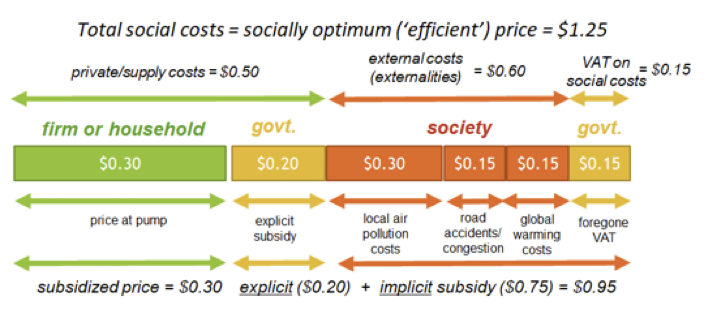
The article goes on to explain the difference between explicit and implicit subsidies, the former being the obvious direct payments to fossil fuel producers to bring down the unit cost of the fuel. The latter is a subsidy that is likely always present, vis in the practice of not charging the fossil fuel producers for the costs of pollution, climate change etc that are a consequence of their business. 

“Implicit subsidies occur when the retail price fails to include external costs, inclusive of the standard consumption tax. External costs include contributions to climate change through greenhouse gas emissions, local health damages (primarily pre-mature deaths) through the release of harmful local pollutants like fine particulates, and traffic congestion and accident externalities associated with the use of road fuels”(1)

By way of example they provide the following bar chart: 

(1) https://www.imf.org/en/Topics/climate-change/energy-subsidies

Counting on … day 1.104

28th April 2023

An article from the We Mean Business website points to the importance of switching from fossil to renewal energy to limit the rise in global temperatures. It is hoped that this will be the basis of the outcomes from the G7 meeting in Japan next month

“The Group of Seven nations’ energy ministers agreed this week to accelerate the phase out of all fossil fuels as an essential step in our efforts to limit global temperature rise to 1.5°C.

To replace them with clean energy in the timescale required means immediately repurposing billions of dollars’ worth of fossil fuel subsidies that G7 nations still offer.

In 2021, G7 fossil fuel subsidies came to over $80 billion. Redirecting this capital towards scaling up renewables, increasing energy efficiency and supporting communities affected by this transition will put our climate goals within reach.”


https://www.wemeanbusinesscoalition.org/blog/to-phase-out-fossil-fuels-the-g7-must-stop-subsidising-them/?utm_source=Climate+Weekly&utm_campaign=1805d3d517-EMAIL_CAMPAIGN_2023_04_21_02_34_COPY_01&utm_medium=email&utm_term=0_-947741a97e-%5BLIST_EMAIL_ID%5D