9th November 2025

Reflection with readings below

The first chapter of the book of Haggai is set a month before today’s passage. In it Haggai is told by God that it is not yet time to rebuild the Lord’s house. But then God speaks again asking Haggai to consider the wellbeing of the people – they have planted much but harvested little; they have something to drink but not enough to satisfy their thirst; they have clothes but not enough to keep warm. And God says “Give careful thought to your ways.”

It seems that God is setting the ground – maybe enacting a parable – that challenges the people to understand that there are different ways of living. They can live according to the ways of the past, of convention, which don’t  satisfy their needs, or they can live according to the ways of God which will satisfy all their needs. And so it is in the next month that God’s word to Haggai calls on the people to restore God’s house and so restore their own well-being – and handsomely so with much wealth!

For the people of Judah, the temple was the house of God that had been destroyed by the Babylonian invaders. Now that some of those exiled to Babylon have returned to Jerusalem, the desire is to rebuild the temple. But for us in the 2st century might we rather consider the Earth as being God’s house? 

“The God who made the world and all things in it, since He is Lord of heaven and earth, does not dwell in temples made with hands” Acts 17:24 

And if we look at the Earth as God’s temple, do we see it as a place that has been well cared for, a place of peace and beauty? Or do we see a place that is broken and damaged, and in need of repair? 

When we look at the wellbeing of our fellow creatures (human and nonhuman)do we not see communities that do not have enough to eat and drink, that do not have adequate clothing and protection? Could that be because we are not living in accordance with God’s ways?  Are we misusing the world’s resources such that the needs of many are not satisfied? Surely it is therefore time to reassess and redirect the way we live? 

Absolutely! Time and again we hear scientists warning us that our continued use of fossil fuels and of greenhouse gas emitting practices is continuing to fuel the climate crisis. We are now on track for more than 2C of warming. This will ensure brings even more extreme weather events – droughts, storms, wild fires and hurricanes such as Melissa last week – more food shortages (over the last three years, British farmers have lost the equivalent of a year’s supply of bread because of adverse weather affecting harvests) – more deaths from excess heat, the increasing loss of species and destruction of delicate ecosystems, etc. 

We also hear social welfare and justice campaigners telling us that the gap between rich and poor is growing; that people’s lives are being diminished not because the resources aren’t there, but because they are not being made available; that they are not being shared fairly. We hear that mental ill health is rocketing;  that corporate power is trumping democracy; that the justice systems favours governments over individuals, and big businesses over everyone. Injustice is endemic world wide.

And we hear of governments ignoring the warning signs, of governments focusing on those with loudest voices, of governments focusing on the next election not our corporate long term survival. Next week COP30 begins its deliberations. Participating nations knew well in advance that they would have to come to this meeting with updated plans to reduce their national emissions in line with the net zero targets.  In fact they have known this since the  signing the Paris Agreement in 2015. Yet many have not even submitted a plan, and of those that have, none have been sufficiently ambitious to keep the world on track to avoid even a 2C rise in temperatures!

Absolutely it is time to reassess and redirect the way we live.

Haggai 1:15b-2:9

In the second year of King Darius, in the seventh month, on the twenty-first day of the month, the word of the Lord came by the prophet Haggai, saying: Speak now to Zerubbabel son of Shealtiel, governor of Judah, and to Joshua son of Jehozadak, the high priest, and to the remnant of the people, and say, Who is left among you that saw this house in its former glory? How does it look to you now? Is it not in your sight as nothing? Yet now take courage, O Zerubbabel, says the Lord; take courage, O Joshua, son of Jehozadak, the high priest; take courage, all you people of the land, says the Lord; work, for I am with you, says the Lord of hosts, according to the promise that I made you when you came out of Egypt. My spirit abides among you; do not fear. For thus says the Lord of hosts: Once again, in a little while, I will shake the heavens and the earth and the sea and the dry land; and I will shake all the nations, so that the treasure of all nations shall come, and I will fill this house with splendour, says the Lord of hosts. The silver is mine, and the gold is mine, says the Lord of hosts. The latter splendour of this house shall be greater than the former, says the Lord of hosts; and in this place I will give prosperity, says the Lord of hosts.

Psalm 145:1-5, 18-22

1 I will exalt you, O God my King, *
and bless your Name for ever and ever.

2 Every day will I bless you *
and praise your Name for ever and ever.

3 Great is the Lord and greatly to be praised; *
there is no end to his greatness.

4 One generation shall praise your works to another *
and shall declare your power.

5 I will ponder the glorious splendour of your majesty *
and all your marvellous works.

18 The Lord is righteous in all his ways *
and loving in all his works.

19 The Lord is near to those who call upon him, *
to all who call upon him faithfully.

20 He fulfils the desire of those who fear him; *
he hears their cry and helps them.

21 The Lord preserves all those who love him, *
but he destroys all the wicked.

22 My mouth shall speak the praise of the Lord; *
let all flesh bless his holy Name for ever and ever.

2 Thessalonians 2:1-5, 13-17

As to the coming of our Lord Jesus Christ and our being gathered together to him, we beg you, brothers and sisters, not to be quickly shaken in mind or alarmed, either by spirit or by word or by letter, as though from us, to the effect that the day of the Lord is already here. Let no one deceive you in any way; for that day will not come unless the rebellion comes first and the lawless one is revealed, the one destined for destruction. He opposes and exalts himself above every so-called god or object of worship, so that he takes his seat in the temple of God, declaring himself to be God. Do you not remember that I told you these things when I was still with you?

But we must always give thanks to God for you, brothers and sisters beloved by the Lord, because God chose you as the first fruits for salvation through sanctification by the Spirit and through belief in the truth. For this purpose he called you through our proclamation of the good news, so that you may obtain the glory of our Lord Jesus Christ. So then, brothers and sisters, stand firm and hold fast to the traditions that you were taught by us, either by word of mouth or by our letter.

Now may our Lord Jesus Christ himself and God our Father, who loved us and through grace gave us eternal comfort and good hope, comfort your hearts and strengthen them in every good work and word.

Luke 20:27-38

Some Sadducees, those who say there is no resurrection, came to Jesus and asked him a question, “Teacher, Moses wrote for us that if a man’s brother dies, leaving a wife but no children, the man shall marry the widow and raise up children for his brother. Now there were seven brothers; the first married, and died childless; then the second and the third married her, and so in the same way all seven died childless. Finally the woman also died. In the resurrection, therefore, whose wife will the woman be? For the seven had married her.”

Jesus said to them, “Those who belong to this age marry and are given in marriage; but those who are considered worthy of a place in that age and in the resurrection from the dead neither marry nor are given in marriage. Indeed they cannot die anymore, because they are like angels and are children of God, being children of the resurrection. And the fact that the dead are raised Moses himself showed, in the story about the bush, where he speaks of the Lord as the God of Abraham, the God of Isaac, and the God of Jacob. Now he is God not of the dead, but of the living; for to him all of them are alive.”

Counting on … day 127

8th  August 2025

We live in a time of global shortages as well as global overconsumption, so living with enough may involve re-examining what ‘enough’ looks like. 

Whilst  I can get all that my family needs, such as foods, clothes, shelter, medicine etc,  there are other people who cannot either access or afford these essentials. Should I reduce the amount  I think I need, to make more available  for others? 

Isn’t that the dilemma of Earth Overshoot Day? Here in the west in consuming what we ‘need’ for our comfortable lifestyles, we are doing so at the expense of other people, often those living in the global south. 

If for example, eating meat on a regular basis means we are ‘using’ agricultural land that could otherwise be used to grow food to better feed others or that could be better used to restore biodiversity and/ or store carbon, then should we not significantly reduce our consumption of meat? 

Enough becomes eating less meat.

As well as meat, we might consider reducing our western levels of consumption of electronic and electrical goods which use large proportions of limited resources  such as lithium and copper. These limited resources might be better used to meet the more pressing needs of others? (Or being left in the ground so as not to damage the environment).

Enough becomes consuming fewer electrical goods.

And might we also consider how much plastic we consume? Plastic use becomes yet one more reason for companies  to justify extracting more carbon-emitting oil from the ground. Plastic waste causes widespread pollution damaging both our own health and the environments of others across the globe.

Enough  becomes consuming less plastic – especially single use items and plastic packaging.

There are many such ways in which we can re-examine what enough looks like.

Counting on … day 126

7th August 2025

According to the Book of Acts (Acts 2:42-47), one of the features that attracted people to the first Christians was their willingness to share what they had with each other, to hold their belongings in common. 

Living simply, sustainably, and joyfully within the limits enough, would logically involve sharing and holding possessions in common. This enables things to be shared. It also means that fewer possessions are needed overall which makes for better use of limited resources. 

Some people share the use of a communal car or subscribe to a car sharing scheme. (1) 

Libraries provide a collection of books (as well as dvds, audio tapes etc) which are held in common for everyone to use. And there are also toy libraries and Libraries of Things as well as street sharing schemes, that allow a community to own things such as electric drills, lawn mowers, wallpaper strippers, that the whole community can use.

Churches are places kept open for the use by anyone in the community. Church/village/community halls are large gathering spaces that anyone can use (for a fee and terms and conditions will apply). 

Roads are communal spaces where anyone can drive, cycle or walk (again terms and conditions apply). 

Green spaces and parks are publicly (or sometimes privately) owned which are kept open for the whole community to enjoy. Ditto public sports centres and swimming pools (fees and conditions may apply) – few of us could afford, either in terms of finance or space, to build and own a swimming pool for our own use, but having a public one kept for common use makes real sense.

In Cambridgeshire there is a village owned heat pump to which householders can opt to connect! (2)

The more we can hold and use in common the better. 

  1. https://www.como.org.uk/shared-cars/overview-and-benefits
  2. https://www.positive.news/environment/pumping-hot-inside-britains-first-heat-pump-village/

Counting on … day 125

6th August 2025

The principles of the Franciscan Third Order says with regard to living simply that we ‘avoid luxury and waste, and regard our possessions as being held in trust for God’ and be  ‘concerned more for the generosity that gives all, rather than for the value of poverty in itself.’

Being willing to cheerfully let go of possessions rather then clinging onto them and being gladly generous, is a positive way of living more sustainably within the limits of the Earth’s resources. It would also develop characteristics that would be attractive to others, encouraging others to want to live a life of simplicity rather than one that accumulates more and more possessions. 

Counting on … day 123

4th August 2025

It is an old slogan but still pertinent: “Reduce, Reuse, Recycle”. If we are to live sustainably within the Earth’s finite resources, if we are to live simply – with joy in enough – then  reducing what we consume is a good starting point. Ditto reusing what we have. 

And recycling as the last resort. 

That said, I do recycle cardboard boxes rather then hoarding them for future use. During Covid whilst so many things were being bought on line, people were hanging onto the boxes, which led to a shortage of recycled card with which to make new boxes. I guess there would be logic in having. Reusable boxes  – as for example, with Riverford vegetables boxes.

Greentau: issue 111

Earth Overshoot Day 

24th July 2025

Leviticus 25 explains that the land should have a sabbath rest every seventh year. In that year no crops would be sown and the people would live off the surplus of previous years. Farmers over the millennia have learnt that you cannot constantly expect the land to keep on producing crops year on year without fail. The land either needs to lay fallow (rest), or it needs to be sown with a restorative crop such as nitrogen fixing beans or clover, or it needs the input of artificial fertilisers (although we are now becoming aware that relying on artificial fertilisers may be a quick fix and not a long term solution), so that it may recuperate its productivity. It is a lesson we are sometimes reluctant to heed. The Dust Bowl disaster of 1930s in the USA destroyed vast acres of farm land because farming practices did not maintain the fertility of the soil. 

It is not just soil that has to be maintained. Water systems too. If we drain more water out than is replenished by precipitation or the melting of glaciers (themselves replenished by winter snow) water supplies will diminish. The Aral Sea – an inland lake – was once the fourth largest area of fresh water in the world,  but has now been reduced to nothing because more water has been extracted year on year – to irrigate local cotton crops – than the rate at which water flows were refilling the lake.

It’s hard to imagine, but we also need to maintain the atmosphere. The Earth’s atmosphere is a delicate mix of various gases, which in the right proportions maintain our climate at one with which we are comfortable. If we put too much of certain gases into the atmosphere it can upset that balance. Too much carbon dioxide, methane and other greenhouse gases, and the atmosphere traps more of heat within the Earth’s atmospheric envelope; global temperatures rise and the climate becomes more extreme and uncomfortable. We are experiencing this every year with floods, heat waves, wildfires and intense storms.

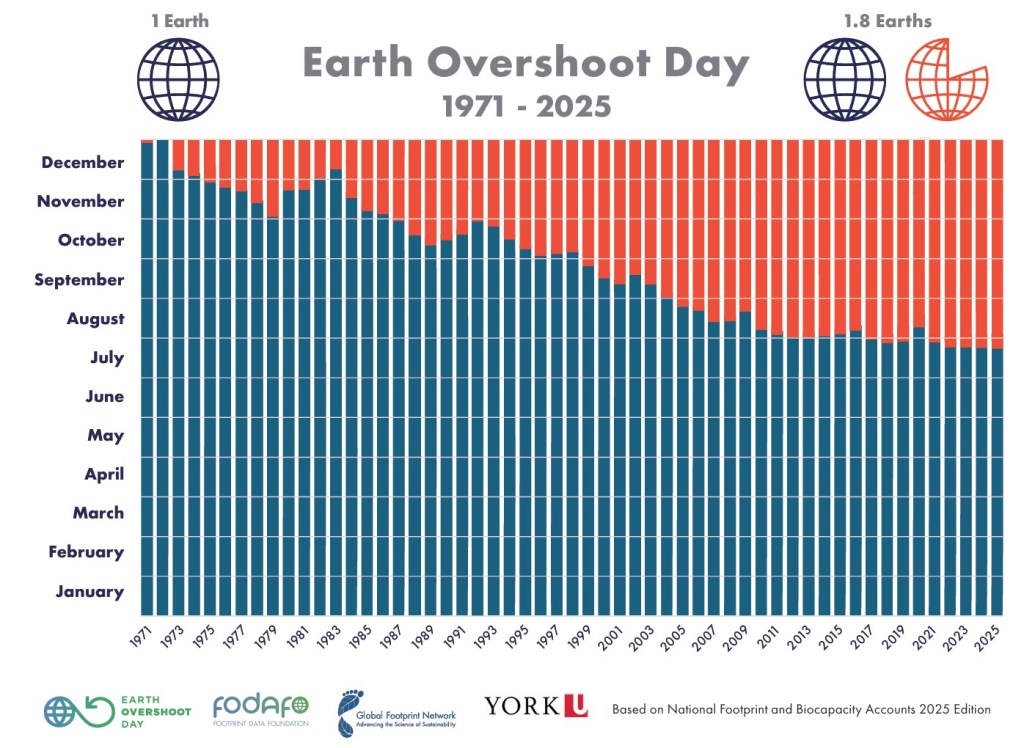
Ideally what we consume from the natural world – crops, timber, drinking water, clean air, energy – is balanced by the earth’s ability to regenerate. Prior to 1970 that was the case. Since then we have been using up the earth’s renewable resources at a rate faster than they are replenished. Scientists each year calculate that point  when we pass from credit to deficit. This is called Earth Overshoot Day. This year the predicted date is 24th July. Seven months into the year and we have already – globally – consumed as much as the earth can replenish in one year! 

Surely this state of affairs can not continue? What can we do about it and why aren’t we doing it? 

Since 1970, Earth Overshoot Day has been falling earlier and earlier each year. Only in 2020 did it reverse: the reduction in world wide consumption came about because Covid gave the earth a three week reprieve. Consuming less has to be the answer which means consuming more carefully and more sustainably. 

If we could do that in 2020 whilst coping with a pandemic, surely we could do it every year? What we must do is make sure that it is not the poor – who already lack a sufficiency – who are the ones who get to consume less; rather it must be the richer over consumers who need to change their lifestyles. And here is another caveat, to live more sustainably and fairly, will need a fundamental change in economic and political systems.

The Earth Overshoot website has details of various ways in which the global community could do this. https://www.overshootday.org/ Meantime we as individuals can make changes to our own lives  and  patterns of consumption. And we can ask or push for our churches, places of work, sports clubs, local authorities, museums, retailers, and government, to make similar reductions in consumption. We need change to happen at all levels.  

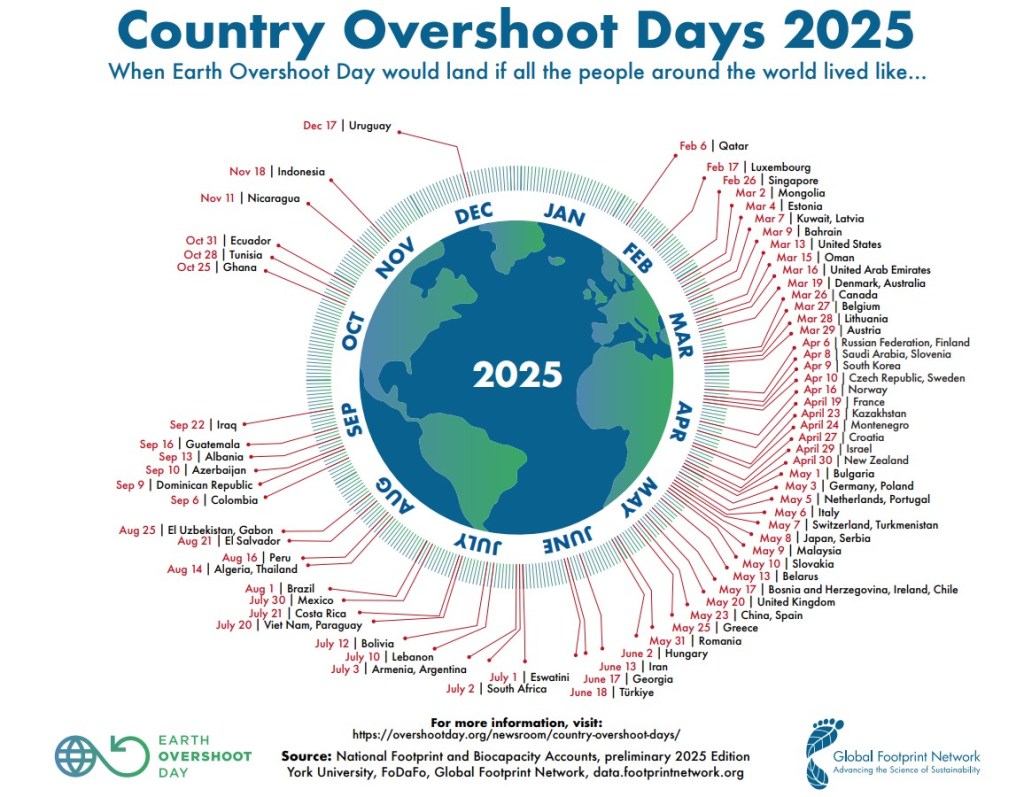
24th July is 2025’s Earth Overshoot Day at the global level. That date is the average  of each nation’s own Overshoot Day. The overshoot dates for individual nations in the diagram below range from  17th December for Uruguay (ie Uruguay pretty much balances its books,  consuming only slightly more than it can regenerate in a year) to 6th February for Qatar. What this diagram does not show are the many poorer nations who do not even use up their equivalent of one year’s resources each year – The UK’s Overshoot Day  was 20th May. We would need three United Kingdom’s to satisfy our current consumption levels; in reality we consume resources of other countries to make up the shortfall. Reducing the Earth Overshoot problem requires cooperation and understanding at a global as a well as at local levels. The Earth is a shared life-support system.

Counting on … day 115

23rd July 2025

Joy in Enough is the name of one of the Green Christian groups, and it strikes me  as a beautiful description of how it would be to live well. And so how to live in a world where waste is valued.

Their aim is to seek out, develop and pursue a new form of economics that would ensure joy in enough for all.

‘…the purpose is clear. We want to build a society where there is delight in enough, taking from the earth only enough to meet our needs rather than satisfying our greed. We want to allow time for earth’s resources to be replenished, safeguarding them for future generations. We joyfully seek a just and ecologically sustaining economy where there is enough for everyone, locally and globally.’ (1) 

  1. https://joyinenough.org/resources/awakening-to-a-new-economics/

Counting on … day 106

10th July 2025

Using waste water. Is rain water from the roof waste water or a valuable resource? Collected in a rainwater butt it is ideal for watering plants. Rainwater butts are also useful in terms of preventing flood because the flow of storm water is delayed before it enters the drainage system and therefore helps the system cope with peaks.

Mains water coming into our homes is drinking water quality. We don’t need that same quality of water with which to flush toilets. ‘Grey water’ – ie water that has been used to wash hands or shower,  launder clothes, etc – is perfectly adequate for flushing toilets. Grey water is waste water that can be reused. We have a small bowl under the taps in the wash basins to collect hand wash water and a jug to empty it into. This jug of grey water is used for flushing the toilet (unless a bigger flush is needed). We also collect water in a larger bowl from the shower when waiting for the hot water. 

A jug by the kitchen sink collects water from cleaning or boiling vegetables, rinsing plates etc and goes to water the garden.

Households are asked to keep a 2-3 day supply of drinking water on hand in case of emergencies. Not wanting to stock up on bottled water – which will in time have to be replaced – I keep two demijohn jars full of drinking water. I empty one (into the pond) and refill it each day so that that our emergency stock of water is constantly fresh without wasting the water.

Counting on … day 102

4th July 2025

Fast fashion is as destructive of our environment as fast tech and is fuelled by many of the same features. Fast fashion is cheap (in terms of purchase price only – its lifetime cost is considerably more when factoring in disposal); its new and trendy and it – and its advertising – is designed to attract our attention; it’s intended to have a short life. 

Yet just like fast tech, fast fashion produced vast amounts of waste that cannot easily be recycled. And like fast tech, a lot of the materials used in production are plastic based (ie synthetic fibres, plastic zips etc). Instead discarded clothing ends in landfill sites, in incinerators, clogging up oceans, and strewn across deserts. 

Again we need to ask ourselves: Do I need this item of clothing? Should I buy the cheapest, or should I look for the durable, repairable option? Will I value it?

And we also need to ask questions about the system that allows so many cheap (and not so cheap) items of clothing to be produced and as quickly discarded. Does the fashion industry  need to be held to accountable? Should manufacturers also be responsible for end of life disposal or recycling of garments? Should manufacturers be reviewing how much plastic goes into their garments? And on a related issue, should manufacturers be reviewing how much they pay those who actually do the making?  Cheap products are often cheap because wages are cheap.

Further reading –

Counting on … day 100

2nd July 2025

Plastic recycling is now much more common place, with local authorities making collections of certain frequently used items such as plastic bottles, margerine and other food tubs, shampoo bottles etc. Soft plastics can be recycled if they are kept separate from more rigid plastics – and some supermarkets have collection points for these. However there is, apparently, no guarantee that plastics going into a recycling bin will be recycled (sometimes it is cheaper and easier to incinerate the waste which causes air pollution). Nor are there many effective closed loop recycling programmes – each a system where a plastic bottle, for example, is recycled and returns as a ready to use plastic bottle. It is often cheaper to make a plastic bottle from virgin oil based polymers than from recycled plastic. 

These problems are a further incentive for us to reduce the plastic we use so rescuing the problem at source. If we don’t buy things that come in  plastic bottles, plastic tubs and tubes, in plastic wrappers etc then we reduce the amount of plastic that is in circulation before it becomes a problem. 

Further reading –