Counting on … day 207

5th November 2024

Food packaging also includes plastic bottles used for water and other liquids. Buying water in single-use bottles can easily be avoided by using a refillable water bottle – it’s also much cheaper! Similarly single-use coffee/ tea cups can be avoided by carrying a keep cup.

NB In the UK we consume more than 2.5 billion litres of bottled water per year and throw away over 7.7 billion plastic water bottles!

And we get through  2.5 billion single use coffee cups each year. Each cup – typically made of paper with a thin plastic layer – has a carbon footprint of 60.9g and that is before it leaves the cafe. Only 1 in 400 will be recycled with the remainder ending up in landfill, further adding to their carbon foot print.

Further reading – 

Counting on … day 204

31st October 2024

Other ways of eating more sustainably include eating food that is locally -or even home – produced and eating what is in season. Shorter supply chains reduce the chances of food becoming damaged/ lost, whilst by being fresher,  ensures greater retention of nutrients. Locally produced food also strengthens the local economy and community. 

As well as eating what’s in season, we can also preserve any seasonal excesses. Surplus fruits can be made into jam,  and fruit and vegetables into chutneys and pickles. Surplus produce can also be dried, frozen or bottled. 

Preserving tips – https://greentau.org/2021/08/23/preserving-fruit-and-vegetables/

Counting on … day 203

30th October 2024

Whilst the Ethical Consumer’s report ‘Closing the Gap 2024’ shows that meat and dairy consumption is declining in the UK, food waste is not. 

Typically food loss is food that is grown and processed but not eaten – ie food that does not even pass from the farm or factory to the  retailer or consumer. Food waste is food that has reached the retailer or consumer but is them not eaten. This could be food that has not been sold by the retailer because it has become damaged or because more has been ordered than has been bought. 30% of food waste is attributable to the retailers, but 70% of food waste derives from households. 

This can include those parts of the food we typically do not eat such as banana and onion skins, apple cores etc but the majority is food we buy and chose not eat. The most frequently wasted foods include bread, milk, potatoes and chicken. (1) We can reduce this waste by not buying nor cooking more than we will eat, eating up leftovers, and by storing food more carefully. 

For  tips about reducing food waste – 

  1. https://www.wrap.ngo/resources/report/uk-household-food-waste-tracking-survey-2022-behaviours-attitudes-and-awareness

For more information on what is food loss and food waste – https://www.sciencedirect.com/science/article/pii/S2352550920314202

Counting on … day 195

18th  October 2024

Scientific concern about the adverse affects of climate change in the Earth capacity to absorb carbon dioxide, extends to the land as well as the oceans. 

“In 2023, the hottest year ever recorded, preliminary findings by an international team of researchers show the amount of carbon absorbed by land has temporarily collapsed. The final result was that forest, plants and soil – as a net category – absorbed almost no carbon…

“A paper published in July found that while the total amount of carbon absorbed by forests between 1990 and 2019 was steady, it varied substantially by region. The boreal forests – home to about a third of all carbon found on land, which stretch across Russia, Scandinavia, Canada and Alaska – have seen a sharp fall in the amount of carbon they absorb, down more than a third due to climate crisis-related beetle outbreaks, fire and clearing for timber.

“Combined with the declining resilience of the Amazon and drought conditions in parts of the tropics, the hot conditions in the northern forests helped drive the collapse of the land sink in 2023 – causing a spike in the rate of atmospheric carbon.”

This shortfall or decline in the carbon absorbing capacity of the natural world is a serious concern when we are relying on that capacity to achieve a net zero target. Indeed if this persists, we will have to reduce our human enduced carbon emissions faster and at a greater rate.

Counting on … day 192

15th October 2024

Rewilding the sea – seawilding – is as important as rewilding the land. Rewilding Britain explains why. “Britain’s seas used to be home to the biggest creatures on the planet: blue, humpback, fin, sperm, bottlenose and sei whales. Our rich, soupy waters helped fuel a thriving, diverse ecosystem, attracting huge numbers of small fish, and in turn massive balls of herring and whiting, which would bring these ocean giants to our shores to feed. Like the decline of large mammals on land, whales were hunted to near local extinction for their meat and oil. Alongside the decline of these very visible giants, all marine ecosystems are suffering. The UK has lost around 92% of its seagrass meadows, 95% of its native oyster reefs and nearly all its kelp in regions like Sussex where it once was abundant” (1)

In February 2023 three areas of water of the coast of England were given the status of Highly Protected Marine Areas (HPMA) where all activities such as fishing, mining and laying cables that might damage the sea bed, are banned. The aim is to protect marine biodiversity by allowing seaweeds such as kelp and sea creatures to recolonise the sites. That said, these areas cover only 0.5% of English seas. 

There are other projects where a proactive approach has been taken by actively replanting new kelp meadows – such as the Sussex Kelp Recovery Project – or in the Humber Estuary by creating oyster reefs to serve as nurseries for the reintroduction of native oysters (2)

  1. https://www.rewildingbritain.org.uk/why-rewild/what-is-rewilding/examples/introduction-marine-rewilding

(2) https://www.theguardian.com/environment/2023/aug/02/oyster-restoration-project-rebuild-uk-reefs-overfishing-seabed-trawling?CMP=Share_iOSApp_Other

Green Tau: issue 96

13th October 2024

The biodiversity crisis and the Church

Globally we have been loosing vast amounts of the rich biodiversity which God gave us – both with the extinction of individual species and with the loss of numbers within species. The Natural History Museum has produced the Biodiversity Intactness Index (BII) which “measures biodiversity change using abundance data on plants, fungi and animals worldwide. The Index shows how local terrestrial biodiversity responds to human pressures such as land use change and intensification.” A BII of less than 90% is considered to be detrimental to planetary wellbeing. Sadly large amounts of the globe, including Europe, fall below this level. (1) For the UK the BIK is 53%.

The UK’s State of Nature Report 2023 noted that species studied had declined on average by 19% since 1970; that 16% of species were threatened with extinction – including 43% of birds, 31% of amphibians and reptiles, and 28% of fungi and lichen – and that 151 of the 10,008 species assessed had already become extinct since 1500.(2)

This year’s Big Butterfly Count Big Butterfly Count revealed the lowest numbers on record. (3)

Biodiversity loss in the UK – as well as globally – is real and alarming. 

Why is the of concern? 

Agricultural production is dependent on healthy soils but this relies on a multitude of organisms that live in the soil. If these become depleted in both number and diversity, the health of the soil suffers – and this is not something that can be repaired by the addition of artificial fertilisers.

Many crops are dependent on pollinators, typically insects. If these decline in number and diversity, yields decline. 

Agricultural yields can be adversely affected by flooding. Declining areas of wetlands, of peat moors, of woodlands, and of natural river courses and floodplains, increased the risk and extent of flooding.

Food security is also threatened if we become reliant on only a few commercial species. A virus or a change in climate can wipe out crops. Future losses can be avoided if scientists can access wild plants that have more resilient characteristics. But what if those wild alternatives are no longer there? 

Air quality too is affected by the decline in biodiversity. Trees in particular, but other plants too, are important natural absorbers of pollutants both in the air and in the water. 

The lack of anyone species can cause a cascading affect where other dependent species also decline. Declining numbers of insects lead to declining numbers of species of birds and bats. Biodiversity decline can accelerate at speed.

Biodiversity loss affects us as spiritual beings. Our lives are diminished as biodiversity is diminished. I have never heard a nightingale sing – that is a loss. I am lucky that as a child I did hear cuckoos, and even now as an adult, I do hear sky larks because they are still resident in Richmond Park. If I did not have green spaces to walk in, my mental health would suffer. 

God too suffers from the loss of biodiversity. By their very nature, the flora and fauna of this world praises God in an endless wordless song. As they decline, so does this profound worship. 

The nations of the world have been rightly concerned at the rapid loss of biodiversity globally and the impact that was – and increasingly would have – on human life and wellbeing. In 2022 the United Nations Biodiversity Conference (COP15) agreed the Kunming-Montreal Global Biodiversity Framework (GBF). This set out to halt and reverse nature loss, including putting 30 per cent of the planet and 30 per cent of degraded ecosystems under protection by 2030. This is often summarised as the 30:30 target.  (4) 

The UK government was party to this UN Conference and undertook the commitment to achieving this 30:30 target. However it is a tough target and progress to date has been slow and patchy. 

Earlier this year  Restore Nature Now organised a march in London in which between 60,000 and 100,000 people took part, representing  a wide range for groups including the RSPB, the National Trust, the Wildlife Trusts, the Climate Coalition, WWF-UK, the WWT, the Woodland Trust, the Wildlife and Countryside Link, Rewilding Britain, Extinction Rebellion and Christian Climate Action. 

Their demand was for more and greater action by the government. (5)

Last weekend another march took place organised by the group, Wild Card. A scroll was unrolled before the vast edifice of St Paul’s Cathedral, revealing 95 theses as to why as Christians and therefore as a Church, we should care about biodiversity and the well-being of the natural world. Just as Martin Luther’s 95 theses were put forward to stimulate theological debate, so too are these theses. (6) 

Hymns were sung and speeches given, highlighting the plight of biodiversity and calling on the Church to show leadership in addressing the crisis. In particular the call was made that the Church Commissioners, as stewards of extensive land holdings (105,000 hectares) , should undertake to rewild 30% by 2030. (7)

Wild Card defines rewilding thus: “To rewild the land and water is to allow untamed life to return to ecosystems and landscapes, such that they are once again sustained by the natural processes that created them in the first place. In restoring these processes, humans are often intimately involved. Be it from rewetting bogs to reintroducing missing species, humans are very much invited to the rewilding party.” (8) Rewilding goes beyond goes simply protecting the biodiversity we still have and seeks to restore the biodiversity of our environment back towards 90% BII needed for a sustainable future. 

Of course rewilding church land will have a profound effect on what we harvest – less meat and milk, more diverse horticultural and sylvocultural products; less cereal crops for animal feed, more meadows, fenlands and heaths; less livestock, more wild birds and animals; less mono-species plantations, more mixed broadleaf woodlands; less factory farming, more blue and green spaces for spiritual and mental re-creation, and more green jobs. There will be tough decisions to make and we all need to be part of the discussion: what changes in the lifestyles we live are we prepared to make. As Christians we are called throughout our life time to repent and believe, we are called embrace ‘metanoia’ – to see things differently, to change direction, to transform our relationships.

(1) https://www.nhm.ac.uk/our-science/services/data/biodiversity-intactness-index.html

(2) https://stateofnature.org.uk/

(3) https://butterfly-conservation.org/news-and-blog/uk-butterfly-emergency-declared

(4) https://www.cbd.int/gbf

(5) https://www.restorenaturenow.com/aims

(6) https://wildcard.land/campaigns/rewild-the-church/95-wild-theses

(7) https://wildcard.land/campaigns/rewild-the-church

(8) https://wildcard.land/about/about-wildcard

The Joys and Sorrows of Civilisation 

12th October 2024

There shall come forth a shoot from the stump of Jesse, and a branch from his roots shall bear fruit. Isaiah 11:1

You Lord, are the source of all good things: 

We praise you.

You call us to tend and care for your creation: 

May we strive to do your will.

You have made us as brothers and sisters with all that lives: 

May we live together in peace.

A reading:  So Paul stood up and with a gesture began to speak: ‘You Israelites, and others who fear God, listen. The God of this people Israel chose our ancestors ….. he made David their king. In his testimony about him he said, “I have found David, son of Jesse, to be a man after my heart, who will carry out all my wishes.” Of this man’s posterity God has brought to Israel a Saviour, Jesus, as he promised. Acts 13: 16, 17a, 22b,23

Reflection 

Roots secure us to the past, ensure that we are part of the continuity of creation; shoots  and branches  take our lives forward into the as yet unformed future. Without the next generation there will be no ongoing continuity. The gospels of Luke and Matthew both locate Jesus within a human family tree;  the prologue of John’s gospel locates him as co existent with the beginning of all creation. Later in John’s  gospel, Jesus affirms his coexistence with the Father and the ongoing coexistence, through him, of all believers, all God’s children. 

For gifts of past generations

We thank you God:

For the gift of fire for cooking and heating

For the gift of clean water and sewers

We thank you God:

For the domestication of cattle and horses,

Cats and dogs, sheep and pigs, 

Hens and geese

We thank you God:

For the gift of gardening and arable cultivation,

sowing and reaping, 

growing and harvesting

We thank you God:

For the gift of healing and caring, 

of medicine and surgery

For the understanding of the intricacies of mind and body 

We thank you God:

For the gift of story telling and drama, 

of art and observation 

means of sharing grief and joy.

We thank you God:

For the gift of learning and research, 

of teaching and sharing

We thank you God:

For the gift of exploration and endeavour, of travel and communication 

We thank you God:

For the gift of worship, of self realisation and of the knowledge of God.

We thank you God:

But what shall we pass on to generations to come?

Do we offer gifts or burdens?

Merciful God forgive and inspire us.

Clean air or choking smog?

Merciful God forgive and inspire us.

Living water or dying oceans?

Merciful God forgive and inspire us.

Renewables or fossil fuels?

Merciful God forgive and inspire us.

Biodiversity or widespread extinction?

 Merciful God forgive and inspire us.

Fertile soils or inhospitable dust?

Merciful God forgive and inspire us.

Balmy summers or wild fires?

Merciful God forgive and inspire us.

Snow capped mountains or drowned coastlines?

Merciful God forgive and inspire us.

Homes for all  or camps for migrants?

Merciful God forgive and inspire us.

May we be wise guardians of what we have received 

Skilful custodians of what we consume

Generous donors of what we hand on

That the future of creation will be bright and beautiful, 

fair and just.

Amen

Counting on … day 190

11th October 2024

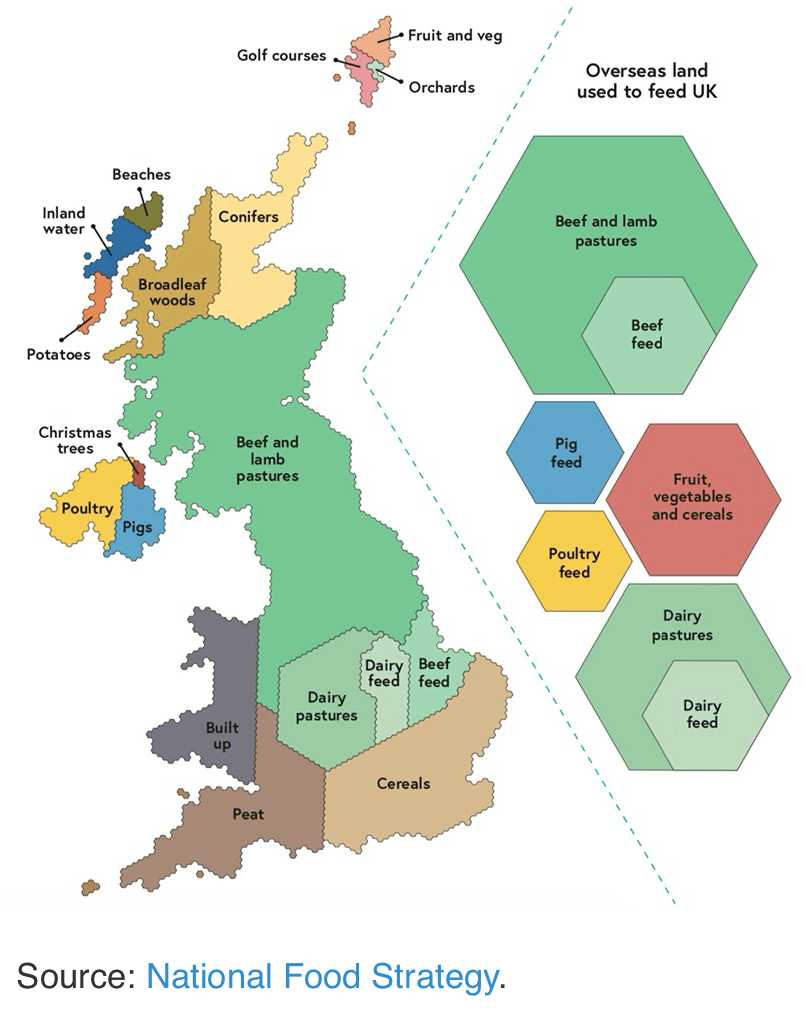
The left hand half of this diagram shows the amount of land used in the UK for different purposes – from providing grazing for beef cattle and sheep (the largest single use) to land cultivated as orchards (smallest alongside land used for growing Christmas tree!). 

The right hand half shows overseas land that we rely on (effectively use) to produce food stuffs that we import – and again land for beef and lamb production is the largest. 

Even just halving our meat consumption, would free up huge amounts of land that could be better used for rewilded biodiverse rich landscapes, as well as having space for increased horticultural production of a wide range of fruits and vegetables. 

Counting on … day 189

10th October 2024

Restoring biodiversity and protecting 30% of the UK is going to need a widespread reworking of farming practices and objectives. This will mean taking some land out of food production – eg to create peat bogs or woodlands – but on the other hand if we view land as the means of supporting not just food production but primarily as the means of supporting life, this makes sense. Should we be paying a life support tax to finance this? 

Restoring biodiversity will also mean reducing the intensity with which the land is farmed for food – widening existing, and planting new, hedges, cultivating the borders of fields as wild flower meadows, creating ponds and rewiggling rivers, reducing stocking levels (and reducing the total number of livestock to a proportionate level given that for every animal more land has to be used to grow feed crops), changing crop planting patterns to reduce the need for fertilisers that then pollute waterways etc. 

All this will mean a change in the way we eat. We need to switch to diets that are largely plant-based and dependent on locally grown crops. Diets that will in fact be both tasty and healthy.