Restoring biodiversity and protecting 30% of the UK is going to need a widespread reworking of farming practices and objectives. This will mean taking some land out of food production – eg to create peat bogs or woodlands – but on the other hand if we view land as the means of supporting not just food production but primarily as the means of supporting life, this makes sense. Should we be paying a life support tax to finance this?
Restoring biodiversity will also mean reducing the intensity with which the land is farmed for food – widening existing, and planting new, hedges, cultivating the borders of fields as wild flower meadows, creating ponds and rewiggling rivers, reducing stocking levels (and reducing the total number of livestock to a proportionate level given that for every animal more land has to be used to grow feed crops), changing crop planting patterns to reduce the need for fertilisers that then pollute waterways etc.
All this will mean a change in the way we eat. We need to switch to diets that are largely plant-based and dependent on locally grown crops. Diets that will in fact be both tasty and healthy.
Community gardens can not only boost biodiversity but also the supply of locally grown food.
“Pam Warhurst … the founder of Incredible Edible, a food-focused guerrilla gardening movement, wants the state to get out of people’s way. “The biggest obstacle is the inability of people in elected positions to cede power to the grassroots,” she says… Her big idea is guerrilla gardening – with a twist. Where guerrilla gardeners subvert urban spaces by reintroducing nature, Incredible Edible’s growers go one step further: planting food on public land and then inviting all-comers to take it and eat. “I used food because it seemed to me that we needed to act fast,” Warhurst says. “We needed to get experience as soon as we could, and probably food was the thing that we could demonstrate an alternative way of living around, in a really simple way.”” (1)
In 2019 London declared itself to be the first National Park City, to enable residents to live greener, healthier and ‘wilder’ lives, as well as promoting new business opportunities. (1) Already green and blue spaces cover 49.7% of the land.
The fact that an area of land is designated as a National Park does it always mean that it will be used or cared for in such a way as to promote biodiversity. (2)
On the other hand plenty of organisations work really hard to achieve this. In London many organisations are drawing up and implementing biodiversity action plans, including the City of London, the Royal Parks, the Greater London Authority, various London Boroughs, as well as organisations such as the Wildlife and Wetlands Trust, the South East Rivers Trust, Barnes Common Limited, and many more, both smaller and larger. Positive change is possible!
Practising the same environmentally friendly habits on holiday as we do at home. This can include using active travel over cars for getting around; carrying a keep cup to avoid single use takeaway cups; using a refillable water bottle; showers rather than baths – and if we are somewhere where there are water shortages such as in Sicily, being very careful not to waste water.
This approach might also include not buying things we don’t need. A souvenir that simply gathers dust when we come home is not always the best way of remembering a holiday. There is a saying that we should ‘Take nothing but pictures and leaven nothing but footprints’.
At the same time we may want to support the local economy where we are staying – which could be by using the local cafe or bar.
After travel, what accommodation? The following maybe of interest if you’re staying in a hotel.
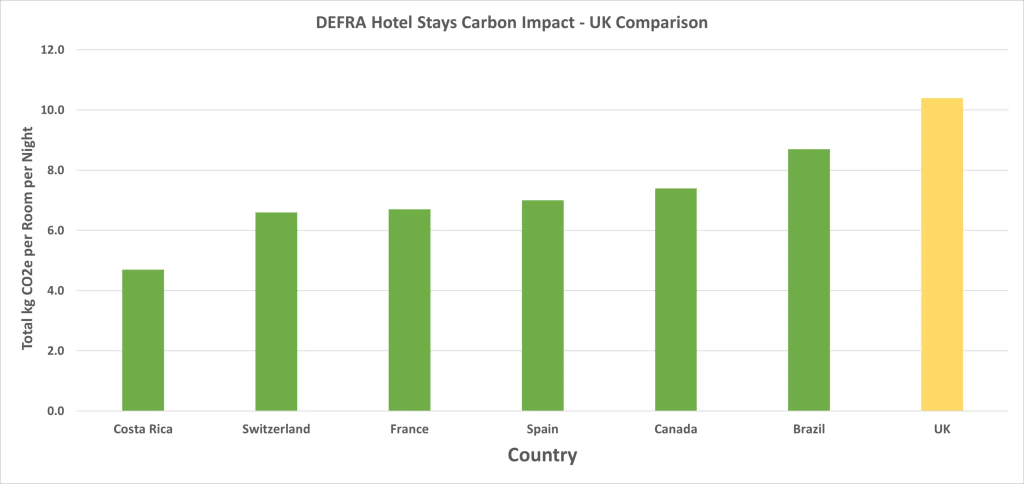
“According to DEFRA, the carbon emissions of staying in a hotel in the UK are 10.4 kg CO2e. (Per room per night). How does this rank amongst the other available data? A figure of 10.4 kg CO2e per room per night ranks the UK a little outside the top five lowest impact hotel stays in 7th place. Overall, it is the 4th lowest footprint within the European countries where data is available. Only Switzerland, France and Spain outrank the UK.
“Figure 4 shows the top five countries as well as the UK in yellow for comparison. Although the UK has one of the lower carbon emissions per room per night, there are still significant opportunities for further reductions by increasing our use of renewable energy. Whilst Costa Rica has the advantage of consistent sunshine for its solar panels and France have a significant amount of nuclear power, they provide an example of where the UK would one day need to be.” (1)
Whilst The Home Camper and Campspace web site suggests 23kg CO2 emissions per night for a B and B, 21kg for a hotel and 0kg for a tent. (2)
I suspect there is more to be a sustainable, low carbon hotel than just the offer of ‘not washing your towels on a daily basis’ which is so often the sole suggestion made by hoteliers. I wish providing a good vegan menu were more often the case.
Advice from a bank “do I really need this product?”
Simply spending money on buying stuff is not good for the environment and as damage to the environment, is already and will at present rates increasingly, incur financial costs that will affect us all, it is not good economically either.
Over the last few weeks I have made a grand tour of England and Wales, visiting iconic National Trust sites. Ours is still a green and pleasant land, from St Michael’s Mount in the south west to Newcastle’s Souter Lighthouse in the northeast; from Windermere in the northwest to Box Hill in the south east, from Worms Head on the Gower Peninsula in the west to Kinder Scout in the middle. It is green and pleasant because people care passionately about the environment!
This is not to say that there isn’t room for improvement – uniform green fields full of grazing sheep may in reality be products of monoculture, and placid waters may mask life-damaging pollutants.
One of the greatest threats to our green and pleasant land is climate change. Rocketing temperatures in the oceans are fuelling a wet and windy summer here and across Northern Europe. Flooding and tree damage, poor harvests and dwindling numbers of butterflies is one of the many consequences. Late autumns and early springs upset the breeding patterns of birds, and the flowering cycles of plants. Intermittent heat waves stress many plants and animals, and increase the risk of wild fires.
And yes, generally, people do care and do want a sustainable, green, accessible, biodiverse rich environment in which to live. The National Trust is one of the bigger organisations that is making that a reality. And we know we must do all we can to limit the output of carbon dioxide to keep climate change in check. And again the National Trust is addressing this specific issue with a target of net zero by 2030.
We know we need fossil fuel companies to cut back their output and transition to renewables. We know we need pension funds, insurers and banks to use their financial power to press for faster change.
So why then does the National Trust – the nation’s largest conservation charity – still bank with Barclays, the biggest funder of fossil fuels in Europe?
This week there is a week of action, coordinated by Christian Climate Action, which aims to press the National Trust to go that one more step, to become that bit greener, by switching from Barclays to a bank that is fully aligned with the National Trust’s environmental credentials.
The actions at various National Trust sites across the country with banners and placards – possibly even with visits by Peter Rabbit -will be peaceful and friendly, inviting people to learn more about banking with Barclays is an issue and inviting them to sign a petition asking the National Trust to drop Barclays – something which other charities, such as Oxfam and Christian Aid, have already done.
To reduce our global footprint we need to live much more sustainably. Whilst Earth Overshoot Day for the whole world will this year be 1st August, we passed the UK’s Overshoot Day last month – 1st June. In other words we in the UK would need two earths to support our current lifestyles!
Earth Overshoot day has a ecological footprint calculator which you might want to try out – http://footprintcalculator.org/home/en – it is not very refined but points out areas we might want to think about as we try and reduce our negative impact on the environment.
It is easy to see how plant and animal/ fish resources can be regenerated. But what about metals?
The iron ore that is mined from the earth was typically formed millions of years ago – the exception being where recent volcanic eruptions release iron-containing magma. So rather than talking about regenerating metals, we should talk about recycling metals.
Do we recycle as much – indeed all – the metal we discard?
The FT reports “The UK produces 10mn-11mn tonnes of scrap steel each year of which less than 3mn is recycled. The rest is exported as there is not enough demand from domestic steelmakers.” https://www.ft.com/content/1e273a6d-2683-419c-9567-91281df3c648 However as the UK switches from coal burning blast furnaces to green electric furnaces, which smelt 100% recycled steel, that demand will grow.
What about newer metals such as lithium, which we have only recently begun to exploit? Even if we did recycle all that we discard, growing demand for lithium still means more raw ore will be mined. Can this be sustained – and sustained in a way that does it exploit people nor damage their land and ecosystems?
In less than a month the world’s population will have used up a year’s worth of renewable resources. Earth Overshoot Day – this year 1st August – is the day when our consumption of resources exceeds the rate at which the earth can regenerate those resources for future consumption.
Natural resources regenerate over time. For example annual plants such as wheat, poppies, beans lettuces produce seeds each year which can sprout and produce a fresh crop. Some do this on an annual cycle, whilst others, such as rice, may reproduce several crops per year – depending on climatic conditions. Other plants have a much longer regenerative time frame. An oak for example may take 150 years to be of an age to produce acorns.
The same is true for fauna. Some species such as fruit flies will produce the next generation within a matter of days, where as for an elephant, the time scale is closer to twenty years.
Other regenerative resources include water, nitrogen and carbon. The life cycle of these varies according to climatic, topographical, and other factors. In tropical rain forests water can go through a daily cycle of rainfall, evaporation, condensation and once again, rainfall. In the artic regions rainfall is usually infrequent with much of the water then being locked away as ice sheets and glaciers.
Air, soil and water have regenerative features in terms of absorbing and ‘cleaning’ pollutants. One of the major causes of the current climate breakdown is our human action in pumping more carbon dioxide into the atmosphere than can safely be absorbed. The safe level of carbon dioxide in the atmosphere is around 280 part per million. In March 2024 CO2 levels were at 425 ppm and still rising.



 The Green Tau