After travel and accommodation, food maybe the next consideration. We can, whether eating out or self catering, make our diet more or less environmentally friendly depending on what we choose to eat. Choosing a plant based diet will have a lower environmental impact than one based on dairy and/or meat. “Avoiding meat and dairy products is one of the biggest ways to reduce your environmental impact, according to scientific studies” (1)
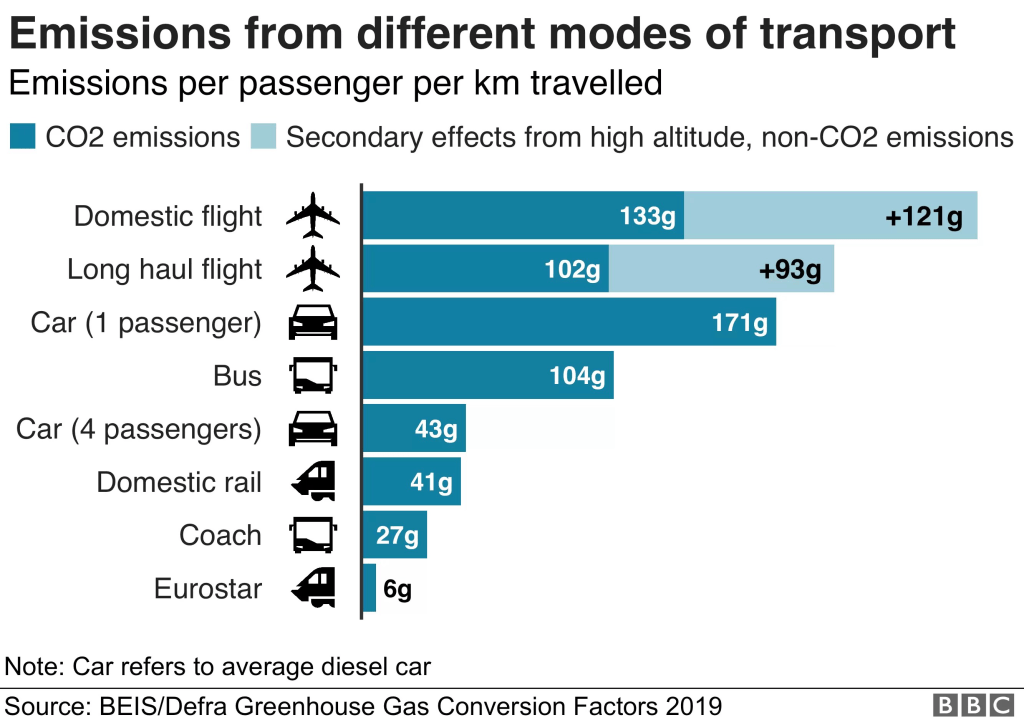
Do our holidays adversely impact on the environment? Googling eco friendly holidays, I am surprised how many website focus on the eco credentials of the destination but not the mode of travel. This is not always the case and some websites do give advice on flight free holidays. Nevertheless the transport element of our holidays usually contributes most to its environmental impact.
“Global tourism accounts for about 8% of total greenhouse gas emissions and transport between origin and destination explains three quarters of this impact” (1) Cutting out flying will benefit the environment most. After that saving has been made, cutting back on the distance travelled will also have an impact. (2)
The most environmentally friendly way of getting around is by walking or cycling – and it has the added benefits of being good for our physical and mental health. If you live in an area that is the equivalent of a 15 Minute City (https://greentau.org/2021/07/17/the-green-tau-issue-8-18th-july/) then it is easy to make all your daily journeys to the shops, the doctors, the gym, the school, the library, the park, the station on foot or by cycling.
Adopting active travel as your default mode of getting around may take a little practice at first. It is also worth sorting out the right clothes and equipment appropriate to different weather conditions, lighting levels and whether you need to carry things like shopping –
Public transport is also an environmentally friendly way of travelling – shared between users it makes best use of resources and road space. Of course it is easier switching from private car to public transport if you live an area with a good public transport network. Maybe experiment with a weekly car-free day or work towards a car-free Lent.

 The Green Tau