Counting on … 157

3rd October 2025

“Growing wealth inequality in the UK could be a “major driver of societal collapse” within the next decade, according to a new report by the Fairness Foundation and the Policy Institute and Department of War Studies at King’s College London…

“The participants identified a negative feedback loop, whereby the government’s failure to tax wealth effectively means it lacks sufficient revenue to uphold the social contract by which strong public services, an effective social safety net and a healthy economy provide people with decent living standards.

“Trust in politics then declines further, politicians avoid honest discussions of the underlying problems and what to do about them, and the system’s legitimacy is increasingly questioned as the social contract collapses.” (1) 

Looking at public attitudes, the report  that “two-thirds (63%) of Britons now think the very rich have too much influence on politics in the UK – far higher than the share who say the same about businesses (40%), religious organisation (40%) or international organisations like the EU and UN (38%).

Improving incomes levels for the poorest, and taxing the richest clearly has multiple benefits.

  1. https://www.kcl.ac.uk/news/wealth-inequality-risks-triggering-societal-collapse-within-next-decade-report-finds

Counting on … day 122

1st August 2025

The third aim of the Third Order of St Franciscan addresses the issue of wealth, income and advantage so as to focus on living simply.

“The first Christians surrendered completely to our Lord and recklessly gave all that they had, offering the world a new vision of a society in which a fresh attitude was taken towards material possessions. This vision was renewed by Saint Francis when he chose Lady Poverty as his bride, desiring that all barriers set up by privilege based on wealth should be overcome by love. This is the inspiration for the third aim of the Society, to live simply.

“Although we possess property and earn money to support ourselves and our families, we show ourselves to be true followers of Christ and of Saint Francis by our readiness to live simply and to share with others. We recognise that some of our members may be called to a literal following of Saint Francis in a life of extreme simplicity. All of us, however, accept that we avoid luxury and waste, and regard our possessions as being held in trust for God.

Personal spending is limited to what is necessary for our health and well-being and that of our dependents. We aim to stay free from all attachment to wealth, keeping ourselves constantly aware of the poverty in the world and its claim on us. We are concerned more for the generosity that gives all, rather than the value of poverty in itself. In this way we reflect in spirit the acceptance of Jesus’ challenge to sell all, give to the poor, and follow him.” (1)

Living simply is about sharing what we do have, avoiding luxury and attachment to wealth, and using/ spending what we do have in a way that we would happily declare to God, aligning our use of resources according to the will of God – including environmental issues.

  1. https://tssf.org/about-the-third-order/the-principles/

Green Tau: issue 112

“Poor Clare” and the tricky question of wealth

31st July 2025

“Improbably funny US drama about Saint Clare of Assisi’s renouncement of worldly wealth” Time-out (1)

Earlier this week I went to see a performance of “Poor Clare”, by Chiara Atik, at the Orange Tree theatre in Richmond. It was a beautiful production set in 13th century period costume with a wonderful script that was conversely in the idiom of the 21st century. Clare and her sister Beatrice are like two teenagers preparing for a prom night. 

“Okay so for the skirt, I’m thinking like a gold thread and then the cloth would be like … I don’t know, I’m thinking purple … or like … purplish blue…”

“I like that ‘cause it’s like … deferential.”

“What for you mean?”

“Blue is like, modest. It’s what Mary wore”

“For the bodice … like I want it to go to here-ish – very covered up, very classy.”

“K”

“In red”

“No”

“Just like, a cute lil’ red bodice.”

“Red? Mom would never let you!”  (abridged) (2) 

We see how theses two sisters are ensconced in the world of wealth, how wealth and class shapes what they can and can’t do. We see their acceptance of the status quo as they happily allow maids to do their hair and wash their feet. 

Francis on the other hand we see as the born again idealist who is so caught up in his utopian dream of embracing poverty, that his thoughts run faster than his feet. Francis is acutely aware how wealth and the privilege both inflicts pain on those who don’t have it,  and  blinds those that do. He sees wealth and privilege as so utterly opposed to what God desires that he cannot for a second be compromised by living within its structures. As the story unfolds, he is casting aside piece by piece every part of his life that undermines his vision. 

Francis of course is – or rather was – himself a rich young man. Is his decision to renounce the world something that only someone who is rich can do? We see Clare’s two maids debating the impracticality of doing away with wealth and class – Maybe if the poor had just a little bit more, then they wouldn’t be quite so poor? We also see the homeless ex-soldier and the down-and out beggar giving their take on the issues of redistributing wealth – Does a second hand doublet really fit the bill?

Piqued by Francis, Clare begins a journey of self exploration – does she truly deserve the wealth she has? Does it make her happy? Can she reconcile her good fortune with the plight of those she would rather avoid? Can she justify being wealthy if she were to be a bit more generous? 

Clare’s mother understands the dilemma having travelled to the Holy Land many years before. There, she tells Clare,  however much food they gave to the starving children that swarmed around, there always seemed to be more at the next pilgrim site. Her mother commends getting pregnant: Clare will be able to pour out all her pent-up love and devotion on her children; she will never need have a conscience about anything else.

Step by step Clare follows Francis’s example, divesting herself of the world. But of the two, I think she has greater certainty, greater confidence that she is doing the right thing. She has thought through each issue and knows that she cannot remained within a system which perpetuates such injustices and suffering. 

The play left me feeling challenged: how can I be part of a system that I believe to be flawed? And yet how can I not be part of that system when there seems to be no realistic  alternative? And that challenges me to look again at my vocation as a Franciscan tertiary and how it can enable me to live within but contri to the system of worldly wealth. 

(1) https://www.timeout.com/london/theatre/poor-clare-review

(2) https://www.dramatists.com/previews/6322.pdf

NB The first tertiaries/ secular Franciscans where in fact given their particular vocation and lifestyle by Francis himself in response to the large numbers of married couples who wanted to follow his example. They were to continue living in their own homes and yet still devote themselves to living according to the principles and objectives that Francis taught.

There are different groups of Franciscan tertiaries (Anglican) and seculars Franciscans (Roman Catholic) across the world.

I’m part of the Third Order of the Society of St Francis – https://tssf.org.uk/

Counting on … day 120

30th July 2025

Wealth too plays a part in what is ‘enough’. I’m in my sixties, my husband a decade older. We live comfortably on his pension – but we can do so because we own the house we live in; we have never not had enough and so benefit from good health;  we both get joy from walking, swimming and cycling; we both have had good educations and appreciate the enjoyment of reading and writing; we have over the years accumulated good quality clothes and shoes and so have little  need to spend on what we wear; we have good networks of friends and socialise through activity groups; we have strong family relationships; we are both active church goers. Not all of these are the direct benefits of wealth but wealth has certainly helped shape of lives and health and wellbeing and allows us to do things that bring us joy for free.

Other people of a similar age may not have these benefits nor feel the security net that wealth brings. For them an income that allows for joy in enough would be more than I and my husband need.  

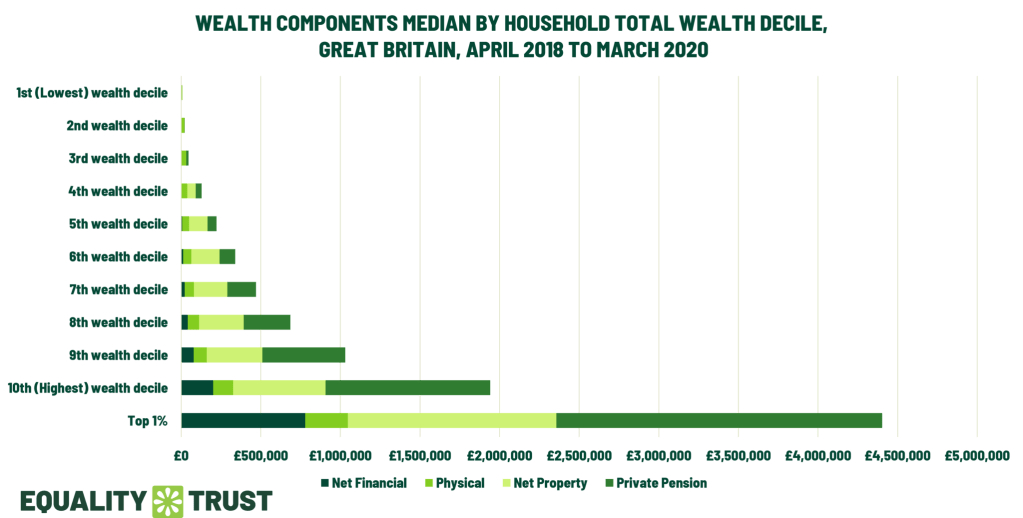
The bar chart below shows how disproportionately wealth is spread and the considerable contribution that stems from having property (and that will increase the closer one lives to London or other property hot spots) and having a private pension. 

2nd Sunday before Lent

Could we withstand seven years with no harvests? 

The UK imports 60% of its food – and amazingly if viewed by sector we import 45% of our vegetables and 83% of our fruit! As many of the countries from whom we import fruit and vegetables are prone to the adverse effects of climate change, food security for us as a nation is a concern. And for us as part of a global population, the adverse impacts of climate change of food security for many vulnerable communities should be an even greater concern.

What about our food security as individual households? Unlike in the past, many of us do not bottle, dry or otherwise preserve food to see us through the rest of the year. Nor do we tend to stock large quantities of staples such as flour, oats and rice.  If they were a snow storm or flood such that the shops were closed for even a week, would we have enough food in our homes? 

God has created a world which is constantly producing edible plants, fruits and seeds which serve to feed all manner of fauna including humans. Our love for God should be expressed in the grateful caring and sharing of this harvest – and that surely includes safeguarding the soil and the climate upon which the plants depend, and ensuring that throughout the seasons and during times of sufficiency and insufficiency, that food is fairly shared.

Jesus is quite clear in his teachings that love is not something that we reserve just for ourselves and our nearest and dearest. Echoing the challenge of last Sunday’s readings about the blessings of feeding the hungry rather than the woes of stashing away private wealth, today’s gospel tells us to love our enemies. To do good to those who hate and abuse us. To give without expecting anything in return – and in fact to give in an outrageously extravagant manner, giving more than is asked. 

This may seem counter-intuitive to those of us who brought up to look after ourselves, to be self-sufficient, to safely garner wealth so that we won’t be needy. It is hard to give generously if we feel we can not trust that our own future needs will be met – and for me the fear is that even if I am generous, the financial institutions are not and will persist with their greater power to hoard more and more of the world’s wealth. But is that a self fulfilling approach that does not allow us to try the alternative of being truly generous now so that everyone can have enough – the poor as well as the rich, the bad as well as the good? 

Each time we say the Lord’s Prayer we say ‘Your kingdom come, your will be done.’ God’s kingdom is surely the one where everyone shares generously what they have been given, so that all may have enough regardless of their merits? How do we get to that situation? 

What will change global systems so that those with power and wealth can’t get and take more and more?

What will change global systems so that the needs of the poor and vulnerable are met? So that everyone can get enough food, live in a safe comfortable home, have access to education, employment and health care, have quality leisure time with access to green spaces and community events?

What will change global systems so that all nations and communities are treated with respect?

What will change global systems so that justice and peace prevail, so that we all cooperate for the common good?

Can we as Christians, who know we are weak and compromised, act upon Jesus’s instruction and be overwhelmingly generous with what we have to share? Can we respond to the words of the prayer he taught us and work to change systems – at what ever level: family/local/ community/ national – to enable God’s kingdom, God’s reign to prevail?

Genesis 45:3-11, 15

Joseph said to his brothers, “I am Joseph. Is my father still alive?” But his brothers could not answer him, so dismayed were they at his presence.

Then Joseph said to his brothers, “Come closer to me.” And they came closer. He said, “I am your brother, Joseph, whom you sold into Egypt. And now do not be distressed, or angry with yourselves, because you sold me here; for God sent me before you to preserve life. For the famine has been in the land these two years; and there are five more years in which there will be neither plowing nor harvest. God sent me before you to preserve for you a remnant on earth, and to keep alive for you many survivors. So it was not you who sent me here, but God; he has made me a father to Pharaoh, and lord of all his house and ruler over all the land of Egypt. Hurry and go up to my father and say to him, ‘Thus says your son Joseph, God has made me lord of all Egypt; come down to me, do not delay. You shall settle in the land of Goshen, and you shall be near me, you and your children and your children’s children, as well as your flocks, your herds, and all that you have. I will provide for you there–since there are five more years of famine to come–so that you and your household, and all that you have, will not come to poverty.'”

And he kissed all his brothers and wept upon them; and after that his brothers talked with him. 

Psalm 37:1-12, 41-42

1 Do not fret yourself because of evildoers; *
do not be jealous of those who do wrong.

2 For they shall soon wither like the grass, *
and like the green grass fade away.

3 Put your trust in the Lord and do good; *
dwell in the land and feed on its riches.

4 Take delight in the Lord, *
and he shall give you your heart’s desire.

5 Commit your way to the Lord and put your trust in him, *
and he will bring it to pass.

6 He will make your righteousness as clear as the light *
and your just dealing as the noonday.

7 Be still before the Lord *
and wait patiently for him.

8 Do not fret yourself over the one who prospers, *
the one who succeeds in evil schemes.

9 Refrain from anger, leave rage alone; *
do not fret yourself; it leads only to evil.

10 For evildoers shall be cut off, *
but those who wait upon the Lord shall possess the land.

11 In a little while the wicked shall be no more; *
you shall search out their place, but they will not be there.

12 But the lowly shall possess the land; *
they will delight in abundance of peace.

41 But the deliverance of the righteous comes from the Lord; *
he is their stronghold in time of trouble.

42 The Lord will help them and rescue them; *
he will rescue them from the wicked and deliver them,
because they seek refuge in him. 

1 Corinthians 15:35-38,42-50

Someone will ask, “How are the dead raised? With what kind of body do they come?” Fool! What you sow does not come to life unless it dies. And as for what you sow, you do not sow the body that is to be, but a bare seed, perhaps of wheat or of some other grain. But God gives it a body as he has chosen, and to each kind of seed its own body.

So it is with the resurrection of the dead. What is sown is perishable, what is raised is imperishable. It is sown in dishonour, it is raised in glory. It is sown in weakness, it is raised in power. It is sown a physical body, it is raised a spiritual body. If there is a physical body, there is also a spiritual body. Thus it is written, “The first man, Adam, became a living being”; the last Adam became a life-giving spirit. But it is not the spiritual that is first, but the physical, and then the spiritual. The first man was from the earth, a man of dust; the second man is from heaven. As was the man of dust, so are those who are of the dust; and as is the man of heaven, so are those who are of heaven. Just as we have borne the image of the man of dust, we will also bear the image of the man of heaven.

What I am saying, brothers and sisters, is this: flesh and blood cannot inherit the kingdom of God, nor does the perishable inherit the imperishable.

Luke 6:27-38

Jesus said, “I say to you that listen, Love your enemies, do good to those who hate you, bless those who curse you, pray for those who abuse you. If anyone strikes you on the cheek, offer the other also; and from anyone who takes away your coat do not withhold even your shirt. Give to everyone who begs from you; and if anyone takes away your goods, do not ask for them again. Do to others as you would have them do to you.

“If you love those who love you, what credit is that to you? For even sinners love those who love them. If you do good to those who do good to you, what credit is that to you? For even sinners do the same. If you lend to those from whom you hope to receive, what credit is that to you? Even sinners lend to sinners, to receive as much again. But love your enemies, do good, and lend, expecting nothing in return. Your reward will be great, and you will be children of the Most High; for he is kind to the ungrateful and the wicked. Be merciful, just as your Father is merciful.

“Do not judge, and you will not be judged; do not condemn, and you will not be condemned. Forgive, and you will be forgiven; give, and it will be given to you. A good measure, pressed down, shaken together, running over, will be put into your lap; for the measure you give will be the measure you get back.”

Green Tau: Issue 90

24th May 2024

Profits part 2

Having written about what profits are and whether they are per se good, I have come across some news stories which point to the moral downside of pursuing profits.

Medicines

Is the profit motive a good way of determining which new medicines to develop or for which diseases to seek a cure? Should it be necessary to make a profit – as opposed to covering costs – in order to develop a medicine that will relieve suffering and/ or enable someone to live a more normal life? 

And when a medicine has been developed, is it appropriate to sell it at a profit, knowing that this may be put it out of the reach of people whose health might otherwise be improved? Is it appropriate to charge a license fee for would be manufacturers in less affluent parts of the world? 

Of course there is a cost in researching and developing new medicines and treatments – but how is that best paid for? Future profits or through taxation, allowing research to be seen as public service for the common good?

 – https://www.theguardian.com/commentisfree/article/2024/may/16/imagine-getting-life-saving-drugs-to-sick-people-without-relying-on-big-pharma-we-may-have-found-a-way?CMP=Share_iOSApp_Other

Supermarkets

Supermarkets typically promote their business as selling best value foods – either as very cheap foods or as affordable but quality foods. But how benefits most from these low prices or who pays the cost of cheap food? 

To ensure low prices, supermarkets utilise the benefits of economies of scale. This can exclude small traders from selling produce to them. It can cause particular complications for farmers if they struggle to grow enough of their crop that is of the right size, at the right time and in the right quantity. Failure may mean loosing the whole supermarket order: no sale, no payment.  

Another way of ensuring low prices is to cut costs, especially labour costs which can mean cutting back on hourly rates or hours worked or staffing levels. This is usually to the detriment of the low paid workers rather than higher grade staff.

But where supermarkets are in fact primarily focused on profits, prices will be no lower than needed  enough to maintain sales at levels that maximise profit. In this example profits rose by 159% whilst sales rose by just 7.4%.

https://www.theguardian.com/business/article/2024/may/14/tesco-ceo-near-10m-pay-a-slap-in-the-face-for-struggling-workers-union-says?CMP=Share_iOSApp_Other

Oil profits

Shell, like many oil companies has repeatedly made record profits – enhanced in part by the war between Russia and Ukraine. As consumers were forced to pay more and more for their energy bills, the government introduced a 35% windfall tax to recoup some of the unearned profits. The policy however allowed the oil companies to offset this tax to the tune of 91p for every pound they invested in fossil fuel extraction projects in the UK. 

In 2023 Shell made profits of £22.3 billion and paid in tax £1.1 billion, including £240 million in relation to the windfall tax. This was the first time Shell had paid any taxes since 2017. As well as offsetting losses, Shell has also offset against tax, costs incurred in decommissioning North Sea platforms – a task that has yet to be completed, leaving many parts of the infrastructure leaking poisonous chemicals into the sea.

The profits that Shell makes does not benefit its consumers, nor UK citizens, nor the environment – only shareholders (which still includes various pension and investment funds) and board members. 

https://www.bbc.co.uk/news/business-60295177

https://www.theguardian.com/business/article/2024/may/02/shell-unveils-new-35bn-share-buy-back-after-higher-profits-than-expected?CMP=Share_iOSApp_Other

The super rich

Whilst most people in the UK have seen their annual income fall in real terms, a select few have seen their income and wealth continue to rise. Typically these were people who inherited or otherwise could access money. People with money can buy property rather than renting, and can then gain from rising property values. At the same time this has the effect of raising property prices out of the re@ch of many people. People with money find that proportionately the things they buy – luxury items – do not rise as fast in price as basic items. The inflation rate for basic foods has been consistently higher than for more upmarket items. It is a true saying that ‘money begets money’.

The unequal spread of money distorts markets – shopping streets in affluent areas continue to thrive whilst in deprived areas, more and more shops have closed. 

The Guardian reported “The richest 350 individuals and families together hold a combined wealth of £795bn – a sum larger than the annual GDP of Poland. Priya Sahni-Nicholas, a co-executive director of the Equality Trust, a charity that campaigns for the creation of a fairer society, said the list “demonstrates the obscene extent of inequality” in the UK. “Billionaire wealth is up by more than 1,000% since 1990 at a very real cost to us all,” she said. “This rich list is built off record bill increases, massive price hikes for essentials, an endless shortage of decent homes, and huge investment in fossil fuels.

“To make progress on these crises we must tackle inequality. The super-rich have spent centuries diverting wealth into their hands, making our democracy less responsive to people’s needs and damaging our communities. The result is we are poorer, sicker, less productive, unhappier, more polarised, and less trusting.”

https://www.theguardian.com/business/article/2024/may/17/british-asylum-housing-tycoon-breaks-into-sunday-times-rich-list?CMP=Share_iOSApp_Other

Proper 13

31st July 2022

Reflection (scroll down for readings)

Last week we heard how Hosea  chose as Gomer, a prostitute, as his wife and how their family rapidly grew in size as Gomer gave birth to two sons and a daughter. We can imagine then that Hosea had some experience of the trials and tribulations of parenthood, how as a parent you want the best for your children, and yet you know that if you are too rigid, imposing your own way,  it will lead to rebellion. It is hard as a parent to stand by and let your children go their own way and make their own mistakes. And often there comes a point where your compassion as a parent pushes to you to dive in and rescue your children. You forgive and forget their mistakes and offer instead love and help.

So it is, observes Hosea, with God: “My people are bent on turning away from me…[yet] my compassion grows warm and tender.” 

Hearing those words fills me with hope that we are not doomed because of our human rebelliousness (quite what our future will look like, I am not sure and it may not be that rosy for some time time to come). The psalmist too offers hope: “Give thanks to the Lord, for he is good, and his mercy endures for ever.” The Hebrew word “חַסְדּֽוֹ׃” (chesed) here translated as mercy, has the meaning of kindness and steadfast love, of loyalty and of truth. It is not a word that might simply mean withholding due punishment, but rather a more proactive remedying of the situation. God wants the best for all of creation. The psalmist goes on to talk of how God does this, delivering those who ask for help, putting their feet on a straight path, feeding the hungry and satisfying the thirsty. 

Why is it that we do not seek God’s help? Why do we not attune our hearing and listen to God? Do we forget that in Jesus we have the lived out expression of God’s will, the Word?

The writer of the letter to the Colossians sees a divided world, a world in which some do good things and some bad. He contrast those things that are from above – heavenly – with those that are earthly.  In this I think he is drawing out the difference between those who consciously follow God’s way and those who do not. In this sense earthly things are not what God has created, but that way of living that ignores God, that does not wish to accept that God – like parents – knows best. 

In today’s gospel reading we don’t know what the parents of the two brothers have said or done, but there appears to be a dispute as to how what they have inherited should be shared. As is often the case, Jesus doesn’t give a straight forward answer but rather poses another question: this wealth that you are craving, is it going to make you happy? 

It seems as if this family’s accumulation of wealth might make one or other of the brothers happy, but more likely it will make both of them unsatisfied. Neither wants to forgo what they see as their rightful share of the wealth. 

When we look around the world today, both between regions and nations, and within our own country, we see a great inequality in the distribution of wealth. And when it comes to a question of sharing out that wealth more equitably, those who have are very reluctant to be generous with what they have – even though they can see that others are suffering from lack. We in the global north have accumulated great national wealth from years of industrial development that has relied upon the cheap import of labour and resources from the global south, and yet we are unwilling to share that wealth with people suffering hunger and starvation in east Africa. We are unwilling to share it with indebted nations such as Zambia and Sri Lanka. We are unwilling to share it with small islands communities in the Pacific whose lands are threatened by rising sea levels. We are unwilling to share it with people in Afghanistan, in Peru and Columbia whose livelihoods are being washed away by the affects of climate change. 

Instead we are like the farmer, with our multi national oil companies, continuing to build larger and larger oil producing sites, whilst ignoring that the scale of this greed is diminishing our chances of enjoying a comfortable future. Jesus in his parables, and the prophets before, all spoke of the foolishness of pursing wealth at the expense of others, and still we do not listen, still we do not change our behaviour. We persist with an ‘earthly’ rather than a heavenly mindset. 

Lord may our prayer that ‘your kingdom come’ be genuinely meant. 

Hosea 11:1-11

When Israel was a child, I loved him,
and out of Egypt I called my son.

The more I called them,
the more they went from me;

they kept sacrificing to the Baals,
and offering incense to idols.

Yet it was I who taught Ephraim to walk,
I took them up in my arms;
but they did not know that I healed them.

I led them with cords of human kindness,
with bands of love.

I was to them like those
who lift infants to their cheeks.
I bent down to them and fed them.

They shall return to the land of Egypt,
and Assyria shall be their king,
because they have refused to return to me.

The sword rages in their cities,
it consumes their oracle-priests,
and devours because of their schemes.

My people are bent on turning away from me.
To the Most High they call,
but he does not raise them up at all.

How can I give you up, Ephraim?
How can I hand you over, O Israel?

How can I make you like Admah?
How can I treat you like Zeboiim?

My heart recoils within me;
my compassion grows warm and tender.

I will not execute my fierce anger;
I will not again destroy Ephraim;

for I am God and no mortal,
the Holy One in your midst,
and I will not come in wrath.

They shall go after the Lord,
who roars like a lion;

when he roars,
his children shall come trembling from the west.

They shall come trembling like birds from Egypt,
and like doves from the land of Assyria;
and I will return them to their homes, says the Lord.

Psalm 107:1-9, 43

1 Give thanks to the Lord, for he is good, *
and his mercy endures for ever.

2 Let all those whom the Lord has redeemed proclaim *
that he redeemed them from the hand of the foe.

3 He gathered them out of the lands; *
from the east and from the west,
from the north and from the south.

4 Some wandered in desert wastes; *
they found no way to a city where they might dwell.

5 They were hungry and thirsty; *
their spirits languished within them.

6 Then they cried to the Lord in their trouble, *
and he delivered them from their distress.

7 He put their feet on a straight path *
to go to a city where they might dwell.

8 Let them give thanks to the Lord for his mercy *
and the wonders he does for his children.

9 For he satisfies the thirsty *
and fills the hungry with good things.

43 Whoever is wise will ponder these things, *
and consider well the mercies of the Lord.

Colossians 3:1-11

If you have been raised with Christ, seek the things that are above, where Christ is, seated at the right hand of God. Set your minds on things that are above, not on things that are on earth, for you have died, and your life is hidden with Christ in God. When Christ who is your life is revealed, then you also will be revealed with him in glory.

Put to death, therefore, whatever in you is earthly: fornication, impurity, passion, evil desire, and greed (which is idolatry). On account of these the wrath of God is coming on those who are disobedient. These are the ways you also once followed, when you were living that life. But now you must get rid of all such things– anger, wrath, malice, slander, and abusive language from your mouth. Do not lie to one another, seeing that you have stripped off the old self with its practices and have clothed yourselves with the new self, which is being renewed in knowledge according to the image of its creator. In that renewal there is no longer Greek and Jew, circumcised and uncircumcised, barbarian, Scythian, slave and free; but Christ is all and in all!

Luke 12:13-21

Someone in the crowd said to Jesus, “Teacher, tell my brother to divide the family inheritance with me.” But he said to him, “Friend, who set me to be a judge or arbitrator over you?” And he said to them, “Take care! Be on your guard against all kinds of greed; for one’s life does not consist in the abundance of possessions.” Then he told them a parable: “The land of a rich man produced abundantly. And he thought to himself, `What should I do, for I have no place to store my crops?’ Then he said, `I will do this: I will pull down my barns and build larger ones, and there I will store all my grain and my goods. And I will say to my soul, `Soul, you have ample goods laid up for many years; relax, eat, drink, be merry.’ But God said to him, `You fool! This very night your life is being demanded of you. And the things you have prepared, whose will they be?’ So it is with those who store up treasures for themselves but are not rich toward God.”

Green Tau: issue 38

29th March 2022

Am I Wealthy?

When we think of wealth our first thoughts are probably of piles of money – and if not actual notes and coins, them lots of zeros on one’s bank balance. When we talk about someone’s wealth, we do so in terms of pounds. According to The Times Rich List the wealthiest person in the UK for 2021 was Sir Leonard Blavatnik, with a wealth of £23 billion. The wealth of nations is also typically measured in pounds/ dollars etc. The wealthiest nation in the world is the United States with a gross domestic product of  $18.62 trillion. The UK stands in 5th position with $2.65 trillion. 

Although we talk in terms of pounds and dollars, these examples of wealth are not piles of money (whether as cash or bank balances). Rather they are investments in stocks and shares, investments in property, luxury yachts, art works etc – all of which can be expressed in monetary terms and could in theory be sold/ liquidated to provide cash. 

But are there other forms of wealth? 

Wealth has in the past had the meaning of happiness as well as financial riches, and the word developed from the Middle English ‘wele’ or ‘weal’ meaning well-being. 

As a resident of Richmond in south west London, many things have and do contribute to my well-being. They are a wealth that I have inherited through being a citizen of the UK.

  • I was born into stable middle class family. My childhood was happy with no traumatic events. My parents were supportive and encouraging. I had a happy extended family of grandparents, aunts and uncles. 
  • I spent my childhood in a rural part of the country where I learnt to appreciate the natural world.
  • Growing up I had the benefits of free health care (including dental care) and free education right through to my graduation from university. 
  • I continue to benefit from free healthcare – and can afford to access dental and other therapeutic treatments.
  • I am free to follow my chosen religion.
  • Even though I am a woman I can vote, I am free to work outside the home, and I can expect my husband to assist with domestic tasks and childcare.
  • I live in a country with reliable mains water, electricity and gas; with well maintained roads and a public transport network; with regular refuse collections; with dedicated emergency services and with a welfare and benefits system. I will in due course benefit from a state pension.
  • I live in a country with a respected police service and judicial system. 
  • I live in a country where bribery and corruption is not an every day occurrences.
  • I live in a country with well endowed schools, universities, museums and libraries. 
  • I live in a country with a free press. 
  • I live in a country where green spaces are protected, where there are rigorous standards for food quality and animal welfare. 

I am not saying that all the provision of all these in the UK is perfect and that there isn’t considerable scope for improvement, but compared to what is available for the average member of our global community, they are a significant source of wealth and wellbeing.

This wealth, from which I have and do benefit, arises from investments made by earlier generations and, to a lesser extent, from the current spending of tax revenues by the government and local authorities. It is a wealth that derives from the UK’s early investment in the Industrial Revolution, and from its exploitation of resources from other countries – either those which it colonised or those with which it arranged beneficial trading relationships. It is a wealth that has developed through the widespread use of, initially coal, and subsequently oil and gas, which has contributed significantly to the global climate crisis that we all now face. 

Is this wealth that I have something I can redistribute? I benefit from it but I don’t own it. I can’t realise its cash value and redistribute it. I can’t divide up or share my education or my good health, but I can use them to change the world. I can inform and campaign; I can recognise the injustices and inequalities that exist between people and across the world; I can volunteer and protest; I can influence by example; and I can effect change through my financial spending and donations.