14th August 2022 (the readings follow after the reflection)
Reflection
This passage from Isaiah reminds us that parables are not just to be found in the New Testament. The image of Israel as a vine planted and tended by God appears in both the passage from Isaiah and in the Psalm. Both passages tell very much the same story. Despite the thorough and expert ministrations of God, the vine fails to deliver its goods and is therefore allowed to fall prey to those destructive forces that seem ever present. Its protective surrounds are dismantled, its territory invaded. The vine is consumed and trampled upon. The psalm talks of wild boar being the protagonists; Isaiah is less specific but wild beasts come to mind and later in the same chapter the alien forces invading Israel are likened to roaring lions. The cost of not responding positively to God’s loving care and attention is extreme.
Do we sense that that is our predicament when we look at the disasters that surround us? Heatwaves, droughts and wild fires; floods and storms; rapidly diminishing biodiversity; poverty and starvation; war and conflicts and threats of war?
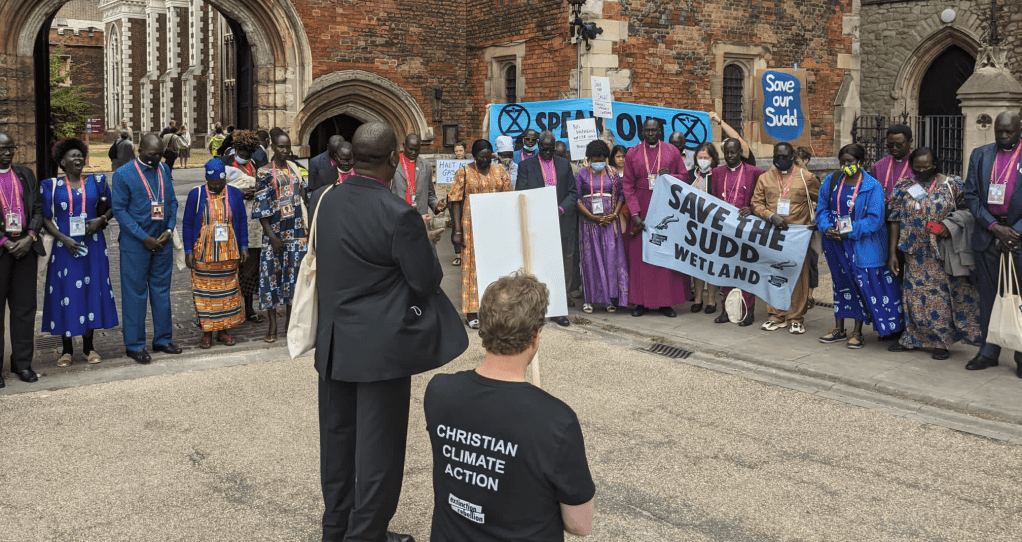
In his opening speech at the Lambeth Conference, Justin Welby spoke of the ‘roaring lions’ that best our world. The reference comes from the Letter of Peter which warns its readers to be aware of the devil that prowls around like a roaring lion. One of the loudest of the roaring lions is, says Welby, climate change – the climate crisis that is causing such devastation and anguish world wide – and closely followed by the lion of inequality. We might echo the Psalmist in saying ‘Restore us, O Lord God of hosts; show the light of your countenance, and we shall be saved.’
The writer of Hebrews reminds us of the importance of faith. Faith that can close the mouths of lions. Faith that can with stand mockery and torture, persecution and destitution, imprisonment and death. The writer ends with the stark reminder that faith doesn’t mean that in this life everything will turn out rosey. Often faith is tested to the hilt because it persists even when there is no hope of salvation any time soon. Our only hope is faith in Jesus Christ.
The words of Jesus from today’s gospel are equally blunt. Jesus has not come to white wash over the cracks in society, to call lions cats, or in anyway downplay the evil which we have created. Rather Jesus has come to transform the world. He has, to use Welby’s words, come to kill the roaring lions. To remove the causes of conflict and suffering.
It is not, I believe, that Jesus wills division and conflict, but rather that He knows the state of the world, the prejudices and proclivities of those of us how should know better and of those who have been trapped in a system that gives them very little choice. What I think does anger Jesus is that we can see the signs of impending disaster and suffering all around us and yet do nothing. We ignore the signs that tell us that we cannot keep on drilling for oil and burning it. That we cannot keep on taking from the soil and do nothing to restore its fertility. That we cannot stand back as all around plants and animals, birds and insects decline in numbers to the point of extinction. That we cannot allow a few to take and take building up wealth and riches, whilst the many struggle to feed themselves. That we cannot allow businesses to invest in products that destroy our environment rather than in those that would enhance life for all. That we cannot stand back whilst big pharmaceutical companies profit from selling vaccines to the rich whilst the poor go away empty handed. That we cannot stand back whilst media moguls control what we hear whilst burying the truth.
Welby began his address by saying that he hoped everyone would leave the Conference with their “heart full of desire for friendship with Jesus Christ. For to desire Jesus is to desire God. To desire Jesus is to desire to be filled with love for God and, by God, love for His people and love for His word.”
Time and again, this is where we must return: to the overwhelming love that God has for us and the power that love has to change the world.
Isaiah 5:1-7
Let me sing for my beloved
my love-song concerning his vineyard:
My beloved had a vineyard
on a very fertile hill.
He dug it and cleared it of stones,
and planted it with choice vines;
he built a watchtower in the midst of it,
and hewed out a wine vat in it;
he expected it to yield grapes,
but it yielded wild grapes.
And now, inhabitants of Jerusalem
and people of Judah,
judge between me
and my vineyard.
What more was there to do for my vineyard
that I have not done in it?
When I expected it to yield grapes,
why did it yield wild grapes?
And now I will tell you
what I will do to my vineyard.
I will remove its hedge,
and it shall be devoured;
I will break down its wall,
and it shall be trampled down.
I will make it a waste;
it shall not be pruned or hoed,
and it shall be overgrown with briers and thorns;
I will also command the clouds
that they rain no rain upon it.
For the vineyard of the Lord of hosts
is the house of Israel,
and the people of Judah
are his pleasant planting;
he expected justice,
but saw bloodshed;
righteousness,
but heard a cry!
Psalm 80:1-2, 8-18
1 Hear, O Shepherd of Israel, leading Joseph like a flock; *
shine forth, you that are enthroned upon the cherubim.
2 In the presence of Ephraim, Benjamin, and Manasseh, *
stir up your strength and come to help us.
8 You have brought a vine out of Egypt; *
you cast out the nations and planted it.
9 You prepared the ground for it; *
it took root and filled the land.
10 The mountains were covered by its shadow *
and the towering cedar trees by its boughs.
11 You stretched out its tendrils to the Sea *
and its branches to the River.
12 Why have you broken down its wall, *
so that all who pass by pluck off its grapes?
13 The wild boar of the forest has ravaged it, *
and the beasts of the field have grazed upon it.
14 Turn now, O God of hosts, look down from heaven;
behold and tend this vine; *
preserve what your right hand has planted.
15 They burn it with fire like rubbish; *
at the rebuke of your countenance let them perish.
16 Let your hand be upon the man of your right hand, *
the son of man you have made so strong for yourself.
17 And so will we never turn away from you; *
give us life, that we may call upon your Name.
18 Restore us, O Lord God of hosts; *
show the light of your countenance, and we shall be saved.
Hebrews 11:29-12:2
By faith the people passed through the Red Sea as if it were dry land, but when the Egyptians attempted to do so they were drowned. By faith the walls of Jericho fell after they had been encircled for seven days. By faith Rahab the prostitute did not perish with those who were disobedient, because she had received the spies in peace.
And what more should I say? For time would fail me to tell of Gideon, Barak, Samson, Jephthah, of David and Samuel and the prophets– who through faith conquered kingdoms, administered justice, obtained promises, shut the mouths of lions, quenched raging fire, escaped the edge of the sword, won strength out of weakness, became mighty in war, put foreign armies to flight. Women received their dead by resurrection. Others were tortured, refusing to accept release, in order to obtain a better resurrection. Others suffered mocking and flogging, and even chains and imprisonment. They were stoned to death, they were sawn in two, they were killed by the sword; they went about in skins of sheep and goats, destitute, persecuted, tormented– of whom the world was not worthy. They wandered in deserts and mountains, and in caves and holes in the ground.
Yet all these, though they were commended for their faith, did not receive what was promised, since God had provided something better so that they would not, apart from us, be made perfect.
Therefore, since we are surrounded by so great a cloud of witnesses, let us also lay aside every weight and the sin that clings so closely, and let us run with perseverance the race that is set before us, looking to Jesus the pioneer and perfecter of our faith, who for the sake of the joy that was set before him endured the cross, disregarding its shame, and has taken his seat at the right hand of the throne of God.
Luke 12:49-56
Jesus said, “I came to bring fire to the earth, and how I wish it were already kindled! I have a baptism with which to be baptised, and what stress I am under until it is completed! Do you think that I have come to bring peace to the earth? No, I tell you, but rather division! From now on five in one household will be divided, three against two and two against three; they will be divided:
father against son
and son against father,
mother against daughter
and daughter against mother,
mother-in-law against her daughter-in-law
and daughter-in-law against mother-in-law.”
He also said to the crowds, “When you see a cloud rising in the west, you immediately say, `It is going to rain’; and so it happens. And when you see the south wind blowing, you say, `There will be scorching heat’; and it happens. You hypocrites! You know how to interpret the appearance of earth and sky, but why do you not know how to interpret the present time?”