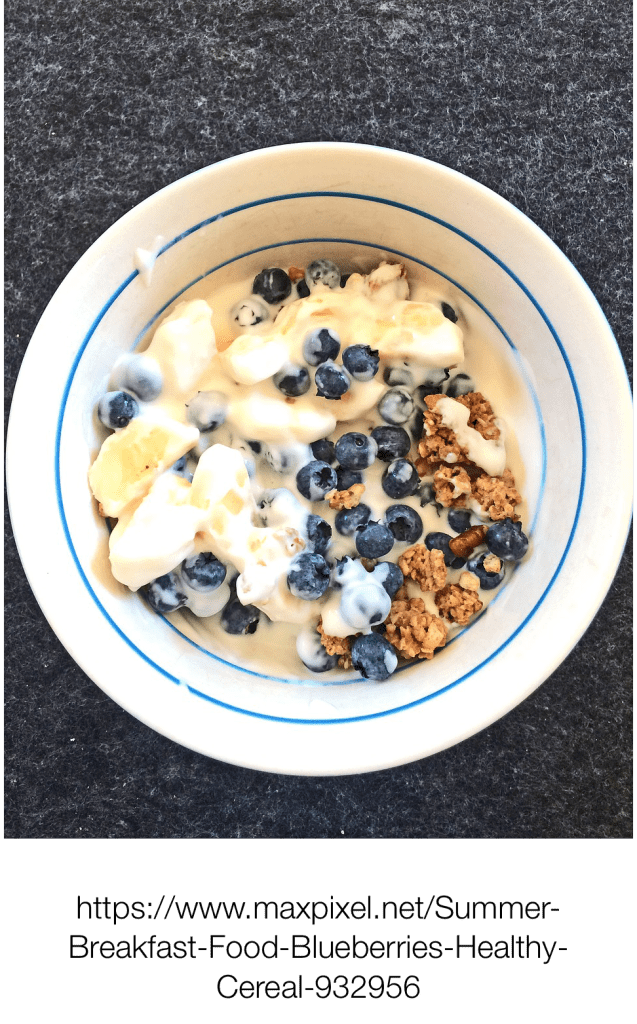
Action 10:. Swop oat milk for dairy milk. Dairy milk produces a carbon footprint of 3kg/ litre compared with 0.9kg/litre for oat milk (BBC carbon footprint calculator). Oats grow well in a temperate climate such as ours in Britain. Oatso, Made By Land and and Pure Oaty are all UK produced oat milks. Some oat milks are fortified with vitamins and minerals to mimic those in dairy milk but you can obtain these from other sources too. Using oat milk in coffee, on cereal, in cooking and baking is an easy way to reduce your carbon footprint!
You might try the equally delicious oat yogurts, fromage frais and creams that are available.
Action 9: Write to your local supermarket and ask what are their plans for reducing their carbon emissions. What targets do they have and how will they measure their progress?
Morrisons have been proactive on this front. In 2019/20, they reduced operational carbon emissions by 28% (2017 baseline) and plan further reductions of 33% by 2025, 53% by 2030 and net zero by 2040 (2017 baseline).
Action 8: The climate crisis is affecting the whole world. Sometimes in the UK it can seem as if the effects of the crisis are minimal – although recent flash floods and heat waves are changing this -so why not choose a country somewhere else in the world -eg in the Pacific or the Arctic – and find out how life there is being changed.
Action 7: Growing your own food. One way of reducing the carbon footprint of what we eat is to grow our own food. A daily salad of 50g of lettuce eaten over the course of a year will create 10kg of carbon dioxide if UK grown, or 20kg if imported from Europe. Salads like cress, rocket and mustard are easy to grow at home on a window sill or in the garden. For extra colour grow nasturtiums – both leave and flowers are edible as are the seeds which can be pickled like capers.
Action 5: 22% of the UK’s carbon emissions come from domestic use (Energy Savings Trust, 2021). Change your energy supplier to one who specialises in producing and supplying green – ie renewable – energy and make a significant dent in your domestic carbon emissions. Leading green energy suppliers include Ecotricity, Good Energy Group, Green Energy, Bulb and Octopus.
Action 4: Being self-informed, being curious about what is happening, where and why, helps us to have a better understanding of climate change. This week cut out any articles you find in the newspaper (cut and past if you read on line) about climate change and make a display with them. Looking at the overall picture may give you new insights. Why not share them?
The world’s resources are finite. The more we personally use, the less there is for others. We should reuse, repair and recycle what we do use. Plastic is conventionally made from oil but can be made from recycled plastic which has both a smaller carbon footprint and allows virgin oil to be left in the ground together with its potential carbon emissions.
Recycling plastics is a good thing.
Whilst all plastic can potentially be recycled, with some forms of plastic the process is deemed too expensive. Plastics that can easily and cheaply be recycled are typically the ones that can go in your kerb side recycling bin or in recycling points at super markets etc. Items made of several different plastics can be difficult to recycle but more and more business are making this possible. Costa Coffee collects coffee cups for recycling (typically made of paper with a thin plastic lining). Superdrug collects blister packs from pills etc for recycling.
32% of all plastic in the UK was recycled in 2020: including 50% of plastic packaging and 77% of plastic drinks bottles. Plastic that is not recycled ends up in landfill sites or incinerators, or as pollution in rivers and the sea. There is scope for more and better recycling. Equally there is scope for reducing the amount of plastic that is in circulation. Do we need all that plastic packing? Do bananas need to come in plastic bags? Do we need drink coffee from throw away cups? Why aren’t sandwiches wrapped in paper?
Good Plastic Recycling Practice
Before throwing plastic in the land waste bin, check whether it could be recycled. If necessary contact the manufacturer. If enough people keeping asking, they may even swop to a more readily recycled plastic.
Check the type of plastic you are recycling. Is it a recyclable plastic that can go in your kerb side bin or do you need to take it to an alternative recycling point? The ‘wrong’ sort of plastic can contaminate the recycling process.
Make sure the plastic is clean: rinse to remove traces of food, detergent etc. Dirty plastic can contaminate the recycling process.
Stack plastic trays together to minimise the amount the of space they take up – this stops your recycling bin from overflowing and reduces the need for larger sized recycling trucks. Similarly flatten plastic bottles. Both these practices will prevent loose items of plastic being falling or being blown out of your bin.
Action: One of the key ways in which we can reduce our carbon footprint is by eating more plant based foods and less meat and dairy products. Swopping plant based milk and butter in baking is one easy way to make the change without even noticing. I am always surprised that even though most cafes offer plant based milk, very few offer a selection of – or even just one – vegan cakes!
So here I a recipe for vegan rock buns.
Ingredients
250g raising flour ( I use wholemeal flour plus baking powder)
75g vegan butter (unlike margarine this has the hard texture of butter)
1tsp grated nutmeg
1 tsp egg replacement powder (eg Free and Easy)
50g sugar
75g dried fruit – eg raisins
Oat milk
Method
Cut the butter into cubes and rub into the flour.
Add remaining dry ingredients and mix.
Add just enough milk to bind the whole into a stiff mix. (If it is too soft, the buns will look more like cookies than rocky buns).
Place in rough spoonfuls onto a greased baking tray. It will make about 10 or 12.
Bake in a pre-heated oven at 175C for 15 to 20 minutes until lightly brown.
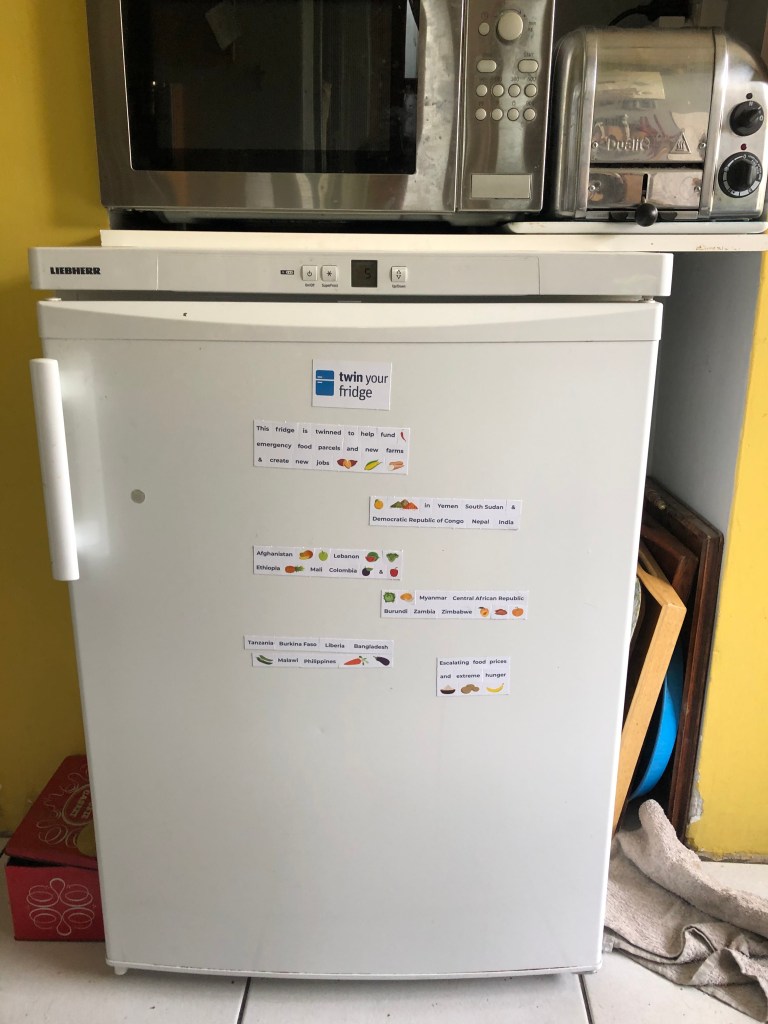
This week we twinned our fridge (having already through the auspices of TearFund twinned out toilets and rubbish bins). Our fridge is never unintentionally empty, there is always enough food in the house for us to eat. We have never experienced the hunger that comes from not knowing where your next meal will come from. Twinning our fridge is a reminder to us that we are in world terms, exceptionally fortunate and that at the very least we should be willing to contribute towards the cost of feeding those who know real hunger.
Hunger world wide is often not the result of over population, nor even of drought or floods – although this is increasing as countries increasingly experience the impacts of climate change. Most hunger arises from war (as we are seeing currently in Tigray, Syria and Yemen) and from unequal access to and sharing of, resources. Since the mid 1960s all parts of the world have been producing sufficient food to allow every person in every country to have 2000 calories a day. However within many countries the sharing of that food means that between a third and a half of the population do not receive that fair share.
Even here in the UK people go hungry, not because there is not enough food to go round, but because they do not have enough money. Their lack of money stems from a unequal sharing of the nation’s wealth. UK households waste 4.5m tonnes of food a year that could have been eaten, worth £14bn – ie the average family spends £700 a year on food it does not eat, whilst 1 in 8 people go hungry. In the last year 2.5 million people used on of the UK’s food banks.
What is the problem?
Today’s psalm tells how all God’s works – ie everything human and creaturely that God has created – praises God. In praising God, these ‘works’ reveal the glory of God’s kingdom and God’s power. And they do this so that the people may know God’s power and recognise God’s dominion. The Psalmist sees dominion as being of God – not of humans – and that because of God’s power and dominion there is food enough for all to eat. Any problems due to food shortages are not God’s problem.
The reading from 2 Kings about Elisha was one I was completely unfamiliar with. It is a story brimming with interest. It begins with a person bringing to Elisha, a man of God, their first fruits in the shape of twenty loaves of barley bread and a sack full of ears of grain – barley? The first fruits were those first to be harvested, and as is clear here, it is the barley crop that is first to be harvested. According to Leviticus 23:20, the first fruits would be given to the priest who would offer them to God. This offering was a way of thanking God, the ultimate provider of food. So here the farmer is bringing bread and grain to give thanks for God’s generosity.
Normally such food would then be available for the priests to eat. But here Elisha – who probably in the context of the Book of Kings counts as a priest – does not keep the bread and the grain for himself. Rather he shares them with the people. Food offered to God, is eaten not just by God’s holy man but by everyone – or according to the servant, by a minimum of 100 people. This a sharing of God’s food with God’s people and there is more than enough.
The writer of the letter to the Ephesians is equally bowled over by the riches of God’s glory. It is a glory which manifests itself in the power experienced by the believers in Ephesus through the Spirit and through the presence of Christ in their hearts which allows them to grow in love and faith. The writer, like the Psalmists, talks of every family on earth – every being – as being in a relationship with God. It is a parental relationship in which they may experience the fullness of God which is exemplified by the height, length and depth of Christ’s love.
John’s gospel does not have a specific description of the blessing and sharing of bread and wine at the last supper. Rather these actions are present within many of the episodes throughout the gospel. Today’s story takes place on the verge of the feast of Passover and concerns the blessing and sharing of bread. A large crowd that needs to be fed. Philip – and maybe some of the other disciples too – sees the problem as one of money. Andrew looks at what food they have to hand – the packed lunch of one small boy – and likewise sees a shortfall. And note, the writer of John’s gospel is quite specific that these are loaves of barley bread. In Jesus’s hands this offering does indeed feed the crowd – crowd not 100 but 5000! There is enough food – and more to spare – to feed God’s people.
The problem of hunger is not a lack of money nor a lack of food but a failure to share both these resources in a God-given way – with thanksgiving. When we share bread together at the Eucharist is should remind us not just of God’s love and generosity to us, giving us both food and the gift of Christ the living bread, but also that we too are meant to ensure everyone is fed.









 The Green Tau