
Biodiversity part 1
What do we mean by ‘biodiversity’?
The WWF defines it as ‘all the different kinds of life you’ll find in one area—the variety of animals, plants, fungi, and even microorganisms like bacteria that make up our natural world. Each of these species and organisms work together in ecosystems, like an intricate web, to maintain balance and support life. Biodiversity supports everything in nature that we need to survive: food, clean water, medicine, and shelter.’
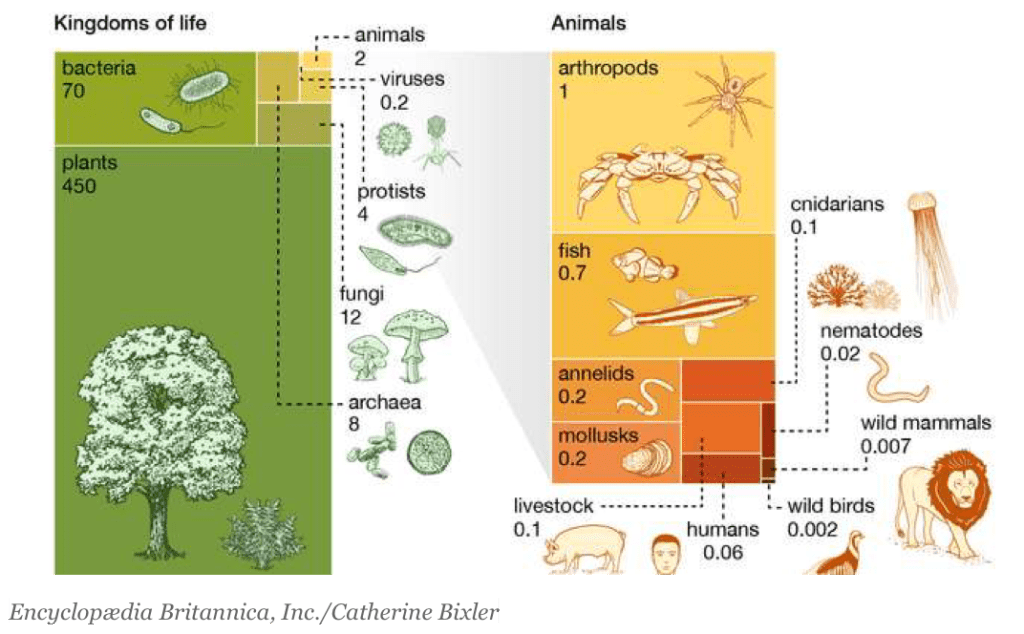
The pictogram shows the relative proportions of different life forms (in shades of green on the left) and from within that the relative proportions of animals (in shades of orange on the right). All these life forms have been measured in terms of their carbon mass, otherwise known as biomass. It creates a surprising image! Humankind appears to be almost insignificant. Yet we are increasingly aware that this is not so. Humans are highly significant because they are dramatically and drastically altering life on earth.
What is the issue?
The WWF estimates that since 1970 there has been a 60% decline in the number of animal species on the planet. Mass extinction on this scale has not been seen since the age of the dinosaurs. Almost all the causes are man-made: destruction of natural habitats; forests clearances for agriculture and industrial use; road and rail building programmes; overfishing; pollution of air, water and soils; degradation and erosion of soils; over extraction of water and loss of rivers and lakes; tourism; introduction of invasive alien species; mining operations; climate change etc.
It is not just large creatures such as polar beers, tigers and rhinos that are threatened with extinction – only two white northern rhino still exist and they are other female – but smaller ones too. In Australia the Bramble Cay Melomys, a small rodent, is the first mammal whose extinction is due to climate change. Here in the UK creatures at risk of extinction include the Scottish wildcat, a cicada native to the New Forest (no sightings have been recorded since 2000), the natterjack toad, the turtle dove, dormice, the Cosnard net-winged beetle, and 30 or more species of solitary bee (13 are now already extinct). Each species lost is in itself a loss of biodiversity but also diminishes the eco system of which it was apart and potentially puts other creatures that prey or otherwise rely on it, at risk. That risk extends to humans too. Many of our food crops (apples, strawberries, tomatoes, green beans, coffee and cocoa, kiwi fruits, avocado, cashew nuts, to name but a few) rely on bees and other insects to pollinate them. In the UK there has been a 30% decline in pollinating insects since 1980.
A recent report, The State of the World’s Trees, concludes that 30% of trees are at risk of extinction. With each species that is lost, there is a knock-on threat to other plants and creatures that rely on its unique ecosystem. The biggest threat for trees is deforestation for agricultural purposes. Disease also plays a role and here in the UK ash trees are under threat from ‘ash die back’. This fungus originates from Asia where indigenous ash trees have a natural resistance to it. It is likely it was inadvertently introduced here with imported saplings, but now it is could destroy up to 80 or 90% of our native ash trees.
Why is biodiversity important?
- Protection of food supplies (as mentioned above)
- Protection of ecosystems: loss of one species can radically change or destroy an ecosystem, so the effect can be cumulative
- Many species are key contributors maintaining the well being of the planet:
keeping soils fertile – eg earth worms
controlling pests – eg ladybirds and wasps
keeping water clean – eg oxygenating plants
removing decaying material – eg slugs and snails, crows and vultures
keeping the air clean – eg trees
keeping oceans healthy – eg sea grass which absorbs CO2 and provides food for fish etc
- Source of medicines, many of which have perhaps yet to be discovered
- Green and blue spaces – ie nature – is good for mental health and well being
- Aesthetic and cultural values – eg oak trees are symbolic of England, tigers are culturally significant in India, as are reindeer for the Sami. Even here in London biodiversity is embedded geographically: eels must once have swum through Eel Brook Common, beavers once lived along Beverly Brook and presumably nightingales once sang in Berkeley Square.
- And above all, because it’s out there, it’s amazing and it’s God-given.
Slowly work is being undertaken to restore and protect the world’s biodiversity. It will feature as part of the forth coming COP26 climate change conference as well as being the subject of its own COP15 conference which should take place April 2022 in China. More immediately here in the UK the Government’s Environment Bill which will set binding targets for the recovery of biodiversity. After it’s third reading in the House of Lords on 13th October it will return to the House of Commons for a final reading. Do write to your MP and ask them to vote down any amendments that attempt to water down this Bill.






 The Green Tau