Creation-tide – Christian Climate Action and the prophetic role 

17th September 2023

Reflection (readings below)

To be a prophet is not a popular calling. Often the message you have been given by God is not exactly the message that people want to hear. The message is often contradictory, challenging the norm; it may ask for a life-style that is counter cultural, it may be a message that counters the way people  current live  – and are happily living in fact, ‘thank you very much!’

Jeremiah was certainly in that position. The message God asked Jeremiah to deliver was definitely not what the people of Judah wanted to hear. 

Nor was it the message the religious leaders wanted to hear.

Nor was it the message the political leaders, including the King, wanted to hear. 

How is Jeremiah going to get the people to pay attention, how is he going to get them a) to listen to God’s message and b) to respond to it positively?

In the passage we have just heard, Jeremiah takes an earthware jar – a large one I’m guessing – and throws it the ground. (Push a heavy book onto the floor) SMASH! That surely got their attention! And he gives them God’s message. 

Why am I telling you this? Because I see the role of the climate activist as being like that of a prophet. The climate activist has a message to deliver, a message that people do not necessarily want to hear because it is asking them to make changes in their lifestyle, to change the way they relate to other people, to change the way they relate to other creaturely beings, to change the way they relate to the entirety of God’s creation. 

Is the climate activist’s message a message from God or just a repetition of what the scientists are saying? From the very beginning we are told that the earth is the work of God, that God created all that exists in its beauty and diversity, and declared it to be good. And we are also told that God specially created humans to have a very particular role within creation: to tend and care for the earth, working with and for the wellbeing of the other beings that God has created. The unfolding drama of the Bible, especially in the books of the prophets, tells us that when we live in harmony with God’s will, the earth is a place of flourishing. And when we go astray and live in disharmony with God, then the earth becomes a place of desolation – crops fail, animals and people die, rivers dry up, and warfare and illness stalk the land. For the Christian climate activist, the message they bear is definitely one from God; it is based on prayer and on the study of both scripture and scientific research.

As a Christian climate activist, I endeavour to speak God’s truth, to call out injustice, and to call on people – whether as individuals or as organisations – to pay attention to the crisis creation faces and to reorientate their way of living – shaping it as God wills. Like the prophets, I have engaged in nonviolent direct action to get the message across. I have knelt in prayer outside Shell’s headquarters, I have petitioned my MP, I have marched on the streets, I have been arrested for obstructing the highway, I have written a blog, I have preached, I have knelt in the cathedral and had my hair cut off as a sign of penitence. Other Christian activists have gone further and even been sent to prison for the non violent disruptive actions they have taken in the cause of safeguarding creation. That is something Jeremiah also encountered. At one point he was even imprisoned in a pit by his opponents.

But is disruptive action in line with the teaching, the example, of Jesus? 

Think back to our gospel reading. Can you imagine the scene? Here is Jesus riding on a donkey – one that has been rather oddly purloined for him – riding slowly into Jerusalem whilst all around his followers are pulling branches from the trees and taking off their garments to cover the road. And all the time they are doing this, they and the crowd are shouting slogans, slogans that challenge the religious status quo and the political status quo! What is Jesus doing if not being disruptive? And does he stop when those in authority ask him to? No way! This is the word from God. Even if the people were to be silent, then the very stones would take up the message!!

This is one example, but throughout the gospels we see and hear Jesus carrying out actions that challenged the status quo. He healed the sick on the sabbath. He touched the unclean. He brought in the outsider. He preached a message which turned the economics of the day upside down. He fed the hungry. He inaugurated a meal that demonstrated that in him is the divine source of life. He provoked the authorities to seek his execution and even in death challenged them to see the world differently.

Prophets do not just highlight what is going wrong, they also point to what is possible, to the vision of how God wishes and desires things to be. John – the John who is named as the writer of the Book of Revelation –  knows of the evils and destructive habits of the world of which he is a part, but he is also aware that God envisages something far better – a new heaven and a new earth in which no evil resides, in which all live in harmony with God. Climate activists too have a vision to share of a new and possible future. A world of clean energy. A world of homes well insulated against the cold and the heat respectively.  A world in which there is enough good food for everyone. A world in which resources are shared fairly and used sustainably. Indeed a world where everyone lives in harmony just as God desires. 

To be a climate activist is a prophetic calling. It is, I think, a calling that is more widespread than many people would believe. But if one looks at the state of the world, the enormity of the crisis we face, the scale of social injustice being created, then actually we should not be surprised that God is calling more and more of us to take on the prophetic role and become climate activists.  Maybe this creation-tide you will find yourself moved by God to become a  climate  activist. 

Jeremiah 19:1-6, 10-13

Thus said the Lord: Go and buy a potter’s earthenware jug. Take with you some of the elders of the people and some of the senior priests, and go out to the valley of the son of Hinnom at the entry of the Potsherd Gate, and proclaim there the words that I tell you. You shall say: Hear the word of the Lord, O kings of Judah and inhabitants of Jerusalem. Thus says the Lord of hosts, the God of Israel: I am going to bring such disaster upon this place that the ears of everyone who hears of it will tingle. Because the people have forsaken me, and have profaned this place by making offerings in it to other gods whom neither they nor their ancestors nor the kings of Judah have known, and because they have filled this place with the blood of the innocent, and gone on building the high places of Baal to burn their children in the fire as burnt-offerings to Baal, which I did not command or decree, nor did it enter my mind; therefore the days are surely coming, says the Lord, when this place shall no more be called Topheth, or the valley of the son of Hinnom, but the valley of Slaughter. 

 Then you shall break the jug in the sight of those who go with you,  and shall say to them: Thus says the Lord of hosts: So will I break this people and this city, as one breaks a potter’s vessel, so that it can never be mended. In Topheth they shall bury until there is no more room to bury.  Thus will I do to this place, says the Lord, and to its inhabitants, making this city like Topheth.  And the houses of Jerusalem and the houses of the kings of Judah shall be defiled like the place of Topheth—all the houses upon whose roofs offerings have been made to the whole host of heaven, and libations have been poured out to other gods.

Revelation 21:1-4

Then I saw a new heaven and a new earth; for the first heaven and the first earth had passed away, and the sea was no more. And I saw the holy city, the new Jerusalem, coming down out of heaven from God, prepared as a bride adorned for her husband. And I heard a loud voice from the throne saying,

‘See, the home of God is among mortals.
He will dwell with them;
they will be his peoples,
and God himself will be with them;

he will wipe every tear from their eyes.
Death will be no more;
mourning and crying and pain will be no more,
for the first things have passed away.’

Luke 19:29-40

When he had come near Bethphage and Bethany, at the place called the Mount of Olives, he sent two of the disciples, saying, ‘Go into the village ahead of you, and as you enter it you will find tied there a colt that has never been ridden. Untie it and bring it here.  If anyone asks you, “Why are you untying it?” just say this: “The Lord needs it.”’  So those who were sent departed and found it as he had told them.  As they were untying the colt, its owners asked them, ‘Why are you untying the colt?’  They said, ‘The Lord needs it.’ Then they brought it to Jesus; and after throwing their cloaks on the colt, they set Jesus on it. As he rode along, people kept spreading their cloaks on the road. As he was now approaching the path down from the Mount of Olives, the whole multitude of the disciples began to praise God joyfully with a loud voice for all the deeds of power that they had seen, saying,

‘Blessed is the king
    who comes in the name of the Lord!
Peace in heaven,
    and glory in the highest heaven!’

Some of the Pharisees in the crowd said to him, ‘Teacher, order your disciples to stop.’  He answered, ‘I tell you, if these were silent, the stones would shout out.’

Counting on …. Day 1.173

15th September 2023

Yesterday I joined a multi faith group to hand over a letter to Lloyd’s of London asking them to cease insuring new oil projects. Whilst companies such as Lloyd’s finance/ financially enable oil projects, the exploration and production of oil will continue- and indeed will be seen as socially acceptable by the wider public. All parts of the fossil fuel industry need to be challenged and changed, if we as global community, are going to reduce carbon emissions to safeguard the environment.

For the text of the letter see – https://www.quaker.org.uk/documents/lloyds-of-london-faith-letter-2023-04-24 

Counting on … day 1.172

14th September 2023

On Wednesdays I kneel for an hour’s vigil outside Shell’s Headquarters. I first began this when the campaign group Fossil Free London held weekly pickets outside the building protesting at Shell’s continuing exploration and production of oil. At all stages of oil production damages the environment – whether that is the leaking of oil that has pollute the Niger Delta; the noise from underwater explosions that disorientates whales off the coast of South Africa; the flailing of oil wells that releases methane into the atmosphere ( a gas which rapidly increases global warming); leaks from pipelines and tankers that pollute the sea and coat seabirds an oily slick; the air pollution from diesel and petrol engines; the global warming from the release of CO2 when oil is burned as energy; and the pollution of all areas of our planet by fragments of plastic. We need on some many counts to press oil companies to rapidly phase out the production of oil and instead develop renewable energy supplies.

Green Tau: issue 78

13th September 2023

Is peace simply the opposite of war?

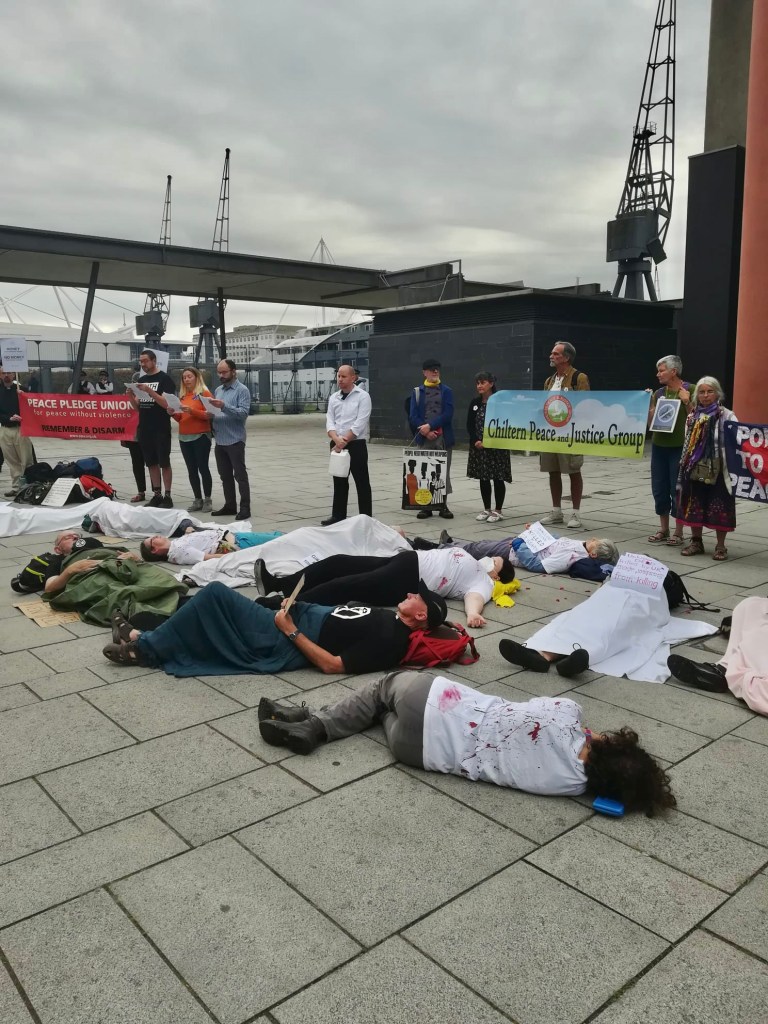
Recently I took part in a peace vigil outside the DSEI arms fair being held at London’s ExCel centre. Setting aside for a moment the morals of using weapons, there is something deeply uncomfortable about the idea of an arms fair: the idea that just as one can a book fair, or an Ideal Homes exhibition, or a horticultural show, one can have a ‘jolly day out’ walking round stands full of weapons, admiring staged demonstrations, picking up samples and goody bags, whilst enjoying alcoholic and other beverages. There is equally something very disturbing about people making profits out of buying and selling products designed to inflict fear, maim and kill.

But on the other hand are weapons a necessary evil, things that do have at some point to be bought and sold? Would we have wanted  the Ukrainians to be weaponless when the Russians invaded? Perhaps weapons are a necessary evil if we want peace not war? 

The following is not based on academic research, but simply a reflection of wha has been going through my mind. 

Is peace the opposite of war or vice versa? I think that peace is the opposite of war but that the reverse proposition is flawed. Peace is not simply an absence of war. It is far more. 

Peace is justice and equality. 

Peace is freedom. 

Peace is contentment and fulfilment. 

Peace is about the individual and the community. 

Peace is about the present and the future. 

This is a rigorous set of imperatives to meet. But does peace exist anywhere in the world? Here in the UK we are not at war, but do we enjoy the peace described above? I think not.

Justice is unevenly delivered. For those with money to pay for lawyers and the cost of court cases, there can be justice. Indeed for those with money to serve injunctions, injustice can be perpetuated. Justice is uneven delivered depending on one’s colour, race or faith. Activists seeking the right to protest can find their actions constrained by injunctions served on them by big corporations and institutions – and to compound the injustice, may then be billed for the injunction!

Equality is patchy – again depending on your wealth. The more you have, the more the system will work in your favour. If you can afford to go to a good school (whether by living in the right catchment area or paying fees) you will get better qualifications and better employment opportunities. If you can afford a better house – especially one you own rather than rent – you will be healthier, learn better and again  have better employment opportunities. If you are homeless, the chances of being as healthy, of getting good qualifications and a job are much less. If you grow up in a household with two parents, if you grow up in a household where everyone is literate, if you grow up in a household where everyone has a job, then you too will have better educational outcomes and better employment opportunities. Then there are postcode lotteries that affect your access to schools and health care. There are geographical north-south divides that shape your opportunities.

Freedom often depends upon access to money. To be free to travel, you need to be able to pay for transport.  To be free to take a holiday you need a higher enough wage – and/ or holiday pay – to cover your costs of living whilst on holiday. To be free to change career, you need sufficient money to cover re-training costs plus what is need to cover living costs whilst you study. To be free to live where ever you want, you need sufficient funds to match the great variation of costs across the country, from region to region, area to area. 

Contentment and fulfilment will vary from person to person, and some may find them for a very low outlay, but for others the cost may be prohibitive. One may find fulfilment in hillwalking, but another in skiing.  Neither ambition is inherently better but the latter may financially be unobtainable. If one’s contentment  depends upon swimming, fulfilment may depend upon whether your local authority still runs to swimming pools or whether your local water company keeps your rivers clean.

Because of the inequalities so far highlighted, you can see that some individuals in the UK may achieve lives of relative peace, but that as a community, our achievements are limited.

Again, sadly, whilst we may have relative peace for now, the ongoing likelihood of such peace is in the balance. With underfunded health, social care  and educational provision, the inequalities of access becoming increasingly dependent on money, seems likely to increase. And with the lack of investment in renewable energy, energy efficient infrastructure and in infrastructure (including things such as tree planting) to mitigate the  effects of the already changing climate, many people’s hope for future contentment  also looks bleak. Such is the state of peace in the UK. But what about more vulnerable countries?

What about Mali where rival militias tax or destroy rural communities? And where climate change is causing the loss of agriculture land with the expansion of the Sahara?

What about North and South  Sudan and Uganda where control of the water in the Sudd wetlands and the White Nile, is leading to disagreement and conflict?

 What about Pakistan where climate change is both melting glaciers and intensifying the wet and dry seasons, making agriculture less viable, and where rising sea levels are reducing the amount of available farm land? With limited opportunities to make a future at home, where can these farmers and their families go to seek a fulfilled life? Seeking refugee in Europe is increasingly difficult.

What about the people of the Democratic Republic of the Congo, where the race to mine copper and cobalt to make batteries, is driving many local people off their land, whilst at the same time polluting land and water supplies? 

Across the world there are many instances where one can see that peace is not present. These are potential hotspots which could lead to internal or cross border warfare. My contention is that if the money that would be spent on the wars that are likely to erupt, was instead spent on removing the obstacles to peace, we would not need to be investing in the arms trade. Where war is already happening, I do see that a different response is needed, but that is still needs to be one that establishes peace on both sides of the conflict.

I can well imagine that rather than building up resources for future war, building up the resources for peace would be financially cheaper. This peace building would involve establishing justice and systems of maintaining justice – both internally within countries and between them. It would involve removing existing inequalities and rebalancing fairly access to resources and opportunities. It would involve valuing contentment and fulfilment as more important than GDP. It would involve valuing equally the needs of individuals and the needs of communities. 

Not an easy task but one that is biblically mandated, perhaps, as in this passage from Micah.

And many nations shall come and say:
‘Come, let us go up to the mountain of the Lord,
    to the house of the God of Jacob;
that he may teach us his ways
    and that we may walk in his paths.’
For out of Zion shall go forth instruction,
    and the word of the Lord from Jerusalem.

He shall judge between many peoples,
    and shall arbitrate between strong nations far away;
they shall beat their swords into ploughshares,
    and their spears into pruning-hooks;
nation shall not lift up sword against nation,
    neither shall they learn war any more;

but they shall all sit under their own vines and under their own fig trees,
    and no one shall make them afraid;
    for the mouth of the Lord of hosts has spoken.

For all the peoples walk,
    each in the name of its god,
but we will walk in the name of the Lord our God
    for ever and ever. Micah 4:2-5

Here there is justice, for God arbitrates between nations and between peoples. Here there is equality such that  everyone can sit under their own vines and their own fig trees. Here freedom is suggested for  weapons have been turned into gardening tools, and no one makes anyone afraid. Here is (religious) freedom where people walk with their own gods. Here is contentment and fulfilment for all are taught the ways of God. 

Counting on …. Day 1.171

13th September 2023

Yesterday I took part in a peace vigil outside the Excel Centre which was hosting the DESI arms fair. The names of just a few of those who have been killed by military armaments were slowly read out accompanied by a slow drum beat. Armaments kill people. They also kill birds and animals, destroy trees and plants, and pollute soils and water ways. Their noise disrupts the migratory movements of birds and other creatures including migrating sea creatures.

In the season of creation-tide it is important to understand the widespread and destructive consequences of resorting to war.

Pilgrimage for the Planet

12th September 2023 – afterword

A Pilgrimage for the Planet –  

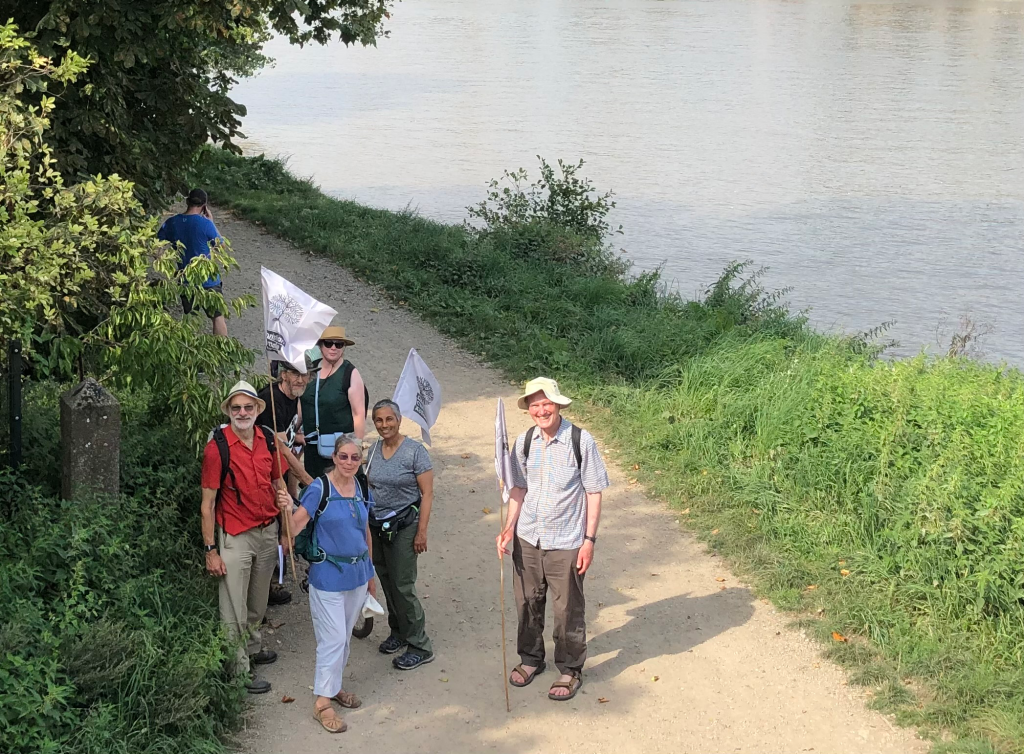
Out of thirteen pilgrimages organised by Christian Climate Action across the country, four took place along the Thames including the one from Putney to Richmond. Our small band of pilgrims were sent off with a blessing and prayers led by John Whitaker, vicar of St Mary’s Putney. As we followed the Thames Path upstream we paused to give thanks for the beauty and benefits of the river and its environment, as well as lament our shortcomings in caring for both its vitality and for our failure to ensure justice for the vulnerable in our local and global communities. pilgrimages organised by Christian Climate Action. Our recurring refrain was Let justice roll on like a river, righteousness like a never failing stream (Amos 5:24 and one of this year’s tag lines for creation-tide. Halfway we benefited from the welcomed hospitality offered by St Mary’s Mortlake as especially with the heat we needed to refill water bottles and enjoy the cool of the church. Exhausted (slightly fewer in number) but exultant we finally reached Richmond Bridge closing with a modern Franciscan blessing:

May God bless us with discomfort at easy answers, half-truths, and superficial relationships, so that we may live deep within our hearts.

May God bless us with anger at injustice, oppression, and exploitation of people, so that we may work for justice, freedom, and peace.

May God bless us with tears to shed for those who suffer from pain, rejection, hunger, and war, so that we may reach out our hands to comfort them and turn their pain into joy.

And may God bless us with enough foolishness to believe that we can make a difference in this world,  so that we can do what others claim cannot be done, to bring justice and kindness to all our children and the poor. Amen. 

For more information about Christian Climate Action visit https://christianclimateaction.org/ where similar events in the future will be advertised. 

Counting on … day1.170

12th September 2023

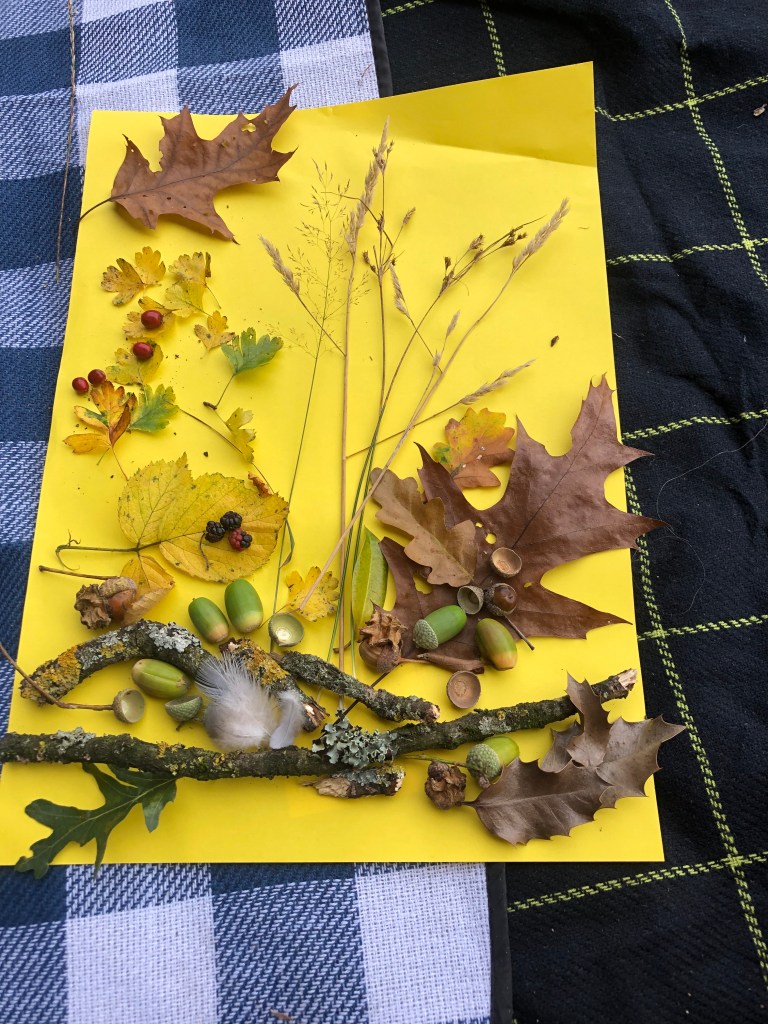
Yesterday I was helping with our local church’s Messy Church which this month was held on Sheen Common. Children with their mums/ carers did a scavenger hunt, made bark rubbings and arranged things they found to make a picture. It was good to see them having such fun whilst getting up close and personal with the natural environment. 

Counting on … day 1.169

11th September 2023

Here in the UK not  everyone has equal access to green spaces, fresh fruit and vegetables, clean air. 

This is a justice issue and one that should be tackled to improve wellbeing for the individuals and for society as a whole. It is something that has been recognised by the Government but how it can be realised and financed is not so clear. 

“Parks and greenspaces in England deliver an estimated £6.6 billion of health, climate change and environmental benefits every year. But with 80% of people now living in towns and cities, one third of people do not have access to good quality green and blue space within 15 minutes of their home. The government’s Environmental Improvement Plan, published [31st January 2023], includes a commitment that the public should be able to access green space or water, such as woodlands, wetlands, parks and rivers, within a 15-minute walk from their home.” https://www.gov.uk/government/news/natural-england-unveils-new-green-infrastructure-framework

Pilgrimage for the Planet

Today, 10th September I am leading a pilgrimage as part of CCA’s Weekend of pilgrimages.

These are the prayers we will be using as we walk from Putney to Richmond along the Thames Path.

“Let justice flow on like a river, righteousness like a never-failing stream.” Amos 5:24

The ancient practice of pilgrimage, honoured by many of the world’s great faiths, has a renewed focus in this age of climate and ecological emergency. Walking together with intention, mindfulness and prayer proclaims a different pace and place in relationship to the earth; and with each other. We become fellow travellers, learning again to ‘tread lightly’ on the earth. Pilgrimage invites a renewal of body, mind and spirit, while offering a visible sign of a different way of living and travelling.

Opening prayers:

Most High, all powerful, good Lord,
To you we offer praise and glory, the honour and blessing.
All creation – all that lives and breathes and moves – praises you. 

All the elements praise you – 

Brother Sun radiant with light and energy, beautiful and awesome,

And who with Sister Moon, establishes day and night,  tides and seasons. 

All praise to God!

Brother Wind and air, calm and serene, powerful and fearsome, 

Bringer of weather, and source of energy.

All praise to God!

Sister Water, humble yet precious, simple and beautiful, 

fluid energy and source of life. 

All praise to God!

Brother Fire, playful, robust and strong, 

offering warmth and comfort, yet to be handled with care!

All praise to God!

Sister-Mother Earth who sustains us and governs us,

And  produces plants and minerals, sustaining life in all its rich diversity.

All praise to God!

All the elements praise you 

and so too all that lives and breathes within your creation!

All praise to God!

In your bountiful love, 

forgive our carelessness, our greed and our destructive acts. 

Lord have mercy

Forgive our selfishness, and our failure to show compassion. 

Lord have mercy

Forgive our heartlessness, our narrowness of vision and  our failure to act justly.

Lord have mercy

Forgive our self-certainty, our disregard for your wisdom and our failure to learn.

Lord have mercy

With humility and contrition, we praise you 

and ask your blessing on our endeavours. 

May we serve you with humility,

seeking justice and showing loving care for all creation.

To you be all honour and power, praise and glory.

Amen. 

Pauses for prayer.

1. Putney Bridge, beneath which runs the newly constructed super sewer.

This tunnel will be 25km long and 7.2 metres in diameter, when it finishes construction in 2025. It will carry away London’s sewage and rainwater with sufficient capacity that even during storms effluent will not enter the Thames. Instead this effluent will make its way to Beckton Sewage Treatment Works before being discharged as clean water into the Thames estuary.

We give thanks for the super sewer that will prevent sewage spilling into the Thames. We give thanks for the rich diversity of wildlife – fish, flora and fauna – that a clean Thames can support. 

Yet we lament our human foolishness that so often allows harmful chemicals, sewage and litter to pollute the waterways on which we depend. 

Lord have mercy:

Let justice flow on like a river, righteousness like a never failing stream.

2. Betwixt the boat houses and the playground at Leader’s Gardens. 

We give thanks for joy that the Thames provides a place for recreation and relaxation, both in, on and by the water. We give thanks for the healing and health-giving capacity of the natural world.  

Yet we lament the thoughtless creep of urbanisation that can destroy such beauty and the inequalities of our society that precludes  everyone having easy access to blue and green spaces. 

Lord have mercy:

Let justice flow on like a river, righteousness like a never failing stream.

3. London’s Wetland Centre. Over the past twenty plus years these  disused Victorian reservoirs have been transformed to provide a rich habitat for different wetland – and other birds, including sand martins – insects, reptiles and amphibians, bats and various other small mammals. The Wetland Centre is also working with the Borough of  Richmond to rewild the lower sections of the Beverley Brook to help prevent locally flooding as well as enriching biodiversity. In the past  Beverley meant beaver meadow and, like Eel Pie Island, reminds us that in the past there were many more species resident in these waters. 

We give thanks for nature’s capacity to both recover and to recreate biodiverse rich habitats. We give thanks for those opportunities that have been taken to rewild the landscape, even within the confines of a city.

Yet we lament those times when nature has been pushed out of the picture. We lament lawns that have been lost to astroturf, flowers beds lost to driveways, streets that still lack the companionship of trees.

Lord have mercy:

Let justice flow on like a river, righteousness like a never failing stream.

4. Mortlake – where in the 17th century the famous Mortlake tapestries were woven by Flemish weavers. Some of the master weavers were granted English citizenship, whilst orphaned boys from the City  of London were taken on as apprentices. This river location has also attracted other migrants; we passed but the Swedish school  in Barnes, and if we went further  upstream we would pass the German school at Petersham. 

We give thanks for the diverse people who have settled along the Thames enriching the lives of their local communities.

Yet we lament the attitude of our our current government towards those who come to these shores seeking safety. We lament the affects of the climate crisis on communities across the globe, particularly for those who are already impoverished because of global inequalities. 

Lord have mercy:

Let justice flow on like a river, righteousness like a never failing stream.

5. Kew Gardens – which has a plant collection of some 17,000 species, whilst at its millennium seed bank at Wakehurst it has 2.4 billion seeds from around the world. Kew Gardens is also carrying  out research research into climate change-resistant crops, zero-carbon fertiliser and plant- and cell-based meat and dairy products.

We give thanks for the rich diversity of plants that exists around the world, and for the research being done to protect and enhance plants and habitats.

Yet we lament the industrialisation of farming and the over grazing and exploitation of land to satisfy our desire for meat. We lament the economic model that leave many in the world with inadequate and poor diets .

Lord have mercy:

Let justice flow on like a river, righteousness like a never failing stream.

6.  Richmond Lock. The Thames is still tidal here and the lock helps maintain water levels between here and Teddington Lock. Even so during height tides and/ or times of heavy rain land either side of the river can flood and the risk is growing as a result of the climate crisis with rising sea levels and extreme weather systems. To ease this, work is being

carried out in the Old Deer Park to create creeks and swales, allowing the land to become once again a real floodplain. 

We give thanks for the natural capacity of the soil, trees and plants to absorb rainfall. We give thanks for the diversity of habitats that create sustainable ecosystems.

Yet we lament the pressure we are placing on the environment to cope with the climate crisis that we have caused. We lament the threat that rising sea levels  causes for so many small nations. 

Lord have mercy:

Let justice flow on like a river, righteousness like a never failing stream.

Our final pause is at Richmond Bridge, the end of our pilgrimage. Having begun our journey with a variation of St Francis’s Canticle of the Creatures, let us end with a modern Franciscan blessing.

May God bless us with discomfort at easy answers, half-truths, and superficial relationships, so that we may live deep within our hearts.

May God bless us with anger at injustice, oppression, and exploitation of people, so that we may work for justice, freedom, and peace.

May God bless us with tears to shed for those who suffer from pain, rejection, hunger, and war, so that we may reach out our hands to comfort them and turn their pain into joy.

And may God bless us with enough foolishness to believe that we can make a difference in this world, so that we can do what others claim cannot be done, to bring justice and kindness to all our children and the poor.

Amen. 

further info:

Christian Climate Action  is a community of Christians who support each other to take meaningful action in the face of imminent and catastrophic anthropogenic climate breakdown. We are inspired by Jesus Christ and guided by the Holy Spirit. Following the example of social justice movements of the past, we carry out acts of public witness, nonviolent protest and civil disobedience to urge those in power to make the changes needed. We also work to engage and mobilise people to take action.

Earth Vigil – Westminster. Every Wednesday, 11-1pm, 1-3pm, we sit together outside parliament, praying to our Creator God For more info contact christianclimateaction@gmail.com

‘Make Polluters Pay’ 23rd September for a day of action with Christian Aid.

‘Oily Money Out’  17th – 19th October. Join us for protest, prayer and action outside the annual Oil and Money Conference 

Proper 18, 17th Sunday after Trinity

10th September 2023

Reflection (readings are below)

All change! 

Many stories in the Bible are about change, often a radical change in direction. In the Book of Genesis, God’s relationship has been with individuals – Abraham, Isaac and Jacob – and their households. This changes in the Book of Exodus. God’s relationship is now with a whole people – a new nation in the making. God will lead not just individuals but the whole people of Israel out into the wilderness and there will shape them into a nation. The nature of the change was equally radical. One day they were people who had, over several generations, been sucked into a situation of enslavement; who had found their freedom of movement and action curtailed; who had become enmeshed into an unwilling dependency on the Egyptian authorities; who had become unwilling and possibly unwitting cogs in a system beyond their complex.

Overnight they were uprooted from their homes, their work, their daily routines. Overnight they were called to flee; to put their complete trust for survival in God; to face down the armed forces of their overlords. Then stripped from all that was familiar, they were to adopt a new nomadic lifestyles, learn new way of living, and accept their total dependency on God for the barest of essentials including food and water. 

Today’s story from Exodus describes a carefully orchestrated meal that is more than just a meal. It is a domestic event that binds together the whole community. It is a ritual that defines the identity of a people. It is an act of worship in which everyone is a celebrant. It is a sacrament that establishes a new and particular relationship between God and the people. 

The meal, both initially and annually thereafter, takes place in the home and not in a designated place of worship, sacred site or temple. The blood painted on the door frames identifies which households are part of God’s people and which are not. The killing of the lamb – one that is without blemish – is a sacrificial act carried out not by priests but by the householders. From now on, God will lead all the people – not just individuals who were noteworthy, but the whole community presumably including some who were good and some not so good.

Of all the stories in the Old Testament, this will become the defining one, the most significant. It encapsulates the recurring truth that God will save his people, will gather them and rescue them from evil forces and establish them ready for a new life.  Every year celebrating the Passover will be central to those of Jewish faith. It is the key feast in the life of Jesus, causing him, as with his thousands of his contemporaries, to make the special journey to Jerusalem. The meal itself is transformed by Jesus. It is given a new layer of meaning in which Jesus himself is the sacrifice, and whose blood marks the beginning of a new covenant – a new relationship – between God and God’s people.

All change is also St Paul’s expense. In his letter to the Romans, he is writing about an equally radical change. God’s relationship with people which was once through the Jewish Law is now widen to an understanding that we are all sinners, we none of us of our own will and strength can be righteous, BUT that all can be made righteous through faith in Jesus Christ. The Law of the Jews, which St Paul calls the Law of sin, is now replaced with the law of God, the law of love. 

As we celebrate and share in the Eucharist, let us be ready for change, embracing whole heartedly the law of love. 

Exodus 12:1-14

The Lord said to Moses and Aaron in the land of Egypt: This month shall mark for you the beginning of months; it shall be the first month of the year for you. Tell the whole congregation of Israel that on the tenth of this month they are to take a lamb for each family, a lamb for each household. If a household is too small for a whole lamb, it shall join its closest neighbour in obtaining one; the lamb shall be divided in proportion to the number of people who eat of it. Your lamb shall be without blemish, a year-old male; you may take it from the sheep or from the goats. You shall keep it until the fourteenth day of this month; then the whole assembled congregation of Israel shall slaughter it at twilight. They shall take some of the blood and put it on the two doorposts and the lintel of the houses in which they eat it. They shall eat the lamb that same night; they shall eat it roasted over the fire with unleavened bread and bitter herbs. Do not eat any of it raw or boiled in water, but roasted over the fire, with its head, legs, and inner organs. You shall let none of it remain until the morning; anything that remains until the morning you shall burn. This is how you shall eat it: your loins girded, your sandals on your feet, and your staff in your hand; and you shall eat it hurriedly. It is the passover of the Lord. For I will pass through the land of Egypt that night, and I will strike down every firstborn in the land of Egypt, both human beings and animals; on all the gods of Egypt I will execute judgments: I am the Lord. The blood shall be a sign for you on the houses where you live: when I see the blood, I will pass over you, and no plague shall destroy you when I strike the land of Egypt.

This day shall be a day of remembrance for you. You shall celebrate it as a festival to the Lord; throughout your generations you shall observe it as a perpetual ordinance.

Psalm 149

1 Hallelujah!
Sing to the Lord a new song; *
sing his praise in the congregation of the faithful.

2 Let Israel rejoice in his Maker; *
let the children of Zion be joyful in their King.

3 Let them praise his Name in the dance; *
let them sing praise to him with timbrel and harp.

4 For the Lord takes pleasure in his people *
and adorns the poor with victory.

5 Let the faithful rejoice in triumph; *
let them be joyful on their beds.

6 Let the praises of God be in their throat *
and a two-edged sword in their hand;

7 To wreak vengeance on the nations *
and punishment on the peoples;

8 To bind their kings in chains *
and their nobles with links of iron;

9 To inflict on them the judgment decreed; *
this is glory for all his faithful people.
Hallelujah!

Romans 13:8-14

Owe no one anything, except to love one another; for the one who loves another has fulfilled the law. The commandments, “You shall not commit adultery; You shall not murder; You shall not steal; You shall not covet”; and any other commandment, are summed up in this word, “Love your neighbour as yourself.” Love does no wrong to a neighbour; therefore, love is the fulfilling of the law.

Besides this, you know what time it is, how it is now the moment for you to wake from sleep. For salvation is nearer to us now than when we became believers; the night is far gone, the day is near. Let us then lay aside the works of darkness and put on the armour of light; let us live honourably as in the day, not in revelling and drunkenness, not in debauchery and licentiousness, not in quarrelling and jealousy. Instead, put on the Lord Jesus Christ, and make no provision for the flesh, to gratify its desires.

Matthew 18:15-20

Jesus said, “If another member of the church sins against you, go and point out the fault when the two of you are alone. If the member listens to you, you have regained that one. But if you are not listened to, take one or two others along with you, so that every word may be confirmed by the evidence of two or three witnesses. If the member refuses to listen to them, tell it to the church; and if the offender refuses to listen even to the church, let such a one be to you as a Gentile and a tax collector. Truly I tell you, whatever you bind on earth will be bound in heaven, and whatever you loose on earth will be loosed in heaven. Again, truly I tell you, if two of you agree on earth about anything you ask, it will be done for you by my Father in heaven. For where two or three are gathered in my name, I am there among them.”