After travel and accommodation, food maybe the next consideration. We can, whether eating out or self catering, make our diet more or less environmentally friendly depending on what we choose to eat. Choosing a plant based diet will have a lower environmental impact than one based on dairy and/or meat. “Avoiding meat and dairy products is one of the biggest ways to reduce your environmental impact, according to scientific studies” (1)
After travel, what accommodation? The following maybe of interest if you’re staying in a hotel.
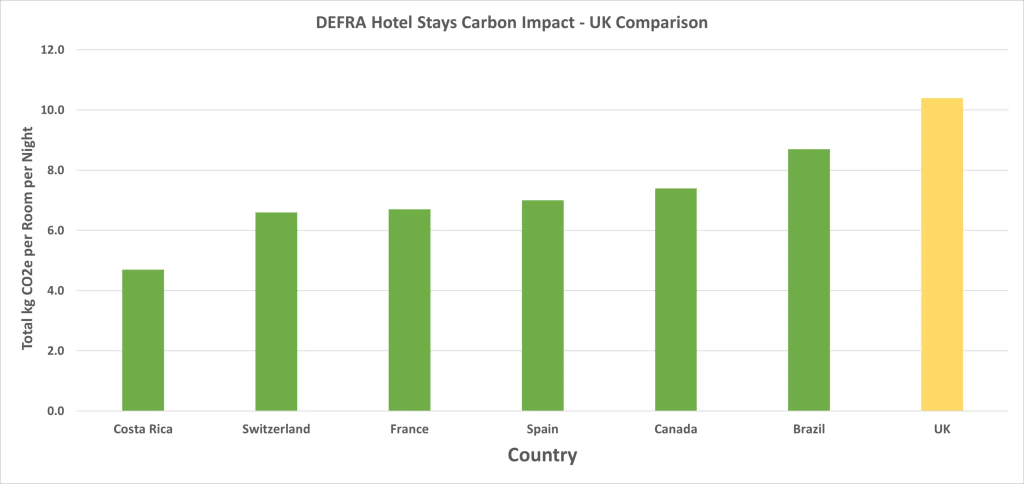
“According to DEFRA, the carbon emissions of staying in a hotel in the UK are 10.4 kg CO2e. (Per room per night). How does this rank amongst the other available data? A figure of 10.4 kg CO2e per room per night ranks the UK a little outside the top five lowest impact hotel stays in 7th place. Overall, it is the 4th lowest footprint within the European countries where data is available. Only Switzerland, France and Spain outrank the UK.
“Figure 4 shows the top five countries as well as the UK in yellow for comparison. Although the UK has one of the lower carbon emissions per room per night, there are still significant opportunities for further reductions by increasing our use of renewable energy. Whilst Costa Rica has the advantage of consistent sunshine for its solar panels and France have a significant amount of nuclear power, they provide an example of where the UK would one day need to be.” (1)
Whilst The Home Camper and Campspace web site suggests 23kg CO2 emissions per night for a B and B, 21kg for a hotel and 0kg for a tent. (2)
I suspect there is more to be a sustainable, low carbon hotel than just the offer of ‘not washing your towels on a daily basis’ which is so often the sole suggestion made by hoteliers. I wish providing a good vegan menu were more often the case.
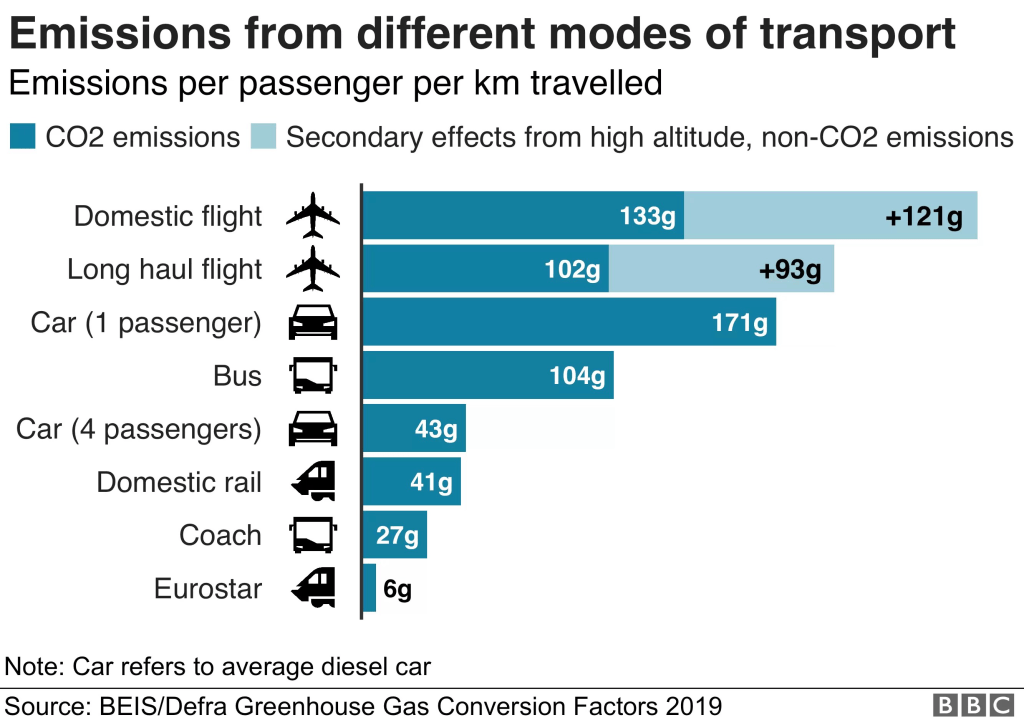
Do our holidays adversely impact on the environment? Googling eco friendly holidays, I am surprised how many website focus on the eco credentials of the destination but not the mode of travel. This is not always the case and some websites do give advice on flight free holidays. Nevertheless the transport element of our holidays usually contributes most to its environmental impact.
“Global tourism accounts for about 8% of total greenhouse gas emissions and transport between origin and destination explains three quarters of this impact” (1) Cutting out flying will benefit the environment most. After that saving has been made, cutting back on the distance travelled will also have an impact. (2)
This week is probably the peak of the holiday season. Before reflecting on the potential environmental impact of holidays, it’s good to remember that holidays are ‘holy days’. Like Sundays, holy days are days we are given for rest and for acknowledging that, along with all of creation, we are God’s handiwork.
Holidays should give us time to rest and to be refreshed, time to spend enjoying relationships with family and friends, with God and with creation. Time to be re inspired by all that is holy.
Preparing for a holiday might therefore include: what parts of me needs to rest, what needs refreshment, how can I make this holiday a time of joy.
Ecosystem engineers have an ability to modify resources they have to hand to alter their environment. This alteration maybe to change or to destroy or to maintain (ie prevent change) a habitat. Coral species that form coral reefs, and trees that form forests, both have the impact of radically changing the environment into which they move. Beavers are well known for creating new habitats by felling trees and damming water ways. Prairie dogs by tunnelling and turning over the soil, provide accessible habitats for other burrowing mammals, birds, snakes and toads. They also keep the grass nibbled short, providing a favoured habitat for various birds, as well as enabling the prairie dogs to spot would-be predators – and their whistled alarm alerts other creatures in the vicinity too.
Many living beings, on land and in water, are important because they can engineer environments that support a greater diversity of life forms than might otherwise be the case. Humans fall into this category of ecosystem engineers but the outcome is not always one that promotes greater biodiversity.
Both humans and creatures have developed and do use tools to help them make better use of their environment. Bottlenose dolphins carry marine sponges in their beaks to stir ocean-bottom sand and so uncover prey; sea otters and chimpanzees uses stones as hammers to break open shells etc; octopuses use coconut shells – carrying them from place to place -to wear as armour; crows use sticks to winkle insects out of logs.
That humans also use tools, does not per se mark them out as different to other beings in the natural environment – it is just the scale with which humans do this.
Many creatures – and plants – create niche environments that benefit their well being. For example, many birds make nests as a safe place to raise their young; beavers build dams to create deep waters where they can build a lodge (home) where they will be safe from predators such as wolves and bears; termites build mounds to both protect their underground nests from predators and to ensure cool fresh air for their nest.
Likewise humans have from early days created niche environments that have helped them thrive – building houses on platforms in a lake to protect them from predators; burning wooded areas to create open spaces where they could graze animals and sow crops; obstructing rivers to trap fish. And we continue to do this! One new venture could be in creating 15 minute cities where we can live more independently of cars and improve social communication.
One thing humans have done is to domesticate plants and animals. This is trait is not unique to humans. Whilst we domesticated dogs to help us both with hunting and to guard our homes and – when we had domesticated sheep – our flocks, other creatures too have domesticated plants and creatures to improve their lives.
For example leaf cutter ants have domesticated particular fungi by feeding them freshly cut plants and protecting them from pests and moulds (by secreting an antibacterial chemical). The ants then use the fungi to feed their themselves and their young.
Once domesticated, that plant or creature may not be able to thrive without its domesticator. Domestication can nevertheless help creatures control their habitat in a way that can be mutually beneficial.
If we embrace the definition that humans are as much a part of nature as any other living thing, how does that prompt us to understand humans as contributors to the natural environment?
As hunter gatherers, were early humans any different from other creatures in their interaction with the natural environment? Like other creatures they would have found ways of getting food – hunting and gathering – and water, finding shelter from the elements and protection from dangers, evolving ways of rearing their young, learning and passing on knowledge about what was safe and what was dangerous in their environment, developing forms of communication to share knowledge, to give warning of danger, and to build social cohesion. They would have developed patterns of living that optimised their survival – and on an ongoing basis adapted these as and when the environment changed around them.
There is a movement called ‘We are Nature’ (1) which aims to redefine the word ‘nature’. Dictionary definitions of nature define nature as being other than what is human. This setting apart appears assumes that that which is human is superior,more important, than nature, and thus to undervalue nature. The definition this group is looking to introduce would be along the lines of “The living world comprised as the total set of organisms and relationships between them. These organisms include bacteria, fungi, plants and animals (including humans). Some definitions may also include non-living entities as part of nature – such as mountains, waterfalls and cloud formations – in recognition of their important role underpinning the web of life.” This one comes from The Conversation – https://theconversation.com/a-new-campaign-wants-to-redefine-the-word-nature-to-include-humans-heres-why-this-linguistic-argument-matters-229338
If we see humans as being integral to, and not separate from, nature then how will that affect our understanding of what is a natural environment? For surely by this new definition a natural,
environment is not necessarily an environment free from a human presence or influence? Might a natural environment be better defined then as an environment in which there is a harmonious – long lived? – numerically rich biodiversity?

 The Green Tau