The imbalance of the nitrogen cycle also causes air pollution. Whilst nitrogen based fertilisers in the soil and water are being consumed by various microbes, processing nitrites in to become a nitrates which can be absorbed by the plants, nitrogen oxide (NO) is released as a bi-product. (1)
Nitrogen oxide, like carbon dioxide, is a greenhouse gas, but with 300 times the warming potential.
Nitrogen oxide readily reacts with other gases in the atmosphere to form nitrogen dioxide which is a healthy hazard inflaming airways and increasing susceptibility to respiratory infections and allergens.
Together nitrogen oxide and nitrogen dioxide are nitrous oxides or NOx. (2)
Whilst agriculture is the main source of nitrous oxides, they are also emitted through the burning of fossil fuels – including from petrol and diesel power vehicles, diesel powered shipping and railway engines, and from aviation.
“Biogeochemical cycles are the pathways through which chemical elements move and are recycled through both the living and nonliving components of Earth’s systems. The term “biogeochemical” combines “bio” (living organisms), “geo” (Earth’s geological aspects like rocks, air, and water), and “chemical” (elements and compounds). These interconnected processes ensure the continuous availability of elements essential for sustaining life on our planet. Through these cycles, elements like carbon, nitrogen, and water are exchanged between the atmosphere, oceans, land, and all forms of life.” (1)
Biogeochemical cycles include the water cycle (water from the oceans evaporates, is carried up into the atmosphere, moves with the wind, forms clouds and fall as rain creating rivers that flow back into the seas) , the carbon cycle (carbon dioxide from the atmosphere is absorbed by plants via photosynthesis, the plants are eaten by creatures building up their bodies; when either plants or creatures die, the carbon in their body is realised by the processes of decay and returns to the atmosphere); nitrogen cycles (relying on specialised plants such as peas and beans, as well as bacteria in the soil,, that can capture nitrogen from the atmosphere as well as in the case of bacteria and fungi, return nitrogen from decaying bodies back into the soil: nitrogen is important for promoting growth in plants) etc
These cycles are important for ensuring the health of all living things. If the cycles are disrupted it leads to environmental problems. So if humans use synthetic nitrogen and phosphorus fertilisers to boost plant growth, the runoff into the soil and water causes an imbalance in the local ecosystems. Too much of these chemicals produces algal blooms that damaging other life forms, rivers become dead and soils loose their fertility.
Widespread use of phosphorus and nitrogen based fertilisers to boost crop yields – including grass and crops grown to feed livestock – has exceeded safe planetary boundaries severely damaged clean water supplies, the health of our soils and biodiversity. Agricultural practices need to change!
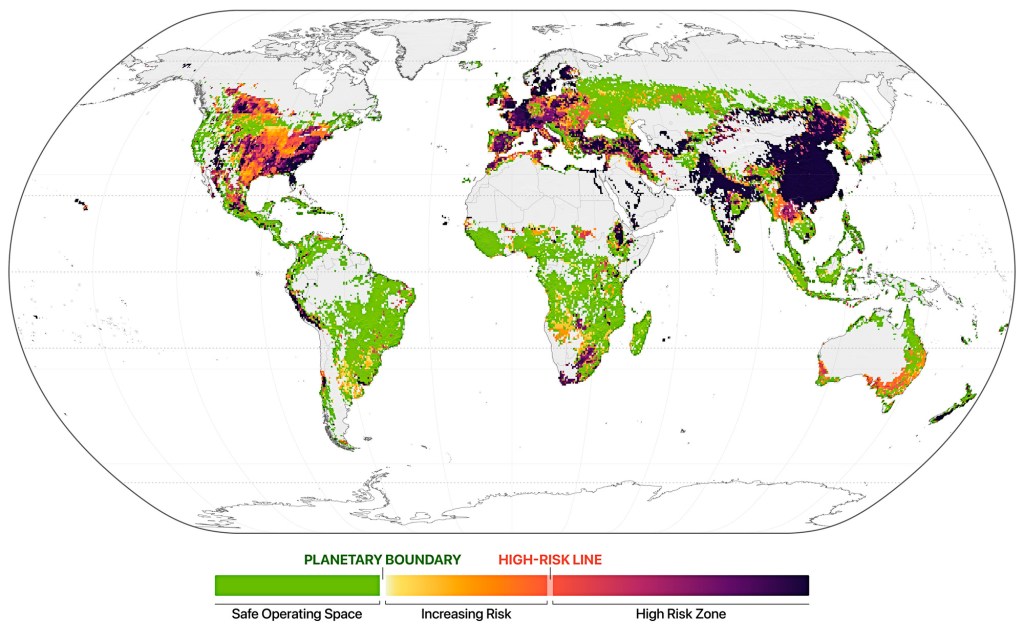
“Nitrogen use in agriculture has exceeded safe ecological limits in several regions of the world, particularly in parts of Asia and Europe, indicating significant environmental risks.
The regional boundary status is calculated based on agricultural nitrogen surplus in the year 2020 and estimates of regional surplus boundaries. Values range from within the Safe Operating Space (green; no exceedance of regional surplus boundaries) to the Zone of Increasing Risk (orange), and extend to the High-risk zone (red/purple). Based on data from model runs with IMAGE-GNM, using the methodology of Schulte-Uebbing et al. (2022).” (2)
How can the potential harm caused by novel entities be curbed?
Reduce the sheer number of synthetic chemicals produced globally
Where possible substitute naturally occurring alternatives
Ensure novel entities are recycled as a part of a closed circular economy.
Ensure no leakage of novel entities into air, water or soil systems
Continue to evaluate the risks posed by each novel entity.
As consumers we can try and avoid products that utilise novel entities but in reality we will have to accept that they are so engrained into our systems, that we will not always be able to avoid them. Nevertheless doing what we can will help highlight the issue for others.
Returning to a focus on planetary boundaries (see https://greentau.org/2025/10/22/counting-on-170/) one boundary that may not automatically spring to mind is that of ‘novel entities’. A novel entity is a substance created by humans from synthetic chemicals and/or natural chemicals that processed in wholly new ways to produce a new – ‘novel’ – entity. Or it is something created by us by modifying the genetics of living organisms or the like, again producing a completely new entity. (1)
Examples of novel entities includes:
numerous synthetic fertilisers, insecticides and pesticides – whilst these may increase harvests they also pollute soil and water and kill off pollinators and other essential insects. DTD is one such infamous example.
chloroflurocarbons – these were used in fridges and aerosols before being restricted, because they were damaging the ozone layer.
PFAs which are petrol based chemicals that offer amazing properties in resisting heat, oil, water, grease et such that they have been widely used in creating non-stick cooking ware, waterproof clothing, stain resistant and fire retardant fabrics etc. However they also cause infertility and various cancers, and have such a long life (remaining active pollutants) such that they are termed ‘forever chemicals’.
BPA (Bisphenol A) is widely used in hard plastics cups, baby bottles, toys, food boxes, etc and can linings. It too can damage fertility, disrupt hormones, and cause eye damage, skin reaction and respiratory irritation.
Artificial food additives are used to enhance flavour, smell, texture or shelf-life of foods, with the word artificial indicating that these are synthetic rather than natural ingredients. Whilst they are regulated for safety, there is still evidence that they can harm health. For example, the consumption of artificial sweeteners is linked to both cancer and cardiovascular diseases, and nitrates and nitrites (found in products such as bacon) may also have links to these diseases.
Genetically modified organisms includes such things as golden rice (a GM rice that produces Beta-carotene); Bt Crop Maize which is toxic to certain pests; and AquAdvangage salmon that grow at twice the rate of conventional salmon. Again there are concerns around links between GM food and cancer, allergic reactions etc but before they enter the food chain there are safety assessments to be passed. Another concern is that GMO will disrupt the DNA of their natural counterparts. And with F1 hybrid plants we already know that their seeds have a lower germination success rate.
Plastics generally – much has been written about the problems with plastics, that they hang around in the environment for centuries, and that when they break down into micro and nano-particles they enter into every part of our bodies and into every part of the global environment. As yet we don’t know whether the impact on humans is neutral or harmful. We do know that plastic does maim and kill wildlife and damage ecosystems.
Novel entities are widespread in the world – The Chemical Abstracts Service maintains a database of chemical names which has identified 204 million new chemicals! (2) – yet what we don’t know is the extent to which they are damaging the world’s environment. It is therefore instructive to read this from a report by the American Chemical Society:-
“We submit that the safe operating space of the planetary boundary of novel entities is exceeded since annual production and releases are increasing at a pace that outstrips the global capacity for assessment and monitoring.” (3)
As an addendum to last weeks blogs about rainforest deforestation, a timely update about COP30 from Greenpeace.
Legislation exists in Europe and the UK which aims to reduce deforestation. The EU passed the Deforestation Regulation (EUDR) in June 2023, which requires companies to check and be able to confirm that their products (whether using raw materials such as beef, cocoa, palm oil, rubber etc or derivatives) do not contribute to deforestation. There has been resistance and its implementation has been delayed till December 2025 (and till June 2026 for small companies). UK companies that trade with the EU will perforce have to work within these same regulations. (1)
The UK has enacted the Environment Act 2021, which aims, amongst other things, to tackle deforestation in UK supply chains as set out in Schedule 17. However this is a much narrower piece of legislation in terms of both the protection it offers and in terms of the companies that will be required to take action. (1)
One area of concern is the welfare of small farmers in the poorer parts of the world where their farming practice still rely on deforestation. Small farmers may have insufficient capital resources to adopt climate and nature friendly practice and therefore may simply go out of business and have to resort to subsistence farming – or will resort to deception and continue to cut down trees. (2) Ideally funding to facilitate a fair transition should be forthcoming from our wealthier nations and business organisations.
Deforestation of tropical rainforests also takes place to make space for oil-palm plantations. Palm oil is widely used in products as diverse as hair shampoo and chocolate. Clearing the forest to replace it with a monoculture not only impacts climate change but also biodiversity and a loss of the traditional ways of life of the indigenous inhabitants.
“West Papuan Indigenous people call for KitKat boycott over alleged ecocide” Thousands of acres of rainforest is being cleared to produce palm oil, used in popular Nestlé and Mondelēz brands. West Papua’s Indigenous people have called for a boycott of KitKat, Smarties and Aero chocolate, Oreo biscuits and Ritz crackers, and the cosmetics brands Pantene and Herbal Essences, over alleged ecocide in their territory. All are products that contain palm oil and are made, say the campaigners, by companies that source the ingredient directly from West Papua, which has been under Indonesian control since 1963 and where thousands of acres of rainforest are being cleared for agriculture.”(1)
This year’s COP has seen a more visible presence of indigenous people and hopefully their particular insights are being listened to and their particular needs incorporated in the decision making processes.
Whilst there is uncertainty around when a certain tipping point maybe reached – and the uncertainty may be as to what temperature rise will trigger the tipping point, or at what date that might happen or at what speed the tipping point will develop its full impact – the risks are real and quantifiable: if sea ice melts sea levels will rise; if temperatures rise and/ or rainfall diminishes, trees will die; if oceans heat up coral reefs will die.
“Despite the uncertainty, tipping points are too risky to ignore. Rising temperatures put people and economies around the world at greater risk of dangerous conditions.
“But there is still room for preventive actions – every fraction of a degree in warming that humans prevent reduces the risk of runaway climate conditions. Reducing greenhouse gas emissions slows warming and tipping point risks.
“Tipping points highlight the stakes, but they also underscore the climate choices humanity can still make to stop the damage”. (1)
We cannot afford to ignore these risks: we must hope for success in the negotiations that are ongoing at COP30.
The oceans redistribute cold and warm water across the globe influencing winds – both direction and intensity – and weather patterns. Ocean currents enable the flow of water from hotter to cooler areas (tropics to the poles) and by the flow of water between areas of higher to lower salt density. Here in the UK we particularly benefit from the warmth that the Atlantic currents bring giving us mild winters and year round rainfall.
The driving force for these ocean currents lies in the artic regions. The density of the cold, saline rich waters causes the waters here to sink and as they do this pulls in warmer waters from the tropics. However as sea ice and icecaps melt, so the water becomes less salty, and less inclined to sink, reducing the energy that pulls the oceanic currents. In the North Atlantic this driving force is known as the Atlantic Meridional Overturning Circulation or AMOC.
Here in the UK, our climate and weather patterns are highly dependent on the functioning of AMOC. If this slows or becomes unstable, it will impact temperature and rainfall patterns cross Europe and giving us in the UK and Northern Europe a much colder, wetter climate. And at the same time changing the climate in southern Europe, making it hotter and dryer.
Whilst there are signs that AMOC is weakening, it is hard for predict quite how quickly and to what degree it will change as global temperatures rise. On the other hand the potential damage a change in AMOC will cause, should make decision-makers focus on avoiding that as a matter of urgency.
“The risk of a critical AMOC transition is real and very serious, even if we cannot confidently predict when and whether this will happen. We have already left behind the stable Holocene climate in which humanity has thrived (Osman et al., 2021), and the latest IPCC report warns us that beyond 1.5°C of global warming, we move into the realm of “high risk” with respect to climate tipping points (IPCC, 2023).” (1)
Not only have humans been adding excessive amounts of carbon dioxide to the atmosphere (largely though burning fossil fuels), we have also been destroying the Earth’s own ways of absorbing carbon dioxide. Two of the main ‘carbon sinks’ (as they are known) are forests, especially rain forests, and oceans.
Loss of rainforest in the Amazon continues to increase due to deforestation (principally clearing tree to grow other crops) and wild fires (which are increasing as temperatures rise and as droughts become more severe). (1)
It is sad to report that in the leaders’ summit in advance of COP30, the UK government determined not to help fund the Tropical Forests Forever Fund (TFFF). The TFFF aim is to raise $25 billion from developed countries attending COP30, which will underpin a $125 billion fund (p rest coming from private investors) to protect rainforests on both the Amazon and Congo. (3)
Oceans loose their ability to absorb carbon dioxide as they heat (warm water absorbs less CO2) (2)
and as flora and fauna are removed (from whales to sea grass) and from bottom trawling and mining which release previously absorbed CO2. (4)
To an extended protection of the oceans already exists via the 30 by 30 Kunming-Montreal Global Biodiversity Framework (GBF) where signatories agreed to protect and enhance the biodiversity of 30% of land and sea by 2030. (5) This will hopefully be further extended to include international waters that lie outside those waters controlled by individual nations with the High Seas Treaty. (6)
Here in the UK whilst the Labour Party in its last manifesto promised ‘no new oil and gas’ there is still uncertainty as to how this is to be implemented. Exploration licences for oil fields such as Rosebank and Jackdaw had already been issued. The former to Equinor (Norwegian) and Ithaca (Israeli), and the latter to Shell. However before any oil and gas can be extracted a development license is needed. The development license issued for Rosebank was challenged in court as it took into account only scope 1 and 2 emissions and not scope 3 emissions – these being the emissions released when the oil and gas are used and which are clearly far greater than scope 1 and 2 being those related to the extraction of the fuels.
Equinor and Ithaca have submitted a revised application but as yet we don’t know whether or not the UK government will approve this. If the licence is approved, the subsequent greenhouse gas emissions would significantly undermine the UK’s net zero carbon budget.



 The Green Tau