Counting on … day 90

19th April 2024

How sustainable is wind power? 

The following comes from a report by the German broadcaster, Deutsche Welle (DW).

“On average, wind turbines are operated for about 25 years. During this time, they generate 40 times more energy compared to the energy required for the production, operation and the disposal of a wind power plant.

“So-called upstream emissions, generated mostly through the production of carbon-intensive steel and cement, are included in the overall carbon balance of a wind turbine’s life cycle.

An onshore wind turbine that is newly built today produces around 9 grams of CO2 for every kilowatt hour (kWh) it generates, according to according to the UBA. A new offshore plant in the sea emits 7 grams of CO2 per kWh.

“Compared with other technologies, wind power does well in terms of carbon emissions. By comparison, solar power plants emit 33 grams CO2 for every kWh generated. Meanwhile, power generated from natural gas produces 442 grams CO2 per kWh, power from hard coal 864 grams, and power from lignite, or brown coal, 1,034 grams.” (1)

But what about the renewability of the turbines? Can their component parts be recycled so conserving the materials used? Wind turbines have a lifespan of 30+ years. At present the number being decommissioned is small but will grow – DW suggests that by 2050 up to 50,000 wind farms in Germany alone will need replacing. Whilst to some extent the concrete for the bases can be crushed and recycled as hardcore etc, and the steel and other minerals from pylons can be recycled, recycling the blades is less easy as they are a composite of glass fibre, plastic, carbon etc. Old blades may end up in landfill. However – “The first recyclable rotor blades for large offshore plants are currently being produced in Denmark. By 2030, the plant constructor Siemens Gamesa plans to only sell recyclable rotor blades: from 2040 the production of the company’s wind power plants is expected to be completely carbon neutral.” (1)

Nevertheless, wind power is one of the least environmentally damaging sources of energy.

  1. https://www.dw.com/en/how-sustainable-is-wind-power/a-60268971

Counting on … day 89

18th April 2024

How Renewable are Renewables?

Many things are renewable as in they can be naturally replaced – timber is a renewable resource in that for every tree used/ consumed, another tree can be grown. Water is a renewable resource in that once used it can be recaptured and reused: this might be through the natural water cycle of evaporation, transpiration, condensation and rainfall, or through collecting and cleaning waste water for further use. Fish for use as food is a renewable resource – this supply of food is maintained through the natural reproductive processes of the fish. 

However the renewability of things isn’t necessarily limitless. 

If oceans are overfished, the rate at which new fish are born and mature will not keep pace with the rate at which fish are caught. Eventually there will be no fish.

If trees are felled faster than the rate at which new trees reach maturity – which can be  40 to 150+ years depending on the species – the landscape will become deforested. 

If an ecosystem is not maintained, more can be lost through evaporation in a locality than falls as rain. Without forests in the middle of large continents, rainfall in these areas would be negligible reducing the landscape to desert. If rainforests are cleared, rainfall in those areas will be diminished reducing the landscape to bare earth.

Solar energy is a renewable energy source – the sun is constantly producing heat – as is wind, as the earth’s weather system continues to be generate wind. (Sometimes resources such as sunshine, wind, tides and geothermal energy are known as perpetual resources).

 But whilst solar and wind energy are constant/ renewable, the means by which we capture that energy may not be as readily replaced. Solar panels that convert the sun’s energy into electricity are  made of non-renewable minerals – silicon, silver, aluminium, and copper. Wind turbines that capture the wind’s energy converting it into electricity are made of large amounts of non renewable materials such as steel and carbon fibre.

The source of the energy is renewable but not always the means by which we capture the energy.

Here is an interesting blog describing how solar panels are made – https://blog.ucsusa.org/charlie-hoffs/how-are-solar-panels-made/

and wind turbines – https://blog.ucsusa.org/charlie-hoffs/how-are-wind-turbines-made/

Counting on … day 88

17th April 2024

Green steel and cement alternatives 

Steel, cement and concrete are major contributors to global climate emissions using manufacturing process that are challenging to green. Therefore one approach to safeguarding the environment is to reduce the use of new steel, cement and concrete. 

This could be by not wantonly discarding things before the end of their lifespan. Where I live, it is not infrequently that someone will buy a house only to knock it down and replace it with a new one. This unnecessarily adds to local carbon emissions. The same can also be true of commercial buildings. Simply demolishing an office building to replace it with another is a poor use of resources. 

Where buildings or other structures are of necessity demolished, the prudent use of resources would see the different building materials being salvaged and reused. Equally before demolishing a structure, consideration could be given to re-purposing the building – upcycling!

The same approach of making full use of an item over its lifespan could equally apply to vehicles, domestic appliances, etc. 

When building new structures, alternative materials with a lower carbon footprint can be used. This might be using timber for beams and columns, straw for insulation, compressed clay for bricks as well as recycling materials from other buildings. However if using naturally renewable resources such as timber, there has to be an awareness of the time frame and forwarded planning needed to ensure an ongoing supply of such materials. Trees may need to be up to 80 years old before being used to create    structural building elements – and that timescale also implies large areas of land being set aside for trees (which is not a bad thing but needs to be planned). 

Did you know you can buy bicycles made with a bamboo frame?  – https://www.nethambamboobikes.co.uk/

Further reading:

https://www.weforum.org/agenda/2021/11/sustainable-mass-timber-green-building

https://www.bbc.co.uk/news/science-environment-61580979

Counting on … day 87

16th April 2024

Green cement – part 2

As part of the need to reduce all greenhouse gas emissions to address the climate crisis, reducing emissions from cement production is essential. 

50% of the emissions come from the release of carbon dioxide as a byproduct during the clinker making process. One solution is carbon capture- capturing the CO2 before it escapes into the atmosphere, pressurising it to a liquid which is injected into rock strata deep underground.  This technology has yet to be developed for use at an industrial scale. 

Another solution is to replace the limestone with an alternative that produces less CO2 – such as magnesium oxide mixed with magnesium chloride solution. However such alternative cements may not have all the attributes of cement when in use – different construction methods may be needed.

40% of the emissions are attributable to the energy needed to heat the clinker kilns. Switching to renewable energy to replace coal is one solution but requires considerable investment in green electricity production and distribution. 

Using materials other than limestone – such as volcanic rock – that can produce clinker at lower temperatures is another possible solution. Another alternative is to replace a proportion of the cement with an alternative binder such as ground granulated blast furnace slag or pulverised fly ash. Again this may alter the properties of the cement and require different construction methods.

10% of the emissions comes from energy used in mining and transporting the raw materials. Energy efficiency and the use of renewable energy will be a way forward.

Further reading –https://theconversation.com/green-cement-a-step-closer-to-being-a-game-changer-for-construction-emissions-126033

(https://theconstructor.org/concrete/green-cement-types-applications/5568/

Counting on … day 86

15th April 2024

Green cement? Part 1

Cement is made by heating limestone and clay together at very high temperatures. The clay and limestone is converted to a dried out material called clinker, whilst at the same time releasing large amounts of carbon dioxide. The clinker when ground to a powder is what we know as cement. 

The production of cement has a very high carbon footprint arising from a) the energy needed to roast the clay and limestone which invariably comes from fossil fuels, and b) the carbon dioxide released during manufacture. Each tonne of cement produces up to 622kg carbon dioxide. 

Cement is widely used in large quantities across the globe in the construction of buildings, roads, drains and various other types of infrastructure. CO2 emissions from cement account for 7% of all global emissions – 1605 tonnes per year. Here in the UK cement produces about 4b tonnes CO2.

https://www.bbc.co.uk/news/science-environment-46455844

Counting on … day 85

12th April 2024

Fossil Fuel Subsidies -2

“Since the Paris Agreement, the government has provided £13.6 billion in subsidies to the UK oil and gas industry. From 2016 to 2020 companies received £9.9 billion in tax relief for new exploration and production, including £15 million of direct grants for exploration, and £3.7 billion in payments towards decommissioning costs.” https://www.ethicalconsumer.org/energy/paid-pollute-fossil-fuel-subsidies-uk-what-you-need-know

Research from 2023 commissioned by the Liberal Democrats showed that between 2015 and 2020 renewable energy received £60bn in subsidies whilst fossil fuels received £80bn. In 2020/1 fossil fuels received £1bn whilst renewable energy received a mere £1m!  https://www.theguardian.com/environment/2023/mar/09/fossil-fuels-more-support-uk-than-renewables-since-2015

Such subsidies are the explicit subsidies. As far as I know, renewable energy generation does not produce pollutants or other harmful side effects. Whereas we as citizens and tax payers are also paying for the implicit subsidy of fossil fuels through ill health caused by pollution from fossil fuels, as well as ill health caused by excess temperatures; through the extra cost thus imposed on the health service; from the extra cost of food as more harvests fail; and the extra cost of repairing buildings and infrastructure affected by extreme wind/ rain and temperatures. 

According to Kisters (an international environmental data and insights organisation that focuses on gathering and reporting data on the water, weather, energy, environment and IT sectors) “the cost of natural disasters in the UK is rising by 11.2 per cent a year, while the UK’s GDP grew by 4.3 per cent in 2022 (according to the Office for National Statistics)…Floods are the most expensive risk the UK faces at present, with the cost of dealing with extreme flooding projected to rise to $217.2bn by 2030-2039 without intervention. But an increasing number of extreme storms also poses a threat. Between 2010 and 2019 storms cost the UK around $1.6bn, but by 2030-2039 this is estimated to rise to $3.8bn. In 2020-29, Kisters predicts the UK government will spend $43.8bn on dealing with the effects of all climate-caused natural disasters.” https://www.newstatesman.com/spotlight/sustainability/climate/2023/12/extreme-weather-natural-disasters-uk-economy-government

Counting on … day 84

11th April 2024

Fossil Fuel Subsidies -1

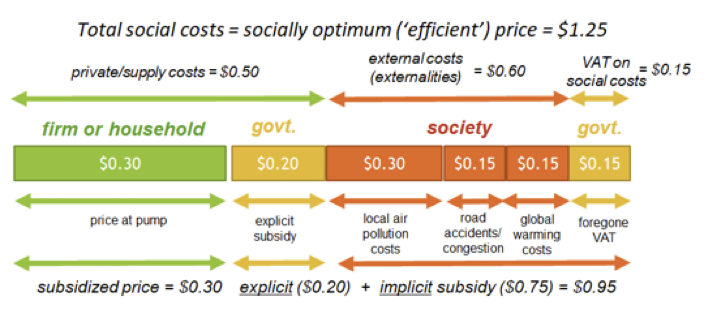
This overview of fossil fuel subsidies comes from the IMF: “Subsidies are intended to protect consumers by keeping prices low, but they come at a substantial cost. Subsidies have sizeable fiscal consequences (leading to higher taxes/borrowing or lower spending), promote inefficient allocation of an economy’s resources (hindering growth), encourage pollution (contributing to climate change and premature deaths from local air pollution), and are not well targeted at the poor (mostly benefiting higher income households). Removing subsidies and using the revenue gain for better targeted social spending, reductions in inefficient taxes, and productive investments can promote sustainable and equitable outcomes.” (1)

The article goes on to explain the difference between explicit and implicit subsidies, the former being the obvious direct payments to fossil fuel producers to bring down the unit cost of the fuel. The latter is a subsidy that is likely always present, vis in the practice of not charging the fossil fuel producers for the costs of pollution, climate change etc that are a consequence of their business. 

“Implicit subsidies occur when the retail price fails to include external costs, inclusive of the standard consumption tax. External costs include contributions to climate change through greenhouse gas emissions, local health damages (primarily pre-mature deaths) through the release of harmful local pollutants like fine particulates, and traffic congestion and accident externalities associated with the use of road fuels”(1)

By way of example they provide the following bar chart: 

(1) https://www.imf.org/en/Topics/climate-change/energy-subsidies

Counting on … day 83

10th April 2024

Carbon Tax – 3

Carbon emissions may be produced outside the country where the final product is consumed. This could be a way of avoiding paying a carbon tax by shifting the emission-producing part of the business elsewhere, or it could equally be a way for a foreign importer to achieve a price advantage over indigenous producers. A good carbon tax needs to be aware of these for means of tax evasion.

The Europe Union is phasing in such a tax avoidance mechanism – it will be 100% in place by 2026.

“The EU’s Carbon Border Adjustment Mechanism (CBAM) is the EU’s tool to put a fair price on the carbon emitted during the production of carbon intensive goods that are entering the EU, and to encourage cleaner industrial production in non-EU countries. By confirming that a price has been paid for the embedded carbon emissions generated in the production of certain goods imported into the EU, the CBAM will ensure the carbon price of imports is equivalent to the carbon price of domestic production, and that the EU’s climate objectives are not undermined. The CBAM is designed to be compatible with WTO-rules.” https://taxation-customs.ec.europa.eu/carbon-border-adjustment-mechanism_en

Just as  domestic carbon taxes can disproportionately affect the poor, so carbon taxes can disproportionately affect poor, less developed countries. Wealthy countries can afford to invest in, for example, electric arc furnaces for producing green steel, or in wind farms to generate green electricity, but poorer countries may struggle to invest to the same degree leaving them stuck with using carbon producing industrial processes and therefore subject to more taxation! Just as poorer households need to be supported with subsidies and grants to  enable them to shift to greener lifestyles, so poorer countries need to be supported with subsidies and grants from the wealthier nations, to enable them  to shift to to greener infrastructures.

Counting on … day 82

9th April 2024

Carbon Tax – 2

Carbon taxes are often criticised for impacting most on the poorest or the most vulnerable. People and businesses with wealth can more easily buy their way out of the situation either by absorbing the tax or through buying alternative products and services that avoid the tax. For example a richer person can more readily buy a new efficient electric car, where someone with less wealth may have to pay more on petrol to continue using their older car. A richer person can more readily afford a heat pump (powered by renewable electricity) and home insulation, whilst a less wealthy person – or someone who is rented accommodation- will have to pay more for running an existing gas boiler in an un-insulated home. 

Such issues need to be addressed. Improving public transport, implementing scrappage schemes for old cars and boilers, offering grants for insulation and heat pump installations – including for rented accommodation – are key. At the same time introducing a carbon tax incrementally over time to ensure users can plan and adapt, is also important. 

Given the urgency of the need to reduce greenhouse gas emissions to address the climate crisis, maintaining the status quo is not a good option. It is certainly not a good option for the poorest or most vulnerable as they are the ones who are – and will be – most affected by the impacts of the crisis.

Counting on … day 81

8th April 2024

Carbon Tax -1

“A carbon tax is a tax levied on the carbon emissions from producing goods and services. Carbon taxes are intended to make visible the hidden social costs of carbon emissions. They are designed to reduce greenhouse gas emissions by essentially increasing the price of fossil fuels. This both decreases demand for goods and services that produce high emissions and incentivises making them less carbon-intensive.” https://en.wikipedia.org/wiki/Carbon_tax

Many definitions of a carbon tax say it is designed to address the social cost of carbon emissions which is interesting. There is certainly a social cost in terms of threats to the stability of social systems, but the carbon tax (surely?) should aim to tackled those threats -physical ones arising from adverse weather and rising sea levels, and economic ones rising from the adverse affects of climate change on growing crops, ensuring a healthy work force and protecting commercial buildings from damage. 

The aim of a carbon tax should be to reduce and ultimately curtail the use of fossil fuels, whilst at the same time encouraging the development and use of alternative renewable energy. There will be a transition period as rapid changes cannot be made overnight. 

For example, to make transport systems free of fossil fuels, needs the development and delivery of sufficient electric vehicles, associated charging points and a proportionate increase in renewable energy supplies. It might also need to develop a wider spread, more frequent and affordable public transport system as a means of making best use of the resources needed to make both vehicles and batteries. A carbon tax would be too blunt an instrument to achieve all these changes unless supported by  legislation outlining the changes needed, and by grants and subsides to enable smaller and more vulnerable businesses and customers to make the transition.