
Counting on … 154

30th September 2025

What is a ‘universal basic income’? What are its benefits?

A universal basic income is a social welfare payment paid to all citizens with either a means test or a requirement to complete any sort of work. As a full basic income, it should be sufficient to cover basic needs. (That said, some people with specific needs might need a higher rate to cover their living costs – eg if they were disabled and needed additional support or equipment). 

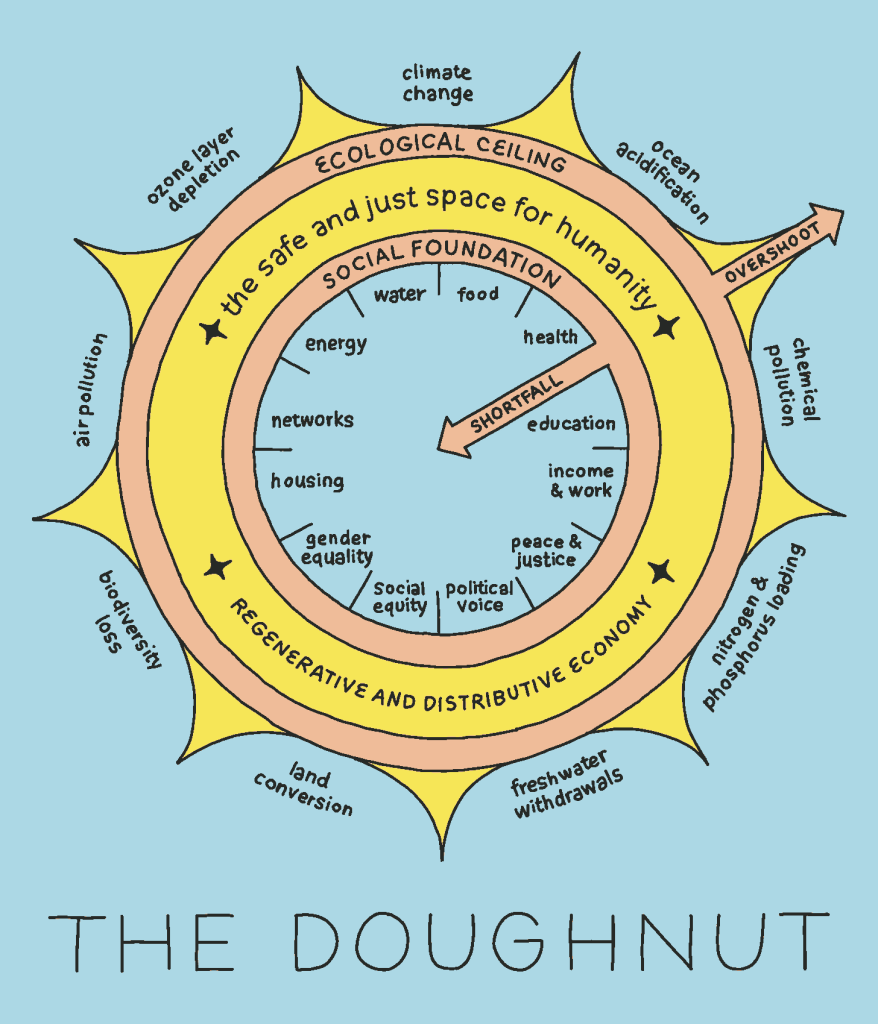
The idea behind the UBI is that everyone in that society will have enough to live on – is that lower limited of the economic doughnut will have been secured. It allows some people to pursue voluntary work – caring for the young or the elderly, working on conservation projects etc. It allows people to take jobs with low pay – such as artists and cleaners – but might there be an argument here to say such jobs should be better paid even if that means higher prices or higher rates. It allows people with stressful jobs to work shorter hours and spend more time relaxing. It ensures security of income for people whose work is seasonal – fruit picking, local tourism etc.

There are clear benefits to society as a whole – the population will be healthier both physically and mentally. This is good in itself. It means people can work better. It reduces costs for health care. It can increase sales of non luxury goods as more people have the money to spend on essentials. Evidence from small scale trials suggests that with the UBI safety net people spend time finding a job they like and are suited to and then become more reliable committed workers.

Perhaps more importantly it allows people to feel valued and be happy and fulfilled.

“Humans need to do work that feels valuable, psychologically,” says Cleo Goodman, a UBI expert at the thinktank Autonomy. “It’s baked into us. It is complete nonsense to suggest that there’s a faction of society that just wants to sit around on the sofa all day, drinking beer and watching TV. We want to spend a fair amount of our time doing something that makes us proud.” (1)

Some people do argue that UBI would lead to people avoiding work, or not working as hard, big I wonder if that would be so? When we are children, everyone asks what do you want to be when you grow up? Getting a job or a role that you want, a job that you will enjoy, is seen as a sensible and worthwhile objective and one which motivates us. For many of us, the jobs we choose are vocational: we choose them not because of the financial reward but because we would not be happy doing anything else.
  1. https://www.theguardian.com/society/article/2024/jul/14/money-for-nothing-is-universal-basic-income-about-to-transform-society

Counting on … 153

29th September 2025

Another way – or rather a parallel way – of reducing the inequality between rich and poor (so enabling us to live within the inner and outer limits of the doughnut) is to ensure minimum pay rates that are sufficiently generous to enable a good level of wellbeing. In this regard the ‘real living wage’(1) should be a minimum. The current real living wage is £12.60 per hour (outside London) which for a 35 hour week equates to £22,050 per annum.

But how generous is that – is it just a necessary minimum?

According to the calculations of Raisin (2) a comfortable salary for a single person would be £28,018. But add in a young child, and that income would need to increase to £51,363 – or for a couple and one young child, a joint income of £65,810.

And equally what if you earn the real living wage but are only able to get 20 hours a week?

An alternative would be to pay everyone a basic income, paid for from taxation, to ensure that no one falls through the safety net of not having enough income to sustain a reasonable standard of living. 

  1. https://www.livingwage.org.uk/what-real-living-wage
  2. https://www.raisin.co.uk/budgeting/how-much-money-do-you-need-to-live-comfortably-uk/

Counting on … 152

26th September 2025

Wealth taxes are also a good idea that could be implemented globally. 

Gabriel Zucman, a French economist, at the request of the Brazilian G20 presidency, has produced a blue print for such a tax – to be collected by participating nations. “[A] minimum tax on billionaires equal to 2% of their wealth would raise $200-250 billion per year globally from about 3000 taxpayers”. He explains that “The G20 has been a driver of international tax reforms over the past decade. Thanks to the leadership of the G20, more than 130 countries and territories have agreed to a common minimum corporate tax for large multinational companies in 2021. What we have collectively done with multinational corporations, we could in principle now do with billionaires.” (1)

One argument against taxing the rich is that it stifles enterprise. However Oxfam’s report Takers Not Makers,  revealed that 60% of billionaire wealth comes from inheritance, cronyism and corruption, or monopoly power. (2) Taxing such wealth would not undermine enterprise. Rather the revenue raised could provide much needed infrastructure for poorer communities enabling them to have more opportunities to become entrepreneurs. The revenue could equally enable poorer nations to adapt to the impact of climate change – a crisis that is being compounded by the growing number of billionaires! 

  1. https://gabriel-zucman.eu/files/report-g20.pdf

(2) https://oxfam.dk/wp-content/uploads/2025/06/2025-english_davos_full-_report.pdf

Counting on … 150

24th September 2025

Doughnut economics refutes the mainstream theory that if the wealth of an economy increases, that that wealth will not just reward the rich but will trickle down and benefit the poorest too. 

One flaw in this trickle down argument is that if you are poor is that you often pay more pro-rata than someone who is wealthy.  A rich person who owns a house has both somewhere to live rent free and the means for raising extra money to invest in money making or money saving schemes and products (eg a rich person can afford the cost of a heat pump that will longterm save money). A poor person will not be able to afford to buy a house and instead will be forced to rent so each month income will be going out of their pockets and into the pockets of someone rich enough to own a buy to let property. 

This flow of income away from the poor and to the rich (a trickle up effect) has been documented both nationally and globally. This is something Oxfam reports on annually.

“In 2024, the number of billionaires rose to 2,769, up from 2,565 in 2023. Their combined wealth surged from $13 trillion to $15 trillion in just 12 months. This is the second-largest annual increase in billionaire wealth since records began. The wealth of the world’s ten richest men grew on average by almost $100 million a day and even if they lost 99 per cent of their wealth overnight, they would remain billionaires.

“UK billionaires saw their collective wealth increase last year by £35 million a day to £182 billion …. Four new billionaires were created last year, taking the current total to 57.

“Meanwhile, according to the World Bank, the number of people still living in poverty – around 3.5 billion – has barely changed since 1990.“ (1) 

The poverty line  in the UK is determined as households whose income is under 60% of the median household income after housing costs for that year. (2) The Joseph Rowntree Report for 2025 reported that  2 in every 10 adults are in poverty in the UK, with about 3 in every 10 children being in poverty. Further the poorest families – those living in very deep poverty – had an average income that was 57% below the poverty line, with this gap increasing by almost two-thirds over the past 25 years. (3)

  1. https://www.oxfam.org.uk/media/press-releases/billionaire-wealth-surges-three-times-faster-in-2024-world-now-on-track-for-at-least-five-trillionaires-within-a-decade/
  2. https://trustforlondon.org.uk/data/poverty-thresholds/
  3. https://www.fva.org/news.asp?id=21118

For further information read more from Oxfam’s report – https://oxfamilibrary.openrepository.com/bitstream/handle/10546/621668/bp-takers-not-makers-200125-summ-en.pdf;jsessionid=1D0798BB3DCCC8B2A556159969CB2CD3?sequence=1

Counting on … 151

25th September 2025

One way of redressing the wealth and income imbalance would be via wealth taxes. In July of this year, 30 economists, the Patriotic Millionaires, the Commission for the Reform of  International Corporate Taxation, and others called for a UK wealth tax and other reforms. (1) The  proposed reforms would not only begin to rebalance wealth inequalities, but would provide useful revenue for funding those things that benefit society – schools, healthcare, a just transition to renewable energy etc

  1. Apply a 2% wealth tax on assets over £10 million, raising up to £24 billion a year.
  2. Reform capital gains tax to raise £14 billion a year.
  3. Apply National Insurance to investment income, raising up to £10.2 billion a year.
  4. Close inheritance tax loopholes to raise £1.4 billion a year.
  5. Close the loopholes in the new non-dom scheme to raise up to £1 billion.
  6. Introduce a 4% tax on share buybacks, raising approximately £2 billion a year. (2)

 Altogether this totals over £52 billion a year. 

  1. https://taxjustice.uk/blog/leading-economists-call-for-a-wealth-tax-in-the-uk/?internal=true
  2. https://www.oxfam.org.uk/get-involved/campaign-with-oxfam/fight-inequality/tax-the-rich/

Counting on … 149

23rd September 2025

The economic systems that predominate globally with their focus on growth (of GDP) and determined by the pursuit of profit (for the share holders) is a cause of growing inequality and with that (as outlined over the last few weeks) come problems such as climate change, biodiversity loss, social injustice etc.

The economic theory that underpins this is flawed. There is no trickle down effect by which one can justify growing wealth for the already wealthy. The economist Kate Raworth has proposed an alternative model known as Doughnut Economics. Its basic premise is that there is on the one hand  an outer limit to our economic activity which is determined by the limitedness of the Earth’s resources – planetary boundaries. And on the other hand a lower limit determined by what is needed to ensure the needs of each individual – food, water, housing, healthcare, education, mental well being. These inner and outer boundaries thus encasing the doughnut of economic activity. 

In other words we would ensure consumption levels stayed within the boundary of what the Earth can provide – and than would include not putting more waste/ pollutants, including carbon dioxide , into the Earth’s systems than can be absorbed. It would mean reining in total consumption to that which one planet can sustain – ie bringing back Earth overshoot day back to 31st December.

And it would mean ensuring a fair and equitable distribution of resources so that everyone has enough – reining in the excessive levels of income and wealth currently accruing to a minority –  and by so doing this will enable everyone contribute from the their full potential rather than being constrained by the limits of poverty, ill health etc.

Counting on … day 148

22nd September 2025

Lack of political will can also worsen the impact climate change. Ilan Kelman, Professor of Disasters and Health, UCL explains it thus: “The IPCC’s summary entirely avoids the phrase “natural disaster”. This reflects decades of work explaining that disasters are caused by sources of vulnerability – such as unequal and inequitable access to essential services like healthcare or poorly designed or built infrastructure like power plants – rather than by the climate or other environmental influences.

“The [2022 IPCC] report states, with high confidence, that “climate change is contributing to humanitarian crises where climate hazards interact with high vulnerability”. In other words, vulnerability must exist before a crisis can emerge. Climate change is not the root cause of disaster. The report explains that places with “poverty, governance challenges and limited access to basic services and resources, violent conflict and high levels of climate-sensitive livelihoods” are more vulnerable to climate change impacts.”

“The report explains that disaster risk and impacts can be reduced by tackling fundamental issues which cause vulnerability, no matter what the weather and climate do. It places high confidence in risk management, risk sharing, and warning strategies as key tasks for adapting to climate change.” (1)

(1) https://theconversation.com/ipcc-report-how-politics-not-climate-change-is-responsible-for-disasters-and-conflict-178071

Counting on … day 147

19th September 2025

Interestingly, lack of political will is seen as a key factor in the failure of governments to address climate change. 

“Political cowardice is hindering European efforts to face up to the effects of the climate crisis, even as the continent is pummelled by a record-breaking heatwave, the EU’s green transition chief [Teresa Ribera]  has warned.…A major part of the problem, she added, was that some political parties “continue to insist, quite vehemently, that climate change does not exist”, or else say that taking decisions to adapt to environmental realities is too expensive. ‘You can’t tell people that climate change is the great existential problem of our generation, and then say, “I’m sorry, we’re not going to do anything”’. (1)

Whilst here in the UK, successive governments are reluctant to enact the recommendations of the Climate Change Committee – a committee set up by Parliament and tasked with researching how the UK can successfully transition to net zero, mitigating our environmental footprint and adapting our infrastructure commensurate with the already built -in  impacts of climate change. Twice now Friends of the Earth and Client Earth have challenged the adequacy of government plans in the courts and won the legal argument. (2) The government has now to issue a new climate plan which should be published October 2025. (3)

(1) https://www.theguardian.com/world/2025/jul/02/political-cowardice-hindering-europe-climate-efforts-eu-green-chief-teresa-ribera

(2) https://friendsoftheearth.uk/climate/whats-uks-climate-plan-and-why-do-we-need-new-one

(3) https://friendsoftheearth.uk/latest/govt-publish-new-climate-action-plan-october

Counting on … day 146

18th September 2025

Introducing alternative ways of managing our economies will require a high degree of political will – and especially the willingness to shift from short term (before the next election) to long term goals. 

One organisation that has done research on how this can be achieved is Nesta (a UK innovation agency for social good).

“Why long-termism doesn’t often happen…Part of the problem is that so much of our system of government pushes in the opposite direction. Decision makers get stuck in “firefighting traps”, a symptom of which includes focusing on the urgent instead of the important.

“Rather than simply indulge in well-intentioned hand waving about the need for greater long-termism in government, we need practical ways of encouraging future thinking that are hardwired into the system. Fortunately across the globe there are pockets of government innovation where we can find just that.”(1) 

Do read the full article. And ask questions when we next have elections – how will the candidate/ party ensure better long term planning to ensure intergenerational justice?

  1. https://www.nesta.org.uk/blog/how-to-build-long-term-thinking-into-government/